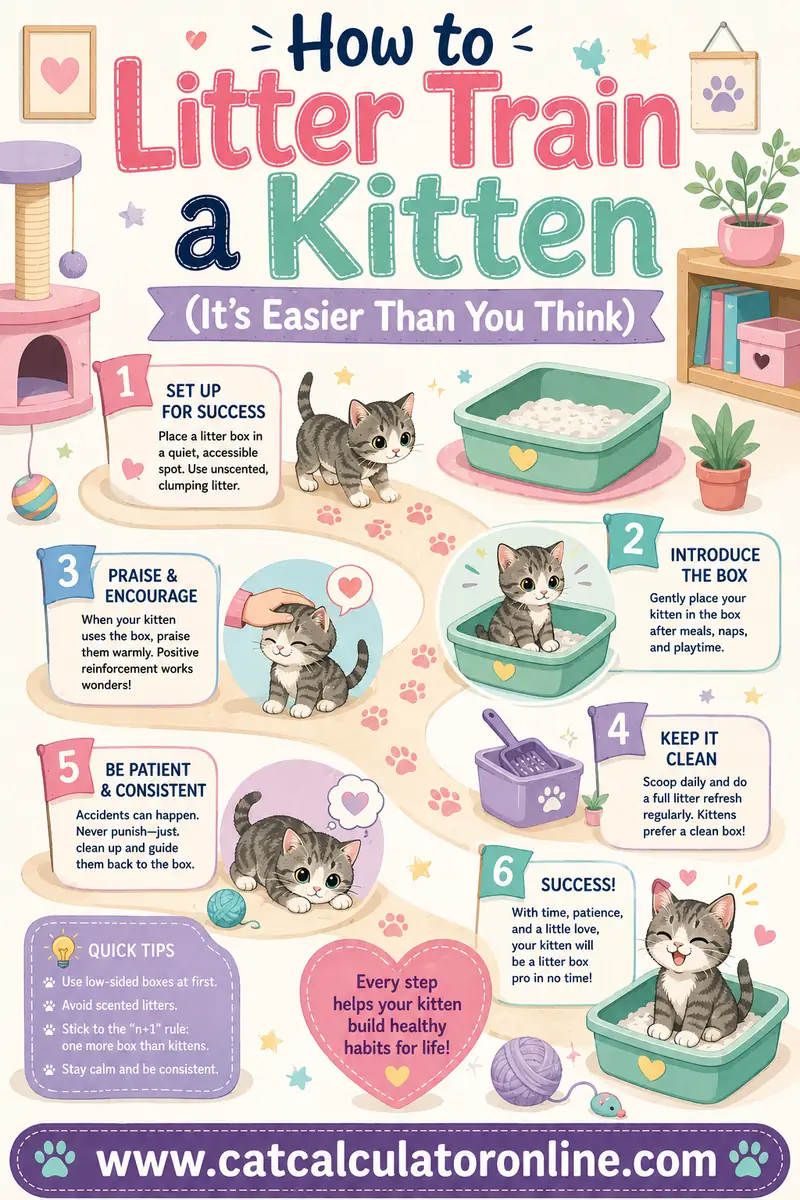
How to Litter Train a Kitten (It's Easier Than You Think)
Litter training a kitten is mostly a matter of showing, not teaching. Digging and burying is instinctive, and most kittens learn from watching their mother by about 4 weeks old — so by the time one comes home to you, she usually already knows what a litter box is for. Your job is to give her a low-sided box with unscented litter, put her in it after meals, naps and play, keep it clean, and praise her when she uses it.
Most kittens are reliably using the box within a few days. If yours isn't, the problem is nearly always the setup — box too tall, litter she dislikes, box too far away — not the kitten. Below is the whole process, plus what to do about accidents and when it's worth a vet call. If you're still working out how old your kitten is, our free cat age calculator will place her life stage in a few seconds.
🐾 Litter training setup checker
Tap a step to see exactly what to do:
Tap a step above for exactly what to do.
When Kittens Learn to Use a Litter Box
Kittens don't eliminate on their own at all for the first few weeks — the mother stimulates them to go and cleans up after them. Somewhere around 3 to 4 weeks old, they start doing it themselves and begin copying her: scratching, digging, squatting, covering.
By the time a kitten is old enough to go to a new home — usually 8 to 12 weeks — that instinct is well established. Which is why "litter training" a kitten looks nothing like housetraining a puppy. You're not building a behavior from scratch. You're pointing at the right spot.
| Kitten age | What to expect |
|---|---|
| 0–3 weeks | Can't eliminate unaided; mother stimulates and cleans. No box needed. |
| 3–4 weeks | Starts going independently; introduce a very shallow box. |
| 4–6 weeks | Learns by copying mum. Most kittens are using a box by the end of this window. |
| 6–8 weeks | Reliable with a low-sided box and a clean setup. |
| 8–12 weeks | Typical rehoming age. Arrives already knowing what a box is for. |
| 3–6 months | Fully reliable. Can move to clumping litter and a full-size box. |
If you're hand-raising an orphaned kitten from very young, the timeline is the same but you're taking the mother's role — check with your vet, since very young orphans need specialist care beyond the litter box.
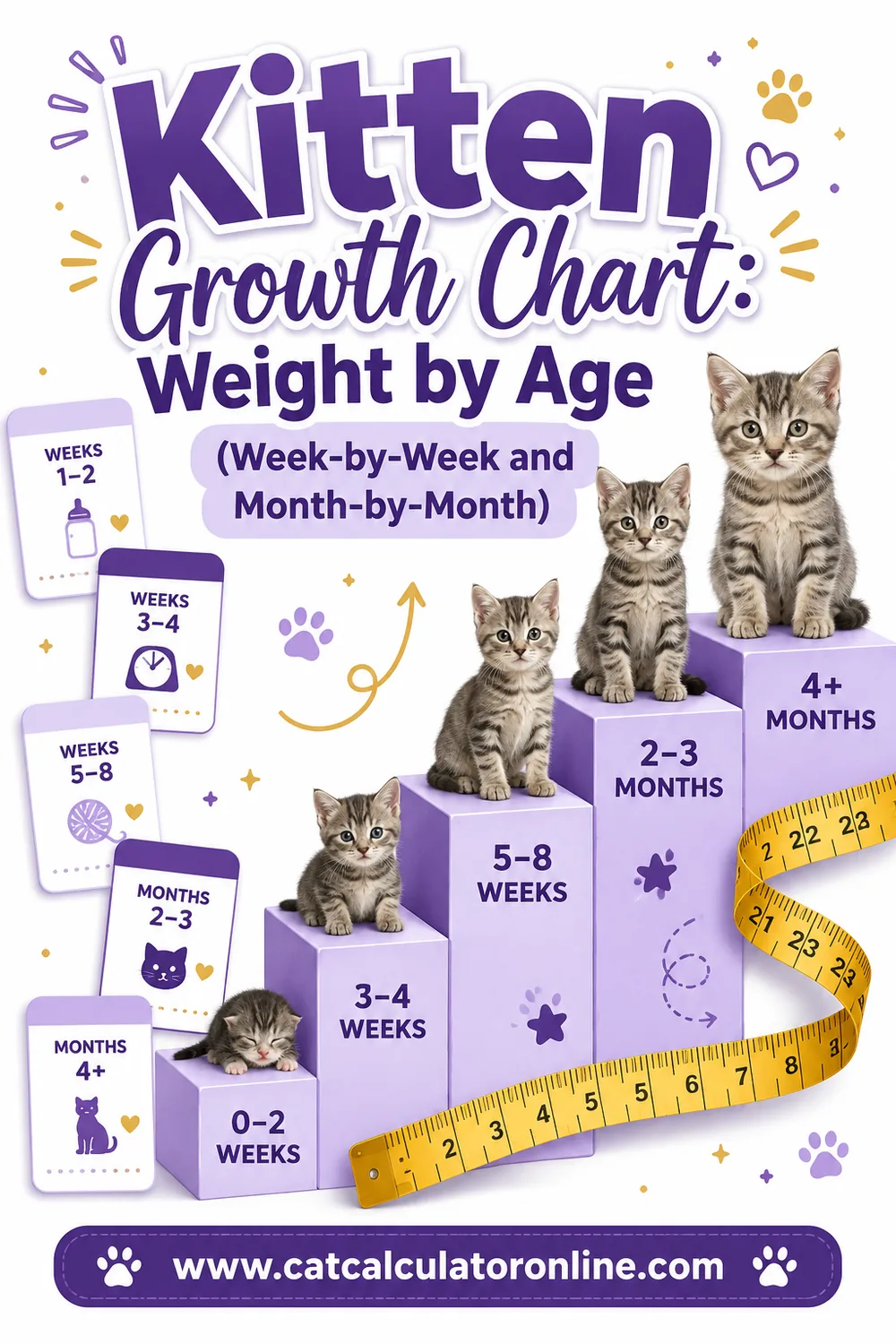
For where litter training fits alongside everything else in the first weeks, see the new kitten checklist, and use the kitten growth chart to check she's developing on schedule.
Setting Up the Box
Get this part right and the training part mostly takes care of itself.
Choose a low-sided box
An adult litter box has sides around 5–6 inches high. To a 2-pound kitten, that's a wall. She'll try, fail, and go somewhere easier.
Aim for an entry height of about 1–2 inches. Options that work:
- A shallow plastic storage lid or a baking sheet
- A cardboard box tray cut down (disposable, fine for the first couple of weeks)
- A standard tub with a U-shaped notch cut into one side and the edges sanded smooth
- A purpose-made kitten box, if it's genuinely shallow — many aren't
Size still matters: she should be able to stand in it, turn around, and dig without stepping out. Size up to a full-size box at around 4–6 months, or when she starts looking cramped.
Skip the lid and the liner
Covered boxes trap smells inside where the kitten is and block her view of the room. Liners catch claws and bunch up when she digs. Neither helps, and both give her a reason to try somewhere else. Plain, open, uncomplicated.
Use unscented litter — and non-clumping for very young kittens
Scented litter is made for human noses. A kitten's sense of smell is much sharper than yours, and heavy perfume is a common reason a cat rejects a box. Go unscented, every time.
The clumping question matters at this age. Kittens explore with their mouths, and they will taste litter. For kittens under roughly 8–10 weeks, many vets recommend non-clumping litter, because clumping clay can be harmful if it's swallowed in any quantity. Non-clumping needs more frequent full changes, but it removes the risk during the mouthing stage.
Once she's past that — usually around 3–4 months, when she's stopped tasting everything — you can switch to unscented, fine-grained clumping litter, which is what most adult cats prefer. Make the switch gradually: mix a little of the new litter in and increase the proportion over a week or so.
Fill to about 1–2 inches deep for a kitten (adults do best at 2–3 inches). Too deep and a small kitten sinks and struggles.
Put it somewhere she'll actually use
- In the room she's living in. A new kitten shouldn't have to explore a strange house to find a bathroom. Keep her in one room at first with the box always visible.
- Never beside her food and water. Cats won't eliminate where they eat. Different corner at minimum, different room ideally.
- Quiet, but not a dead end. Away from the washing machine, the vacuum cupboard and busy doorways — but somewhere she can see out and leave easily.
- One box per floor once she has the run of the house, plus the usual guideline for cats generally: one box per cat, plus one spare, in separate locations.
- Behind no closed doors. A door that swings shut turns a good box into no box.
The Training Routine, Step by Step
- Show her the box on day one. Put her in it gently as soon as she arrives, before she explores anywhere else. Let her sniff, step out if she wants, and take it in.
- Place her in the box after every meal. Eating triggers elimination in kittens, usually within 10–20 minutes.
- Place her in it after every nap. Waking up is the other reliable trigger.
- Place her in it after play sessions. Activity gets things moving.
- Let her dig. If she scratches at the litter, that's the instinct switching on. Don't interrupt. Never take her paws and "show" her a digging motion — most kittens dislike being handled that way and it can put them off the box.
- Watch for the pre-go signals. Sniffing the floor, circling, sudden crouching, scratching at a rug. Pick her up calmly and put her in the box.
- Praise quietly when she gets it right. A soft word, a stroke, or a small treat immediately after. Keep it low-key — a loud celebration can startle a kitten mid-business.
- Scoop after every use at first. Kittens are fussier than adults about a soiled box, and a spotless box early on builds a strong habit fast.
- Expand her space slowly. When she's reliable in one room, open up one more, adding a box as you go. Don't give a 9-week-old kitten a whole house at once.
Most kittens are consistent within a few days of arriving. A week is normal. Longer than that means something in the setup needs changing.
Accidents: What to Do (and What Never to Do)
Accidents will happen, and they mean nothing about your kitten's intelligence or your training.
Never punish her. No shouting, no nose-rubbing, no spraying with water, no shutting her in a room as a consequence. Kittens can't connect a telling-off with something they did minutes ago. What they do learn is that you're unpredictable — and stress makes litter box problems worse, not better. This is one of the few genuinely counterproductive things you can do.
Clean with an enzymatic cleaner. Enzyme-based pet cleaners break down the compounds in urine rather than covering them up. Soak the area generously, let it dwell as long as the label says, and let it air dry.
Never use ammonia-based cleaners. Ammonia smells like urine to a cat, which turns the spot into an invitation to go there again. Avoid strong bleach on soiled areas too.
Add a box where the accident happened. If she's chosen a corner, she's telling you that spot works for her. Put a box there. Once she's using it consistently, move it a few inches a day toward where you'd rather have it.
Look for the reason. Was the box too far? Door closed? Litter changed? Box dirty? Was she asleep upstairs with the only box downstairs? Nearly every accident has a practical explanation.
Troubleshooting Common Problems
| Problem | Likely cause | Fix |
|---|---|---|
| Won't get in the box | Sides too high | Swap to a 1–2 inch entry, or cut a notch in the side |
| Goes right beside the box | Box dirty, too small, or she dislikes the litter | Scoop after each use; go bigger; switch to unscented, soft-textured litter |
| Eats or chews the litter | Normal exploration in young kittens | Use non-clumping litter under ~8–10 weeks; mention persistent eating to your vet |
| Uses it for pee, not poo | Box too small or not clean enough | Bigger box; add a second box in another spot |
| Accidents upstairs only | No box on that floor | One box per floor, minimum |
| Started missing after a change | New litter, moved box, new pet, new home | Go back to the old litter/spot, then change gradually |
| Digs excessively or scatters | Normal kitten enthusiasm | High-backed box with low front entry; a litter mat underneath |
| Won't cover her waste | Individual preference, or litter she dislikes | Not a problem in itself; try a different unscented litter if you want |
| Repeated accidents despite a good setup | Possible medical cause | Call your vet |
When to Call the Vet
Litter training problems are usually a setup issue. But a few things are medical, and they're worth knowing.
Call your vet if your kitten:
- Strains in the box and produces little or nothing. This is urgent in cats of any age — a urinary blockage is life-threatening. Go to a vet or emergency clinic immediately.
- Cries or seems in pain while going.
- Has diarrhea, especially for more than a day, or any blood in the stool. Kittens dehydrate fast.
- Has blood in the urine.
- Isn't going at all for an unusually long stretch.
- Keeps missing the box despite a low-sided, clean, well-placed setup with unscented litter.
- Is eating a lot of litter rather than just tasting it.
- Has worms visible in the stool or around the rear — common in kittens and easily treated.
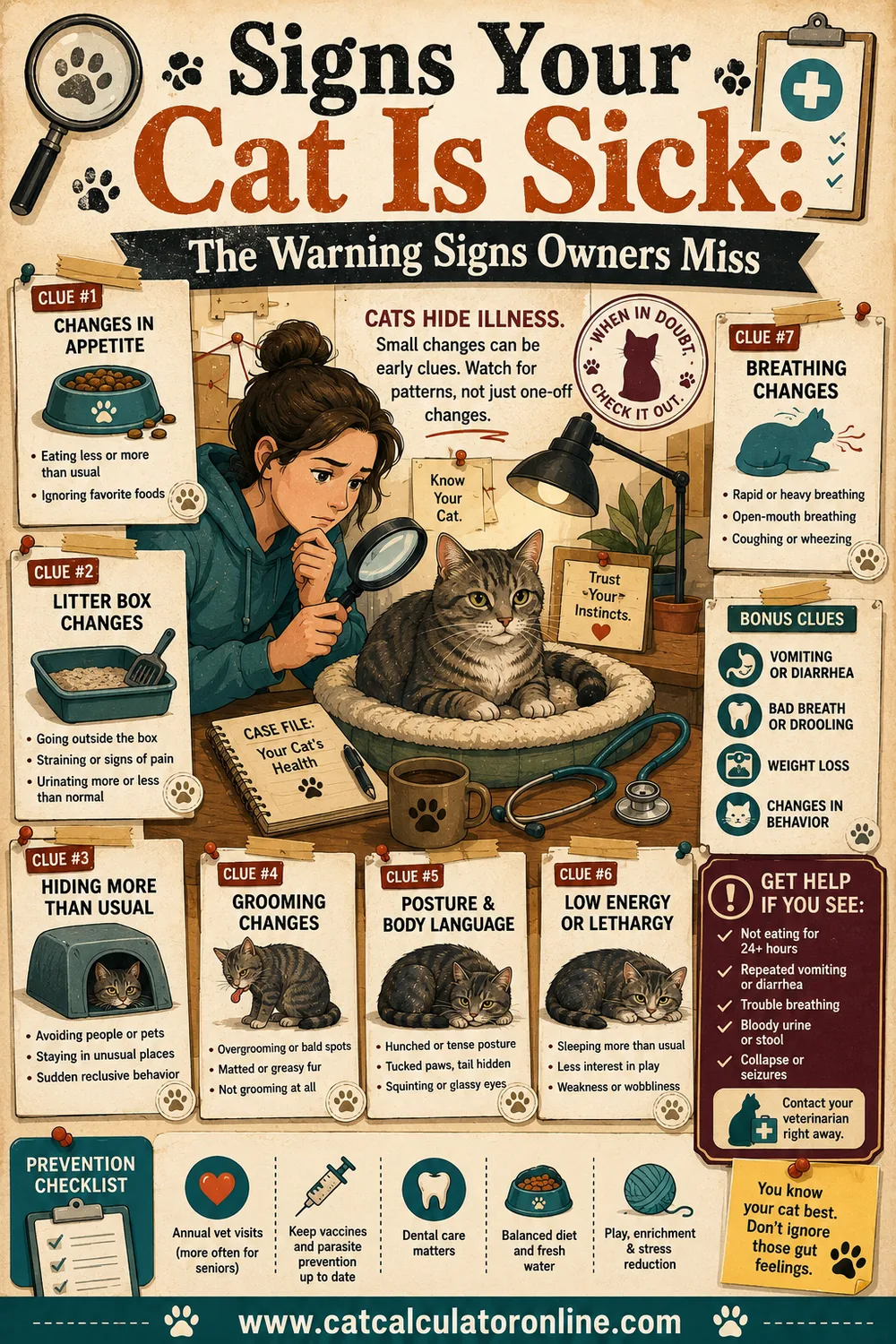
Kittens are also on a vaccination and deworming schedule in their first months, so most of these can be raised at an appointment you already have. Signs your cat is sick covers the wider set of warning signs worth watching for as she grows.
FAQ
How long does it take to litter train a kitten?
Usually a few days. The instinct to dig and bury is already there by about 4 weeks old, so most kittens use a box correctly almost immediately once they're shown where it is. If it's taking more than a week, the box, the litter or the location is the thing to change.
At what age can you litter train a kitten?
From about 3 to 4 weeks, when kittens start eliminating on their own. Before that the mother handles it. Kittens rehomed at 8 to 12 weeks are typically already litter trained and just need to be shown where the box is in the new house.
What litter is best for a kitten?
Unscented and soft-textured. For kittens under roughly 8–10 weeks, many vets recommend non-clumping litter, because kittens taste things and clumping clay can be harmful if swallowed. Switch to unscented fine-grained clumping litter gradually once she's past the mouthing stage.
Why is my kitten peeing outside the litter box?
Most often the box is too tall to climb into, too dirty, too far away, or filled with litter she dislikes. Check those first. If the setup is right and she's still missing, or if she strains, cries or has blood in her urine, call your vet.
Should I punish my kitten for accidents?
No. Kittens can't link punishment to something they did minutes earlier, and it makes them anxious — which increases litter box problems. Clean the spot with an enzymatic cleaner, add a box near where it happened, and carry on with the routine.
How many litter boxes does one kitten need?
Two, in separate locations, and at least one on every floor she has access to. The general guideline for cats is one box per cat plus a spare, and kittens especially benefit from never having to travel far to find one.
The Bottom Line
Litter training a kitten is less about training and more about removing obstacles. Give her a box she can climb into, unscented litter she likes (non-clumping while she's very young), somewhere quiet that isn't next to her food, and put her in it after meals, naps and play. Scoop constantly, praise quietly, clean accidents with an enzymatic cleaner, and never punish her. Most kittens have it sorted within days.
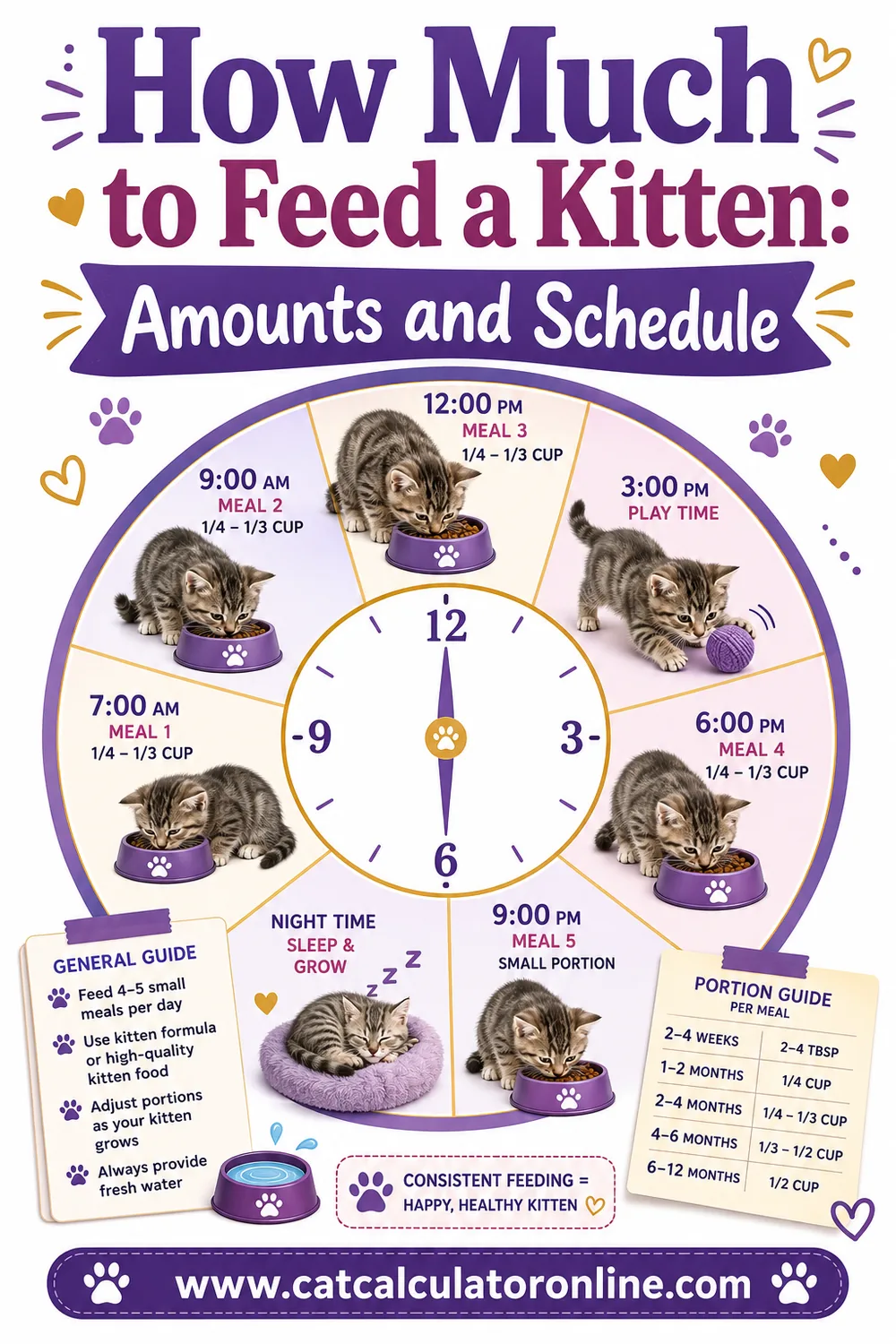
Ready for the rest of the first few months? Check her life stage with our free cat age calculator, work through the new kitten checklist, and get her portions right with how much to feed a kitten.