Why Do Cats' Eyes Glow in the Dark? Cat Vision Explained
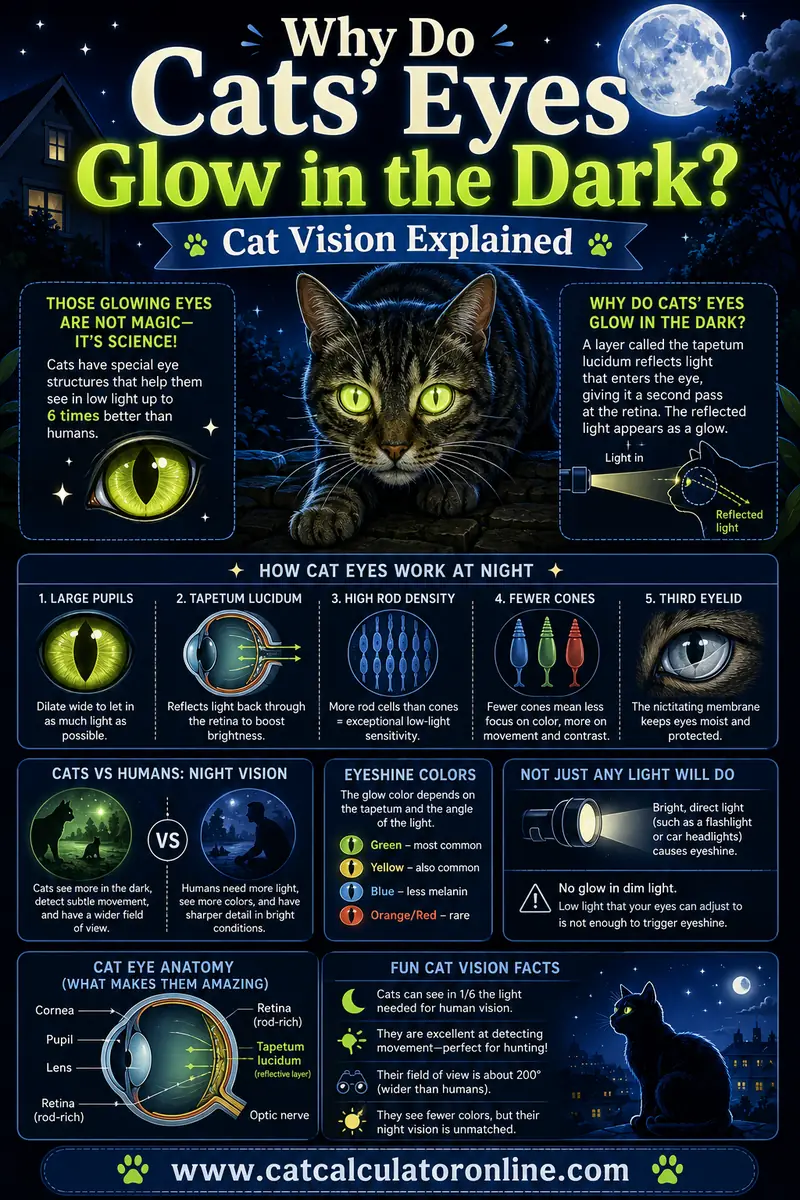
Cats' eyes glow in the dark because of a reflective layer behind the retina called the tapetum lucidum. It acts like a tiny mirror, bouncing incoming light back through the light-sensing cells for a second chance to be detected. When a torch or camera flash hits your cat's eyes, some of that light reflects straight back at you — usually a green or yellow glow, though some cats show red.
That same mirror is why cats see so well in the dark. They need only about one-sixth of the light humans do to see. But — and this surprises people — cats cannot see in total darkness. No light in, nothing to reflect. Curious about the cat behind those glowing eyes? Our free cat age calculator tells you its age in human years in one tap.
👁️ Cat vision myth or fact?
Tap each one to reveal the truth about how cats see:
Tap a statement to see whether it’s myth or fact.
What Is the Tapetum Lucidum?
The tapetum lucidum is a thin, mirror-like layer of tissue sitting just behind the retina at the back of a cat's eye. Its name is Latin for "bright carpet," which is a lovely description of what it does.
Here's the clever part. When light enters a cat's eye, it passes through the retina, where light-sensing cells called photoreceptors try to catch it. In our eyes, any light the photoreceptors miss is simply absorbed and lost. In a cat's eye, that leftover light hits the tapetum and bounces straight back through the retina — giving the photoreceptors a second chance to detect the very same light.
That double pass is the whole trick. It roughly doubles the light available to a cat's eye in dim conditions, dramatically boosting its ability to see when there's very little to work with. The glow you see is just the small fraction of that reflected light that escapes back out of the eye toward you.
Lots of animals have a tapetum — dogs, deer, cattle, and many nocturnal hunters. Humans don't, which is why our eyes show "red-eye" in flash photos (that's blood vessels at the back of the eye) rather than a bright green or gold shine.
Why the Glow Is Different Colors
Not every cat glows the same shade, and that's normal. The color depends on the makeup of the tapetum and, to some extent, the cat's eye color and age.
- Green or yellow-green is the most common glow in adult cats.
- Yellow or gold shows up in plenty of cats too.
- Red appears in some cats — often those with blue eyes or very little pigment, where light reflects more from the blood-rich retina than the tapetum itself. Many blue-eyed cats and kittens show red-eye more like humans do.
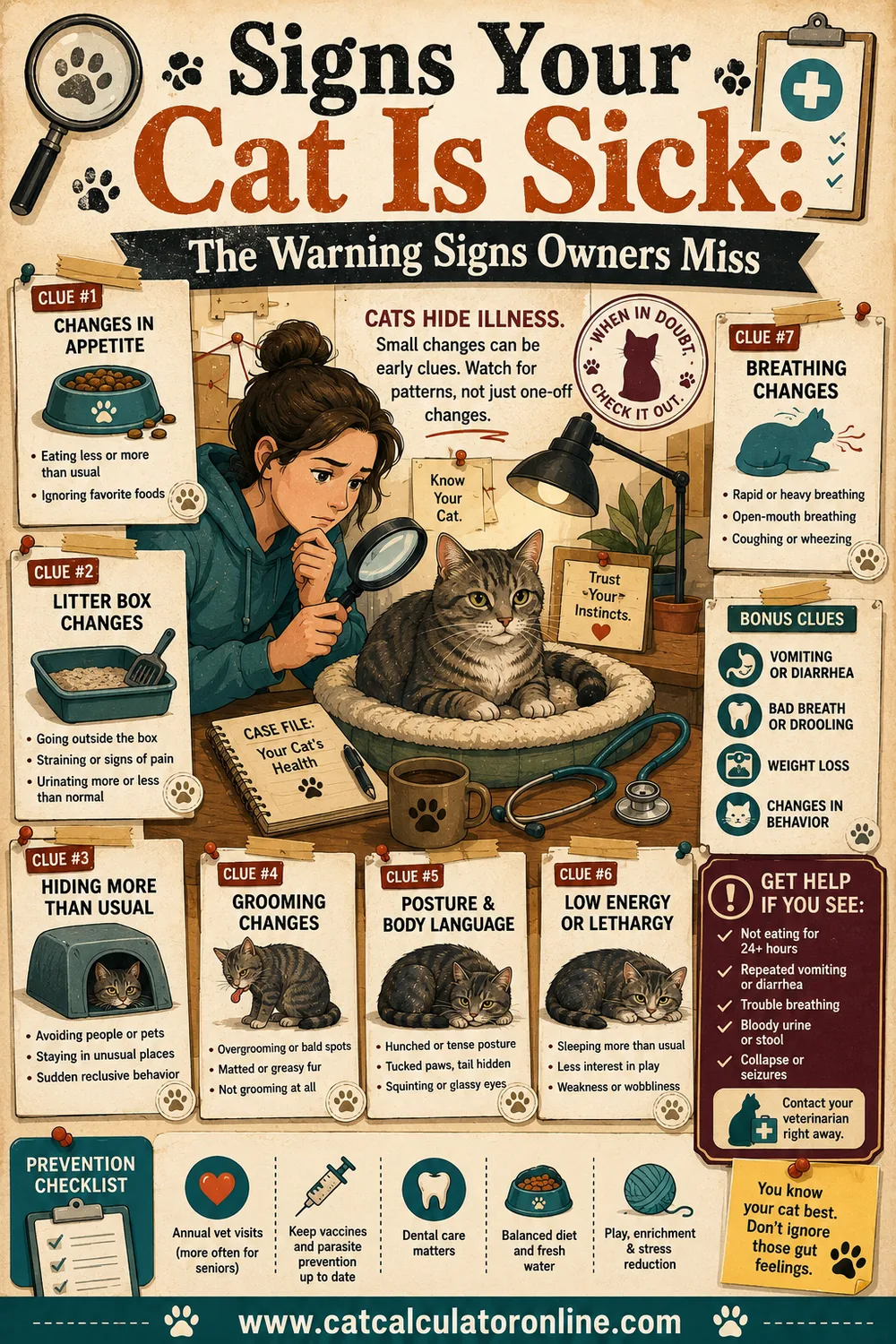
The exact color can even shift slightly with the angle of the light and the age of the cat. If one of your cat's eyes suddenly glows a very different color from the other, though, that's worth mentioning to your vet — it can occasionally signal an eye problem. When in doubt about any change, signs your cat is sick covers what's worth a call.
How Well Can Cats Actually See in the Dark?
Extremely well — far better than us. Thanks to the tapetum plus a few other adaptations, cats need only about one-sixth of the light a human needs to see (some sources put it closer to one-seventh). In practical terms, a room that looks pitch black to you may look like comfortable twilight to your cat.
But cats have no magic. They cannot see in total darkness. Vision, for any animal, requires light hitting the eye. The tapetum can only recycle light that's already there — if there's zero light in a sealed, windowless room, a cat is just as blind as you are. What cats are brilliant at is squeezing every last drop of usefulness out of tiny amounts of light: starlight, the glow from a hallway, moonlight through a curtain.
This is why your cat can tear around the house at night, leap onto furniture, and find its toys when you'd be stubbing your toes. There's almost always a little ambient light, and a little is all a cat needs.
Why Cats' Night Vision Comes With Trade-Offs
A cat's eye is a specialist tool, tuned for a specific job: hunting in low light. Like any specialist, it gives up some abilities to be great at others.
Cats are crepuscular, meaning they're most active and hunt best at dawn and dusk — the dim edges of the day when their prey is also moving. Their eyes are built for exactly those conditions, and that shapes everything about how they see.
The retina is packed with rod cells, the photoreceptors responsible for low-light vision and detecting motion. Cats have far more rods than we do. But they have fewer cone cells — the photoreceptors that handle color and fine detail in bright light. That balance is where the trade-offs come from:
- Fewer, duller colors. Cats aren't colorblind, but with fewer cones they see a narrower, muted palette — mostly blues and yellows, with reds and greens looking washed out. Think of it as a faded version of our color world, not black-and-white.
- Poorer detail and sharpness. Cats have lower visual acuity than humans. What we can see clearly from 100 feet away, a cat may need to be around 20 feet away to see with the same clarity.
- Can't focus up close. Cats struggle to focus on anything closer than about 10 inches from their face. That's part of why their whiskers matter so much — they sense the near world the eyes can't focus on.
None of these are flaws. They're the cost of a nighttime hunter's eye, and for a cat's real job, the deal is well worth it.
Cat Vision vs. Human Vision
Here's how the two stack up side by side. It's a genuinely different way of seeing the world.
| Feature | Cats | Humans |
|---|---|---|
| Light needed to see | About 1/6 as much | Baseline (needs more) |
| Best conditions | Dawn, dusk, low light | Bright daylight |
| Field of view | About 200° | About 180° |
| Rod cells (low light, motion) | Many more | Fewer |
| Cone cells (color, detail) | Fewer | Many more |
| Color vision | Limited — mainly blues and yellows | Full color spectrum |
| Detail and sharpness | Lower acuity | Sharper, better fine detail |
| Close-up focus | Poor under ~10 in | Good |
| Motion detection | Excellent | Good |
| Sees in total darkness | No | No |
| Eyes glow in the dark | Yes (tapetum lucidum) | No |
The short version: we see a sharp, colorful world in good light. Cats see a softer, dimmer, motion-sensitive world that keeps working long after ours has gone dark.
The Other Tricks in a Cat's Eye
The tapetum gets most of the attention, but a few other features round out a cat's remarkable low-light vision.
A wider field of view. Cats take in roughly 200 degrees around them, compared with about 180 for humans. That extra peripheral coverage helps a hunter spot movement sneaking in from the sides — and helps a prey animal spot danger.
Vertical slit pupils. Those dramatic slit pupils aren't just for looks. They can open into wide circles to gather maximum light in the dark, then close to thin vertical slivers in bright sun. That gives cats an enormous range of light control — far more than our round pupils manage — so they're comfortable from near-dark to bright daylight.
Superb motion detection. With all those rod cells, cats are wired to notice movement. A twitching mouse, a fluttering toy, a fast-moving hand — motion grabs a cat's attention instantly, even when a still object might barely register. It's why the flick of a wand toy is irresistible and a motionless treat can be oddly hard for a cat to spot.
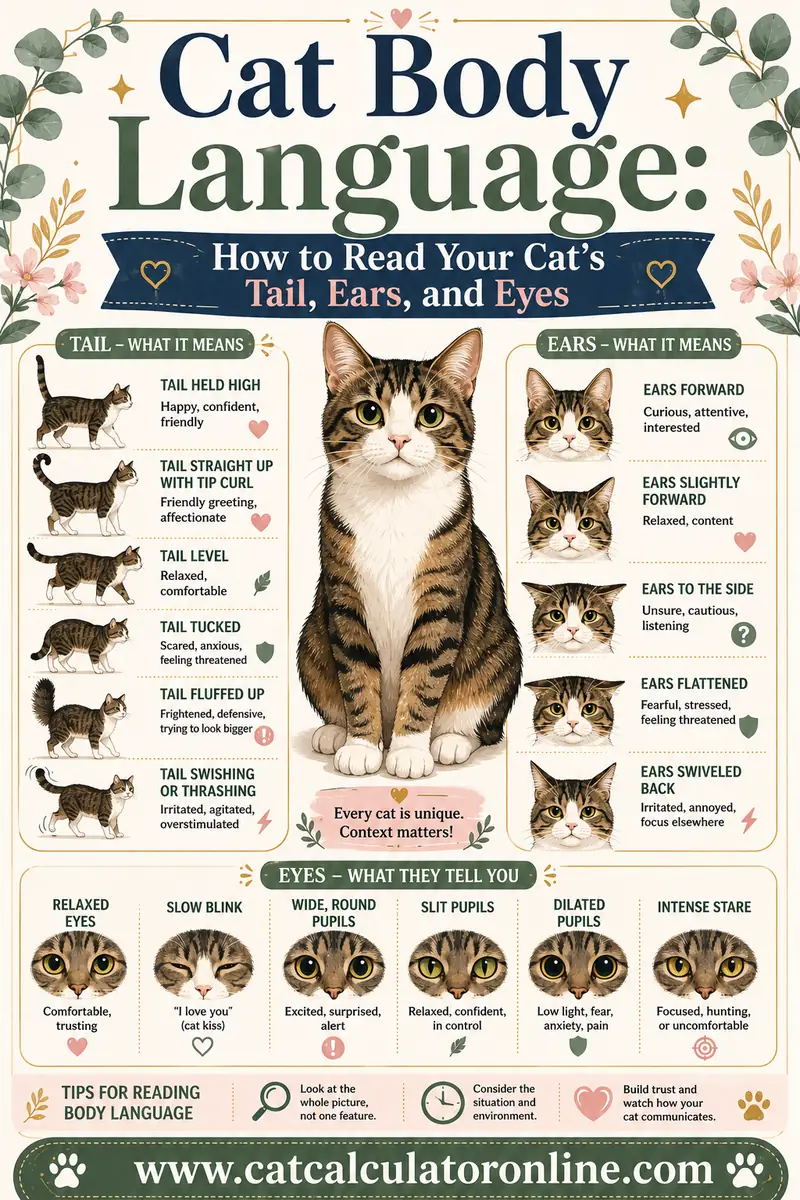
Together with the tapetum, these features make the cat's eye a beautifully complete piece of nighttime hunting equipment. Understanding it also helps you read your cat better overall — pair this with cat body language to see how those eyes signal mood, not just sight.
FAQ
Can cats see in complete darkness?
No. Cats need at least a small amount of light to see — their tapetum lucidum recycles existing light but can't create it. In a truly pitch-black, sealed room they're as blind as we are. What makes them special is needing only about one-sixth the light humans do, so almost any faint glow is enough for them.
Why do cats' eyes glow green in photos?
The camera flash reflects off the tapetum lucidum behind the retina and bounces back toward the lens. Green or yellow-green is the most common reflection color in adult cats. Some cats, especially blue-eyed ones, show red instead because light reflects more from the retina than the tapetum.
Are cats colorblind?
Not exactly. Cats see color, just a limited range of it — mainly blues and yellows, with reds and greens looking dull and muddy. They have fewer color-detecting cone cells than we do, so their world is more muted, but it's not black-and-white.
Why do only some cats' eyes glow red instead of green?
Red glow usually shows up in cats with blue eyes or low pigment, where the light reflects off the blood-rich retina rather than the tapetum. It's the same effect that causes red-eye in human photos. Green and yellow glow come from a fully working, pigmented tapetum.
Do cats see better than humans?
It depends what you mean by "better." In low light, motion detection, and field of view, cats win easily. In color range, fine detail, sharpness, and close-up focus, humans win. Each eye is tuned for a different lifestyle — ours for bright, detailed daytime, theirs for dim-light hunting.
Why can't my cat find a treat right in front of its nose?
Cats can't focus well on anything closer than about 10 inches, so a treat directly under their face can blur out. They rely on smell and their whiskers to locate close objects. Toss the treat a short distance away and watch how quickly they lock onto it.
The Bottom Line
Your cat's eyes glow because of the tapetum lucidum, a reflective layer that gives incoming light a second pass through the retina — the same feature that lets cats see in a sixth of the light we need. It's a night hunter's eye through and through: brilliant in dim light and at catching motion, weaker on color, detail, and close focus, and completely dependent on there being at least some light to work with.
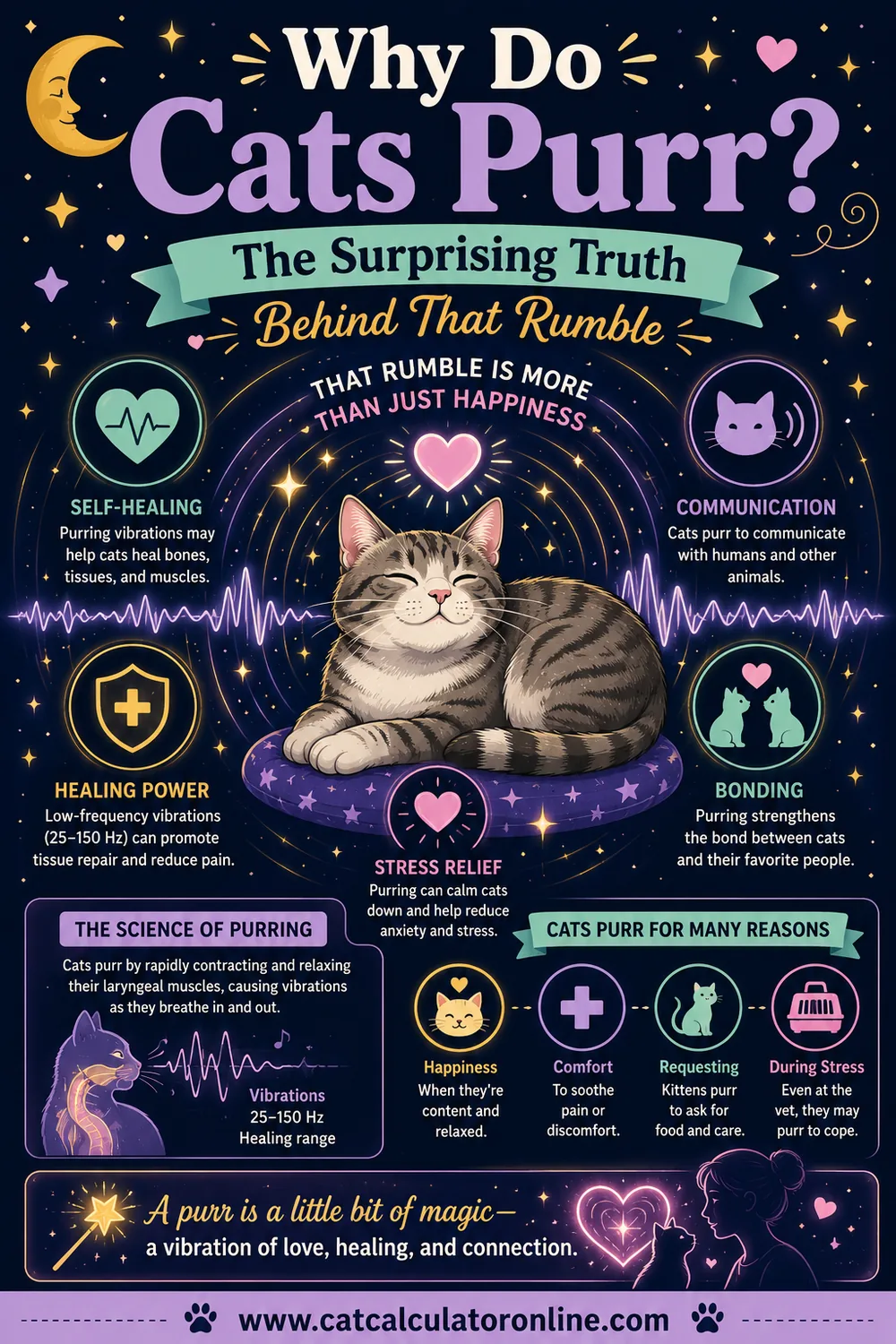
Want to understand the rest of your cat as well as you now understand its eyes? Start with our free cat age calculator to see its age in human years, then explore cat body language and why do cats purr to decode what it's telling you.