Cat Flaps and Microchip Cat Doors, Compared
The decision is not really about your cat. It is about everyone else's. A plain flap lets any cat in the neighborhood walk into your kitchen, and an intruder cat is one of the most common causes of spraying, fighting and litter box problems in otherwise settled households. That is the problem microchip flaps solve, and it is why they are worth the extra money in most areas. The rest of the decision comes down to tunnel length for your wall or door, whether you want a curfew, and the awkward truth that a minority of cats never learn to use a flap at all. Running costs and one-off buys both sit in the cat cost calculator.

What Are the Actual Options?
There are four types on sale, and the gap between them is bigger than the price difference suggests.
Plain flaps are an unpowered plastic door on a hinge, usually with a four-way manual lock: open both ways, in only, out only, fully locked. Cheap, silent, and permanently reliable — but they admit any animal that can push a flap.
Magnetic flaps unlock when a magnet on the cat's collar comes close. They were the original solution and they are now largely obsolete: any cat wearing a matching magnet gets in, the collar can be lost, and the mechanism is noisy enough to put some cats off.
Infrared collar-key flaps work the same way with a small transmitter tag instead of a magnet. Slightly more selective than magnets, still dependent on the cat wearing a collar.
Microchip flaps read the identity chip already implanted between your cat's shoulder blades. Nothing to wear, nothing to lose, and the flap only opens for chips you have registered to it. This is the version that actually works.
Microchip flaps store multiple cats, usually up to about 30, so a multi-cat home is fine. Most also accept an RFID collar tag as a backup for a cat whose chip sits awkwardly.
One important check before buying a microchip flap: confirm the chip standard. Modern 15-digit FDX-B chips are read by everything. Older 10-digit FECAVA and some US-market 125 kHz chips are not universally supported, so check the flap's stated compatibility against your cat's chip number. If your cat is not chipped at all, the cost is small — see how much does it cost to microchip a cat.
Why Is a Neighbor's Cat Such a Problem?
Because from your cat's point of view, an intruder in the kitchen is not a visitor. It is an invasion of the one place she is supposed to be safe.
Indoor territory is where cats relax completely. A strange cat coming through the flap removes that, and the effects show up as behavior rather than as an obvious event you witnessed.
Spraying indoors is the classic sign. A settled, neutered cat who suddenly starts marking near the back door, the flap itself or the windows is very often responding to another cat coming in or hanging around outside — how to stop a cat spraying covers what to do about it.
Food theft is common and easy to miss. An intruder eating your cat's food explains a lot of otherwise mysterious hunger, and a lot of otherwise mysterious weight loss.
Litter box avoidance can follow. A cat that has been ambushed indoors starts choosing corners she can see from.
Tension between your own cats gets worse. An outside threat frequently redirects into fighting between housemates, which then looks like an unrelated problem — the dynamics are set out in how to stop cats fighting.
You often never see the intruder. Owners assume their cat has developed a behavior problem when what has actually changed is that a tomcat two doors down learned the flap opens.
Wildlife is the other half of it. Plain flaps admit rats, squirrels and, in the US, opossums and racoons. A racoon in a kitchen is a genuinely serious problem, and this alone justifies a selective flap in many areas.
How Do You Measure and Fit One?
Get this wrong and the flap is unusable, however good it is.
Measure the cat's shoulder width and belly height. The flap opening needs to be wider than her widest point and tall enough that she does not have to duck. A typical adult needs roughly 6 x 6 in (15 x 15 cm) of clear opening; a Maine Coon needs a large or dog-sized flap.
Step height is the number people miss. The bottom of the opening should sit about 4–6 in (10–15 cm) above the surface she steps from, measured on both sides. Too high and a kitten or an arthritic cat cannot get through comfortably; too low and rain runs in.
Measure the total depth of the hole, not the door thickness. A standard flap tunnel handles about 2 in (5 cm). Anything more needs extender sections, which are sold separately and clip together.
Cavity walls need a full tunnel liner. A 12 in (30 cm) brick wall means four or five extenders, sealed at both ends, otherwise you have created a draft and a wasp route.
Long tunnels put some cats off. A cat has to commit to a dark passage she cannot see the end of. If your wall is very thick, angle the outside end slightly downwards and keep the interior smooth and pale.
Glass doors need a glazier. Toughened and double-glazed units cannot be cut after manufacture, so a new pane is made with the hole in it. Budget $150–$400 for the pane and fitting in the US, often more than the flap itself.
uPVC doors are usually straightforward but check for internal reinforcement bars. Composite doors vary, and some manufacturers void warranties on any cut-through.
Fit it on a sheltered side if you can. A flap in a wind-facing wall rattles, leaks and lets in cold air, and a noisy flap is a flap cats hesitate at.
How Do the Types Compare?
| Type | Typical US cost | Keeps other cats out | Batteries | Best for |
|---|---|---|---|---|
| Plain four-way flap | $15–$35 | No | None | Rural homes, no other cats nearby |
| Magnetic collar flap | $25–$45 | Partly | None | Legacy installations only |
| Infrared collar-key flap | $35–$60 | Partly | Yes | Cats that reliably wear collars |
| Microchip flap | $70–$130 | Yes | Yes | Most households |
| Microchip flap with curfew | $110–$180 | Yes | Yes | Nights indoors, timed access |
| Connected app flap | $150–$250 | Yes | Yes | Remote locking, in-out logging |
| Dog-sized flap for a large cat | $40–$90 | Varies | Varies | Maine Coons, multi-pet homes |
Batteries last roughly six to twelve months in most microchip flaps, and a flap with flat batteries locks or stops reading. Buy a model that warns you, and keep spares in the drawer.
Connected flaps that log entries and exits are more useful than they sound. Knowing your cat has not come home since Tuesday morning, or that she is going out eleven times a night, is real information.
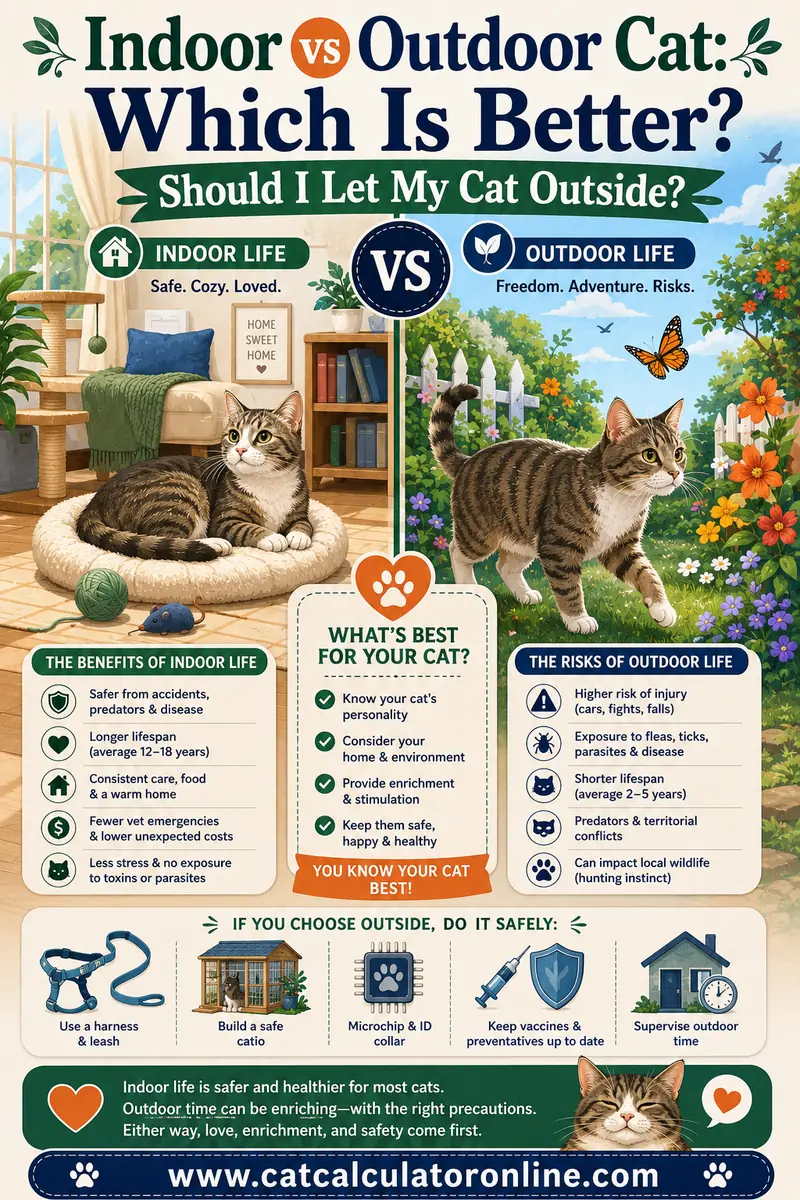
Curfew models are worth the premium if you want her in at night. Most road accidents and most cat fights happen after dark, and a timed lock removes the nightly argument about it. Whether she should be outside at all is a separate question, weighed up in indoor vs outdoor cat.
Will Your Cat Learn to Use It?
Most do, within a week or two. Some never do, and that is worth knowing before you cut a hole in a door.
Start with the flap taped fully open for one to two weeks, so it is just a hole. Let her walk through with no resistance and no noise at all.
Then let it close, but prop it slightly ajar with a wedge so she can see daylight and feel that it moves. Call her through from the other side with food.
Never push her through. Being shoved through a swinging plastic door once is enough to put a nervous cat off permanently.
Feed her on the far side. Meals just beyond the flap do more than any amount of coaxing, and give her weeks rather than days.
Expect a setback when the lock engages. A microchip flap makes a click, and the first time it does that with her head near it, many cats retreat. Go back a stage.
Some cats simply refuse. Long tunnels, noisy mechanisms and previous bad experiences all contribute, and a proportion of cats never accept a flap regardless of technique. If she is still refusing after two months of patient work, that is her answer.
A few cats learn to defeat one. Determined cats have been known to hold flaps open for a friend, or to follow another cat through on the same unlock. Microchip models with a slower relock are less easily exploited.
Old flaps can be retrofitted. Most microchip flaps are made to drop into a standard existing hole, so upgrading from a plain flap is often a screwdriver job rather than a carpentry one.
What Goes Wrong After It Is Fitted?
Draughts and rain. Cheap flaps have a single thin door and no seal. Look for a double-flap design or a magnetic closing strip, particularly on an exposed wall.
Rattling in wind, which puts cats off and keeps people awake. A weighted bottom edge or a brush seal fixes it.
Failed chip reads. Chips can migrate under the skin, and a flap whose antenna is at the top of the frame may miss a chip that has moved down a cat's shoulder. Register a collar tag as a backup.
Batteries dying unnoticed, which usually presents as a cat sitting outside in the rain.
Security. A flap is a hole in your house. Fit it low in a door and away from the lock, and check whether your home insurance has anything to say about it — some policies do.
Two cats, two speeds. In a multi-cat home the confident cat learns the flap in three days and the nervous one takes three months, which usually looks like the second cat waiting by the door to be let out. That is normal, and the fix is more sessions with the flap propped open rather than more pressure.
Noise from the lock mechanism. Microchip flaps click as they unlock and again as they relock, and older units get louder. A cat who has started hesitating at a flap she used happily for years is often responding to a mechanism that needs cleaning or a battery that is going flat.
Prey brought indoors. Selective flaps do not stop your own cat carrying things in. A few models detect a raised head profile and refuse entry, with mixed real-world success.
It becomes an escape route for an indoor cat. If your household includes one cat who goes out and one who must not, a flap is a difficult combination, and a secure outdoor run may suit better — see catios and outdoor cat enclosures.
Kittens should not have flap access. Wait until she is neutered, chipped, fully vaccinated and confident outdoors, which is usually around five to six months. Alongside that, do the wider safety pass in how to cat proof your home.
Frequently Asked Questions
Are microchip cat flaps worth the extra money?
For most households, yes. They read the chip your cat already has, so nothing needs to be worn, and they are the only type that reliably keeps neighboring cats out. Intruder cats are a leading cause of indoor spraying, food theft and fighting.
Will a microchip cat flap work with my cat's chip?
Usually. Modern 15-digit FDX-B chips are read by every current flap. Older 10-digit FECAVA chips and some 125 kHz US chips are not universally supported, so check the flap's compatibility list against your cat's chip number before buying.
How big should a cat flap opening be?
Wider than your cat's shoulders and tall enough that she need not duck — roughly 6 x 6 in (15 x 15 cm) of clear opening for an average adult. Large breeds such as Maine Coons often need a large or small-dog flap instead.
Can a cat flap be fitted in a glass door?
Yes, but toughened and double-glazed panes cannot be cut after manufacture, so a glazier makes a replacement pane with the hole already in it. Expect $150–$400 for the pane and fitting in the US, often more than the flap costs.
How do I train a cat to use a cat flap?
Tape it fully open for one to two weeks so it is just a hole, then prop it slightly ajar and call her through with food. Feed her on the far side. Never push her through — one bad experience can put a cat off permanently.
What if my cat refuses to use the cat flap?
Some cats never accept one, particularly nervous cats and those facing a long tunnel through a thick wall. Go back a stage, reduce the noise and the tunnel length if you can, and give it two months. If she still refuses, that is her answer.
One thing worth deciding before you buy anything: what the flap is for. If the aim is unrestricted access for a confident outdoor cat in a quiet area, a plain flap and $20 does the job and nothing will ever break. If the aim is to keep other people's cats out of your kitchen, only a microchip model achieves it, and the cheaper types are false economies.
Measure the depth of the hole as well as the width, check the chip standard, fit it on a sheltered side, and spend a two weeks teaching her rather than an afternoon. Keep spare batteries somewhere obvious. And if she never takes to it, that is a normal outcome rather than a failure — plenty of cats live happily with a door opened by a human. For where a purchase like this lands against the rest of the year's spending, use the cat cost calculator.