Cat Years to Human Years: The Accurate Way to Convert (Not x7)
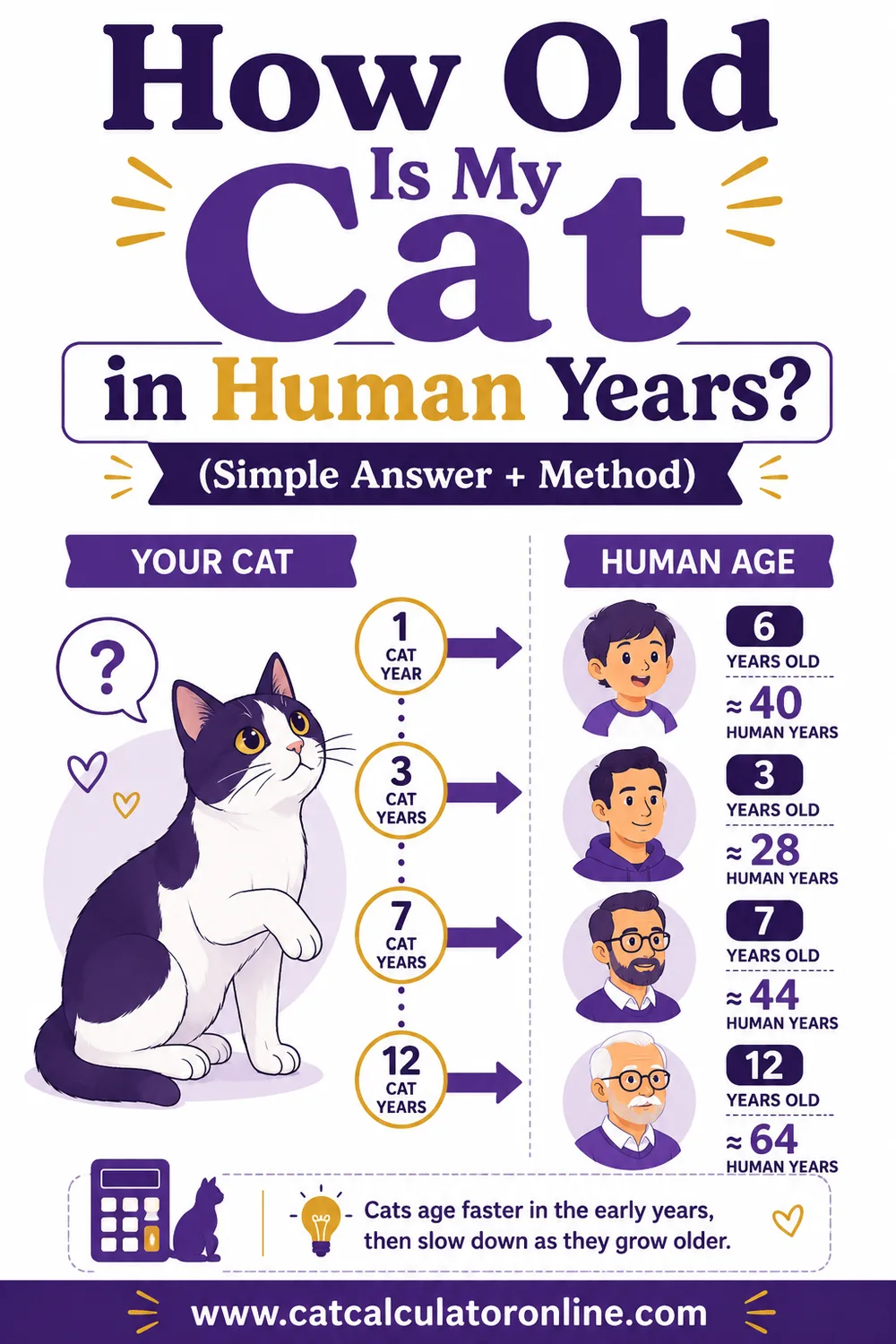
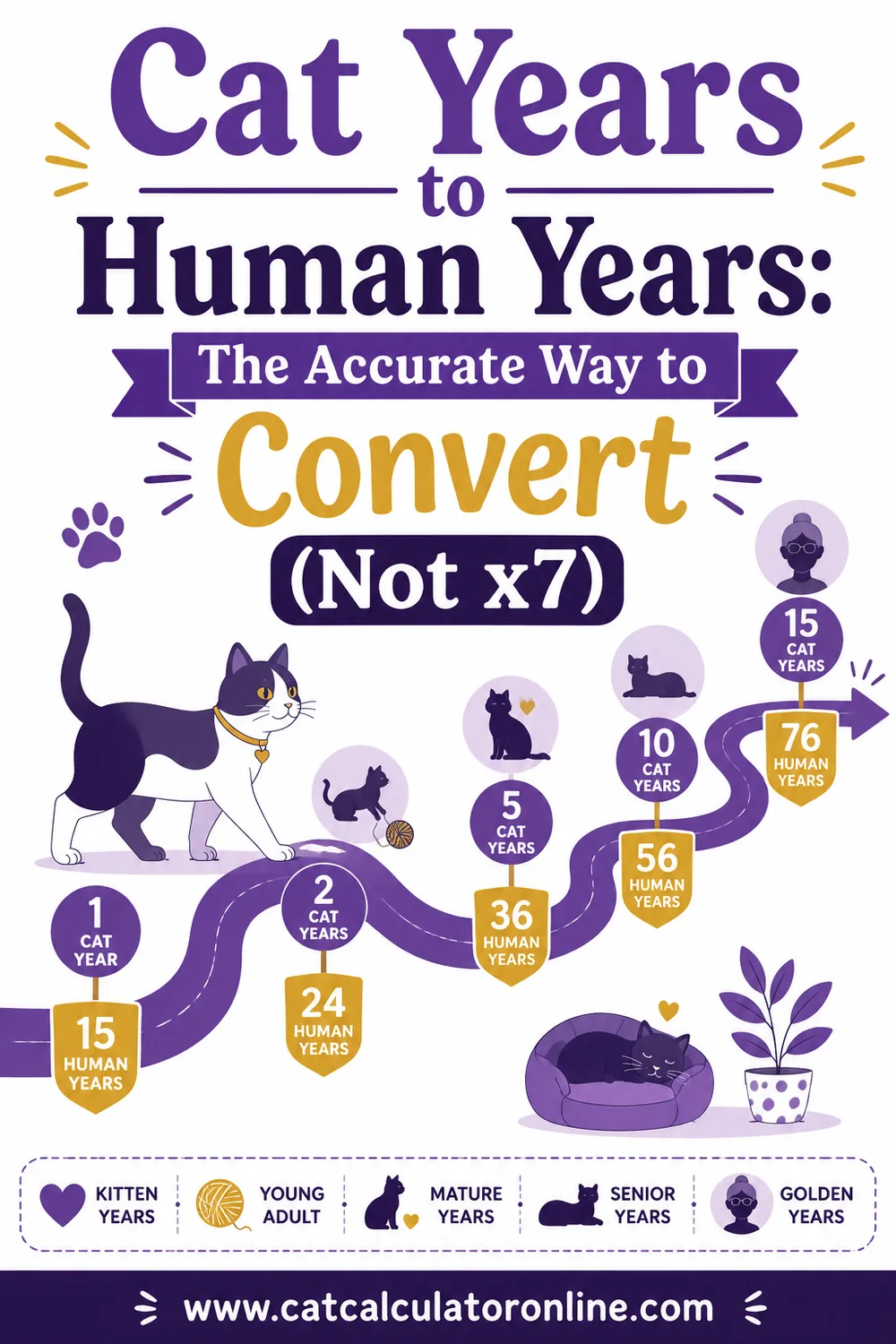
One cat year does not equal seven human years. The method vets actually use says a cat's first year is worth about 15 human years, the second year adds about 9 more, and every year after that adds roughly 4. So a 2-year-old cat is about 24 in human years, and a 10-year-old cat is about 56 — not 70.
If you just want the answer for your own cat, our free cat age calculator does the math in about two seconds. If you want to understand why the old times-seven rule is wrong and see the full conversion chart, keep reading — it's genuinely useful for knowing when your cat becomes a senior and what kind of care she needs.
🐾 Quick converter: cat years → human years
Tap your cat's age to see the human-year equivalent:
Tap an age above to see the human-year equivalent.
Where the 7-Year Myth Came From
The "multiply by seven" rule has floated around for decades, and nobody can point to who started it. The usual guess is simple back-of-the-napkin math: people lived to about 70, pets lived to about 10, so someone divided one by the other and a rule of thumb was born.
It's easy to remember, which is exactly why it stuck. But it falls apart the moment you look closely:
- A 1-year-old cat can already have kittens. A 7-year-old human obviously can't. Cats reach sexual maturity as early as four to six months old — they race through the equivalent of human childhood and adolescence in their first year.
- Aging isn't a straight line. Cats grow up fast, then their aging slows down relative to ours. The 7:1 rule pretends every year is identical, and it just isn't.
- The numbers don't add up at the end, either. By the times-seven rule, a 20-year-old cat would be 140 — a number no human has ever reached. Plenty of cats reach 20. So the rule breaks at both ends of a cat's life.
Veterinary groups moved on from times-seven long ago. The modern standard comes from the American Animal Hospital Association (AAHA) and its feline life-stage guidelines, backed by resources like the Cornell Feline Health Center. Here's what they use instead.
The Method Vets Actually Use
The widely accepted guideline is simple enough to do in your head:
- Year one ≈ 15 human years. A kitten goes from newborn to a fully independent young adult in twelve months.
- Year two adds about 9 more. So a 2-year-old cat lands at about 24 in human years.
- Every year after that adds about 4 human years. Three years is roughly 28, four is 32, five is 36, and so on.
That's the whole system. Let's run it for a 6-year-old cat: 15 + 9 = 24 for the first two years, then four more years at +4 each = 16 more. Total: about 40 human years. A cat in her prime, in other words — right around human middle age.
Worked examples
- 3-year-old cat: 15 + 9 + 4 = 28 human years
- 7-year-old cat: 15 + 9 + (5 × 4) = 44 human years
- 10-year-old cat: 15 + 9 + (8 × 4) = 56 human years
- 15-year-old cat: 15 + 9 + (13 × 4) = 76 human years
You don't have to memorize any of this. Our cat age calculator applies the formula automatically — just enter your cat's age and it returns the human-year equivalent plus the matching life stage.
The One Big Difference From Dogs: Cats Age Uniformly
If you've ever converted a dog's age, you know it depends heavily on size — a Great Dane ages far faster than a Chihuahua, and the multiplier changes with weight class. Cats are different.
A cat's size and breed barely change the aging math. A dainty 6-pound cat and a big 15-pound cat follow essentially the same curve. There's no "giant breed ages faster" rule the way there is for dogs, so the conversion above works for practically every house cat.
There are gentle exceptions worth knowing:
- Large slow-maturing breeds like the Maine Coon keep physically growing until three or four years old. That's about how long they take to reach full size — it doesn't change how their years convert to human years.
- Breed lifespan varies a little. Some breeds tend to live longer on average, but that shifts the odds of reaching 18 or 20, not the year-by-year conversion.
The practical upshot: with cats you can trust one clean formula. That's part of why the chart below works for nearly any cat you'll meet.
The Full Cat-Years-to-Human-Years Chart
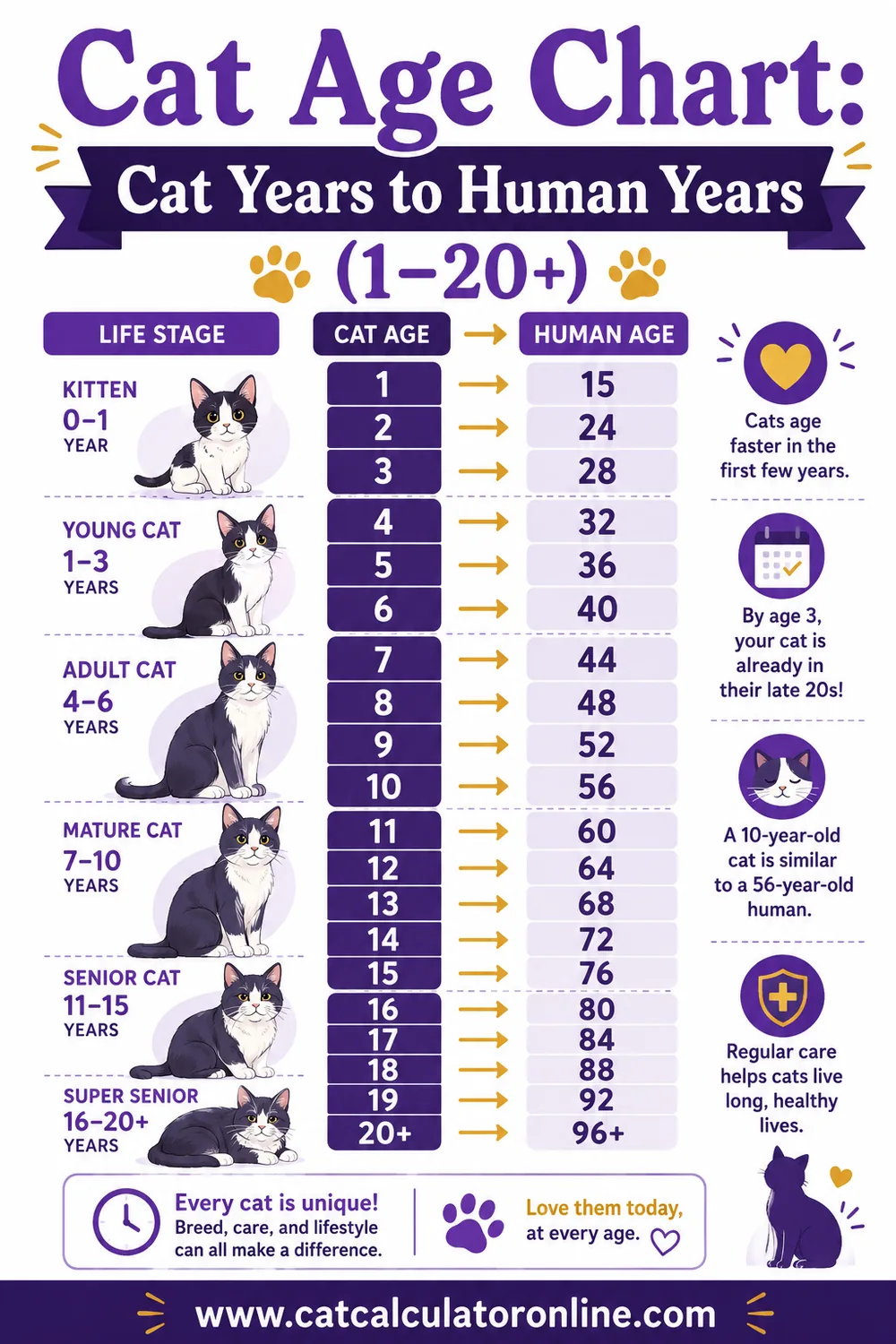
Here's the complete conversion, ages 1 through 20, with the AAHA life stage for each. This single table answers most of the questions people have about their cat's age.
| Cat's age | Human years | Life stage |
|---|---|---|
| 1 | 15 | Kitten → young adult |
| 2 | 24 | Young adult |
| 3 | 28 | Young adult |
| 4 | 32 | Young adult |
| 5 | 36 | Young adult |
| 6 | 40 | Young adult |
| 7 | 44 | Mature adult |
| 8 | 48 | Mature adult |
| 9 | 52 | Mature adult |
| 10 | 56 | Senior |
| 11 | 60 | Senior |
| 12 | 64 | Senior |
| 13 | 68 | Senior |
| 14 | 72 | Senior |
| 15 | 76 | Senior (geriatric) |
| 16 | 80 | Senior (geriatric) |
| 17 | 84 | Senior (geriatric) |
| 18 | 88 | Senior (geriatric) |
| 19 | 92 | Senior (geriatric) |
| 20 | 96 | Senior (geriatric) |
Want this laid out with even more detail? Our cat age chart breaks down each row further, and the cat life stages explained guide walks through what actually changes at each phase.
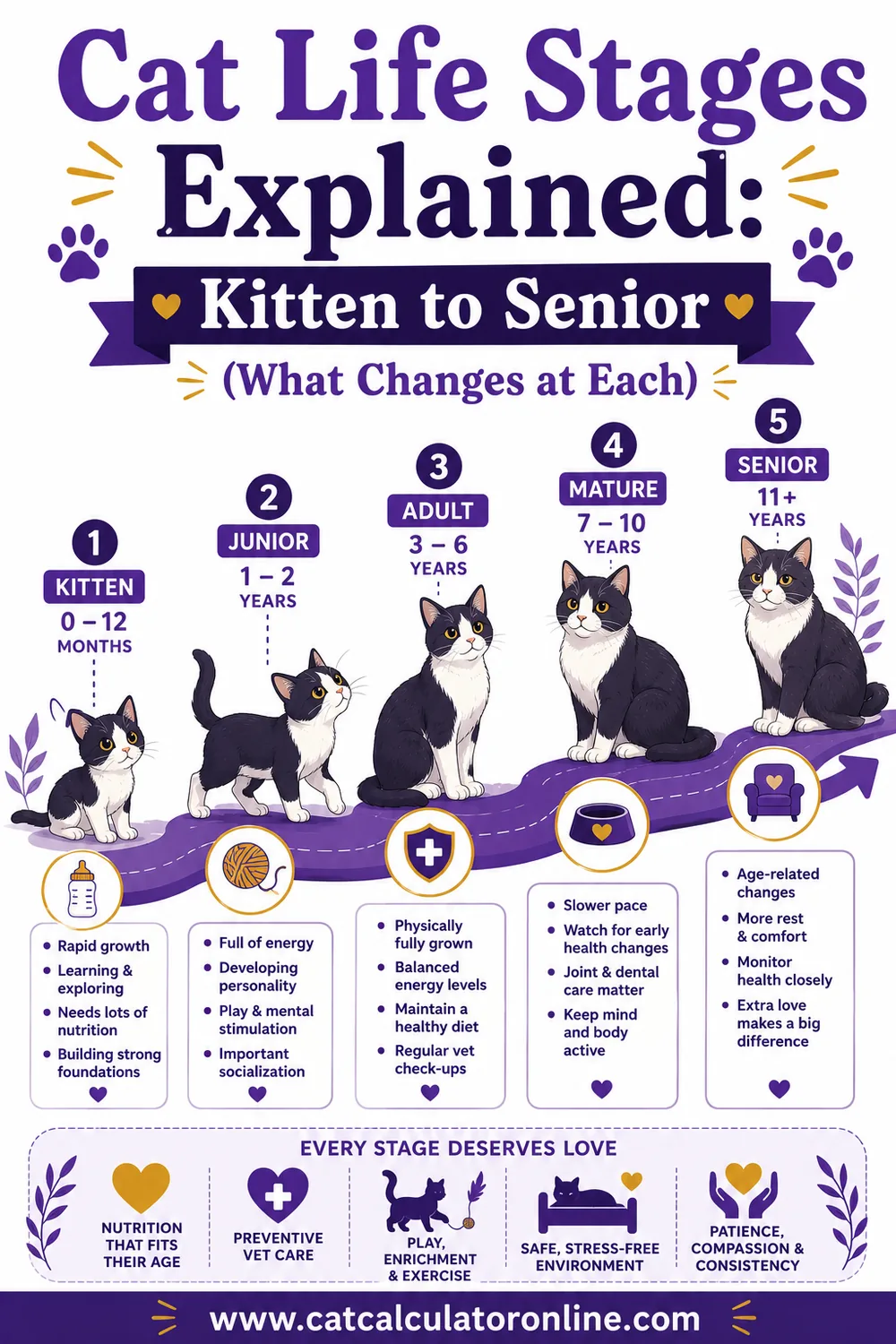
What Each Life Stage Actually Means
A human-age number is a fun headline, but what most owners really want to know is what stage of life is my cat in? The AAHA guidelines group a cat's life into four stages, and each one comes with different care priorities.
Kitten (0–1 year)
Everything happens fast. Eyes open around 7 to 10 days, kittens wean around 8 weeks, and they hit sexual maturity as early as 4 to 6 months (which is why spaying and neutering usually happens young). Expect explosive energy, rapid growth, and a kitten-specific diet.
Young adult (1–6 years)
This is the long, healthy prime of a cat's life — human equivalent of roughly 24 to 40. Your cat is fully grown, settled into her personality, and generally low-maintenance. Annual vet checkups, steady weight, and good dental care keep this stretch smooth.
Mature adult (7–10 years)
The human equivalent of the mid-40s to mid-50s. Cats often start slowing down a touch and can begin putting on weight. This is the stage to watch portions and start paying closer attention to subtle changes — many owners don't realize their cat has crossed into "middle age."
Senior (10+ years)
At 10 human-equivalent years of roughly 56 and up, cats are officially seniors. Vets typically recommend twice-yearly checkups and bloodwork to catch age-related issues like kidney disease, thyroid problems, and arthritis early. Learn more in when is a cat considered senior.
Why the Human-Age Number Is Actually Useful
Converting cat years to human years isn't just a party trick. The number does real work:
- It tells you when to change care. A cat at the human equivalent of 56 benefits from senior screenings, just like a 56-year-old person benefits from more regular checkups.
- It sets realistic expectations. Knowing your 12-year-old cat is roughly 64 in human years helps you understand why she sleeps more and plays less — that's normal, not necessarily a problem.
- It reframes "old." Lots of owners panic when their cat turns 10, thinking she's ancient. At about 56 human years, she's a healthy middle-aged adult with potentially a decade of good life ahead.
The number is a planning tool. It helps you meet your cat where she actually is.
What the Number Can't Tell You
A human-age figure is helpful shorthand, but it has limits worth naming honestly:
- It's an average, not a diagnosis. Two 10-year-old cats can be in very different health depending on genetics, weight, diet, and whether they live indoors.
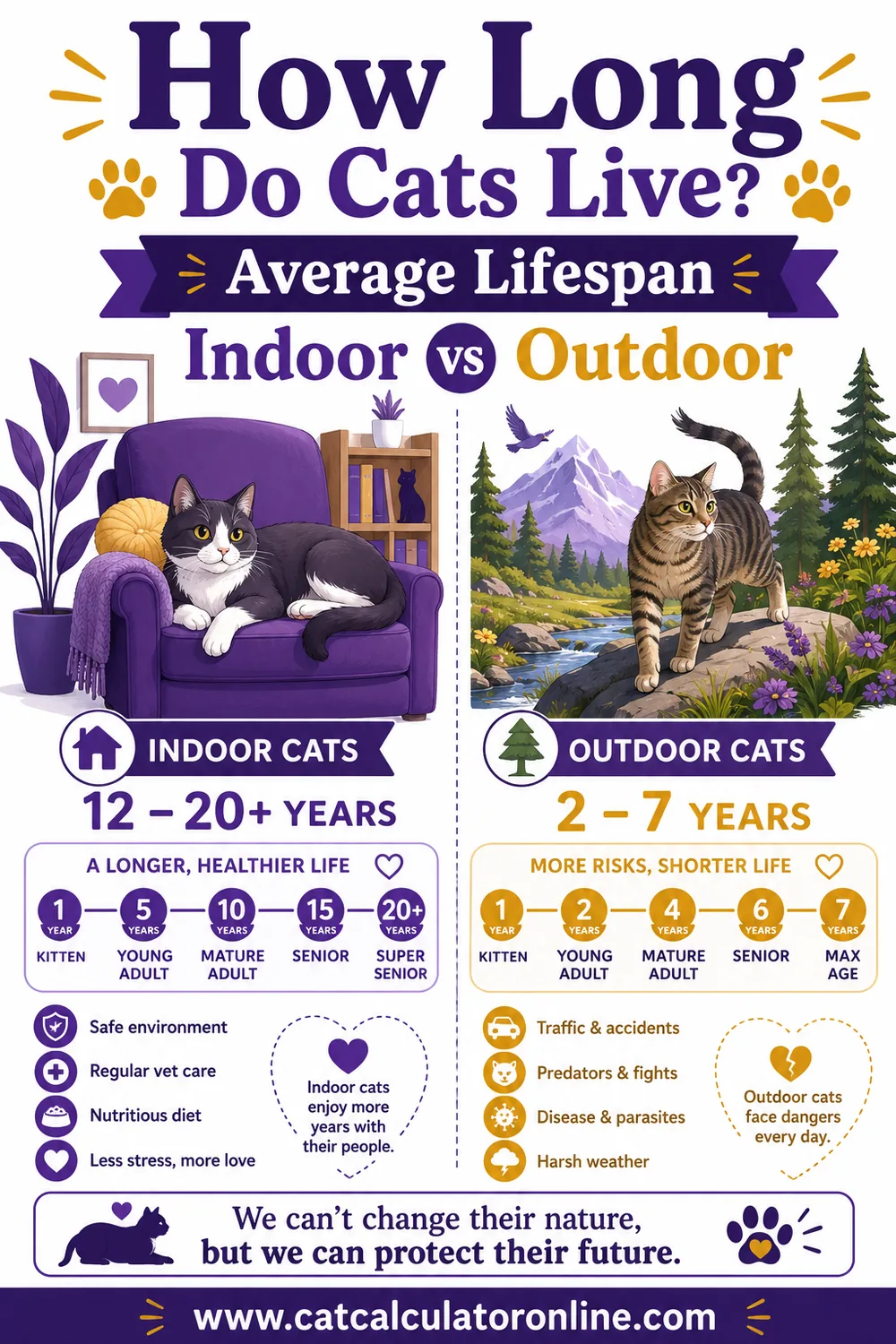
- Indoor vs. outdoor changes the real picture. Indoor cats commonly reach 13 to 17 years and beyond, while outdoor cats average just 2 to 5. The conversion math is the same, but life expectancy is worlds apart. See how long do cats live for the full comparison.
- It doesn't replace your vet. The number sets expectations; your vet reads the actual cat in front of you.
Use the conversion to time your care decisions, then let your veterinarian handle the specifics.
How to Help Your Cat Age Well
Knowing your cat's human age is more useful when it nudges you toward good habits. A few evidence-backed levers make a real difference:
- Keep her at a healthy weight. Obesity is one of the most common — and most preventable — problems in cats, and it shortens lives. If you can't easily feel her ribs, talk to your vet about portions. Our how much should I feed my cat guide gives sensible ranges.
- Don't skip dental care. Dental disease is widespread in adult cats and can affect the kidneys and heart over time.
- Keep her indoors (or supervise outdoor time). This is the single biggest lever on lifespan.
- Schedule regular checkups. Once a year for young adults, twice a year once she's a senior. Early detection is everything with feline kidney and thyroid disease.
None of this changes the math — but it can change how many good years your cat gets.
FAQ
Is one cat year really seven human years?
No, that's a myth. A cat's first year is worth about 15 human years, the second adds about 9 more (so a 2-year-old is around 24), and every year after that adds roughly 4. A single multiplier can't capture that curve.
How do I calculate my cat's age in human years?
Use 15 for the first year, add 9 for the second year, then add 4 for each additional year. Or just enter your cat's age into our free cat age calculator and skip the math entirely.
Do big cats age faster than small cats?
Not really. Unlike dogs, cats age at nearly the same rate regardless of size or breed. Large breeds like the Maine Coon take longer to reach full physical size, but the year-to-human-year conversion stays the same.
At what age is a cat considered a senior?
Around 10 years old — roughly 56 in human years. Vets usually recommend more frequent checkups and bloodwork starting at this stage.
How old is the oldest cat ever?
The verified record holder is Creme Puff, who lived to 38 years. That's extraordinary — most cats live 13 to 17 years, with many indoor cats reaching 20.
Why does my 15-year-old cat seem so healthy if she's "76"?
Because the human-age number is an average, not a verdict. Indoor cats with good care routinely stay active well into their late teens. The number sets expectations; your cat's actual health depends on genetics, weight, and care.
The Bottom Line
Forget times-seven. A cat's first year is worth about 15 human years, the second adds about 9 more, and each year after that adds roughly 4 — and unlike dogs, cats age at nearly the same rate no matter their size. That gives you one clean formula you can trust for practically any cat.
Want the exact number without doing the arithmetic? Our free cat age calculator converts your cat's age to human years and shows her life stage in one tap. You can also explore the full cat age chart or find out how old your cat is in human years if you're not sure of her exact birthday.