How to Tell If a Cat Is in Pain
Start with the warning, because it is the only thing on this page that kills cats every year. Never give a cat human painkillers. Paracetamol (acetaminophen) is lethal to cats — a single standard tablet can kill one — and ibuprofen is highly toxic. Beyond that, the difficulty is that cats conceal pain as a survival behavior, so the signs are subtractive rather than dramatic: things she stops doing rather than anything she starts. A cat in real pain often looks like a cat that has simply gone quiet. This page covers what to look for, how to score her face using a validated tool, and when to ring. Her life stage shapes what is likely, and the free cat age calculator will tell you which one she is in.
Why Cats Hide Pain So Well
Understanding the reason makes the signs much easier to spot.
A visibly suffering small predator is a target. Cats are both hunter and prey, and an animal that limps, cries or lies exposed advertises itself. Concealing weakness is hard-wired, and domestication has not removed it.
They are also solitary by ancestry. Dogs evolved in groups where signalling distress brings help. A solitary hunter gets nothing from advertising injury, so the behavior never developed.
Which means silence tells you nothing. A cat that is not crying, limping obviously, or objecting when handled may still be in significant pain. Absence of complaint is not absence of pain.
Chronic pain hides best of all. Sudden pain sometimes produces an obvious reaction. Slowly worsening pain — arthritis, dental disease, kidney-related discomfort — is absorbed into a gradual change in habits that looks like "getting older".
Owners are the only people who can spot it. A vet sees your cat for ten minutes in a frightening room, where she will freeze and mask everything. What you notice at home over weeks is genuinely better data, and it is worth writing down.
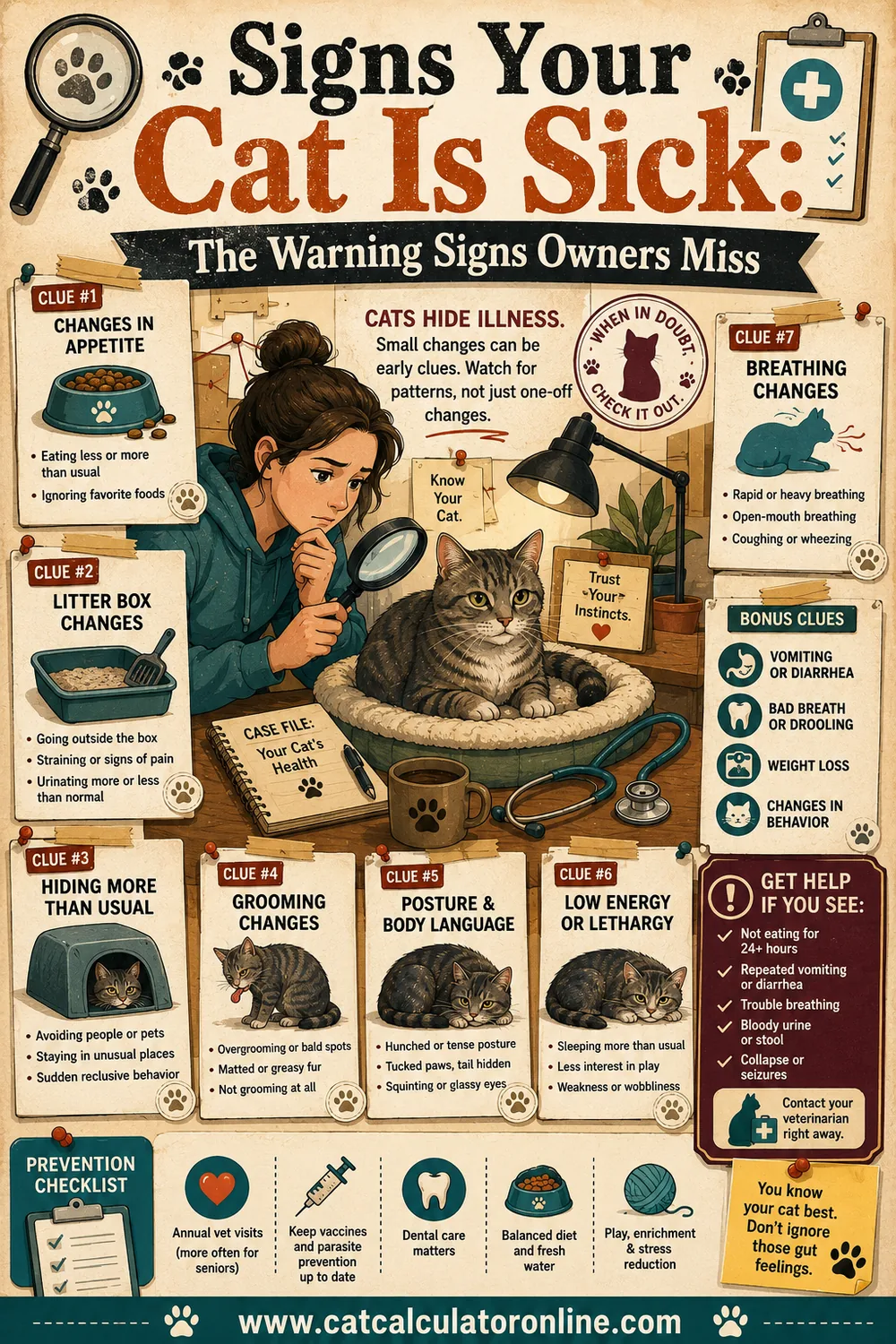
The general illness picture overlaps heavily with pain — signs your cat is sick covers the wider set of changes worth watching for.
The Signs Are Subtractive, Not Dramatic
This is the mental shift that helps most: look for what has stopped.
She has stopped jumping onto the windowsill. Or takes two hops via the chair instead of going straight up. Reduced jump height is one of the most reliable early indicators of joint pain.
She has stopped greeting you at the door. Reduced interaction, less rubbing, less following you around.
She has stopped grooming properly. A coat that has gone dull, greasy, scurfy or matted, particularly along the back and over the hips where she has to twist.
She has stopped sleeping in her usual place. A move to the floor, or to a hiding place, often means getting up to the old spot has become uncomfortable.
She has stopped finishing meals. Eating half, walking away, coming back. Frequently dental pain, and frequently missed.
She has stopped using the scratching post. Scratching requires stretching and gripping, and cats with painful paws, elbows or shoulders quietly give it up.
What she may have started instead is hiding, sitting hunched, sleeping more, sitting with her back to the room, or becoming grumpy when touched in one particular place.
Using the Feline Grimace Scale at Home
This is the single most useful thing an owner can learn, because it is a validated tool designed for exactly this problem.
What it is. The Feline Grimace Scale was developed and validated by researchers at the Université de Montréal to assess acute pain in cats from facial expression alone. It is used in veterinary practice, it is free, and the training materials are publicly available.
How it works. You score five facial features — called action units — from 0 to 2, where 0 is absent, 1 is moderate or uncertain, and 2 is obviously present. The five add up to a score out of 10.
| Action unit | 0 — no pain | 2 — pain present |
|---|---|---|
| Ear position | Facing forward, upright, apart | Rotated outwards and flattened, pulled apart |
| Orbital tightening | Eyes open and round | Eyes squinted or half closed, lids tightened |
| Muzzle tension | Round and relaxed | Tense, flattened, elliptical or oval shaped |
| Whisker position | Relaxed, curved, hanging loosely | Straightened and pushed forward, away from the face |
| Head position | Above the shoulder line | Level with or below the shoulder line |
The threshold that matters. A total of 4 or more out of 10 is the commonly cited cut-off at which pain relief is considered warranted. That is a prompt to call your vet, not a license to treat at home.
Score her when she is settled and unobserved. Watch from a distance, or film her on your phone for a minute. A cat that knows she is being stared at changes her expression, and a frightened cat squints in a way that is not pain.
Compare against her own normal. Take a photo of her relaxed face on a good day. Some cats — flat-faced breeds especially — sit at a different baseline, and the comparison is what makes the score meaningful.
It was validated for acute pain, so it works best for sudden problems. It is less reliable for slow-burning chronic pain, where behavior change over weeks is the better guide.
Grooming: Too Little, or Too Much in One Place
Coat condition is a surprisingly precise pain map.
A neglected coat means she has stopped. Grooming takes flexibility. Cats with spinal, hip or elbow pain lose the ability to reach the middle of the back, the base of the tail and the hindquarters — exactly where matting appears first.
Matting over the hips is close to diagnostic of hind-limb or back pain in an older cat that used to be immaculate.
Over-grooming is the mirror image. A cat that licks one area bald is often telling you that something under that spot hurts. Bald patches over a hip, along the flank, or on the belly warrant investigation rather than a spray.
Belly over-grooming is strongly linked to bladder and urinary pain, which is why it should never be dismissed as a behavioral habit without a urine test first.
Dandruff along the spine in a cat that never had it is a common early arthritis sign, for the same reach-related reason.
Check by running your hands over her weekly. You are feeling for mats, new lumps, flinching, and areas she pulls away from. Doing it routinely means you notice change rather than absolute state.
Movement, Posture and the Arthritis Problem
Most chronic pain in cats is joint pain, and most of it goes untreated.
Arthritis is far commoner than owners think. Radiographic studies have found degenerative joint disease in the large majority of cats over about twelve years old, and in a substantial share of middle-aged cats. Very few of those cats limp.
Cats rarely limp with arthritis because it is usually symmetrical — both hips, both elbows — so there is no good leg to favor. They simply do less.
Watch the jump, not the walk. Hesitation before jumping, jumping up but not down, using furniture as a staircase, or refusing a height she used to manage easily.
Watch the stairs. Bunny-hopping both back legs together, or pausing halfway.
Watch the sitting posture. A hunched posture with the head low, the back arched and the paws tucked tightly under the body is a classic pain posture, particularly for abdominal pain.
Watch the tray height too. A cat that starts going next to a high-sided tray may not be able to climb into it comfortably any more.
Treatment exists and works. Arthritis in cats covers the current options, including the monoclonal antibody injections that have changed feline arthritis management considerably. This is not something to accept as ageing.
Eating, Drinking and Litter Tray Changes
Three habits worth tracking, because changes in them are measurable rather than subjective.
Reduced appetite is one of the earliest signs of pain anywhere. Half-finished meals, slower eating, or a preference for soft food over biscuits.
Dropping food, chewing on one side, or pawing at the mouth points at the teeth. Dental pain in cats is severe, extremely common, and almost entirely silent — dental disease in cats covers what to look for.
Never respond by withholding food. A cat that stops eating is at risk of hepatic lipidosis, a serious liver condition that can develop within a few days of poor intake. Reduced appetite is a reason to call the vet, never a reason to fast her.
Missing the tray can mean it hurts to get in, or that urination itself hurts. Both are worth investigating.
Straining in the tray and producing little or nothing is an emergency. Urinary obstruction is life-threatening within hours and is intensely painful — see urinary blockage in cats and go to a vet or out-of-hours clinic immediately.
Crying while using the tray, or blood in the urine, both warrant a same-day call.
Myths That Stop Owners Acting
Four beliefs that delay treatment, and what is actually true.
"She is purring, so she is fine." She may not be. Cats purr when content, but they also purr when frightened, injured, giving birth and dying. Purring appears to be partly self-soothing. It is never evidence that a cat is comfortable, and it is probably the single most misleading signal in cat ownership.
"She would cry if it hurt." Most cats in chronic pain make no noise whatsoever. Vocalisation is more common with sudden severe pain, and even then far from universal.
"She is just getting old." Slowing down is not a diagnosis. Most of what owners attribute to age in a ten to fifteen-year-old cat is treatable pain — signs your cat is getting old separates genuine ageing from the things worth treating.
"She let me pick her up, so nothing hurts." Cats tolerate a great deal rather than object. Freezing when handled is a pain response too, not a sign of comfort.
"She is eating, so she cannot be in pain." Cats with severe dental disease often eat well, because the alternative is starving.
"She would stop using the injured leg." Frequently not, especially when both sides are affected equally.
Never Give Human Painkillers
This is the most important paragraph on the page, and it is not a matter of dosing carefully.
Paracetamol (acetaminophen) is lethal to cats. They lack the liver enzyme pathway needed to process it. It damages red blood cells so they can no longer carry oxygen, and it destroys liver tissue. A single 500mg tablet can kill an average cat. Signs include swelling of the face and paws, brown or muddy gums, labored breathing, and vomiting, typically within a few hours.
If your cat has swallowed any paracetamol, treat it as an emergency now. There is an antidote, and it works far better given early. Do not wait for signs.
Ibuprofen is highly toxic too, causing stomach ulceration, bleeding and kidney failure at doses far below a human tablet. Aspirin is toxic at normal frequencies because cats clear it extremely slowly. Naproxen is dangerous in tiny amounts.
Do not give a dog's medication either. Several canine anti-inflammatories are unsafe in cats, and dosing is completely different.
Do not give leftover medicine from a previous illness without asking. Doses change with weight, kidney function and what else the cat is on.
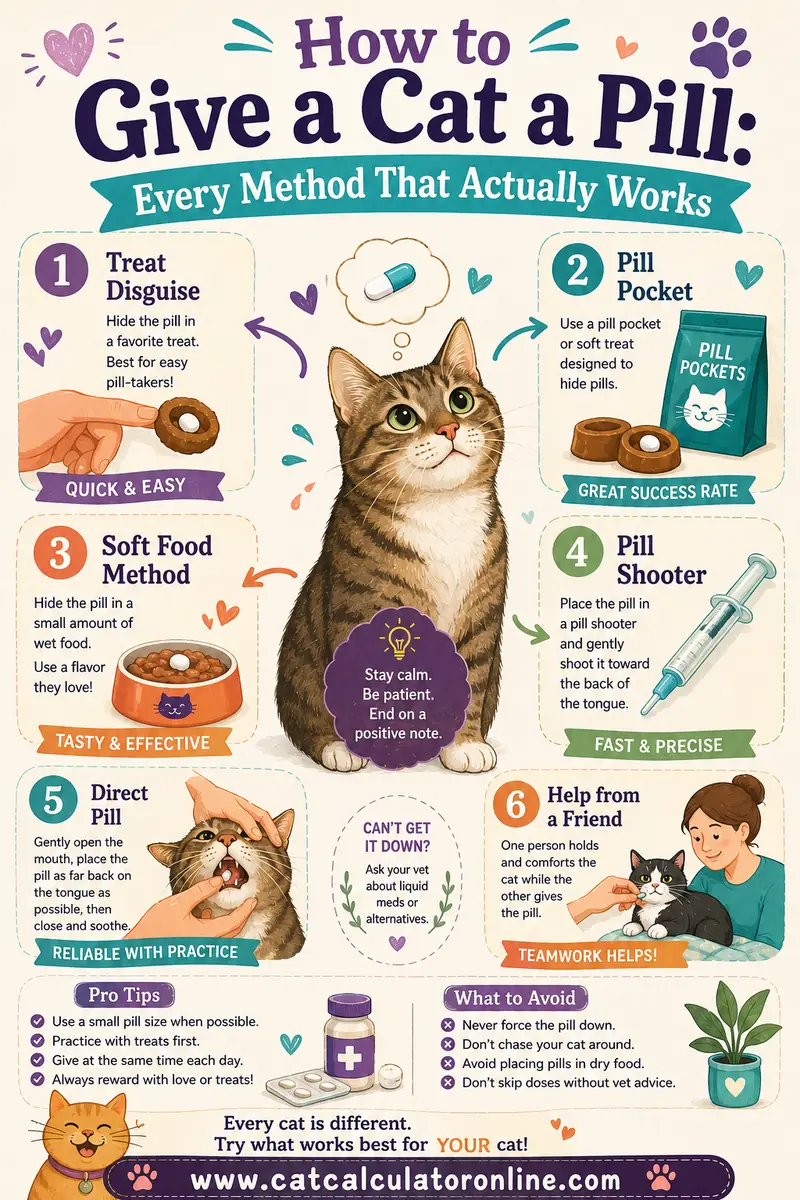
Safe, effective feline pain relief exists — licensed anti-inflammatories, opioids, gabapentin, and the anti-nerve-growth-factor injections used for arthritis. They require a prescription because the dose is small, cat-specific and dependent on kidney and liver function. If administering them is the sticking point, how to give a cat a pill covers the practical technique.
What to Do Now, and When to Ring
A practical sequence rather than a diagnosis.
Write down what has changed and when. Specific and dated beats vague. "Stopped jumping onto the bed three weeks ago, now eating about half her food."
Film her. A thirty-second video of her walking, jumping or sitting hunched is worth more to a vet than any description, because she will not do it in the consulting room.
Score her face. Use the grimace scale above, on a settled cat, and note the number.
Do not medicate, massage a painful area, or apply heat to something you have not had examined.
Keep her eating. Warm the food, offer something stronger-smelling, hand-feed if needed. Never fast a cat.
Ring the same day for: reduced appetite lasting more than about 24 hours, a grimace score of 4 or more, new hiding, crying on handling, over-grooming one spot, or a limp.
Go immediately for: straining in the tray with nothing produced, labored or open-mouthed breathing, collapse, a distended painful abdomen, sudden inability to use the back legs, or any suspected poisoning.
Book a check even if you are unsure. Cats over seven benefit from at least annual examination and seniors from six-monthly, which is when most of this gets found — see how often a cat should go to the vet.
Frequently Asked Questions
What are the first signs a cat is in pain?
Usually things she stops doing: jumping to her usual spots, grooming properly, greeting you, finishing meals, or using the scratching post. Hiding and a hunched posture with the head low are also early. Obvious limping and crying are late signs, not first ones.
Does purring mean my cat is not in pain?
No. Cats purr when content, but also when frightened, injured, in labor and dying — it appears to be partly self-soothing. Purring should never be used to rule pain out, and a purring cat with other pain signs still needs examining.
Can I use the Feline Grimace Scale myself?
Yes. Score ear position, orbital tightening, muzzle tension, whisker position and head position from 0 to 2 each, watching a settled, unobserved cat. Four or more out of ten suggests pain relief is warranted, which means ringing your vet rather than treating at home.
What painkillers can I give my cat at home?
None without a prescription. Paracetamol is lethal to cats and ibuprofen and aspirin are highly toxic, with no safe home dose. Licensed feline pain relief exists and works well, but it must be dosed by a vet against your cat's weight and kidney function.
How can I tell if my cat has arthritis?
Look for reduced jump height, using furniture as steps, bunny-hopping stairs, matted fur over the hips, sleeping lower down, and going beside a high-sided litter tray. Most arthritic cats do not limp, because both sides are usually affected equally.
When should I take a cat in pain to the vet?
Same day for reduced appetite beyond about 24 hours, new hiding, a grimace score of four or more, over-grooming one area, or limping. Immediately for straining in the tray with nothing produced, labored breathing, collapse, or suspected poisoning.
Pain in cats is quiet by design, so recognizing it means noticing what has stopped rather than waiting for something dramatic. Reduced jumping, a coat that has gone unkempt or one bald patch, hiding, a hunched posture, half-eaten meals and changed tray habits are the practical signals, and the Feline Grimace Scale gives you a number to take to your vet — four or more out of ten warrants a call. Purring proves nothing. And the rule that never bends: no paracetamol, no ibuprofen, no aspirin, no dog medicine, ever. Check her life stage with the free cat age calculator and take the notes with you.