Cat Vet Costs Explained
A healthy adult cat costs roughly $200 to $400 a year in routine veterinary care — an annual examination, vaccine boosters and parasite prevention. The bills that actually worry people are the other kind: dental work at $800–$2,000, a urinary blockage at $1,500–$3,000, a swallowed foreign body at $2,000–$4,000, and a cancer course that can pass $10,000. Routine care is predictable and budgetable; the rest is why cat owners need either insurance or a genuine reserve. The cat cost calculator helps you place both sides into one yearly picture.

What Does Routine Cat Vet Care Cost?
For a healthy adult cat with nothing wrong:
| Service | Typical US cost |
|---|---|
| Annual examination | $60–$90 |
| Core vaccine boosters | $50–$100 |
| Rabies vaccine | $20–$40 |
| Flea and worm treatment (year) | $80–$150 |
| Wellness bloodwork (senior) | $80–$200 |
| Microchipping (one-off) | $25–$80 |
| Neutering / spaying (one-off) | $50–$500 |
| Routine dental cleaning | $150–$400 |
That comes to roughly $200–$400 a year for ordinary preventive care, or $250–$600 once senior screening and periodic dental cleaning are included.
Two things worth understanding about how clinics bill.
The examination fee is separate from everything else. Paying $75 for a consultation buys the vet's time and assessment. Bloodwork, imaging, medication and procedures are all itemised on top. A visit that produces a diagnosis and treatment routinely lands between $200 and $500 even for something straightforward.
Prices vary enormously by location. The same procedure can differ by 50% or more between a rural practice and a big-city clinic, because premises, staffing and equipment costs differ. Regional variation is the single largest reason published averages may not match your invoice.
Why Is Dental Work So Expensive?
Because it's surgery, not cleaning — and cats need it more than most owners expect.
Feline dental disease is extremely common. Tooth resorption, where the tooth structure breaks down from within, affects a large share of adult cats and is genuinely painful. Periodontal disease is near-universal in cats past middle age without preventive care.
Treatment requires general anaesthesia, because you cannot examine, X-ray and extract teeth in a conscious cat. That's what drives the cost:
- Pre-anaesthetic bloodwork to check the cat is safe to anaesthetise
- Anaesthesia and monitoring by trained staff
- Dental radiographs, since most resorption sits below the gumline and is invisible otherwise
- The extractions themselves, which can be surgically difficult
- Pain relief, antibiotics and follow-up
A straightforward cleaning with one or two extractions runs $800–$1,200. Multiple extractions, or full-mouth extraction for severe stomatitis, can reach $2,000–$3,000.
Two practical points. Anaesthesia-free dental cleaning is not equivalent — it addresses visible tartar without allowing the below-the-gumline examination where the real disease is. And many insurers require evidence of routine dental checks before paying a dental claim, so skipping the annual look can cost you the cover.
What Do Emergencies Cost?
This is the category that changes people's finances, and the figures are worth knowing before you meet them.
| Emergency | Typical cost |
|---|---|
| Urinary blockage (male cat) | $1,500–$3,000 |
| Foreign body / intestinal obstruction | $2,000–$4,000 |
| Road traffic injury | $1,500–$5,000 |
| Fracture repair | $1,500–$4,000 |
| Poisoning / toxin ingestion | $500–$2,500 |
| Emergency consultation alone | $100–$200 |
| Overnight hospitalisation | $400–$1,000 per night |
Three feline specifics stand out.
Urinary blockage is disproportionately common in male cats and is a true emergency — a blocked cat can die within a day or two untreated. It also recurs in a meaningful proportion of cases, sometimes leading to surgery.
Linear foreign bodies — string, ribbon, tinsel, dental floss — are the classic feline surgical emergency, and they're most common in young cats. This is the single most likely large bill in a kitten's first two years.
Out-of-hours pricing typically runs 1.5–2× daytime rates. The same treatment at 2am on a Sunday costs substantially more than on a Tuesday morning, which is worth knowing when deciding whether something can safely wait for your regular vet.
Emergency clinics almost always require payment at discharge, and insurance reimburses afterward. Being insured doesn't remove the need for available credit on the night.
What Do Common Illnesses Cost to Manage?
Most feline conditions aren't single events — they're diagnosed once and then managed for years. That's the pattern that makes cat costs different from dog costs.
Chronic kidney disease, the most common serious diagnosis in older cats: $1,000–$3,000 a year in bloodwork, prescription diet, medication and fluid therapy, continuing for the rest of the cat's life.
Hyperthyroidism, very common past ten: $500–$2,500. Daily medication is the cheapest route; radioactive iodine therapy costs more upfront but is usually curative.
Diabetes: $1,000–$2,500 a year for insulin, monitoring equipment and the frequent rechecks needed to stabilize a diabetic cat.
Cancer: diagnosis alone runs $500–$1,500, and a full treatment course for lymphoma — the most common feline cancer — commonly reaches $4,000–$10,000+.
Hypertrophic cardiomyopathy: $500–$2,000 a year in monitoring and medication, for life. Diagnosis needs an echocardiogram, usually at a referral center, which alone runs $400–$800.
Inflammatory bowel disease: $600–$2,000 a year once diagnosed, though reaching the diagnosis often costs more than managing it, since it typically requires ruling out several other conditions first.
The recurring theme is that these are annual figures, not one-offs. A cat diagnosed with kidney disease at eleven and living to sixteen generates five years of management — which is why annual limits and lifetime-versus-twelve-month cover matter more than the headline insurance premium.
Why Do Vet Costs Keep Rising?
Veterinary costs have risen faster than general inflation for years, and the reasons are mostly unglamorous.
Better medicine costs more. Feline medicine now offers ultrasound, MRI, chemotherapy, specialist surgery and advanced anaesthetic monitoring. Treatments that simply didn't exist twenty years ago are now standard options — and options have prices.
Staffing. There's a well-documented shortage of veterinarians and veterinary nurses in many regions, which pushes wages up. Staff costs are the largest line in most practices.
Equipment and premises. Diagnostic machines, in-house laboratories and modern surgical facilities represent substantial capital investment amortised across every client.
Consolidation. Corporate ownership of veterinary practices has grown considerably, and pricing has generally moved upward alongside it.
None of this is fraud or gouging, but it does mean your cat's care will likely cost more each year in real terms. That matters when budgeting a sixteen-year commitment: a figure that looks comfortable today will be higher by the time your cat is a senior, quite apart from the age-related increase in what it needs.
What Does a Vet Bill Actually Consist Of?
Invoices surprise people less once you can read them, and understanding the line items makes it far easier to have a sensible conversation about cost.
A typical bill for an unwell cat breaks down roughly like this:
The consultation fee ($60–$90). The vet's time, examination and clinical judgement. Charged whether or not anything is found.
Diagnostics. This is where costs escalate, and each is priced separately: blood chemistry and haematology ($90–$200), urinalysis ($40–$90), radiographs ($150–$350), ultrasound ($300–$600), and biopsies or specialist lab work ($150–$500). A thorough workup for a vague problem such as weight loss can reach $500 before treatment begins.
Procedures and anaesthesia. Sedation ($80–$200), general anaesthesia ($200–$500 depending on length), theater time and surgical materials.
Hospitalisation. $400–$1,000 per night, covering intravenous fluids, monitoring, nursing and medication.
Medication. Both what's given in the clinic and what goes home with you.
Two things follow from this structure. First, the diagnostic phase often costs as much as the treatment, which is why a bill can be large even when the outcome is reassuring — you're paying to rule things out. Second, you can ask for a staged approach. It's entirely reasonable to ask "what would you do first, and what can wait for the results of that?" Most vets will happily work through diagnostics in stages rather than running everything at once.
Asking for a written estimate before proceeding is normal, expected, and not remotely rude. Practices produce them constantly.
How Do Costs Differ by Where You Go?
The same treatment can vary by 50% or more depending on the type of practice, and knowing the landscape helps you match the setting to the need.
Your regular general practice handles routine care, most illnesses and straightforward surgery. Mid-range pricing, and the practice knows your cat's history — which has real value when something ambiguous appears.
Low-cost and charity clinics offer vaccination, neutering and sometimes basic treatment at substantially reduced rates, often with income-based eligibility. Staffed by qualified veterinarians. Excellent for routine work, though they usually don't handle complex cases.
Emergency and out-of-hours clinics charge 1.5–2× daytime rates and are staffed and equipped for critical care. Necessary when something genuinely can't wait — and expensive precisely because that capacity has to sit ready.
Referral and specialist centers handle oncology, cardiology, advanced imaging and complex surgery. The most expensive tier by a wide margin, and usually accessed by referral from your regular vet.
The practical guidance: use low-cost clinics for routine preventive work, your regular vet for everything ordinary, and emergency services when the alternative is waiting through something dangerous. Phoning your practice for triage advice is free and frequently saves an unnecessary out-of-hours visit.
One caution about shopping purely on price for ongoing care: continuity of records matters. A vet who has seen your cat for years spots changes that a new clinic reading a chart cannot.
Is Insurance Worth It Against These Numbers?
It depends on whether you could absorb the bad scenarios without it.
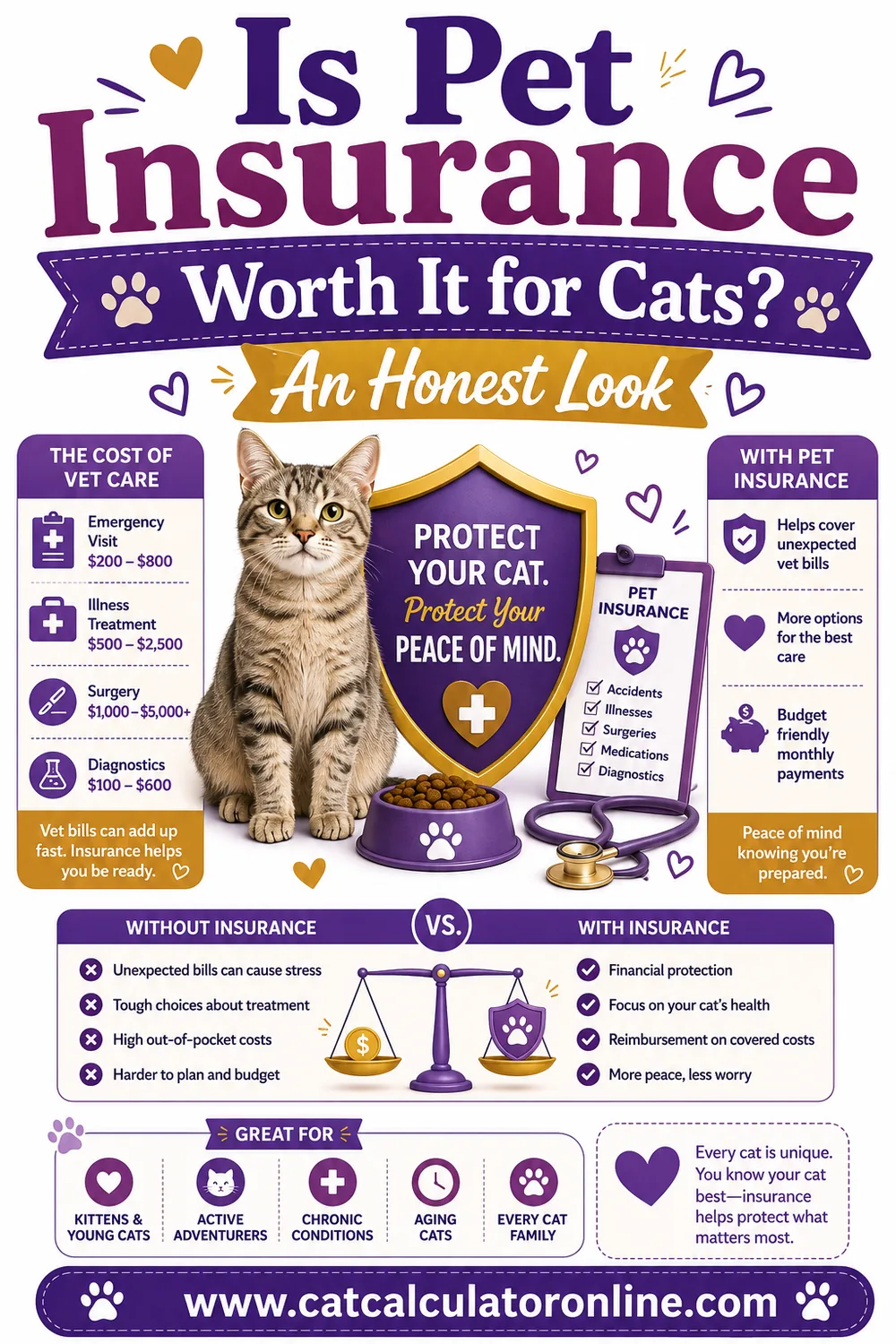
Insurance for a healthy adult cat runs $25–$35 a month, totalling roughly $6,000–$9,000 across a full life. Against that, a fairly ordinary feline life — one urinary blockage, dental extractions, and kidney disease from twelve onward — generates something like $10,000 in claims.
That asymmetry is unusual among insurance products, and it's the strongest honest argument in favor. The cases where it doesn't hold: a cat that stays healthy throughout, or an owner with substantial savings who can genuinely absorb a $4,000 bill without difficulty.
The alternative most often proposed is a dedicated savings account, and it's legitimate. Its real weakness is timing rather than principle: an emergency in year two arrives long before the fund has grown, and the discipline to keep contributing for a decade without touching it is rarer than people expect.
Whichever you choose, the point is to have something. The scenario worth avoiding is neither — where a $3,000 blockage becomes a decision about money rather than about your cat. We weigh both sides in is cat insurance worth it, and premium bands are in how much cat insurance costs per month.
How Can You Keep Vet Costs Down?
Six approaches that genuinely work, without compromising care:
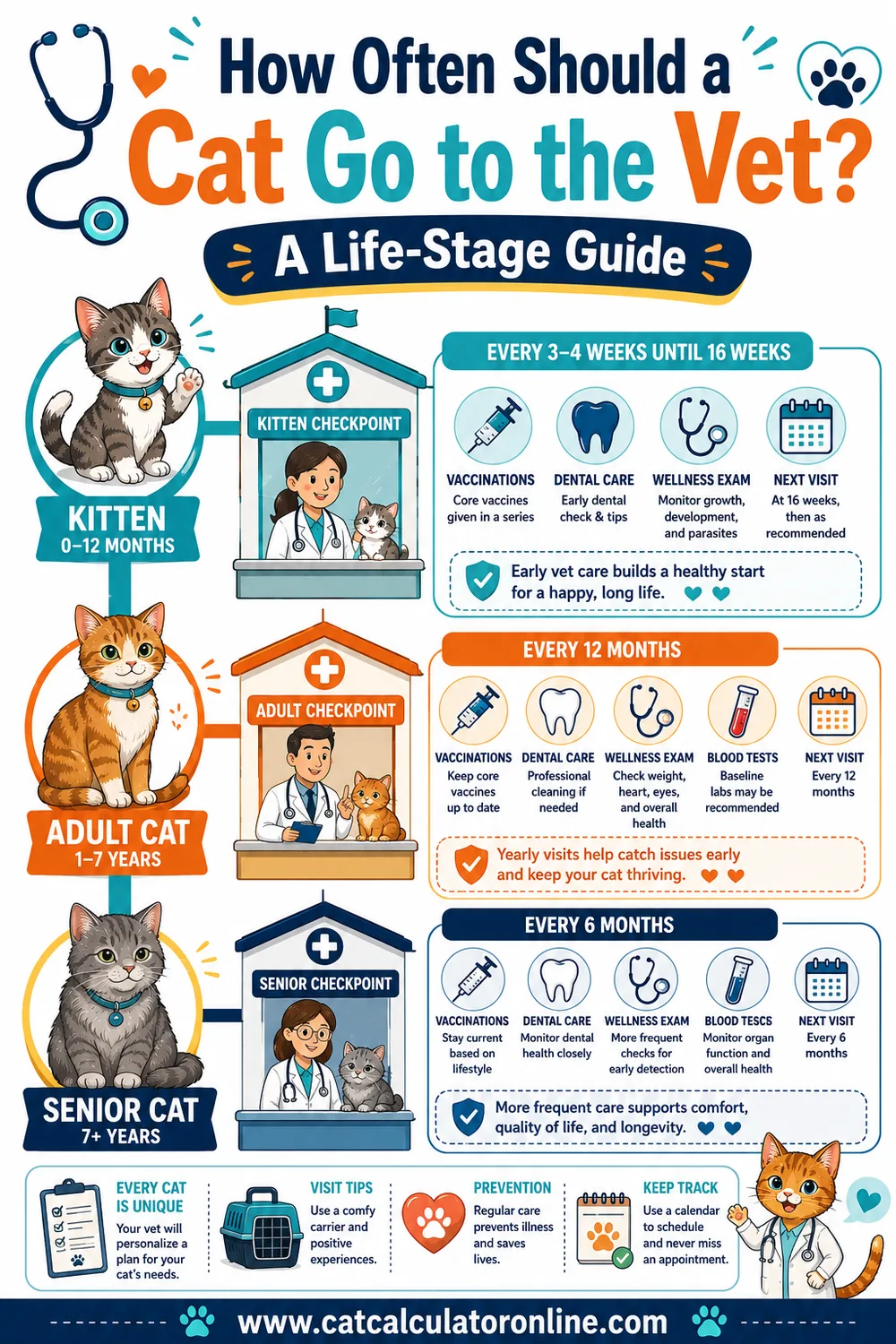
- Don't skip preventive care. Annual exams, vaccines, parasite treatment and dental checks are cheap relative to what they catch early. A dental problem found at a checkup costs far less than the same problem found when your cat stops eating. Frequency guidance is in how often should a cat go to the vet.
- Use low-cost clinics for routine work. Vaccination and neutering schemes run by shelters and charities are staffed by qualified vets and often cost half what a private practice charges. Vaccination guidance is in do cats need vaccines.
- Keep your cat at a healthy weight. Obesity drives diabetes, arthritis and urinary problems, all expensive and all substantially preventable.
- Go during normal hours where it's safe to. Out-of-hours pricing is 1.5–2×. If your vet's phone triage says it can wait until morning, that advice is worth money as well as reassurance.
- Ask for an estimate before proceeding. Practices are used to this and legally expected to discuss costs. Ask what's essential now and what could reasonably wait.
- Ask about payment plans. Many practices offer instalments or work with third-party financing, which is far better than delaying necessary treatment.
What's a false economy: delaying dental work, skipping the annual exam to save $75, or waiting to see whether something resolves. Cats are notably good at hiding illness, so by the time a problem is obvious it's often further along and more expensive.
That last point deserves emphasis, because it's the single biggest driver of avoidable veterinary spending in cats specifically. As a species that both hunts and gets hunted, cats instinctively conceal weakness — a cat in real discomfort will often still eat, still groom and still greet you at the door. Owners frequently report that their cat seemed "fine until last week", when the clinical picture shows a condition months in progress. The practical consequence is that subtle changes matter more than obvious ones: drinking a little more, hiding slightly more often, a small drop in weight, or eating on one side of the mouth. Each is easy to dismiss and each is worth a phone call. Catching kidney disease, hyperthyroidism or dental disease early doesn't just cost less — it usually means a longer and more comfortable life for your cat, which is the part the money is actually for.
Frequently Asked Questions
How much does a vet visit cost for a cat?
The consultation fee alone typically runs $60–$90, with everything done during the visit charged separately. A visit that produces a diagnosis and treatment commonly totals $200–$500. Emergency and out-of-hours consultations start higher, often $100–$200 before any treatment.
Why is cat dental work so expensive?
Because it requires general anaesthesia, pre-anaesthetic bloodwork, dental X-rays and often surgical extractions. A cleaning with a couple of extractions runs $800–$1,200, and full-mouth extraction for severe stomatitis can reach $3,000. Anaesthesia-free cleaning isn't equivalent, since it can't assess below the gumline.
How much does it cost to treat a blocked cat?
Typically $1,500–$3,000 for catheterisation, hospitalisation, fluids and monitoring. It's a genuine emergency requiring immediate treatment, it's far more common in male cats, and it recurs in a meaningful proportion of cases — sometimes leading to surgery costing more.
How much should I budget for cat vet care each year?
Around $200–$400 for routine care on a healthy adult cat, rising to $250–$600 once senior screening and periodic dental cleaning are included. Budget separately for the unexpected, either through insurance or a reserve of $2,000–$3,000.
Are vet costs higher for older cats?
Yes, substantially. Senior cats need more frequent checkups and screening bloodwork, dental disease becomes more likely, and chronic conditions such as kidney disease, hyperthyroidism and diabetes each add $500–$3,000 a year in ongoing management.
What is the most expensive common cat health problem?
Cancer, where a full treatment course can exceed $10,000. Among chronic conditions, kidney disease is the most common serious diagnosis in older cats and costs $1,000–$3,000 a year for the rest of the cat's life, which often totals more than a single acute emergency.
Routine veterinary care is affordable and predictable; the rest of the picture isn't, and no amount of budgeting makes a $3,000 emergency into a monthly line item. Keep up the preventive care that catches problems early, use low-cost clinics for routine work, and make a deliberate decision about insurance versus a reserve rather than defaulting into neither. Put your own figures into the cat cost calculator alongside food and litter for the full yearly picture, or see the recurring view in the monthly cost of owning a cat.