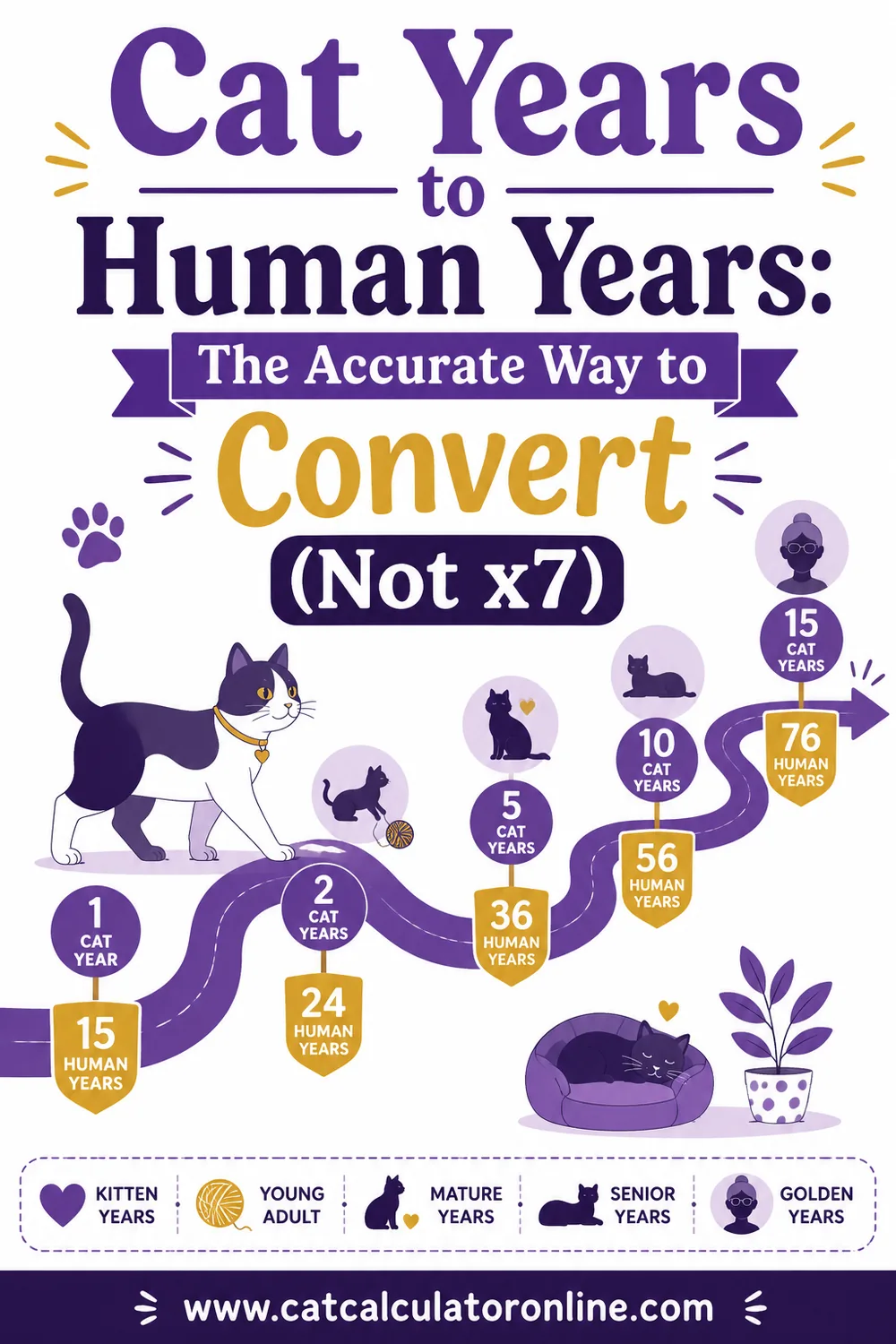
15 Cat Years in Human Years
A fifteen-year-old cat is about 76 in human years. Fifteen is a genuinely old cat — at or past the top of the range most cats are quoted, and an age at which almost every cat has slowed visibly and most are managing something. It is also an age a great many cats reach and then keep going from, into sixteen, seventeen, eighteen and beyond. What matters at fifteen is comfort, close observation, and an honest running sense of how your cat's days are going. This page covers the arithmetic and all three. Any age converts with the cat age calculator.

How Do You Get 76?
The same arithmetic used from the second birthday onwards.
15 for year one, 9 for year two, 4 for every year after. By fifteen: 24 + (13 × 4) = 76.
| Cat's age | Human years | Life stage |
|---|---|---|
| 13 | 68 | Senior |
| 14 | 72 | Senior |
| 15 | 76 | Senior |
| 16 | 80 | Senior |
| 17 | 84 | Senior |
| 18 | 88 | Senior |
| 19 | 92 | Senior |
| 20 | 96 | Senior |
A fifteen-year-old cat at 76 compares to a person in their mid-seventies — often still independent and engaged, usually managing something long-term, and at the point where comfort and daily quality matter more than any single test result.
The years either side are covered in 14 cat years in human years and 16 cat years in human years, the whole table in cat years to human years, and the method in how a cat age calculator works.
Is Fifteen a Long Life for a Cat?
It's a good one, and it's frequently not the end of the story.
The usual figures. Indoor cats are commonly quoted at 13 to 17 years. Fifteen sits inside that, near the upper part. But averages fold in cats lost young to accidents, infectious disease and untreated illness — a cat that has reached fifteen has already outlasted most of what shortens feline lives.
How far cats go. Sixteen, seventeen and eighteen are common enough that vets see them routinely. Cats in their early twenties are unusual rather than remarkable. The oldest verified cat on record reached 38, which is not a target but is a useful reminder of how wide the range is.
What actually determines the years left: whether the cat lives indoors, whether its weight has been controlled, whether its teeth have been maintained, whether existing conditions are diagnosed and managed, and whether new problems get caught early. Not the number itself. More on the range in how long do cats live.
The trap to avoid. At fifteen, owners start attributing everything to age and stop asking questions. That is precisely how treatable problems — dental pain, hyperthyroidism, hypertension, arthritis — go unaddressed. "She's just old" explains slowing down. It does not explain weight loss, night yowling, poor appetite or a sudden change in behavior.
What Does a Fifteen-Year-Old Cat Look Like?
Small, warm, slow, and often extremely affectionate.
Sleeping most of the day — 18 to 20 hours, in short stretches. The waking behavior is what tells you how things are.
Actively seeking heat. Radiators, sunbeams, laps, airing cupboards, the top of the boiler. Older cats lose body heat faster and warmth eases stiff joints. Accommodate it completely.
Little or no climbing. Most cats this age have given up anything above chair height. Steps to favorite spots keep them part of the household.
Lighter and bonier over the spine and hips. Muscle mass declines with age even in well cats, so a fifteen-year-old often feels thinner along the back while the belly stays soft.
A coat needing help. Reduced flexibility means the back and tail base go ungroomed, and long-haired cats mat there. Brushing becomes part of care.
Longer, sharper claws that need checking monthly — a cat that scratches less doesn't wear them down, and overgrown claws can curl into the pad.
Cloudier eyes — usually benign nuclear sclerosis rather than cataract, though a vet should confirm which.
More vocal, partly through reduced hearing, and often noticeably more attached to people.
What still isn't just age: weight loss, increased drinking, vomiting, going outside the box, difficulty eating, night yowling, hiding, or a cat that has stopped grooming its face entirely.
Why Is Weight Loss So Common at Fifteen — and Still Worth Chasing?
Because almost every old cat loses some weight, and because "common" and "normal" are different words.
The scale of it. A 4 kg cat losing 35 grams a month looks unchanged week to week and is down over 10% within a year. Coat hides it; by the time a cat looks thin, a great deal has already gone.
The usual causes at fifteen: chronic kidney disease, hyperthyroidism, dental pain making eating uncomfortable, intestinal disease, diabetes, and less commonly cancer. Several are treatable, and all are easier to manage caught early.
Age-related muscle loss is real too, and it can happen while weight stays stable. That's why the number on the scales matters as much as how the cat feels under your hand.
The practical routine: weigh monthly on the same scales — weigh yourself, then yourself holding the cat, subtract — and write it down. Look at the twelve-month trend. Photograph from directly above every couple of months as a cross-check.
And protect the appetite actively. Warm wet food slightly to lift the aroma, since smell drives feline appetite far more than taste. Use wide shallow bowls so whiskers aren't pressed. Raise the bowl an inch or two if your cat crouches awkwardly. Feed small amounts more often, in a quiet consistent spot.
Two things to treat as urgent: a cat that eats nothing for a couple of days, which risks hepatic lipidosis, and a cat that approaches food, shows interest, then walks away — usually nausea or mouth pain rather than fussiness.
What Should Care Look Like Now?
Practical, cheap, and effective within days.
Warmth, deliberately arranged. Several soft deep beds with sides to lean against, in warm draught-free places in the rooms your cat actually uses. This is the most appreciated change at this age by some distance.
Access to everything. Steps or a sturdy stool to the bed, the sofa, the windowsill. A cat that can still reach its places stays engaged.
Litter made easy. A box on every floor the cat uses, at least one with a low entry. A plastic storage tub with a U cut into one side gives full floor area with a two-inch step. Keep boxes away from food, in quiet corners.
Non-slip footing at landing points and along regular routes.
Night lighting for a cat whose sight has dimmed.
Everything on one floor. Food, water and a box on the level where the cat sleeps, so nothing essential requires stairs.
Grooming several times a week, focused on the back, hips and tail base, plus a monthly nail check.
Quiet. Older cats cope less well with noise and disruption, and a retreat room with bed, water and a box matters more than it used to. The full routine is in how to care for a senior cat.
Screening every six months, still — kidney values with SDMA, urine specific gravity, T4, blood pressure, blood count, liver enzymes, and a dental assessment. At fifteen this is mostly monitoring, and it is still what allows early adjustment.
What Behavior Changes Should You Still Investigate?
At fifteen the temptation is to file everything under age. Resist it — most of the common changes have findable causes.
Night yowling. A cat walking the house calling out at three in the morning is usually not being difficult. The common causes are hyperthyroidism, high blood pressure, reduced hearing, failing sight, pain, and cognitive dysfunction. The first four are all picked up by a standard senior panel and a blood pressure check, so investigate before accepting it.
Going beside the box rather than in it. Very often physical: sore joints making the step painful, or a urinary problem making the box unpleasant. A low-entry box and a vet visit fix the majority of cases, and neither involves any behavioral training.
Hiding, or a new low sleeping spot the cat won't leave. A cat that has moved somewhere dark and out of the way and stays there is usually uncomfortable rather than antisocial. This is one of the more reliable signals in an old cat.
Confusion — staring at walls, standing in doorways, forgetting a familiar route, calling from the wrong room. Feline cognitive dysfunction is a recognized condition. There is no cure, but a steady routine, night lighting, keeping furniture where it has always been, and gentle daily interaction all genuinely help.
Reduced grooming, or over-grooming one patch. The first suggests stiffness or nausea; the second frequently marks something sore underneath.
Increased clinginess, which is common and usually benign but worth noting alongside everything else.
How to raise it usefully. Describe the specific change rather than summarising it. "He used to sleep on the bed and for three weeks he's been under it" leads somewhere. "He's slowing down" doesn't.
How Do You Judge Quality of Life Honestly?
By writing it down, because memory is generous and slow changes are invisible from inside them.
The five practical markers: is the cat eating and drinking; is it comfortable; can it get where it wants to go; does it still engage with you or the household; and are there more good days than bad ones.
Keep a calendar. One mark a day — good, fair, poor. It takes seconds, and after a month it gives you something real. Owners are consistently surprised by what the calendar shows compared with what they'd have said from memory, in both directions.
What a good day at fifteen looks like: wakes and stretches, eats with interest, uses the box without hesitation, finds a warm spot, surfaces to greet you, grooms at least partially, and shows curiosity about something.
What warrants a conversation with your vet: pain that isn't controlled, an appetite that won't hold, continuous hiding, or a cat that has stopped doing everything it used to enjoy. Most of these have answers — better pain relief, an appetite stimulant, anti-nausea medication, a change to the management plan. The reason to ask early is that answers exist.
Ask about pain specifically. Feline pain relief has improved a great deal, but it usually won't be offered unless joint disease is raised by name. Never use human painkillers — paracetamol is fatal to cats, and ibuprofen and aspirin are toxic.
And keep the cat doing a little. A few minutes of gentle play, initiated by you, preserves muscle and shows you what your cat can still manage. At fifteen that's worth more than it was at five.
Frequently Asked Questions
How many human years is 15 cat years?
About 76. The method is 15 human years for the first year, 9 for the second and 4 for each year after — giving 24 at age two, plus thirteen further years at four each.
Is 15 old for a cat?
Yes, genuinely old. It sits at the upper part of the usual 13-to-17-year range, though many cats live well past it — sixteen, seventeen and eighteen are all common, and cats in their early twenties are unusual rather than rare.
Why is my 15-year-old cat so thin?
Some muscle loss is normal at this age, but actual weight loss usually has a cause — kidney disease, hyperthyroidism, dental pain, intestinal disease or diabetes. Most are treatable, so it's worth investigating rather than accepting.
How often should a 15-year-old cat see a vet?
Every six months, with bloodwork, urinalysis and blood pressure. Six months of a cat's life at fifteen is roughly two human years, which is a lot of time for something to develop.
Why does my old cat sleep on the radiator all day?
Older cats lose body heat more easily and warmth relieves stiff joints. It's normal and worth accommodating with warm, soft, draught-free beds in the rooms your cat uses.
Is it worth treating conditions in a 15-year-old cat?
Usually yes. Kidney disease, hyperthyroidism, hypertension and arthritis are all managed rather than cured, and management frequently buys years of comfortable life. Age alone is not a reason to decline investigation.
Fifteen cat years is about 76 human years — genuinely old, frequently well, and often several years short of the finish. Keep the six-monthly checks, make warmth and access easy, weigh monthly, protect the appetite, ask about pain by name, and keep an honest calendar of good days. Convert any age with the cat age calculator.