13 Cat Years in Human Years
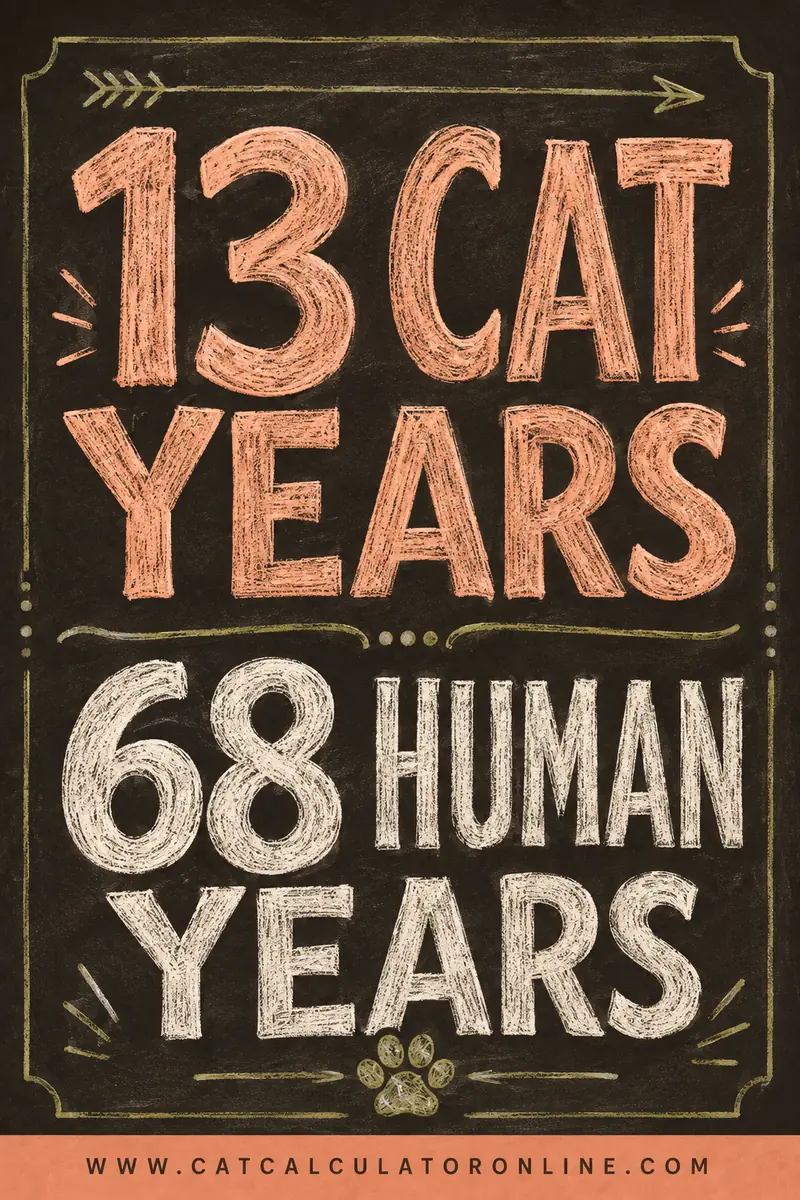
A thirteen-year-old cat is about 68 in human years. Thirteen sits at the bottom of the 13-to-17-year range most indoor cats live within, which sounds ominous and isn't — plenty of cats reach thirteen in good health and carry on for another four, five or six years. What changes at this age is the emphasis: comfort becomes as important as diagnosis, warmth and easy access matter as much as bloodwork, and small daily observations become your most useful tool. This page covers the arithmetic, what thirteen actually looks like, and where to put your attention. Any age converts with the cat age calculator.
How Do You Get 68?
The same arithmetic, still unchanged.
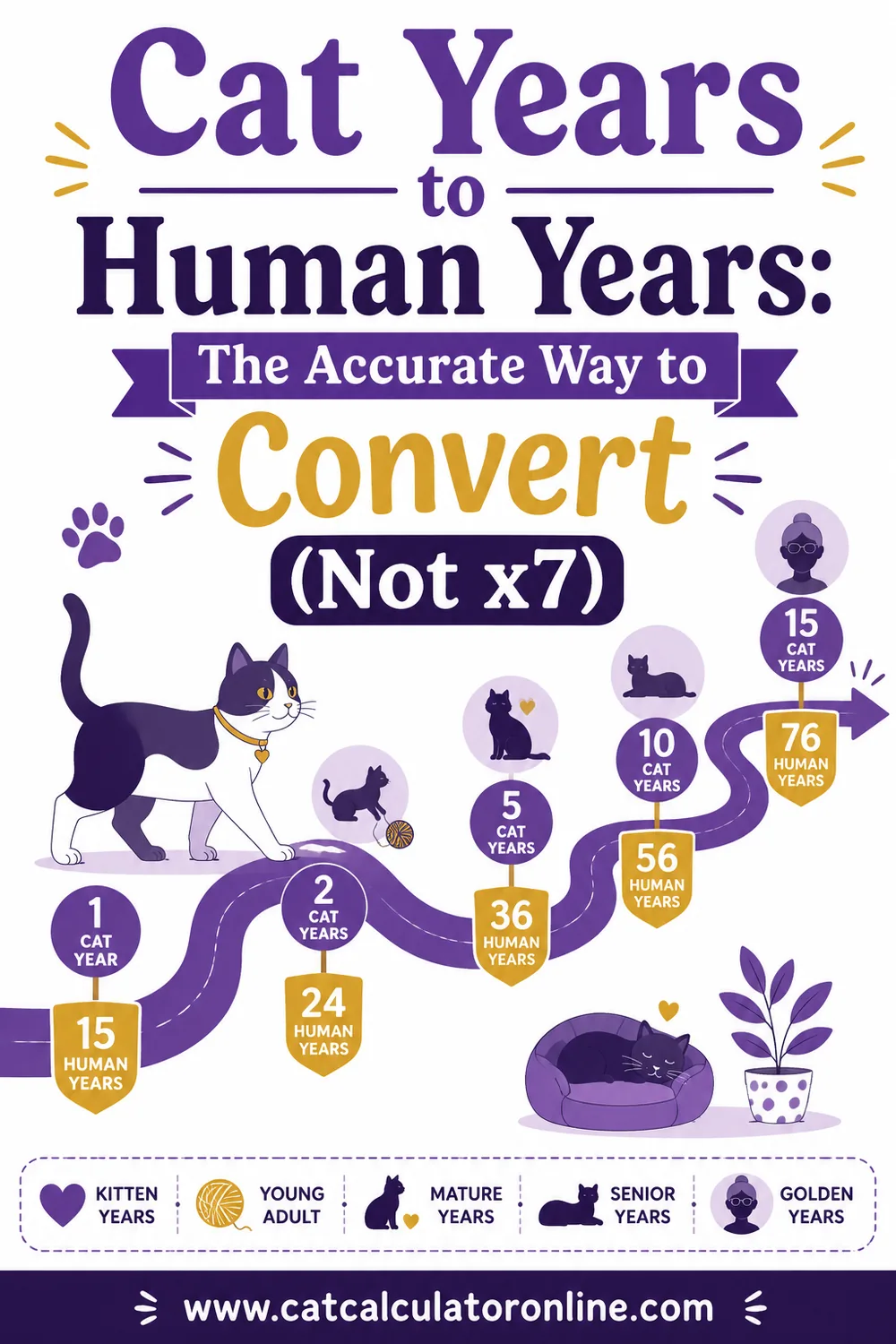
15 for year one, 9 for year two, 4 for every year after. By thirteen: 24 + (11 × 4) = 68.
| Cat's age | Human years | Life stage |
|---|---|---|
| 11 | 60 | Senior |
| 12 | 64 | Senior |
| 13 | 68 | Senior |
| 14 | 72 | Senior |
| 15 | 76 | Senior |
| 16 | 80 | Senior |
| 18 | 88 | Senior |
| 20 | 96 | Senior |
A thirteen-year-old cat at 68 compares to a person in their late sixties — commonly well, commonly managing one or two long-term conditions, and unmistakably in the stage of life where regular medical review pays for itself.
The neighbouring years are covered in 12 cat years in human years and 14 cat years in human years, the complete table in cat years to human years, and the method behind it in how a cat age calculator works.
Is Thirteen Old for a Cat?
Yes — and that is a much less alarming statement than it sounds.
The averages. Indoor cats typically live 13 to 17 years. That figure is an average, not a limit, and it includes cats lost early to accidents and illness. A cat that has already reached thirteen in reasonable health has, by definition, cleared most of what shortens feline lives.
What actually predicts the remaining years: whether the cat lives indoors, whether its weight is under control, whether its teeth have been looked after, whether existing conditions are being managed, and whether problems get found early. None of those is age itself.
The realistic outlook at thirteen. Many cats have three to five more years. Some have considerably more — cats in their early twenties are unusual but not rare, and there are verified cases well beyond that. Thirteen is the beginning of the final stretch, and the final stretch is often the longest-feeling and most affectionate part of living with a cat.
Where the framing goes wrong. Owners sometimes start treating a thirteen-year-old as fragile — cutting play, avoiding handling, declining investigation because "she's old". Each of those makes things worse. A thirteen-year-old cat that is kept moving, kept interested, kept at a sensible weight and kept diagnosed does better than one wrapped in cotton wool.
What Does Thirteen Look Like Day to Day?
Slower, warmer, more particular, and mostly still recognisably your cat.
Sleeping a great deal — 18 hours or more, split across the day. Normal in itself; the waking hours are what tell you something.
Seeking heat consistently. Radiators, sunny patches, laps, airing cupboards. Older cats regulate temperature less well and stiff joints ease in warmth. Give in to this entirely — a warm bed is genuine medicine at thirteen.
Reduced jumping, and often reduced climbing altogether. Many cats this age have stopped using anything above chair height. That is joint disease far more often than it is preference, and it is treatable — see arthritis in cats.
A coat that needs help. Reduced flexibility means the back, hips and tail base get missed. Long-haired cats develop mats there; short-haired cats look slightly unkempt. Regular brushing is now part of care rather than a treat.
Thinner over the spine and hips, even in cats at a healthy weight, because muscle mass declines with age. A cat that feels bonier along the back while its belly stays soft is showing normal age-related muscle loss — but a steady drop on the scales is not, and needs investigating.
Louder and more talkative in some cats, partly through declining hearing.
More affectionate, very commonly. Many owners describe their cat becoming markedly more of a companion in its teens.
What isn't just age: any sustained weight loss, increased drinking, vomiting more than very occasionally, going outside the litter box, a genuinely matted coat, night yowling, difficulty eating, or a cat that has stopped grooming its face. Each of those has a cause worth pursuing.
Why Does Comfort Become the Priority?
Because at thirteen, the changes that improve a cat's daily life are usually environmental rather than medical, and they work immediately.
Warmth first. A soft, deep bed in a warm draught-free spot, ideally with sides to lean against. Several of them, in the rooms your cat actually uses. This is the single most appreciated change at this age.
Access second. Steps or a stool to every favorite spot — the bed, the sofa back, the windowsill. A cat that can still get to its places stays engaged with the household; a cat that can't withdraws.
Litter arrangements third. A box on every floor, at least one with a low entry. A plastic storage tub with a U cut into one side gives generous floor area and a two-inch step, and solves most "he's started going next to it" problems by itself. Keep boxes away from food and in quiet spots.
Non-slip footing at landing points. Hard floors are difficult for an unsteady cat, and a rug where they habitually jump down restores a lot of confidence.
Quiet. Older cats cope less well with noise, visitors and disruption. A room they can retreat to, with their bed, water and a box, matters more than it used to.
Grooming as routine. Brush several times a week, with attention to hips and tail base, and check nails monthly — a cat that scratches less doesn't wear them down, and overgrown claws can curl into the pad. The full routine is in how to care for a senior cat.
How Do You Keep a Thirteen-Year-Old Eating Well?
Appetite is both a health indicator and a health input at this age, so it deserves active protection.
Make the food more appealing, not different. Warming wet food to just below body temperature lifts the aroma considerably, and smell drives feline appetite far more than taste. A microwave burst of a few seconds, stirred and checked, is usually enough.
Make eating physically easy. Raise the bowl an inch or two if your cat crouches awkwardly or stands stiffly — for an arthritic cat, bending to a floor-level bowl is uncomfortable. Use wide shallow dishes so whiskers aren't pressed against the sides.
Feed smaller portions more often. Older cats often eat better across four small meals than two large ones.
Keep the spot quiet and consistent. Away from the litter box, away from the washing machine, away from other pets if there's any tension.
Prioritize water. Wet food raises fluid intake substantially without asking the cat to drink at all, which supports ageing kidneys. Multiple bowls, in different rooms, away from food.
Don't switch foods without a reason. A "senior" label is not a reason. A diagnosis is — a prescription renal or thyroid diet exists for a specific condition and should be introduced slowly, mixed in over one to two weeks.
And treat two things as urgent: a cat that stops eating altogether, and a cat that approaches food, seems interested, then walks away. The first is dangerous in cats within a couple of days; the second usually means nausea or dental pain.
What Should Screening Cover at Thirteen?
Every six months, and by now you're mostly monitoring rather than searching.
Kidney values including SDMA, with the previous results alongside. The trend across visits is the useful information.
Urine specific gravity, which frequently shifts before blood values do. Ask for it specifically.
Total T4, since hyperthyroidism remains common at this age and is very treatable.
Blood pressure, which is silent until it damages the eyes or kidneys, and easy to treat once found.
Blood glucose with fructosamine where diabetes is a question, because stress alone raises feline blood glucose.
Complete blood count and liver enzymes.
A dental assessment. Painful teeth are a common, correctable cause of weight loss and poor appetite, and cats hide dental pain remarkably well.
A proper physical examination — thyroid palpation, kidney size, heart murmur, joint range of movement, and a check for lumps.
Weight, against your own home log. Weigh monthly on the same scales and write it down; a 4.5 kg cat losing 40 grams a month looks unchanged and is down nearly 10% in a year.
How to use the results. A stable set at thirteen is genuinely good news, but the value is in the series — the reason for six-monthly intervals is that six months of a cat's life at this age is roughly two human years, and a great deal can develop in two human years.
What Does Quality of Life Actually Mean Here?
A question worth thinking about calmly while your cat is well, rather than under pressure later.
The practical markers are simple: is the cat eating and drinking, is it comfortable, is it getting to where it wants to go, is it engaging with you or the household, and is it doing more good days than bad ones. Written down, tracked over weeks, those five answers are far more reliable than a feeling.
Keep a simple log. A mark on a calendar each day — good, fair, poor — takes seconds and gives you an honest picture. Memory smooths things over; a calendar doesn't.
What good quality of life looks like at thirteen: a cat that wakes and stretches, eats with interest, uses its box without hesitation, finds a warm spot, surfaces to greet you, grooms itself at least reasonably, and shows curiosity about something in the day.
What deserves a conversation with your vet: pain that isn't controlled, an appetite that won't hold, hiding continuously, or a cat that has stopped doing all the things it used to enjoy. Most of these have answers — better pain relief, an appetite stimulant, an anti-nausea medication, a different management plan. The point of asking early is that answers exist.
Thirteen is not that conversation for most cats. It's the age at which noticing becomes the job, and noticing early is what makes the next few years good ones.
Frequently Asked Questions
How many human years is 13 cat years?
About 68. The method is 15 human years for the first year, 9 for the second and 4 for each year after — giving 24 at age two, plus eleven further years at four each.
Is 13 old for a cat?
Yes, it's solidly senior, but many cats live to 17 or beyond. A healthy thirteen-year-old often has three to five more years, and sometimes considerably more.
Why does my 13-year-old cat sleep near the radiator all the time?
Older cats regulate body temperature less efficiently and warmth eases stiff joints. It's normal and worth accommodating with warm, soft beds in the rooms your cat uses.
How often should a 13-year-old cat see a vet?
Every six months, with bloodwork, urinalysis and blood pressure at least annually. Six months at this age is roughly two human years, which is why the interval is shorter than for a younger cat.
My 13-year-old cat is losing weight but eating well — why?
Eating more while losing weight is the classic pattern for hyperthyroidism, which is common at this age and very treatable. Kidney disease, diabetes and dental pain are other possibilities. It needs a vet visit rather than more food.
Should I switch to senior cat food at 13?
Not automatically. Without a diagnosis, a good quality complete food your cat eats willingly, at a portion that holds weight steady, is fine. Prescription diets exist for specific conditions and should be introduced on veterinary advice.
Thirteen cat years is about 68 human years — senior, usually still well, and the age where comfort and observation matter as much as tests. Keep beds warm, access easy and boxes low-sided, hold the six-monthly checks, protect the appetite, and treat any new behavior as a symptom rather than as age. Convert any age with the cat age calculator.