Cat Labor Signs: What to Watch For
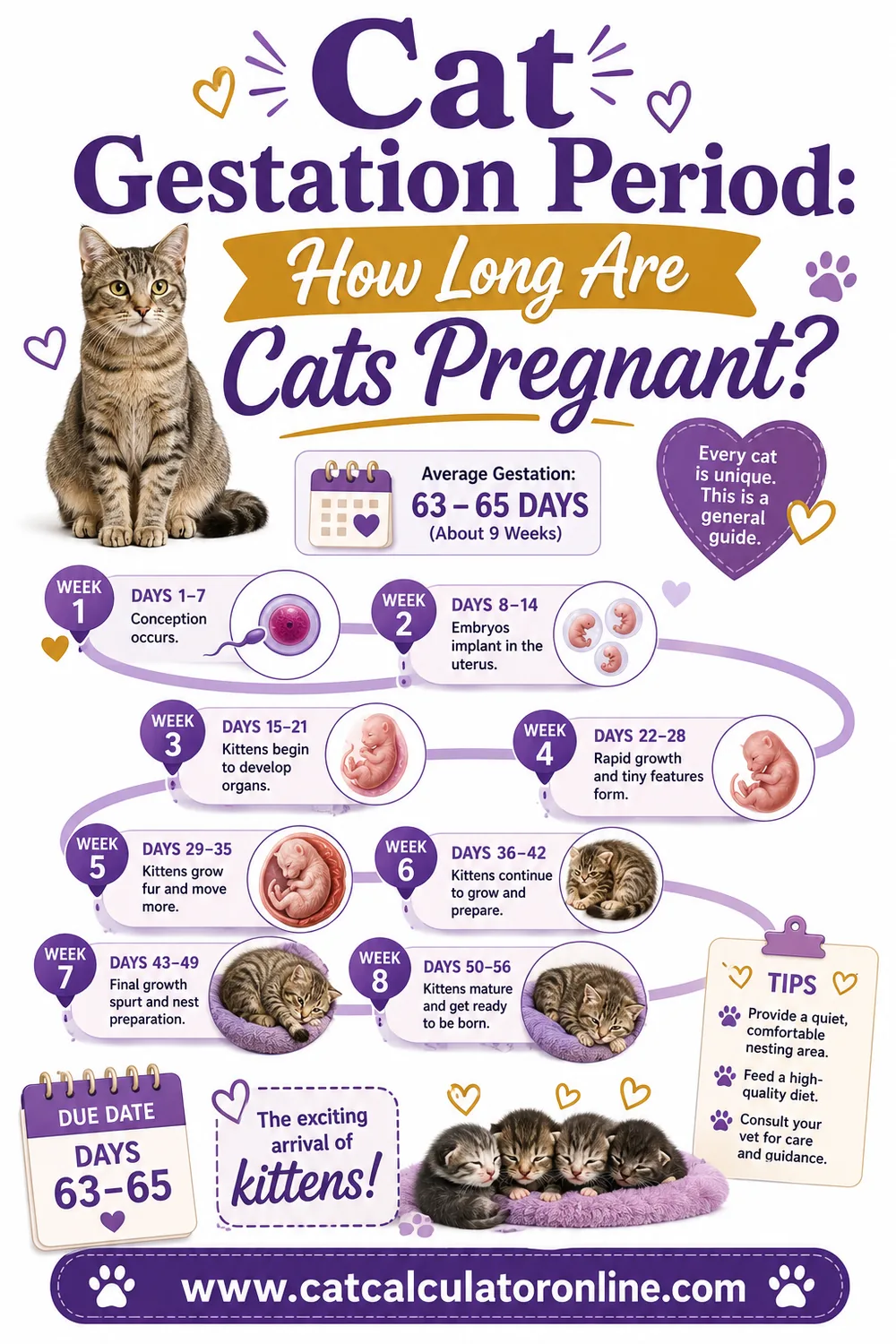
The single most useful thing to know is the sequence, not the list: a queen spends 6 to 12 hours — sometimes up to 24 — in first-stage labor with no visible straining at all, and once she does start straining the first kitten should normally arrive within about an hour. That distinction is what tells you whether to make tea or make a phone call. Restlessness and nesting are not an emergency. Hard, purposeful straining for half an hour with nothing to show for it is. Cat gestation runs roughly 63 to 65 days, and the cat pregnancy calculator will tell you how close she is.

What Are the First Signs That Labor Is Close?
These arrive over the final day or two and are about anticipation rather than action.
A drop in body temperature. A cat's normal rectal temperature sits around 100.5 to 102.5°F (38 to 39°C). In the 12 to 24 hours before labor it typically falls by roughly two degrees Fahrenheit, often to about 99 to 100°F (37.2 to 37.8°C). Breeders use this routinely because it is the closest thing to a countdown clock. Do not attempt it unless your vet has shown you how — a poorly taken reading is worse than no reading, and the check itself stresses her.
Loss of appetite. Many queens go off food in the final 24 hours. At this specific point it is expected rather than alarming. Keep food and water where she can reach them without leaving the nest, and never withhold food from a cat to "help" — cats that stop eating risk hepatic lipidosis within days, and a heavily pregnant queen least of all can afford it.
Serious nesting. She commits to a spot, shreds and rearranges bedding, and becomes reluctant to be far from it. Expect her to reject the box you prepared and choose a wardrobe.
More grooming of the rear end. Persistent licking around the vulva is common in the last day.
A clinginess flip. Some queens become intensely attached to their person and follow them everywhere. Others vanish and want nothing to do with anyone. Both are normal.
A small mucus discharge from the vulva can appear in the final day. Clear or slightly cloudy is fine. Green, black, or foul-smelling is not — that belongs in cat birth complications.
What Happens in Stage One Labor?
This is the long, quiet, misread stage, and understanding it prevents most unnecessary panic.
Uterine contractions begin but you cannot see them. The cervix is dilating and the uterus is contracting, yet there is no visible abdominal pushing. From the outside it looks like a restless cat, not a cat in labor.
Duration is 6 to 12 hours, and up to 24 is still within normal. First-time queens tend towards the longer end. A cat who has been unsettled since breakfast and has produced nothing by teatime is not necessarily in trouble.
What you will see: pacing, repeated visits to the nest, digging and circling, panting, trembling, vocalising, and a great deal of purring. The purring surprises people — it is not contentment, it is a self-soothing behavior cats use under stress and pain.
She may vomit once. A single vomit early in labor is common and not a concern on its own.
Breathing changes. Open-mouthed panting between contractions is normal here. Persistent labored breathing with blue-tinged gums is a different thing entirely and needs immediate help.
The practical response is to leave her alone. Dim the room, keep it warm — around 72 to 77°F (22 to 25°C) for the newborns' sake — keep other pets and children out, and check on her from a distance rather than sitting over her. Some queens will stall their labor if watched too closely.
How Do You Know Stage Two Has Started?
Stage two is unmistakable once you know what you are looking at, and this is where the clock starts to matter.
Visible abdominal straining. Her flanks pull in, she braces, and you can see her pushing. This is voluntary effort added to the uterine contractions, and it is qualitatively different from restlessness.
She usually lies on her side or crouches, often with her tail lifted, and may cry out with the effort.
The water breaks. A gush or trickle of clear or straw-colored fluid as the allantoic sac ruptures. It often goes unnoticed because she licks it away immediately.
The first kitten should arrive within about an hour of purposeful straining beginning, and frequently much sooner — 10 to 30 minutes is common.
Kittens can be born head first or tail first. Roughly a third arrive backwards, and in cats that is a normal presentation rather than an emergency. Do not treat a tail-first kitten as a crisis in itself.
Each kitten arrives in its own sac, which the queen tears open, followed by the placenta. She will bite through the cord and lick the kitten vigorously, which is what stimulates it to breathe. Let her do it. What to do if she does not is covered in what to do when your cat gives birth.
What Does Normal Progress Look Like Between Kittens?
Here is where cats differ from dogs in a way that most articles get wrong.
Kittens usually arrive every 10 to 60 minutes. The whole litter is often delivered in 2 to 6 hours.
But interrupted labor is normal in cats. A queen can deliver two or three kittens, then genuinely stop — settle down, clean them, let them nurse, eat a meal, act entirely comfortable — and resume delivering the rest hours later. This pause can last 24 to 36 hours in a healthy cat and is a recognized feline pattern, not a malfunction.
The distinguishing feature is straining. A queen in an interrupted labor is relaxed and not pushing. A queen who is straining hard with nothing emerging is obstructed. Those two states look nothing alike, and the difference is what decides whether you wait or call.
A resting queen who is bright, warm, nursing kittens and eating is being watched, not treated. One who is restless, distressed, straining, or deteriorating in any way is a phone call regardless of how long it has been.
Placentas should match kittens. Count them. She will often eat them, which is normal, so count as you go rather than at the end. A retained placenta can cause infection days later.
| Stage | What you see | Normal duration | Call the vet if |
|---|---|---|---|
| Pre-labor | Temperature drop, appetite loss, nesting | 12–24 hours | Discharge is green, black or foul |
| Stage one | Restlessness, panting, purring, no pushing | 6–12 hours, up to 24 | Over 24 hours with no progress |
| Stage two, first kitten | Visible straining | Kitten within ~1 hour | 20–30 min of hard straining, no kitten |
| Between kittens | Straining resumes, then delivery | 10–60 minutes | Over 2 hours straining with more due |
| Interrupted labor | Calm, resting, nursing, not straining | Up to 24–36 hours | She becomes unwell or starts straining |
| Stage three | Placenta after each kitten | Within 15 min of each | Fewer placentas than kittens |
Which Signs Are Normal but Look Alarming?
Several perfectly ordinary features of feline labor send owners to the emergency line unnecessarily.
Loud crying. Queens can be dramatic. Yowling during contractions is not proof of a problem.
Panting. Between contractions, this is normal thermoregulation and effort. Sustained heavy breathing with pale or bluish gums is not.
Eating the placentas. Normal instinctive behavior. She may eat some or all of them. Occasionally it causes a bout of diarrhea afterwards, which is harmless.
Blood-tinged fluid. A small amount of blood with the fluids around each birth is expected. Steady, frank bleeding is not.
**A dark greenish discharge after the first kitten** is normal — it comes from the separating placenta. The same color before any kitten has been born means placental separation without delivery, which is urgent.
Kittens born backwards. As above, common and usually uneventful.
She ignores you completely, or demands you stay. Either is fine. Follow her preference rather than a rulebook.
What Should Be Ready Before Labor Starts?
Preparation is quiet and cheap, and it is the difference between calm observation and a scramble.
A nesting box, set up about two weeks early. A cardboard box with a low entry, high sides, and clean towels or puppy pads. Somewhere dark, warm and away from traffic. Introducing it early gives her time to accept it, though many queens still pick elsewhere — if she does, and the spot is safe, let her have it.
Clean towels, more than you think. For drying kittens if she needs help, and for changing soiled bedding between arrivals.
Your vet's out-of-hours number, written down. Not "in the phone somewhere". Written down, where anyone in the house can find it.
Kitchen scales that read in grams. Newborn kittens weigh roughly 90 to 110 g (about 3 to 4 oz) and should gain steadily. Weighing daily from day one catches a fading kitten sooner than watching does.
A warm, safe backup spot — a small box with a covered heat pad or a wrapped hot water bottle — for any kitten that needs warming while the queen deals with the next one.
Nothing else. No scissors, no clamps, no attempts at assistance. The full picture of what pregnancy preparation involves is in caring for a pregnant cat.
When Do the Signs Mean You Should Call?
Crisp thresholds, because vague ones cost time.
Strong, purposeful straining for 20 to 30 minutes with no kitten produced. This is the single most important number in the whole subject.
More than two hours between kittens when she is actively straining and more are due.
A kitten visibly stuck at the vulva and not advancing within a few minutes.
Green, black or foul-smelling discharge before the first kitten arrives.
Heavy or continuous bleeding rather than blood-tinged fluid.
Extreme lethargy, collapse, pale gums, or a queen who seems detached from what is happening.
Pregnancy past about day 70 with no sign of labor at all.
Stage one running beyond 24 hours without moving into visible straining.
Flat-faced breeds — Persians, Exotics, and similar — have measurably higher cesarean rates because of kitten head shape, and are worth flagging to your vet in advance. Every one of these thresholds, plus the post-birth problems, is expanded in cat birth complications.
What Signs Come After the Last Kitten?
Labor signs do not stop when the litter is out, and the days afterwards carry their own watch list.
She settles and nurses. A queen who has finished usually relaxes, curls around the litter, and stays put. Continued restlessness and straining after the apparent last kitten suggests another is still inside.
A reddish-brown discharge (lochia) continues for up to about three weeks, gradually reducing. It should not smell foul.
Appetite returns sharply. By peak lactation she may need two to three times her normal calories, which is why she stays on a growth diet through nursing.
Watch her mammary glands. Hot, hard, painful or discoloured glands suggest mastitis and need veterinary treatment.
Watch for tremors and stiffness. Eclampsia — dangerously low blood calcium — typically appears one to four weeks after birth, presenting as restlessness, muscle tremors, a stiff gait or collapse. It is a true emergency and it moves fast.
Watch the kittens' weights. Steady daily gain is the best single indicator that everything is working. How long the whole process takes, start to finish, is in how long does cat labor last, and the signs that led here are catalogued in signs your cat is pregnant and the cat gestation period.
Frequently Asked Questions
How long before birth does a cat show labor signs?
Nesting, appetite loss and a temperature drop of around two degrees Fahrenheit usually appear 12 to 24 hours beforehand. First-stage labor itself — restlessness, panting and purring without visible pushing — then runs 6 to 12 hours, and up to 24 hours can still be normal.
Is panting a sign of cat labor?
Yes, panting between contractions is common and normal during labor. What is not normal is sustained labored breathing with pale or blue-tinged gums, or panting in a queen who is collapsed or unresponsive. That combination needs emergency veterinary attention immediately.
Why is my cat purring during labor?
Purring is not only a contentment signal in cats — it is also a self-soothing behavior used during stress, pain and illness. Many queens purr loudly through contractions. On its own it tells you nothing worrying, and it does not mean labor has stopped.
How long can a cat be in labor without giving birth?
First-stage labor without visible straining can last up to 24 hours. Once she is straining hard and purposefully, the first kitten should arrive within about an hour, and 20 to 30 minutes of strong straining with nothing produced is the point to call a vet.
Can a cat stop labor and start again?
Yes. Interrupted labor is a recognized and normal pattern in cats. A queen may deliver part of a litter, then rest calmly for up to 24 to 36 hours before resuming. The key is that she is relaxed and not straining — a straining cat who is not progressing needs help.
Should I stay with my cat during labor?
Watch from a distance and let her lead. Some queens want their person present, others stall if observed closely. Keep the room warm, dim and quiet, check periodically rather than hovering, and intervene only if something on the escalation list appears.
Cat labor reads clearly once you separate the two stages. The long, unsettled, purring, panting hours before anything visible happens are stage one, and 6 to 12 of them is ordinary. Visible straining is stage two, and from that moment the first kitten is due within roughly an hour. After that, kittens every 10 to 60 minutes is typical, but a calm, non-straining pause of up to 24 to 36 hours is genuinely normal in cats. Keep clean towels, gram scales and the out-of-hours number ready, count placentas against kittens, and use the cat pregnancy calculator so the due date does not catch you unprepared.