Kitten Growth Stages Week by Week
Kittens develop faster in their first twelve weeks than at any other point in life. They're born blind and deaf at around 100 g, open their eyes at 7–10 days, start walking at three weeks, are weaned by eight weeks, and reach near-adult size somewhere around ten to twelve months. The single most useful thing to track through all of it is weight, which should climb by roughly 100 g a week in the early months — steady gain is the clearest sign a kitten is thriving. The kitten weight calculator shows whether yours is on track for its age.

What Happens in Weeks 0–2?
Newborn kittens weigh around 90–110 g and are almost entirely helpless. They're born with eyes and ear canals closed, they can't regulate their own body temperature, and they can't urinate or defecate without the queen stimulating them.
What happens:
- Days 1–3: Kittens find the queen by scent and warmth. They should nurse within hours of birth — the first milk, colostrum, carries antibodies that provide early immune protection.
- Days 7–10: Eyes open. Every kitten's eyes are blue at this stage; adult color develops later.
- Days 10–14: Ear canals open and hearing begins. The umbilical stump has usually dropped off by now.
- Weight: should roughly double by two weeks, which is the single most important indicator at this stage.
A kitten that isn't gaining weight daily in the first two weeks needs veterinary attention promptly. Newborns have almost no reserves, and a decline that would be minor in an older cat can become serious within a day.
For anyone hand-rearing: newborns need feeding every two to three hours around the clock, need help toileting after each feed, and need an external heat source, since they can't warm themselves. This is genuinely demanding, and a vet or experienced rescue is worth consulting rather than improvising.
What Changes at Weeks 3–4?
This is when a litter stops being a pile of sleeping kittens and starts being a set of individuals.
- Week 3: Wobbly first steps. Baby teeth start coming through. Kittens begin toileting without stimulation, which is when a shallow litter tray can be introduced.
- Week 4: Walking becomes more coordinated, play begins between littermates, and curiosity about the queen's food starts. Weaning can begin with wet kitten food or a gruel.
- Typical weight: around 350–450 g at three weeks, 400–550 g at four.
Two things matter here. Socialization begins now — the window from roughly three to nine weeks is when kittens learn what's normal and safe. Gentle handling by different people during this period has a lasting effect on how confident the adult cat becomes.
And weaning is gradual, not a switch. Kittens continue nursing while exploring solids, and the transition typically runs from four to eight weeks. Removing a kitten from its mother during this window causes both nutritional and behavioral problems.
What Happens During Weaning, Weeks 5–8?
The fastest period of visible change, and the stage most new owners meet their kitten at the end of.
- Week 5: Eating solid food more confidently, playing energetically, using the litter tray reliably. Eye color begins shifting from newborn blue.
- Week 6: Running, climbing and pouncing. First deworming often happens around now.
- Week 7: Largely independent of the queen for food. Play becomes rougher and more coordinated.
- Week 8: Fully weaned. First vaccinations typically given. Weight around 1.7–2 lb (800–900 g).
Eight weeks is the earliest a kitten should go to a new home, and many breeders and rescues now prefer ten to twelve. Kittens taken too early are more prone to behavioral difficulties — poor bite inhibition, anxiety, litter tray problems — because they miss the last weeks of learning from their mother and littermates. The reasoning is set out in when can kittens leave their mom.
If you're collecting a kitten at this point, ask what it's been eating and take some home with you. Changing food and home simultaneously is a common cause of digestive upset in the first week.
How Fast Do Kittens Grow at 2–4 Months?
From eight weeks to about four months, kittens grow fast and consume a great deal of energy doing it.
A useful rule of thumb: kittens gain roughly 1 lb per month through this period, so age in months approximates weight in pounds. A three-month-old kitten commonly weighs around 3 lb, a four-month-old around 4 lb.
What's happening:
- Vaccination course completes, usually two or three visits a few weeks apart.
- Baby teeth start being replaced by adult teeth from around 3–4 months. You may find tiny teeth on the floor, and some chewing is normal.
- Coordination improves rapidly. Climbing, jumping and hunting play become serious business.
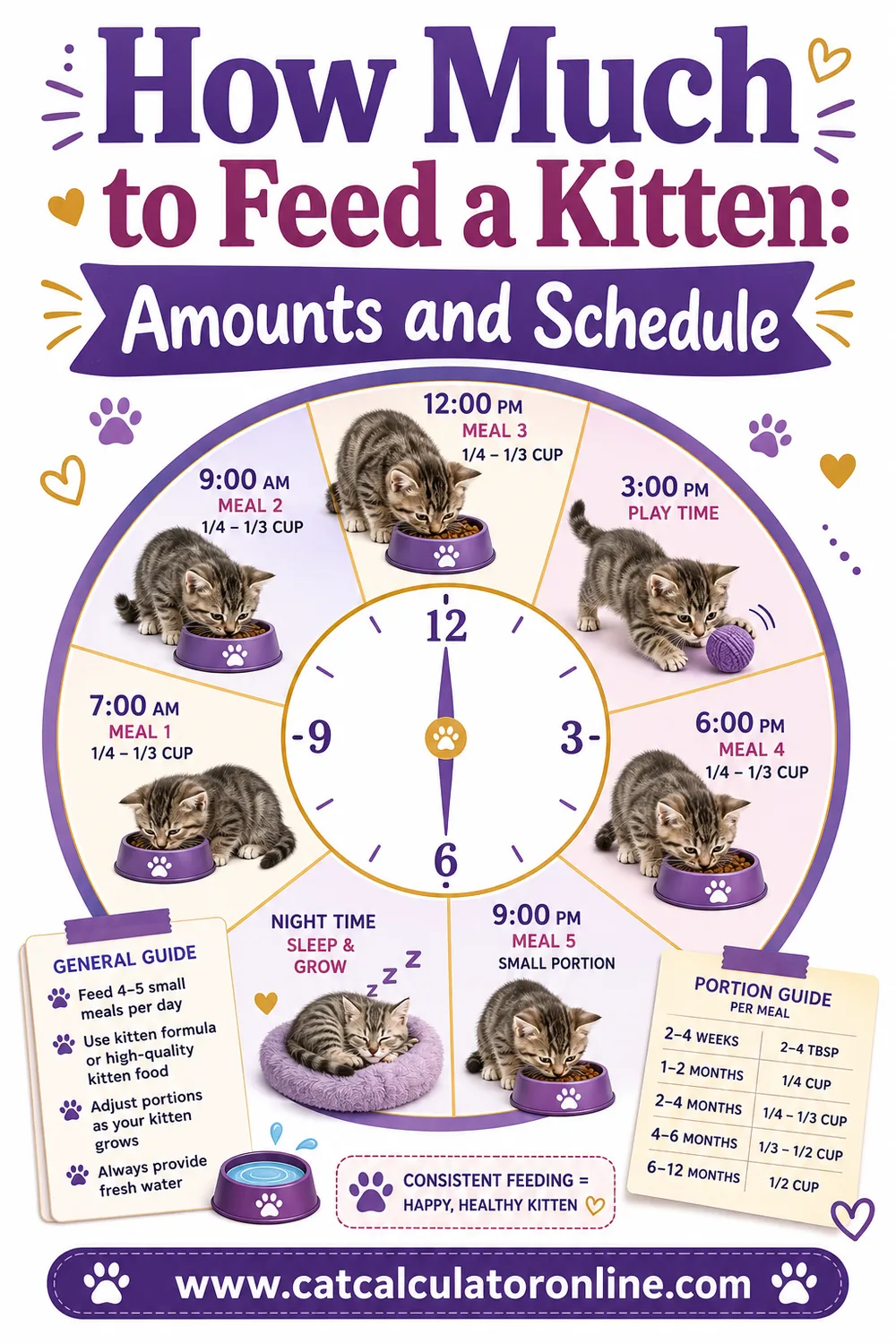
- Appetite is large. Kittens need two to three times an adult cat's calories per pound of body weight, and three to four meals a day suits most at this stage.
This is the point where kitten-specific food genuinely matters. It's formulated with higher protein, fat and calorie density precisely because a growing body needs more than maintenance. Portion guidance by age is in how much to feed a kitten.
What Happens During Adolescence, 4–6 Months?
Growth continues but starts to slow, and behavior changes noticeably.
- Sexual maturity arrives, often around four to six months — considerably earlier than most owners expect. Female kittens can come into season and become pregnant at this age.
- Neutering is commonly performed around this point, though timing varies and some shelters neuter earlier. Worth discussing with your vet rather than assuming a date.
- Teething completes, usually by about six months, once all adult teeth are through.
- Weight typically reaches 4–6 lb, roughly half to two-thirds of adult size.
Behaviourally this is the boisterous stage — energetic, testing boundaries, sometimes rough in play. It passes, and it responds far better to redirection onto appropriate toys than to discouragement.
One practical warning that belongs here: this is peak age for swallowing things. String, ribbon, hair ties, tinsel and dental floss are the classic feline surgical emergencies, and adolescent kittens are the most likely to eat them. Keeping them genuinely out of reach prevents the single most likely large vet bill of your cat's early life.
When Does Growth Finish, 6–12 Months?
Growth slows considerably but hasn't finished.
- Months 6–9: Height and length are largely settled. The cat fills out with muscle rather than getting noticeably bigger.
- Months 9–12: Growth flattens. Most cats reach near-adult size around ten to twelve months.
- At twelve months: transition to adult food, and reduce portions accordingly. This is a critical moment — needs drop substantially, and it's where a great many cats begin gaining unnecessary weight.
Large breeds are the exception. Maine Coons, Norwegian Forest Cats, Ragdolls and Savannahs continue filling out until three or four years old. A two-year-old Maine Coon that seems small for the breed may simply not be finished. Growth timelines by breed are covered in when do cats stop growing.
Your cat's weight at around twelve months is genuinely worth recording. It becomes the reference point for the rest of its life — the target weight against which future gain or loss is judged.
When Do the Senses Develop?
Kittens are born with almost nothing working, and the order in which senses come online explains a lot of early behavior.
Touch and smell work from birth. These are the only senses a newborn has, and they're how it finds the queen and its littermates. A newborn kitten navigates entirely by warmth and scent, which is why a kitten separated from the nest cries until returned rather than looking for its way back.
Hearing arrives around 10–14 days, once the ear canals open. Before that, kittens genuinely cannot hear you.
Vision arrives at 7–10 days, but opening the eyes is only the start — early vision is poor, and it takes several more weeks to sharpen. Depth perception develops through weeks three to five, which is why kittens at that age misjudge jumps so comically. Every kitten opens blue eyes; adult color settles somewhere between six weeks and three months. The detail is in when do kittens open their eyes.
Balance and coordination lag behind the rest. The wobbling of a three-week-old is a vestibular system still calibrating, and it resolves within two weeks.
There's a practical consequence to this sequence. The socialization window runs from roughly three to nine weeks — the period when kittens can see, hear and move well enough to learn what's normal. Experiences during that window shape the adult cat's confidence around people, handling, other animals and household noise more than anything that happens afterward. A kitten gently handled by several people during those weeks is far more likely to become a relaxed adult.
Do All Breeds Grow at the Same Rate?
Not at all, and it's a common source of unnecessary worry in both directions.
Small and oriental breeds — Siamese, Devon Rex, Cornish Rex, Abyssinian — finish growing earlier and land lighter, often 6–9 lb. A Siamese that seems slight at eight months is usually just a Siamese.
Standard domestic shorthairs and longhairs follow the curve in the table above fairly closely, reaching near-adult size around ten to twelve months and 8–12 lb.
Large breeds — Maine Coon, Norwegian Forest Cat, Ragdoll, Savannah, Siberian — grow for far longer. They're often no bigger than other kittens at eight weeks, then keep going long after their peers have stopped, continuing to fill out until three or four years old. A Maine Coon at eighteen months is roughly two-thirds of the cat it will become.
Two practical notes for large-breed owners. Keep them on kitten or growth formula longer than twelve months — often to eighteen — since they're still building. And don't judge an adult weight target until three years, because a calculator run at a year will understate it considerably.
Sex matters too, across all breeds. Male kittens typically start outpacing females from around four months and finish 2–4 lb heavier. That's normal, not a sign one is thriving and the other isn't.
What Weight Should a Kitten Be at Each Age?
| Age | Typical weight | Roughly |
|---|---|---|
| Birth | 90–110 g | 3–4 oz |
| 1 week | 150–200 g | 5–7 oz |
| 2 weeks | 200–300 g | 7–10 oz |
| 3 weeks | 350–450 g | 12–16 oz |
| 4 weeks | 400–550 g | ~1 lb |
| 8 weeks | 800–900 g | ~1.7–2 lb |
| 3 months | 1.4 kg | ~3 lb |
| 4 months | 1.8 kg | ~4 lb |
| 6 months | 2.7 kg | ~6 lb |
| 9 months | 3.4 kg | ~7.5 lb |
| 12 months | 3.6–4.5 kg | ~8–10 lb |
These are averages for a domestic shorthair. Large breeds run above them from early on, small and oriental breeds below, and males typically outpace females from around four months.
The trend matters more than any single figure. A kitten consistently below average but gaining steadily is usually fine. A kitten that stops gaining, or loses weight, needs a vet regardless of where it sits on the chart. Full figures are in the kitten weight by age chart.
When Should You Worry?
Most kittens grow without incident. These are the situations that warrant a call.
See a vet promptly if:
- A kitten isn't gaining weight over several days, or is losing it
- A newborn feels cold or limp, or isn't nursing
- Persistent diarrhea or vomiting, which dehydrates small kittens dangerously fast
- Eyes not open by two weeks, or discharge from eyes or nose
- A kitten stops eating for more than a day
- Noticeably lagging behind littermates in size or activity
Book a routine appointment if growth seems slow but steady, or if your kitten is notably smaller than expected for its age. Poor growth is most often about parasites — roundworms are extremely common in kittens — or nutrition, and both are straightforwardly treatable once identified.
The general principle: kittens have very little reserve. A problem that could safely be watched for a few days in an adult cat should be acted on within a day in a young kitten. Growth rate is the clearest signal you have that things are going well.
How Should You Track a Kitten's Growth?
Weekly weighing through the first four months, then monthly. It takes a minute and it's the most informative thing you can do.
Use a kitchen scale for young kittens rather than bathroom scales — at 200 g the difference between two readings on bathroom scales is mostly noise. A digital kitchen scale reading in grams is accurate enough to see daily progress in a newborn, which is exactly when you most need it. Most kittens will sit in a bowl or a small box; tare it empty first.
Weigh at the same time of day, ideally before a meal, so you're comparing like with like. A kitten weighed straight after nursing can read noticeably heavier.
Write it down. Date and weight in a note on your phone, or a scrap of paper on the fridge. Two things come out of this that memory never delivers: you see the rate of gain rather than just the number, and you have a record for your vet. "Gained 90 g last week and 30 g this week" is a far more useful thing to report than "he seems to be doing all right".
Plot it against the expected curve rather than against a single target. Kittens vary, and a small kitten gaining steadily is in better shape than a larger one that has stalled. Consistency of gain is the signal; absolute size is context.
When to stop weekly weighing: around four months, once growth has slowed and the margins are less critical. Monthly is plenty from there, and the twelve-month reading is the one worth keeping permanently — it becomes your cat's adult reference weight for the rest of its life.
Frequently Asked Questions
How fast do kittens grow?
Roughly 100 g a week in the early months, which works out at about 1 lb per month through the first six months. Age in months approximates weight in pounds for a domestic shorthair — a three-month-old is typically around 3 lb.
When do kittens open their eyes?
Between seven and ten days old. All kittens open blue eyes first, with adult color developing gradually between about six weeks and three months. Eyes still closed at two weeks, or any discharge, warrants a vet check.
At what age can a kitten leave its mother?
Eight weeks is the minimum, and ten to twelve weeks is better. Kittens weaned or rehomed earlier are more prone to behavioral problems including poor bite inhibition and anxiety, because they miss important learning from their mother and littermates.
When do kittens stop growing?
Most cats reach near-adult size between ten and twelve months. Large breeds are the exception — Maine Coons, Ragdolls and Norwegian Forest Cats continue filling out until three or four years old.
How much should an 8-week-old kitten weigh?
Around 1.7–2 lb, or 800–900 g, for a typical domestic shorthair. Large breeds will be heavier and small or oriental breeds lighter. Steady weekly gain matters more than hitting an exact figure.
When do kittens become sexually mature?
Often between four and six months — earlier than most owners expect. Female kittens can come into season and become pregnant at this age, which is why neutering is commonly discussed around four to six months. Timing should be agreed with your vet.
Kitten development is fast and fairly predictable, which makes it easy to follow if you know the markers: eyes at 7–10 days, walking at three weeks, weaned at eight, sexually mature by four to six months, near-adult at twelve. Weigh weekly through the early months and record it — steady gain is the single best evidence that everything is going as it should. Check your kitten against its age using the kitten weight calculator, and see the rate of change in how fast do kittens grow.