Why Do Cats Purr? The Surprising Truth Behind That Rumble
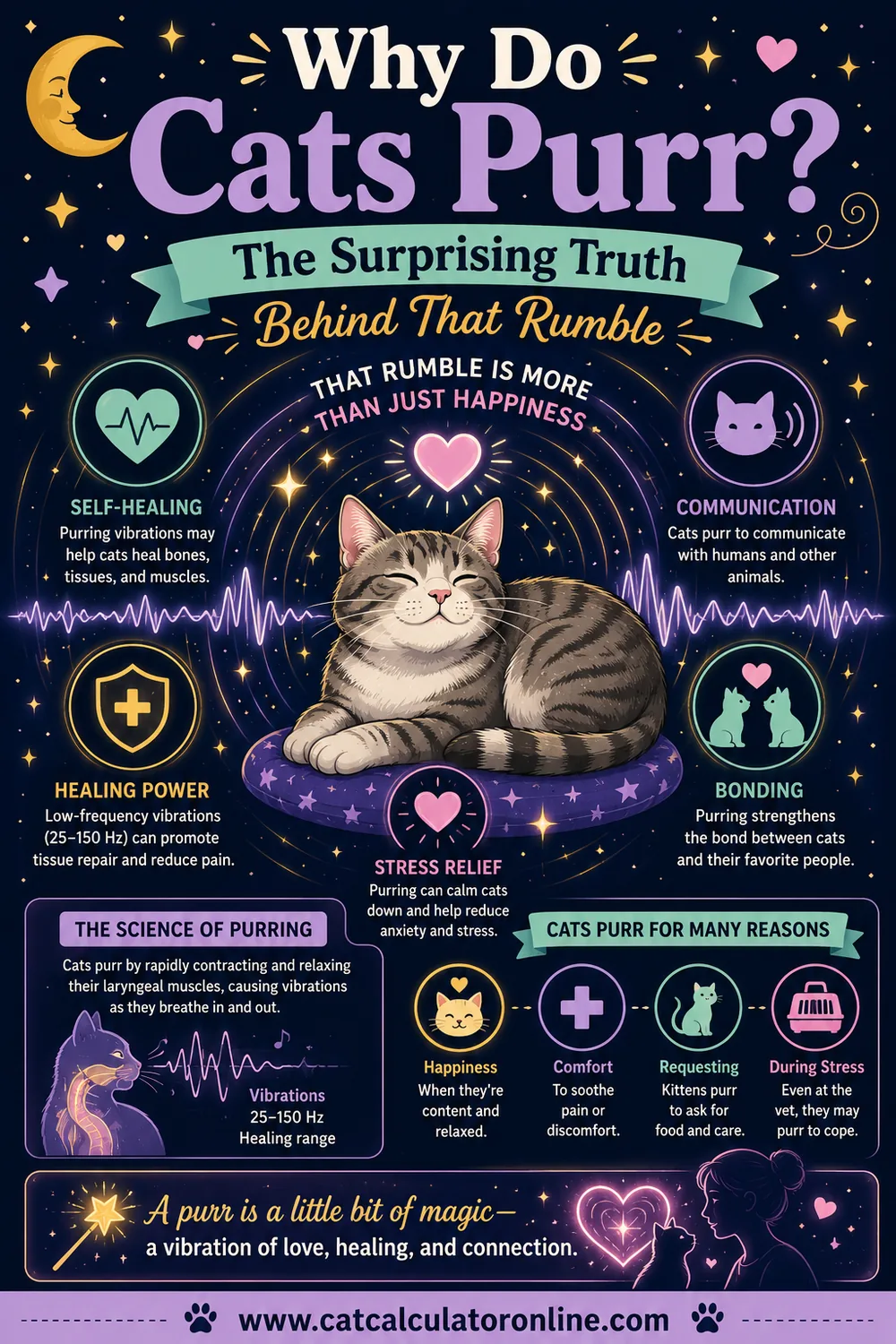
Cats purr by rapidly twitching the muscles around their voice box, which vibrates the air moving in and out at roughly 25 to 150 Hz — that low, steady motor sound. Most of the time it means your cat is content and relaxed. But purring isn't a happiness meter: cats also purr when they're stressed, injured, in pain, or giving birth.
That surprises a lot of owners, and it's genuinely useful to know. If you're also curious how old your cat is in human terms — which changes what her purring habits and health needs look like — our free cat age calculator will tell you in one tap.
🐾 What’s that purr actually saying?
Tap the situation and see the most likely meaning:
Tap a situation above to see what the purr probably means.
How a Purr Is Actually Made
For a long time nobody was sure where the sound came from. The leading explanation now is that purring starts in the brain, which sends a rhythmic signal to the muscles of the larynx — the voice box. Those muscles contract and relax very fast, opening and closing the space between the vocal folds. Air rushing past that flickering gap on both the inhale and the exhale makes the vibration you hear and feel.
Two details make purring unusual among cat sounds:
- It's continuous. A meow happens on the out-breath. A purr keeps going in both directions, which is why it sounds like an idling engine rather than a word.
- It's low. Purring sits in the range of about 25 to 150 Hz — near the bottom of what humans hear well, which is part of why we feel it as much as we hear it.
Not every cat in the world purrs, either. Domestic cats purr but can't roar. Big roaring cats like lions and tigers have a differently structured voice box and don't purr the way your house cat does.
Purring Starts Almost at Birth
Kittens purr when they're just a few days old — before their eyes even open properly, which happens around 7 to 10 days.
That timing tells you something about what purring is for. A newborn kitten is blind, deaf at first, and completely dependent. It can't call out reliably or find its mother by sight. But a vibration travels beautifully through a warm pile of bodies. The queen purrs, the kittens purr back, and the litter stays oriented, calm, and latched on.
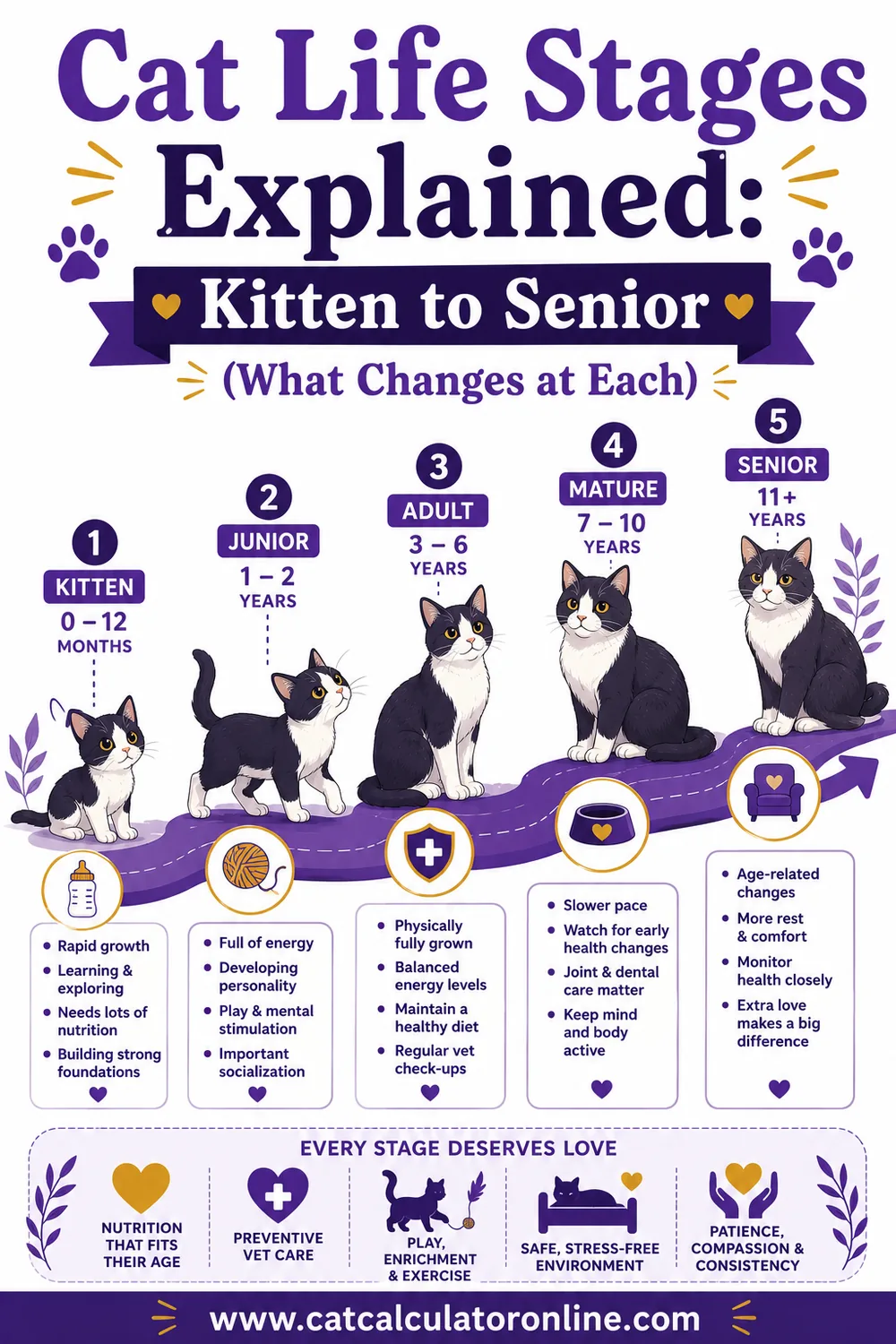
So purring's original job looks less like "I'm happy" and more like "I'm here, we're okay." That's the foundation everything else is built on. For the full picture of what changes at each stage of a cat's life, see cat life stages explained.
The Many Meanings of a Purr
Here's the part most people don't expect. A purr is a general-purpose signal, and the meaning depends almost entirely on context and body language.
| When she purrs | What it usually means | What else you'll see |
|---|---|---|
| Curled on your lap | Contentment | Loose body, half-closed eyes, slow blinking, maybe kneading |
| While you're petting her | Enjoyment, "keep going" | Head pushing into your hand, tail relaxed |
| At the food bowl | A request | Weaving around your legs, an urgent cry mixed into the purr |
| Greeting you at the door | Social bonding | Tail up, cheek rubbing |
| In the carrier or at the vet | Self-soothing under stress | Tense body, flat ears, dilated pupils, hiding |
| While injured or unwell | Coping, self-comfort | Hunched posture, hiding, reduced eating |
| During labor | Coping and calming | Nesting, restlessness, contractions |
| Between mother and kittens | Locating and reassurance | Nursing, the litter piled together |
Read the whole cat, not just the sound. A relaxed cat is loose — soft body, ears forward or neutral, tail still or gently swaying, eyes soft. A stressed cat purring is tight — crouched, ears back, pupils wide, muscles hard under your hand. Same noise, completely different message.
Solicitation Purring: The Purr That Manipulates You
This one is a genuine delight once you know about it, because you'll hear it immediately in your own cat.
Some cats produce a special purr with a high-frequency cry embedded inside it — a sound sitting in roughly the same range as a human infant's cry. The purr says "I'm friendly, don't ignore me." The cry hiding inside it says "act now." People find the combination much harder to tune out than an ordinary purr, and cats who use it tend to use it around food and around wake-up time.
It's not calculated scheming. It's learning. A cat tries a sound, you get up and open a can, and the sound gets reinforced. Over years of living alongside us, cats have gotten remarkably good at finding the noises that move humans.
Owners often describe this as "the annoying purr" or "the 5am purr." Now you know why it works on you.
Purring at the Vet: When Comfort Isn't the Point
Vets see this constantly. A cat arrives clearly frightened — pressed into the back of the carrier, pupils huge — and purrs the whole way through the exam.
The current thinking is that purring is self-soothing. It's a behavior a cat can produce for itself, at low energetic cost, that seems to help it stay regulated under stress. Some researchers describe it as a self-calming mechanism carried over from kittenhood, when purring meant safety and mother.
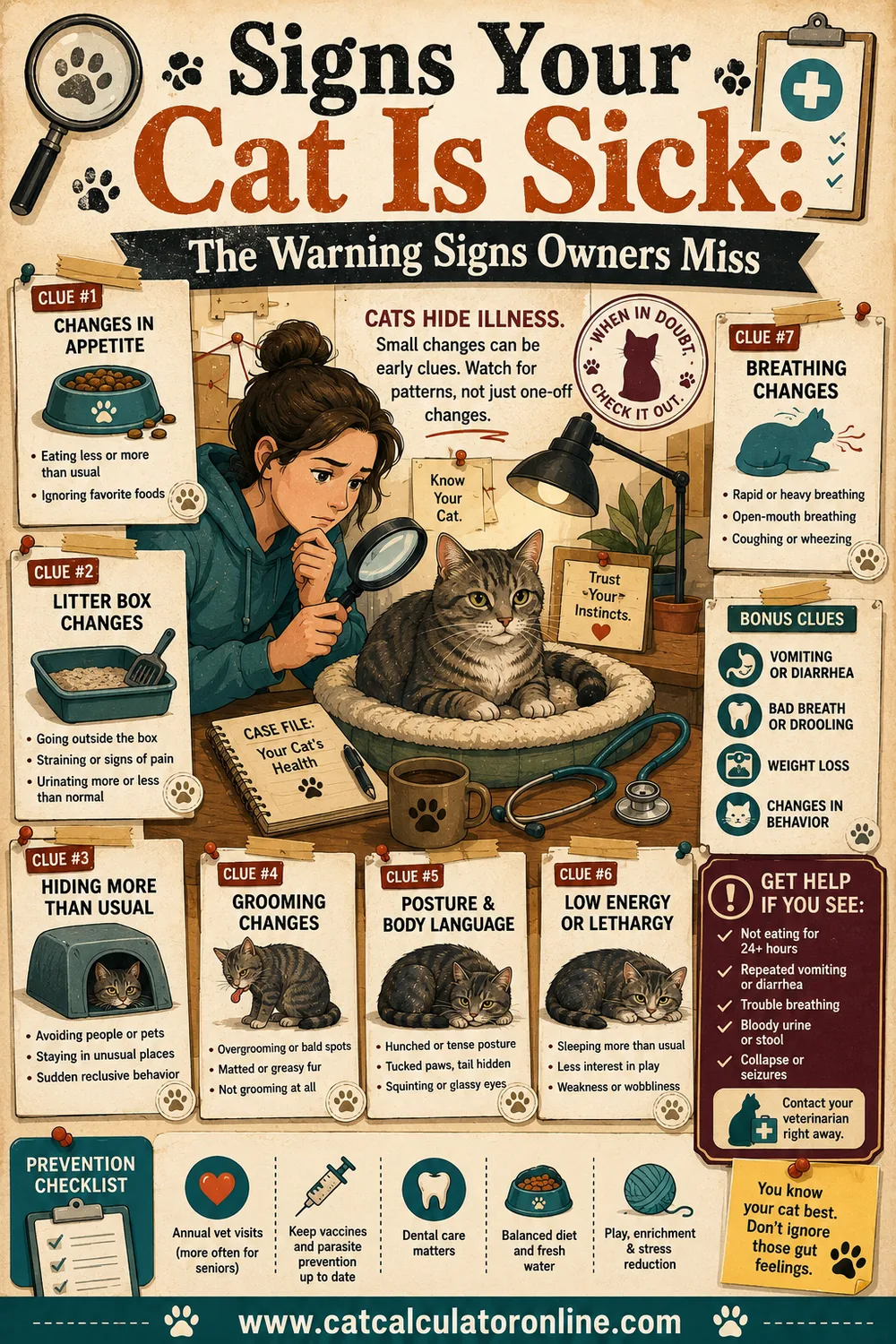
The practical takeaway for you: never use purring alone as evidence that your cat is fine. If she's purring but hiding under the bed, skipping meals, sitting hunched, or reacting badly to being touched somewhere, the purr isn't reassurance — it's part of the picture that says something's wrong. Our guide to signs your cat is sick walks through the changes worth watching.
The Healing Theory — Interesting, Not Proven
You've probably seen the claim that purring heals bones. It's worth explaining properly, because the real story is more interesting than the internet version.
The observation behind it: purring sits in a low frequency range, and separate laboratory research on vibration therapy has found that certain low-frequency vibrations can influence bone density and tissue repair. Some scientists noticed the overlap and proposed a hypothesis — that purring might serve as a kind of built-in, low-energy self-maintenance for an animal that spends most of its day lying still.
It's a genuinely appealing idea. It would explain why cats purr in situations that have nothing to do with pleasure, like injury and labor.
But it is a hypothesis, not a settled finding. There's no strong evidence that a cat's own purring measurably heals its own bones, and no evidence at all that sitting near a purring cat repairs yours. Enjoy the theory. Don't repeat it as fact, and definitely don't treat a purr as a substitute for a vet visit.
When Purring Should Worry You
Purring itself is never the problem. The problem is a purr that comes packaged with other changes. Call your vet if you notice:
- Purring plus hiding. A cat that suddenly wants to be alone, under furniture or in a closet, is often unwell.
- Purring while breathing oddly. Open-mouth breathing, fast or labored breathing, or effort in the belly is an urgent sign — cats almost never pant normally.
- Purring but not eating. Cats can get seriously ill from going without food for even a couple of days.
- Purring when touched in one spot. If a specific area triggers purring plus flinching or tension, that can be a pain response.
- A purr that changes sound. A newly raspy, wheezy, or absent purr in a cat who always purred is worth mentioning.
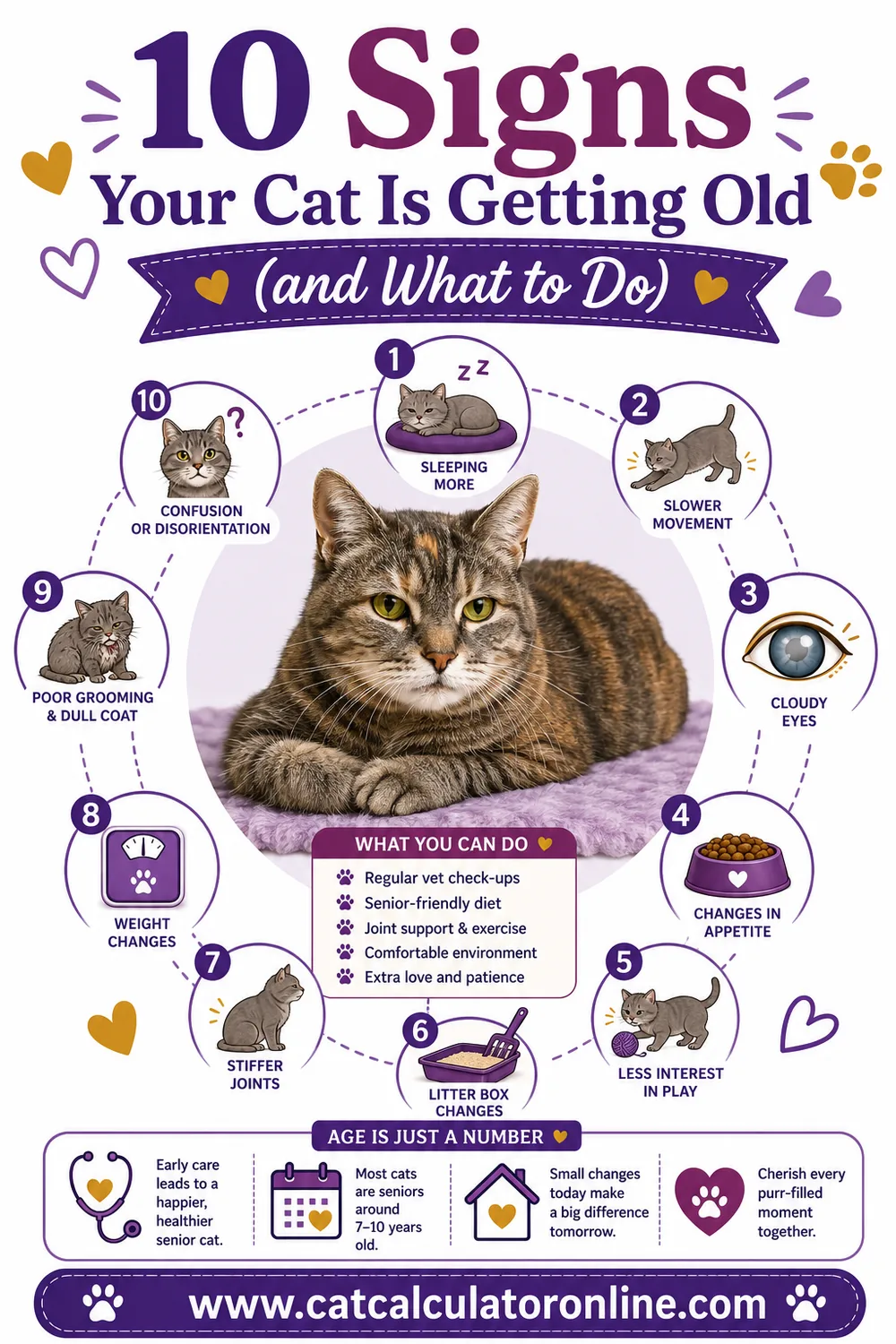
- Constant purring in an older cat, alongside restlessness or night-time yowling. In seniors this can relate to cognitive changes, thyroid issues, or blood pressure. See signs your cat is getting old.
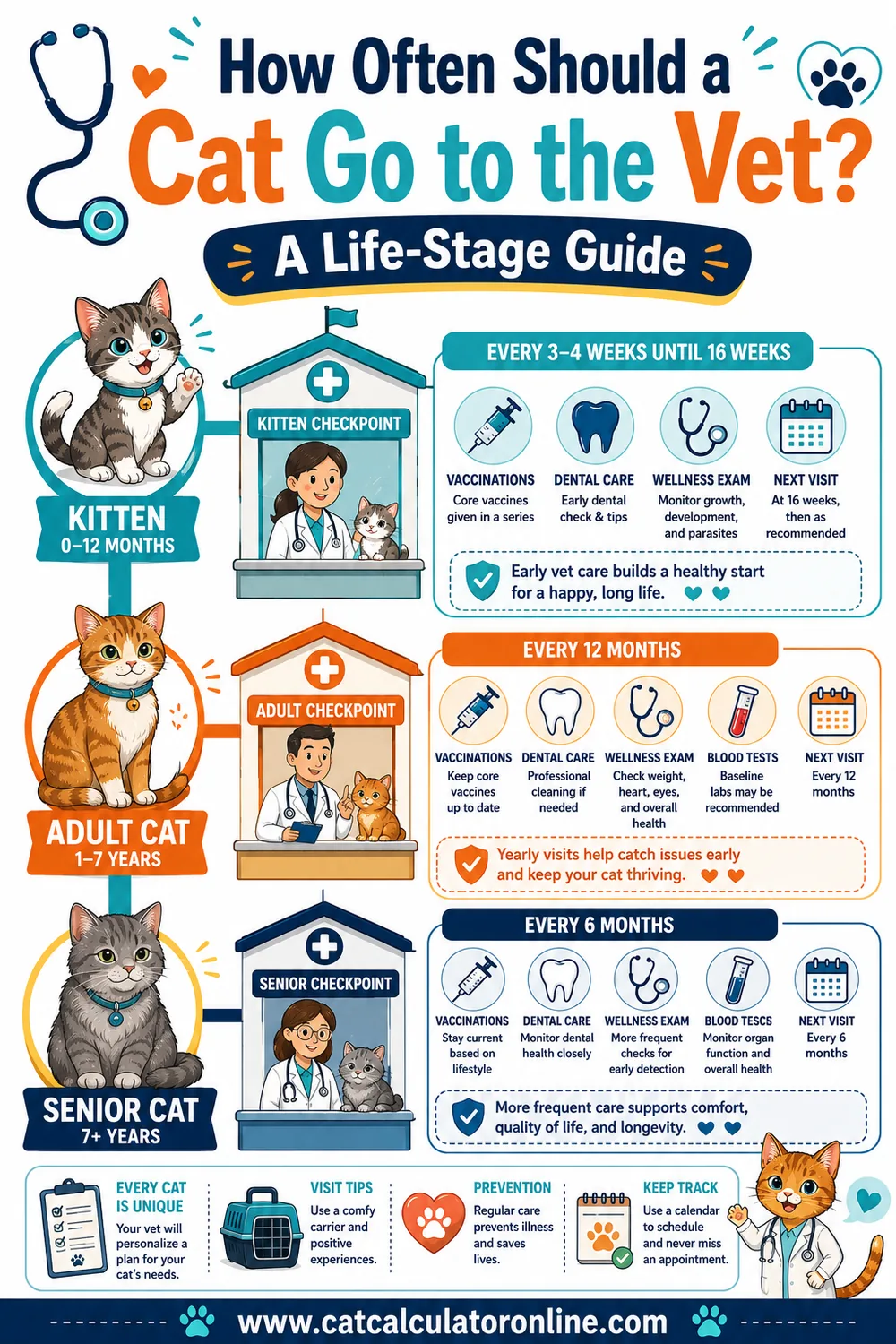
None of these are diagnoses — they're reasons to get a professional set of eyes on your cat. If you're unsure how often that should be happening anyway, read how often should a cat go to the vet.
Why Some Cats Barely Purr
If your cat rarely purrs, she isn't broken or unhappy. Purring varies enormously between individuals.
- Volume differs wildly. Some cats produce a purr you can hear across a room. Others make one you can only feel with a hand on the ribs.
- Personality plays a role. Reserved cats often purr less. That doesn't mean they're less attached — they may just show it through proximity, slow blinks, or head bumps instead.
- History matters. Cats hand-raised without a mother, or those with rougher early lives, sometimes purr differently.
- Some cats save it. Certain cats purr only for one person, or only at specific times of day.
Look at the full relationship instead of the soundtrack. A cat who chooses to sleep near you, follows you between rooms, and blinks slowly at you is telling you plenty without a single rumble.
FAQ
Why do cats purr when you pet them?
Usually because they're enjoying it. Petting mimics the social grooming cats do with trusted companions, and purring is part of the friendly-social signal set. Combined with a loose body and slow blinks, it means she wants you to keep going.
Do cats purr when they're in pain?
Yes. Cats purr when injured, unwell, stressed, and during labor, most likely as a self-soothing behavior. That's why purring alone should never be read as proof that your cat is comfortable — check her posture, appetite, and breathing too.
Can cats control their purring?
Partly. Purring is driven by a rhythmic neural signal to the laryngeal muscles, and it often happens automatically in emotional situations. But cats clearly learn to deploy purring toward people — solicitation purring around feeding time is a good example.
Does purring actually heal bones?
There's a hypothesis that low-frequency purring could aid tissue and bone repair, based on separate research into therapeutic vibration. It's an intriguing idea, not established science. Treat it as a fun theory rather than a reason to skip the vet.
At what age do kittens start purring?
Within the first few days of life, before their eyes are fully open. Early purring works as a signal between a mother and her litter, helping the kittens stay close and calm while nursing.
Why does my cat purr and then bite me?
Often over-stimulation. A cat can enjoy being petted and hit her limit quickly, especially along the belly or the base of the tail. Watch for a twitching tail tip, skin rippling, or ears rotating back — those come before the bite.
The Bottom Line
Purring is a vibration your cat makes with her voice box, somewhere around 25 to 150 Hz, and it starts within days of birth. It usually means contentment — but it also shows up during stress, illness, injury, and labor, so the sound only makes sense alongside the rest of her body language.
Curious what else is going on with your cat as she ages? Start with our free cat age calculator to see her age in human years, then read cat life stages explained and signs your cat is getting old to know what to expect next.