Is There a Such Thing as Cat Years? Yes, Here's How It Works
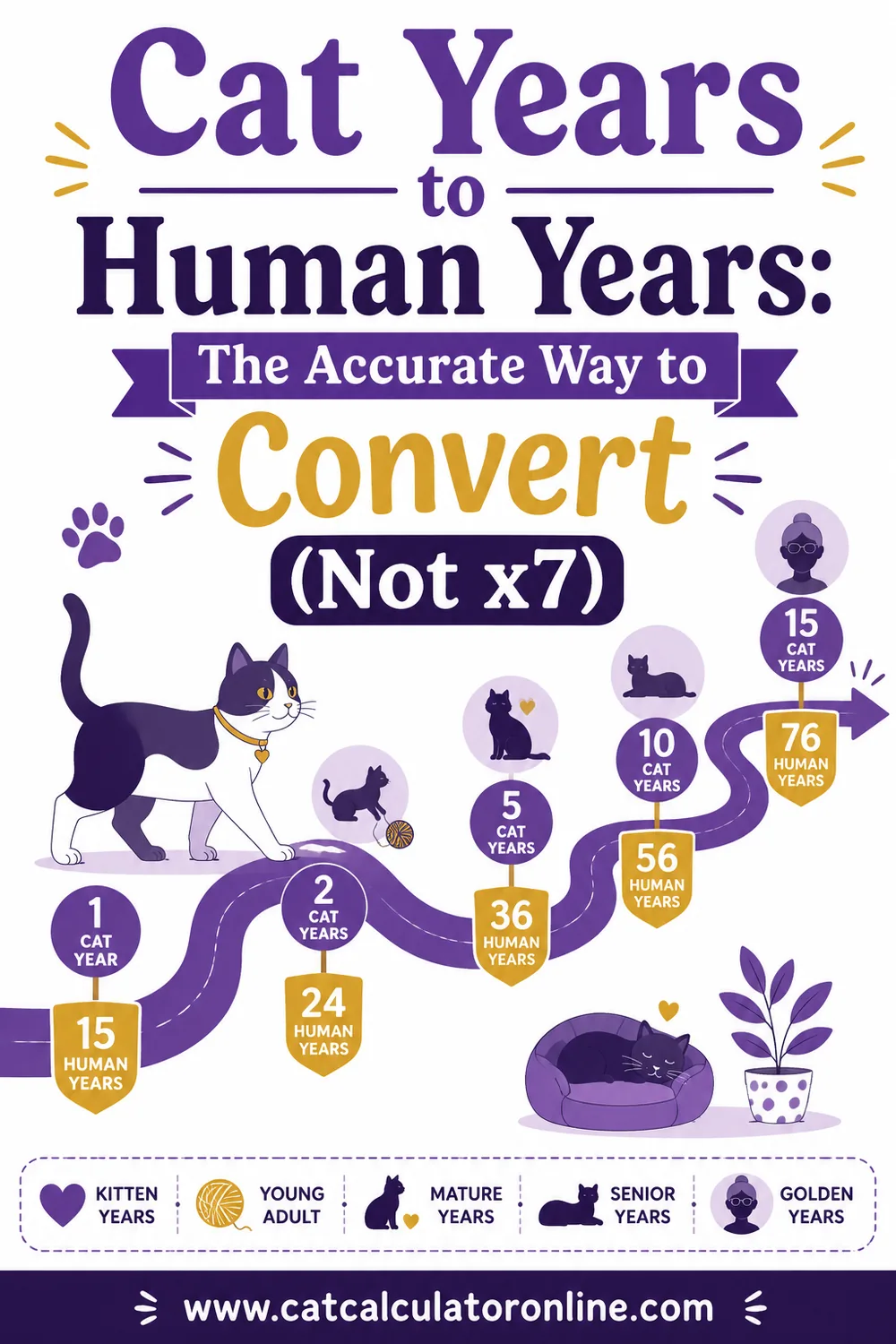
Yes, "cat years" is a real, useful concept — it's just not what most people think it is. Cat years aren't a fixed multiplier like "1 human year = 7 cat years." A cat's aging is front-loaded: the first two years pack in roughly 24 "human-equivalent" years of development, and after that, aging slows to about 4 human years per cat year. The old multiply-by-7 rule gets thrown out by every vet who's looked closely at it, because it makes a 1-year-old cat "7," when in reality a 1-year-old cat is already sexually mature, full-grown, and roughly equivalent to a 15-year-old human.
Why "Cat Years" Exists as an Idea at All
The concept isn't nonsense — it comes from a real need. A cat's lifespan (typically 12–18 years) is so much shorter than a human's that owners have no intuitive sense of what a given age means for their cat's health, energy, or care needs. "Cat years" is an attempt to translate a cat's age into a scale humans already understand, the same way people talk about dog years.
The problem was never the idea — it was the math. The 1-cat-year-equals-7-human-years rule was a simple guess, not a study, and it doesn't hold up against how cats actually age biologically.
The Real Formula: Why Aging Isn't Linear
Cats mature enormously fast in year one, more in year two, and then level off. Veterinary associations (including the American Association of Feline Practitioners) now use a widely cited non-linear scale:
- Year 1 = about 15 human years
- Year 2 = about 24 human years total (year 2 adds about 9)
- Every year after that = about 4 human years added per cat year
So a cat isn't aging at a steady rate at all. It's more like a rocket launch: a huge burst of development in the first 12–24 months to reach adulthood, then a long, gradual cruise afterward.
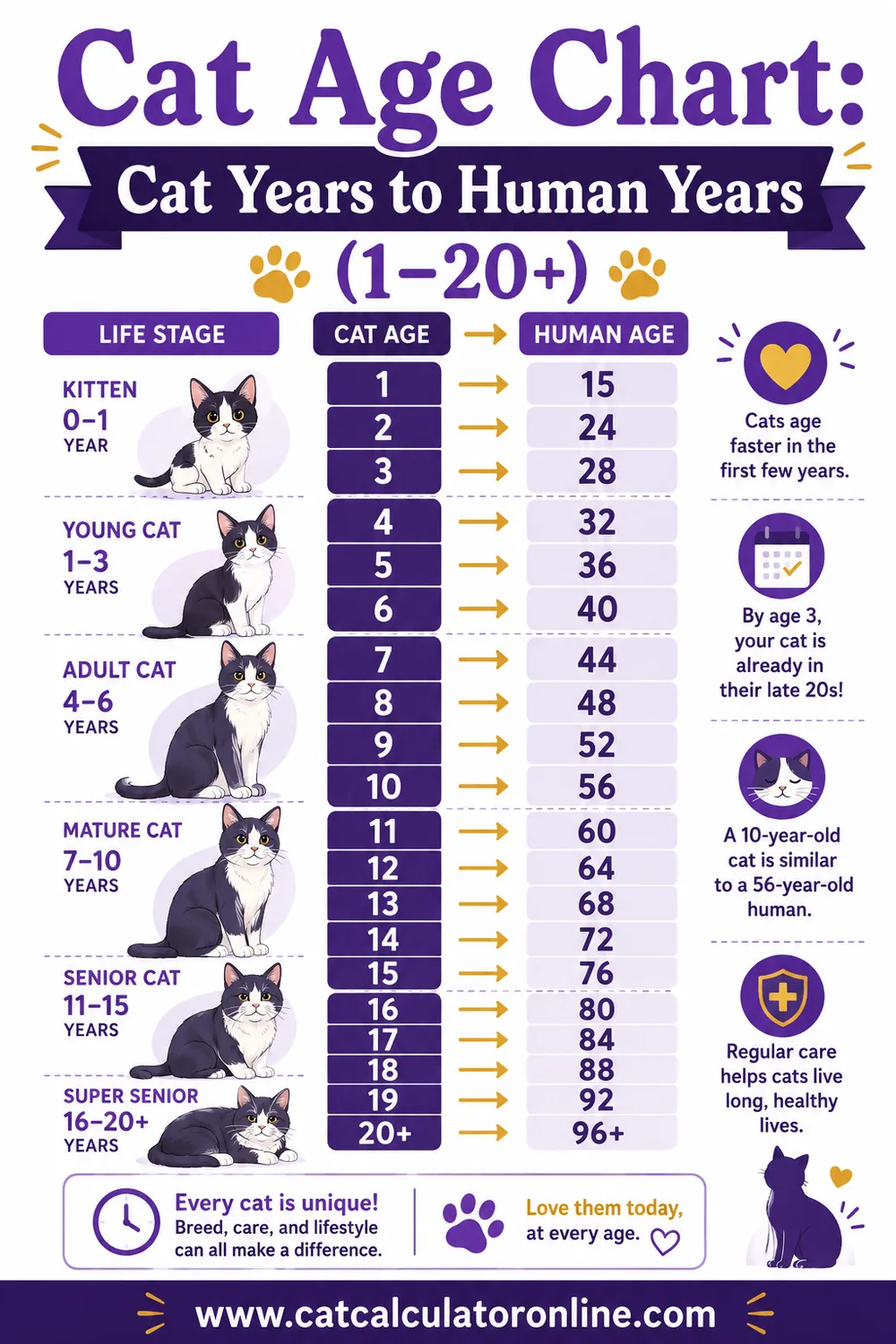
Full Cat Age Chart
| Cat's age | Human-equivalent age |
|---|---|
| 6 months | ~10 years |
| 1 year | 15 years |
| 2 years | 24 years |
| 3 years | 28 years |
| 4 years | 32 years |
| 5 years | 36 years |
| 6 years | 40 years |
| 7 years | 44 years |
| 8 years | 48 years |
| 9 years | 52 years |
| 10 years | 56 years |
| 12 years | 64 years |
| 15 years | 76 years |
| 18 years | 88 years |
| 20 years | 96 years |
If you'd rather not do the math by hand, a cat age calculator gives you the exact number instantly, and adjusts for indoor vs. outdoor lifestyle, which changes the picture more than most owners expect.
Why the Old "×7" Rule Refuses to Die
It's simple, it's memorable, and it was repeated for decades before anyone checked it against real data. The trouble is it fails at both ends of a cat's life:
At the young end: ×7 says a 1-year-old cat is "7" — a child. In reality, a 1-year-old cat can already have kittens of her own and is fully grown. She's much closer to a human in their mid-teens to early twenties.
At the old end: ×7 says a 15-year-old cat is "105" — implausibly ancient. Using the real curve, a 15-year-old cat is about 76, which lines up far better with how a cat that age actually looks and behaves: slower, often a little arthritic, but very much still living a normal life, not in hospice.
The ×7 rule isn't just imprecise — it's wrong in a way that would make you misjudge your own cat's health stage.
Indoor vs. Outdoor Cats Age Differently
The human-equivalent chart above assumes an average, moderately cared-for cat. Two things shift it substantially:
Indoor cats live longer — typically 12–18 years, sometimes 20+, because they avoid cars, predators, disease exposure, and fights. An indoor cat "ages" a bit more slowly across its whole life relative to its calendar age, simply because it's healthier for longer.
Outdoor cats age faster and live shorter — commonly 2–5 years on average, sometimes much less in high-risk areas. This isn't really about biological aging speed; it's about survival odds. An outdoor cat's health curve tends to decline earlier because of accumulated injury, parasite load, and disease exposure that an indoor cat never encounters.
Breed also plays a role: smaller, lighter cats (like Siamese) tend to live longer than large breeds (like Maine Coons), which is the opposite of the pattern in dogs.
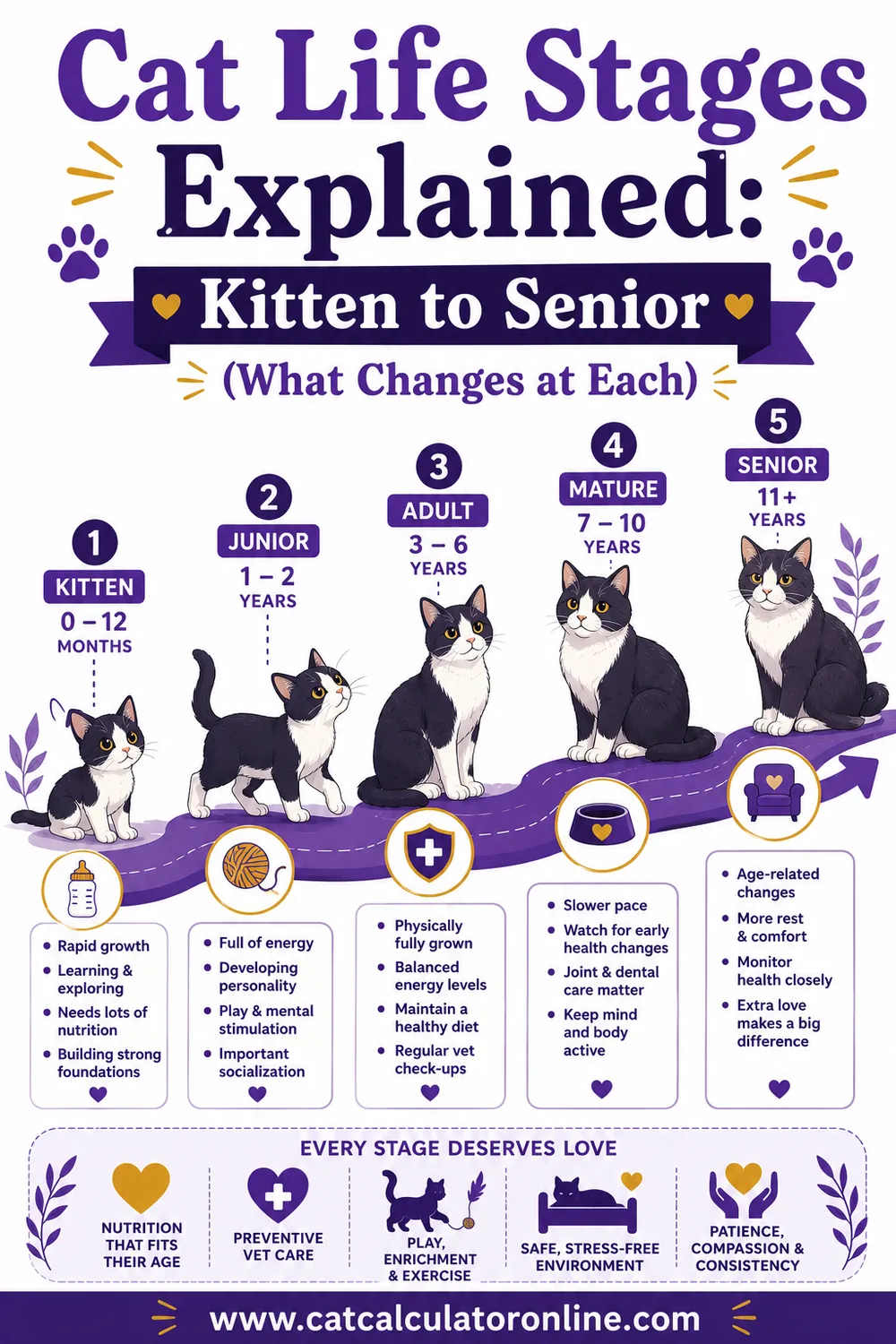
What Each Life Stage Actually Looks Like
Kitten (0–6 months, roughly 0–10 human years): Rapid growth, baby teeth replaced by adult teeth around 6 months, full of energy, still learning social behavior.
Junior (6 months–2 years, roughly 10–24 human years): Reaches full size and sexual maturity, personality settles, energy peaks.
Adult (3–6 years, roughly 28–40 human years): Prime of life. Stable weight, established routine, lowest health-risk period.
Mature (7–10 years, roughly 44–56 human years): Metabolism starts slowing. This is when vets typically recommend starting annual bloodwork, since early kidney and thyroid changes often begin here.
Senior (11–14 years, roughly 60–72 human years): Activity drops, joint stiffness becomes more common, dental disease risk rises.
Geriatric (15+ years, 76+ human years): Cats in this range need more frequent vet visits — every 6 months rather than yearly — since conditions progress faster and are easier to manage caught early.
Why This Matters Beyond Trivia
Knowing a cat's real human-equivalent age isn't just a fun fact — it changes what you should actually be watching for:
- A cat that's "44 in human years" (age 7) benefiting from a vet baseline bloodwork panel, even if she seems perfectly healthy, is a completely reasonable ask — that's roughly the age human doctors start recommending more proactive screening too.
- A cat that's "76 in human years" (age 15) slowing down isn't necessarily sick — that's a completely normal amount of slowing for that stage of life, the same way a 76-year-old human walks slower than they did at 30.
- Weight gain that seems minor in cat terms can be much more significant in human-equivalent terms, especially in the accelerated 0–2 year window.
How Other Animals' "Years" Compare
Cats aren't the only pet whose age gets a popular but oversimplified conversion. Dogs are the most familiar comparison, and they follow a broadly similar pattern — a fast first two years followed by a slower, steadier climb — though dog aging rate also depends heavily on breed size, with large dogs aging faster in adulthood than small ones. Rabbits, by contrast, mature even faster than cats relative to their total lifespan, often reaching adulthood within about six months, since their much shorter overall lifespan compresses the same developmental milestones into a tighter window.
What all of these "years" concepts share is the same underlying flaw in the popular versions: a flat multiplier that assumes constant aging speed across an entire lifetime, when in reality nearly every mammal (humans included) goes through a fast developmental phase early on followed by a much slower, more gradual adult aging curve. The multiplier myths persist mostly because they're simple and memorable, not because they were ever accurate.
Signs of Aging to Actually Watch For at Each Stage
Knowing the numeric human-equivalent age is useful mostly because it tells you what to expect physically and behaviorally. A few concrete markers worth tracking as your cat moves through each stage:
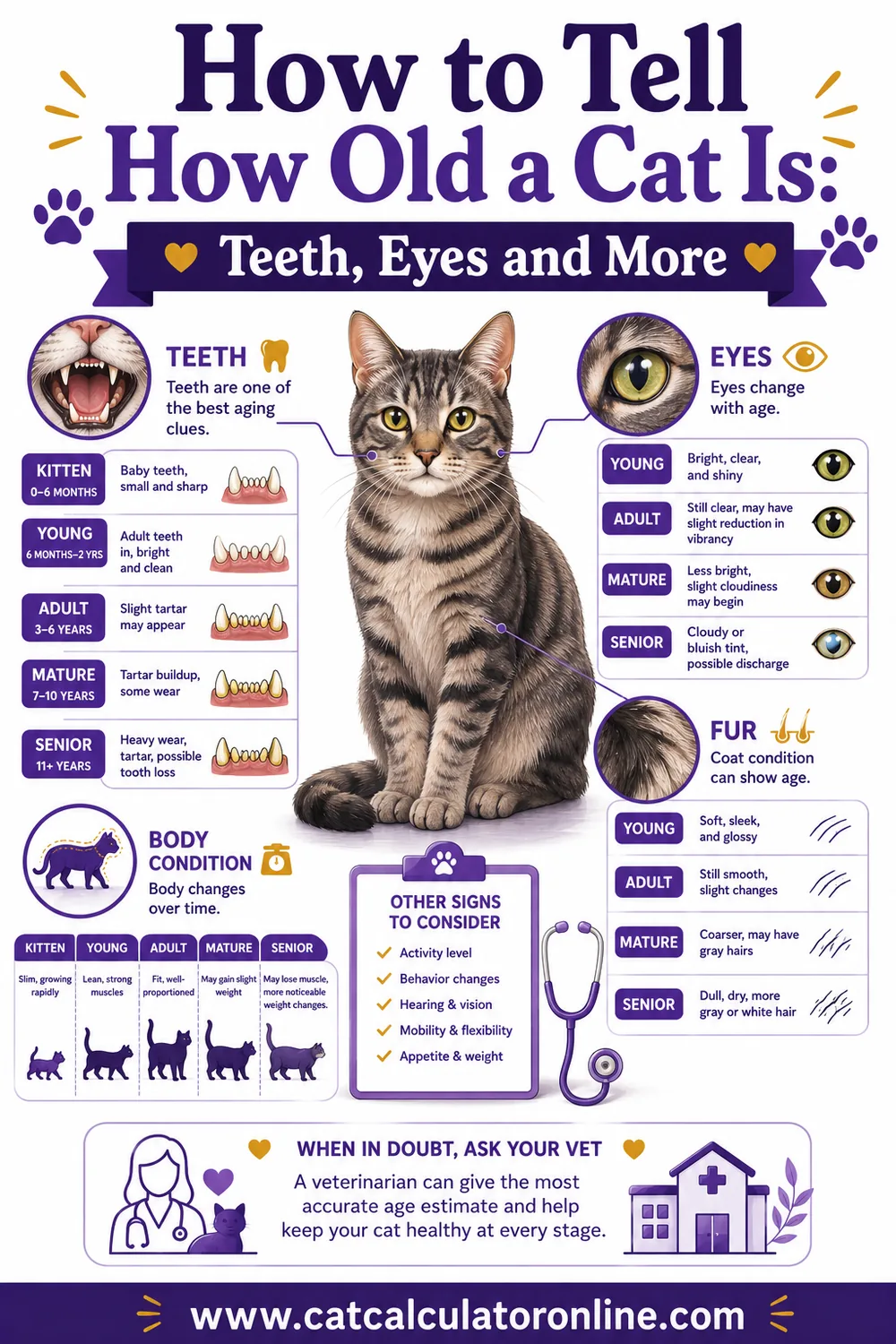
Coat and grooming changes. A cat's coat often becomes slightly coarser or less glossy starting in the mature stage (human-equivalent late 40s), and reduced self-grooming in the senior years can be one of the earliest visible signs of joint discomfort making it harder to reach certain areas comfortably.
Activity and sleep patterns. A gradual increase in total daily sleep and a drop in spontaneous play is completely normal starting in the mature-to-senior transition, but a sudden, sharp change over just a few weeks is worth a vet visit rather than being written off as "just getting older."
Appetite and weight. Both unexplained weight loss and weight gain become more clinically significant as a cat moves into the mature and senior stages, since they're common early indicators of thyroid, kidney, or metabolic changes that are far more treatable when caught early.
Litter box habits. Changes in frequency, straying outside the box, or visible discomfort while using it are worth flagging at any age, but become statistically more relevant health indicators from the mature stage onward, when kidney and urinary issues become more common.
Why Vets Use Age-Adjusted Care Schedules
Once you understand that a cat's human-equivalent age accelerates and then levels off, it makes sense why veterinary care recommendations shift the way they do. A kitten's rapid early development means frequent vet visits in the first year (vaccinations, growth checks, spay/neuter timing) even though very little can go clinically "wrong" with a healthy kitten in the traditional aging sense. An adult cat in its prime years typically needs only annual checkups, since this is genuinely the lowest health-risk period of a cat's life. Once a cat crosses into the mature and senior stages — which, as the chart above shows, can start as early as chronological age 7 — the recommended visit frequency increases again, this time because age-related conditions become statistically more likely and are far more manageable when caught in early, asymptomatic stages through routine bloodwork rather than waiting for visible symptoms.
How Vets Actually Use This Chart in Practice
When you bring your cat in for a checkup, a good vet isn't just looking at chronological age on a chart — they're using the human-equivalent framework as a mental shortcut for what to expect and what to screen for. A vet examining a 9-year-old cat (roughly 52 in human terms) is thinking about the same category of concerns a physician would flag for a person in their early fifties: are cholesterol-adjacent markers (in cats, this looks more like kidney and thyroid values) starting to shift, is joint wear becoming a factor, has metabolism started to change in a way that affects ideal body weight. This is exactly why annual bloodwork panels tend to expand in scope once a cat crosses into the mature stage — not because the vet is being cautious for caution's sake, but because the statistical risk profile has genuinely shifted, the same way a human's does at a comparable life stage.
This is also why breed and individual health history matter alongside the general chart. A cat with a family or breed history of kidney issues (common in certain lines) may benefit from earlier or more frequent screening than the general chart suggests, while a consistently healthy indoor cat with no particular risk factors might comfortably stick to the standard schedule longer. The chart is a starting point for a conversation with your vet, not a rigid protocol that overrides your cat's individual circumstances.
The Emotional Side of Understanding Cat Age
There's a reason so many cat owners search for this information beyond pure curiosity — understanding where your cat actually sits on a human-equivalent scale can reframe how you think about the time you have together. Realizing that your seemingly "still young" 8-year-old cat is actually deep into middle age in human terms (around 48) can be the nudge that gets an owner to finally schedule that overdue wellness exam, or to start being a bit more intentional about weekly playtime and quality time together. On the flip side, understanding that a slower, calmer 12-year-old cat (about 64 in human terms) is behaving completely age-appropriately — not sick, not declining unusually fast, just genuinely getting older — can bring real relief to an owner who was worried something was wrong.
Neither reaction is wrong. Cats live shorter lives than we do, and having an honest, accurate sense of where your specific cat sits on that timeline is part of being a thoughtful, attentive owner — not something to be anxious about, but something worth understanding clearly rather than guessing at with an outdated multiplier that gets the whole picture wrong.
A Few Practical Ways to Support Your Cat at Every Age
Regardless of exact human-equivalent age, a few habits support a cat's health and comfort at every life stage: consistent, measured feeding rather than free-feeding, which helps catch appetite changes early and supports healthy weight; regular, low-stress vet visits rather than only going when something seems wrong, since cats are notoriously good at hiding pain and illness until it's fairly advanced; environmental enrichment (climbing space, scratching options, window access, interactive play) that scales to your cat's current mobility and energy level rather than staying static for fifteen years; and simply paying attention to your own cat's individual baseline, so you notice meaningful changes quickly rather than only in hindsight.
What One Cat Year Is Worth in Human Years
The answer changes depending on which year of the cat's life you mean, and that is the part most quick answers leave out.
What is one cat year in human years? It depends where on the curve you are standing:
- The first year of life: worth about 15 human years.
- The second year: worth about 9 more, taking a 2-year-old to roughly 24.
- Every year after that: worth about 4.
So a single cat year can be worth 15 human years or 4, a nearly fourfold difference, which is exactly why one fixed multiplier cannot work.
Are cat years the same as human years? No — and not only in length. A cat year is a calendar year like yours, but the biological aging packed into it varies enormously by life stage. A kitten's first twelve months cover infancy, childhood, and adolescence in one go; a ten-year-old cat's twelve months cover about the same ground as four of your own.
Put plainly, what are cat years in comparison to human years is a question about translation rather than arithmetic. The number is there to tell you which life stage your cat is in — kitten, young adult, mature, senior — using a scale you already have instincts about. It is a map, not a measurement.
Frequently Asked Questions
Is the "cat years" concept scientifically real, or made up? The concept — translating cat age into a human-equivalent scale — is a legitimate, useful tool that vets and researchers use. What's made up is the old ×7 formula. The real, current formula is non-linear: about 15 years for year one, 24 total by year two, then +4 per year after that.
Why isn't it just a simple multiplier like dog years sometimes are? Because cats (like most mammals, including humans) don't age at a constant rate. They mature explosively in the first two years to reach adulthood, then age much more slowly and steadily afterward. A single multiplier can't capture that curve.
How old is a 10-year-old cat in human years? About 56 human years — solidly into the "mature" life stage, roughly comparable to a human in their mid-fifties.
Do indoor cats really age slower than outdoor cats? Not biologically slower — but they typically live significantly longer and healthier lives because they avoid the accidents, predators, and disease exposure that shorten outdoor cats' lifespans on average.
At what age should I start taking my cat's aging more seriously for vet care? Most vets recommend annual senior screening starting around age 7 (roughly 44 in human years) and stepping up to twice-yearly visits from about age 11–12 onward.