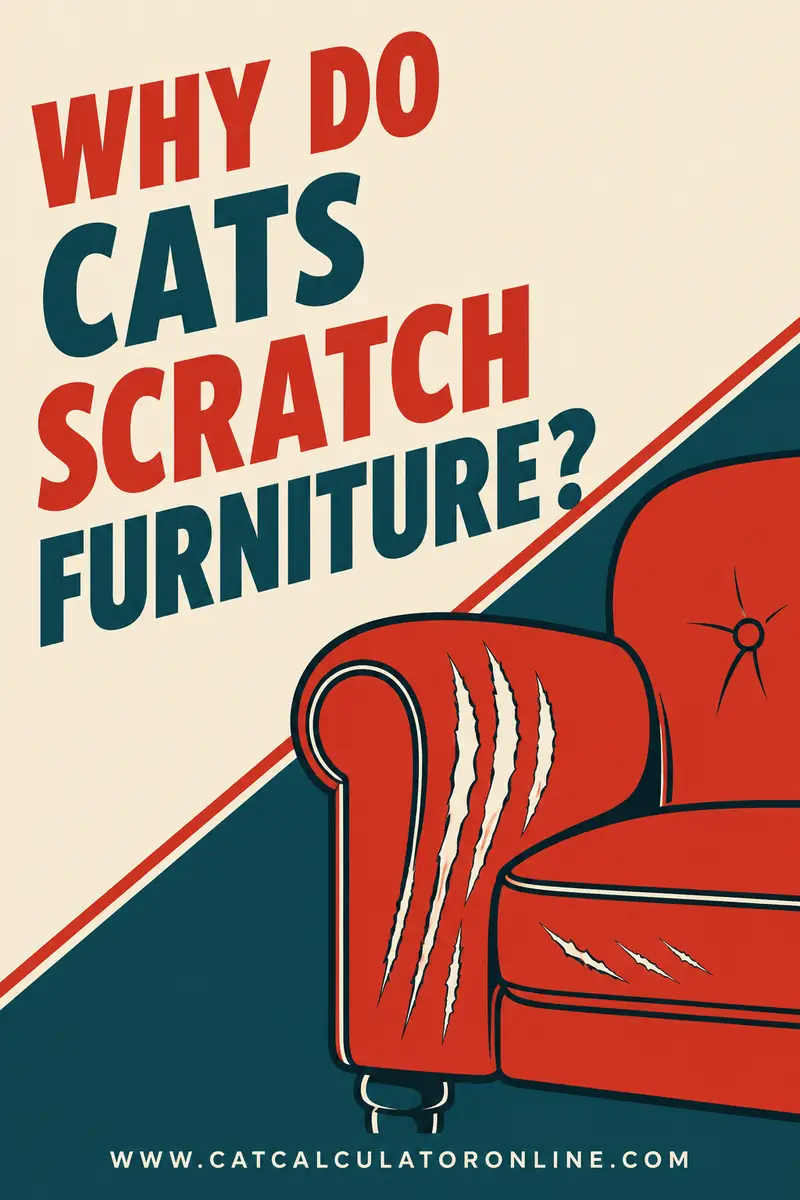
Why Do Cats Scratch Furniture?
Start with the reframe, because it changes what you do next: your cat is not trying to destroy the sofa, and she is not doing it to spite you. Scratching is a normal, necessary behavior that does four jobs at once — it strips the worn outer sheath off her claws, stretches her spine and shoulders, leaves a scent mark from glands between her toes, and leaves a visible mark that other cats can read. A cat who never scratches anything is a more worrying cat than one who scratches the armchair. That is why the fix is never to stop the behavior, only to move it — and why punishment reliably makes things worse. Curious how old the cat currently redesigning your furniture is in human terms? The free cat age calculator will tell you.
The Four Jobs Scratching Does
Every scratch is doing several things at once, which is why removing one outlet never removes the need.
| Job | What is happening | Why it matters to her |
|---|---|---|
| Claw maintenance | The worn outer sheath is pulled off | Keeps claws sharp and functional |
| Scent marking | Glands between the toes deposit scent | Signals ownership and reassures her |
| Visual marking | Shredded fibers and a torn surface | A message other cats can see from a distance |
| Stretching | Anchored claws let her extend fully | Works the spine, shoulders and back muscles |
Notice that only one of them is about claws. People assume trimming her nails will fix the problem. It reduces the damage, and it does nothing about the other three jobs.
Marking is arguably the biggest driver. A scratch post that has her scent on it is far more attractive to her than a new one, which is why replacing a battered post often restarts the sofa problem.
Stretching explains the timing. Most cats scratch within seconds of waking. Watch her tomorrow morning and you will see it.
Emotion plays a part too. Cats scratch when excited, when greeting you and when mildly frustrated — the same way people fidget.
None of it is aimed at you. There is no evidence that cats damage things out of resentment, and interpreting it that way leads straight to punishment, which backfires.
The Claw Mechanism: Why Sheaths Come Off
Cat claws work differently from ours and from dogs', and the difference explains a great deal.
Claws grow in layers, like an onion. As a new claw grows underneath, the old outer layer loosens and must be shed.
Dragging is what removes it. The claw hooks into a fibrous surface and the outward pull peels the dead sheath away.
You will find the sheaths. Small crescent-shaped shells around the scratch post look alarming and are completely normal — not broken claws.
Cat claws are retractable, which is why they need this. Because they are kept sheathed and off the ground, they are not worn down naturally the way a dog's are.
Back claws are usually chewed instead. Cats often groom the hind claws with their teeth rather than scratching with them, which is why the damage is almost always at front-paw height.
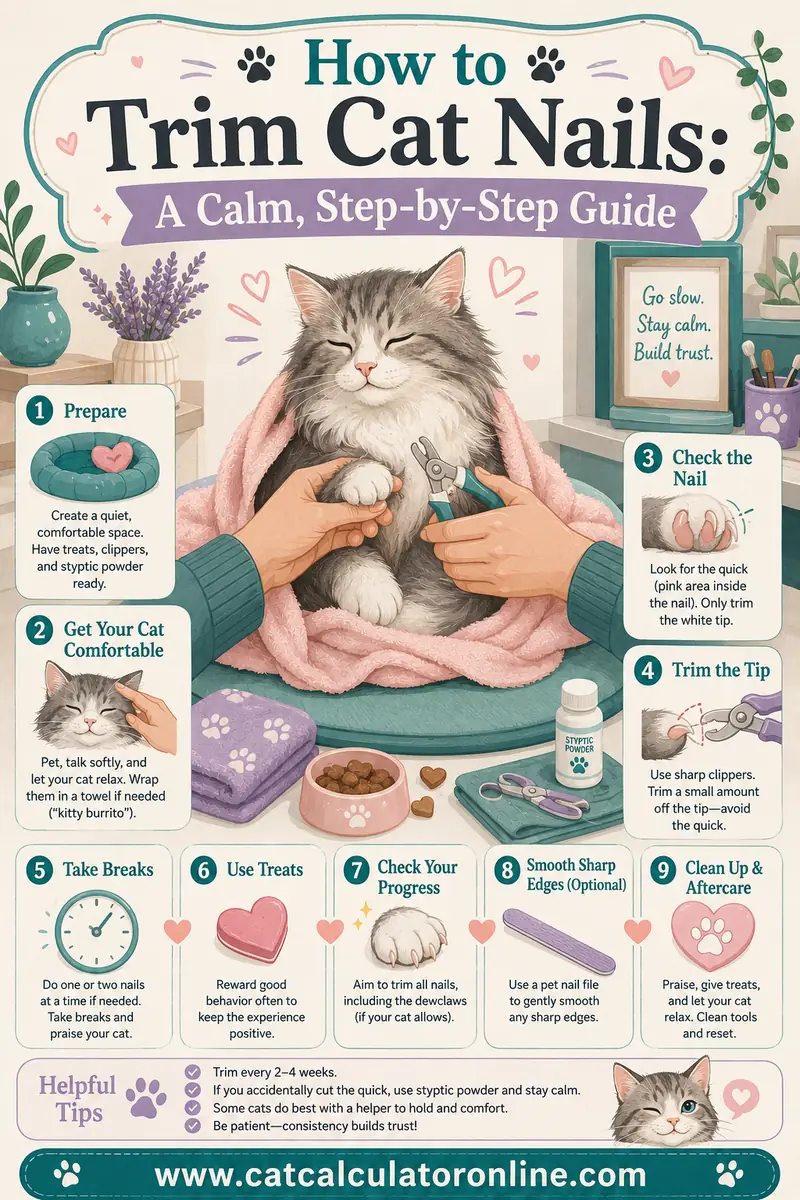
Trimming reduces damage without removing the drive. It is still worth doing regularly, and the method is in how to trim cat nails.
Scent: The Part You Cannot See
This is the reason the behavior is so persistent, and the reason location matters more than the object.
Interdigital glands sit between the toes. Scratching presses them against the surface and leaves a scent mark alongside the visible one.
The mark is a combined signal. Other cats get a visible sign from a distance and a scent record close up, including roughly how recently it was made.
Refreshing it is the point. She returns to the same spot repeatedly because the mark fades, not because she is fixated on your upholstery.
This is friendly marking, not anxious marking. Scratching is normal territorial behavior in a settled cat. Urine spraying is the version that indicates stress, covered in how to stop a cat spraying.
Which is why cleaning the spot rarely works alone. Removing her scent tends to prompt her to reapply it.
And why a used post is worth keeping. Battered and scent-soaked is exactly what a good post should look like.
Why She Picks That Exact Spot
Cats are not scratching randomly, and the pattern is readable once you know the rules.
Prominence matters. Cats mark where the mark will be seen — beside doorways, at the entrance to a room, next to the sofa where everyone sits.
Texture matters. Coarse, vertically threaded fabric that shreds satisfyingly is close to tree bark. Woven upholstery, sisal matting and carpet all qualify. Smooth leather usually does not, though the corners often do.
Stability matters more than anything. A cat needs to put real force through a surface. The sofa never wobbles, which is why it beats a lightweight post every time.
Height matters. She wants to reach full stretch. If her post is shorter than she is long when extended, it is not doing the job.
Routes matter. Scratch marks often line up along the paths she uses through the house, particularly near where she sleeps.
So the sofa is not a preference for expensive things. It is simply the best-designed scratching surface in the room. Full details on choosing furniture she will actually use are in the cat tree buying guide.
Why Punishment Makes It Worse
This is the single most common mistake, and it fails for a mechanical reason rather than a moral one.
She cannot connect the telling-off to the act. Cats do not reason backwards from your reaction to their earlier behavior. What she learns is that you sometimes become frightening.
The need does not go away. Scratching is not optional for her, so suppressing it in front of you simply moves it behind the sofa or to when you are out.
Water spraying damages the relationship. It works while you are watching and teaches her to avoid you, which is a poor trade for a slightly less scratched chair.
Fear increases marking. A cat who feels less secure marks more, so punishment can genuinely increase the total amount of scratching.
Shouting at a cat mid-scratch often reads as play. Some cats learn that scratching the chair summons an entertaining human, and the behavior becomes attention-seeking on top of everything else.
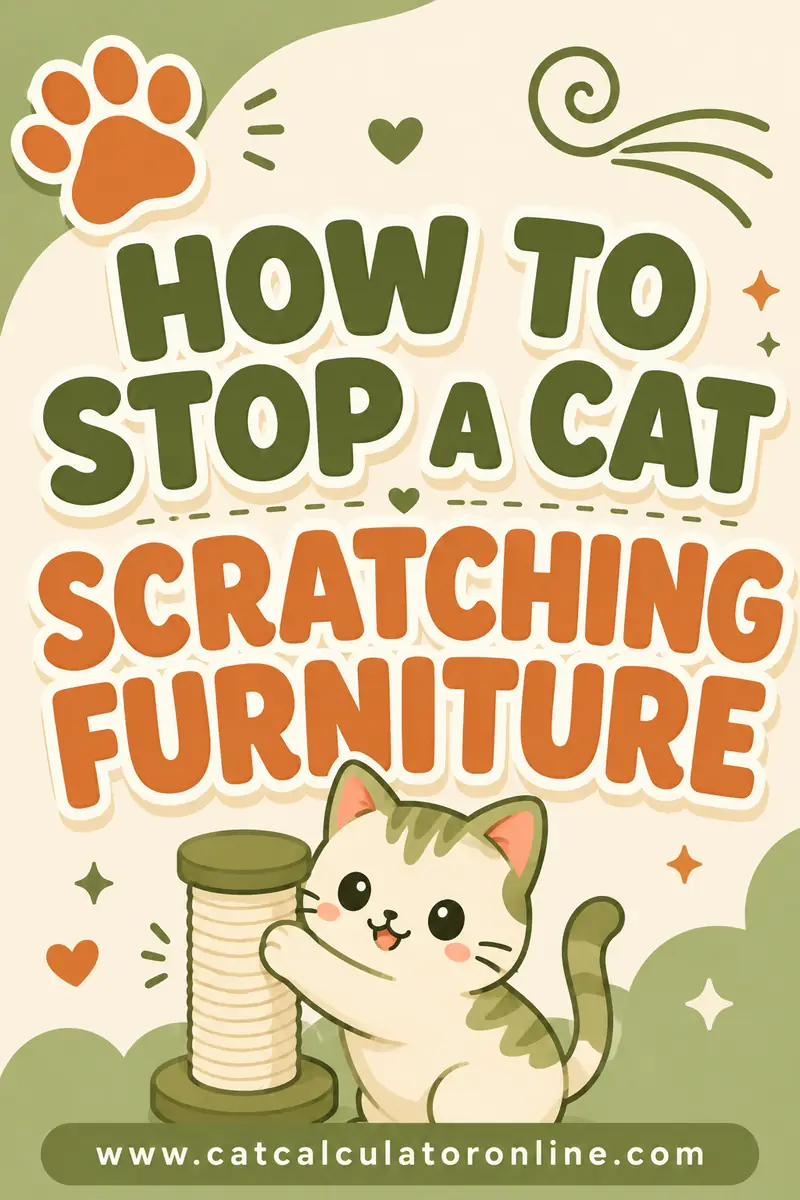
The reliable route is redirection. Give her something better, put it in the right place, and make the sofa temporarily dull — the full method is in how to stop a cat scratching furniture.
Horizontal, Vertical, and Individual Taste
Cats have strong personal preferences, and mismatched equipment is behind a great many unused scratch posts.
Some cats are vertical scratchers. Door frames, chair arms and upright posts. This is the most common pattern.
Some are horizontal scratchers. Carpet, rugs, doormats and flat cardboard pads. Buying an upright post for a horizontal scratcher wastes both your money and her time.
Some prefer an angle. Ramp-style scratchers suit cats that half-stand to scratch, and often suit older cats too.
Material preference is real. Sisal rope, sisal fabric, corrugated cardboard, seagrass and carpet all feel different. Cats generally prefer a surface that shreds in the direction they pull.
Watch what she already uses. Her current victim tells you the orientation and texture she wants, which makes choosing a replacement straightforward.
Offer more than one option. Multi-cat households need multiple scratching sites for the same reason they need multiple litter boxes.
When Scratching Suddenly Increases
A change in the amount of scratching is usually a change in how secure she feels.
A new cat in the house is the classic trigger. Both cats mark more while they work out the territory.
So is a cat outside the window. A visiting tom in the garden can set off indoor marking for weeks, and covering the lower part of the window often settles it.
Moving house resets everything. Expect a burst of marking in the first two weeks while she rebuilds her scent map.
Babies, builders and new furniture all count. Anything that changes the smell or layout of her territory can prompt it.
Scratching plus urine marking means real stress. Scratching alone is normal, and scratching combined with spraying or tray accidents is worth taking seriously.
Check for pain in an older cat. A cat who has stopped scratching at height, or who has thick overgrown claws, may have arthritis making the stretch uncomfortable — worth mentioning to your vet.
Declawing: What It Actually Is
This deserves a plain statement rather than the softened version the name implies.
Declawing is not a nail trim. It is an amputation. The surgeon removes the last bone of each toe, because the claw grows from it and cannot be taken out on its own. In human terms it is cutting off every finger at the last joint.
It is illegal in the United Kingdom under the Animal Welfare Act 2006, and banned or effectively prohibited across much of Europe, Australia, New Zealand and Israel.
It is banned in several Canadian provinces, and in the United States in New York State, Maryland, Washington and Virginia, plus a number of cities. Major veterinary bodies oppose it for anything other than genuine medical necessity, such as a tumour.
The consequences are well documented. Lasting pain in the feet, altered gait and back pain, litter box avoidance because digging hurts, and increased biting — because a cat without claws has one defense left.
It does not fix the underlying need. The behavior is driven by marking and stretching as well as claws, and those drives remain.
There are real alternatives. Good posts in the right places, regular claw trimming, temporary sofa protectors and vinyl nail caps handle almost every case. Cat-proofing generally is covered in how to cat-proof your home.
Reading the Scratch: What She Is Telling You
Scratching is communication, so it is worth learning to read alongside the rest of her signals.
Post-nap scratching is a stretch. Slow, luxurious, with a big yawn. Nothing to interpret.
Greeting scratching is excitement. Many cats scratch enthusiastically the moment you walk in, often with a tail held high.
Pre-play scratching is anticipation. It often appears the second the wand toy comes out.
Frantic scratching after a scare is displacement. Cats redirect tension into a familiar action, much as people tidy when anxious.
Scratching in front of another cat is a statement. Cats often scratch pointedly while a housemate watches, which is territorial rather than incidental.
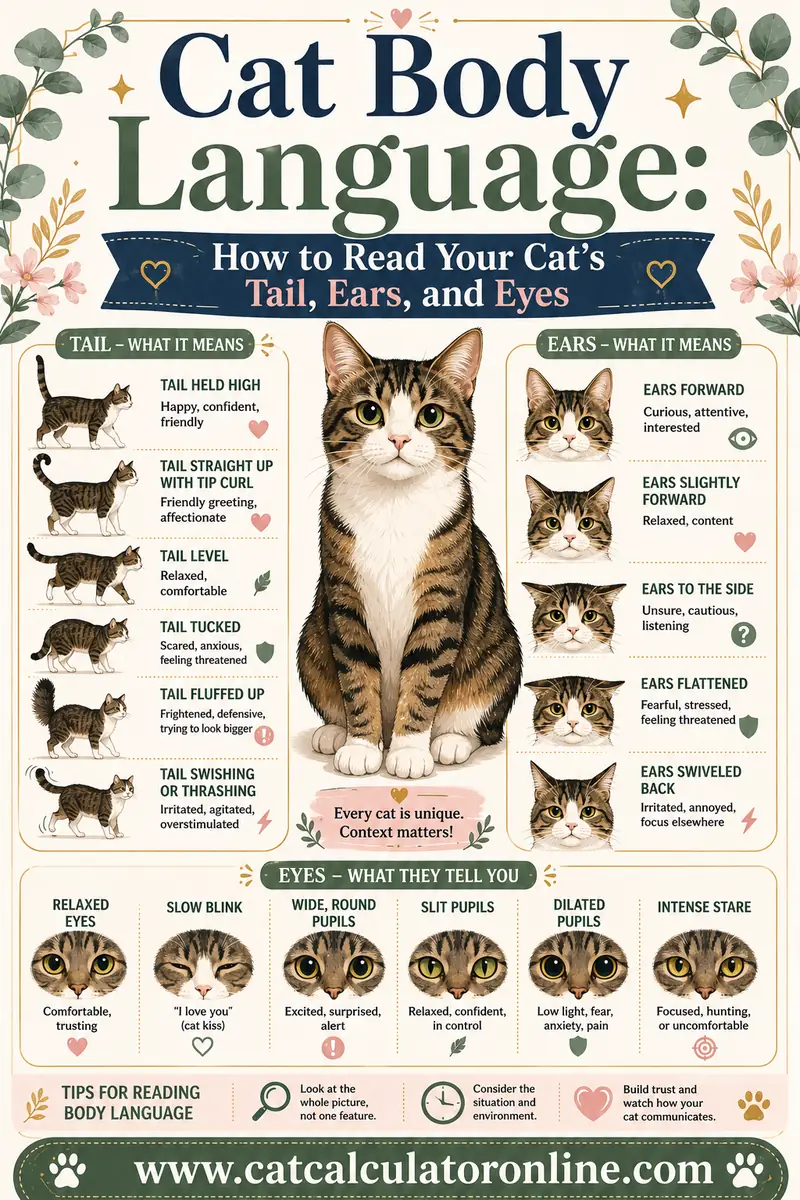
Context is everything, as with all cat signals. The tail, ears and posture around the scratch tell you which version you are seeing — see cat body language.
Frequently Asked Questions
Why do cats scratch furniture and not their scratching post?
Almost always because the sofa is a better scratching surface. It does not wobble, it is tall enough for a full stretch, it has the right shredding texture and it sits in a prominent spot. Posts that are short, unstable or tucked in a spare room fail all four tests.
Is my cat scratching the sofa out of spite?
No. There is no evidence cats damage things out of resentment. Scratching does four jobs — claw maintenance, scent marking, visual marking and stretching — and none of them involve your feelings. A cat who scratches more after being told off is anxious, not vindictive.
Will trimming my cat's claws stop her scratching furniture?
It reduces the damage but not the behavior, because three of the four reasons for scratching have nothing to do with claw length. Trim every two to four weeks to blunt the tips, and pair it with a suitable post in the right location to redirect the habit itself.
Do cats scratch furniture because they are stressed?
Ordinary scratching is normal behavior in a settled cat, not a stress sign. A sudden increase is different: a new cat, a strange cat outside, a house move or a new baby all commonly trigger extra marking. Scratching combined with urine spraying suggests genuine stress.
Is declawing a cat cruel?
Declawing amputates the last bone of every toe, not just the claw. It is illegal in the UK and much of Europe, and banned in several US states and Canadian provinces. Documented consequences include long-term foot pain, litter box avoidance and more biting. Posts, trimming and nail caps are the alternatives.
Should I worry if my cat never scratches anything?
It is worth noticing. Scratching is a normal daily behavior, so a cat who stops may be finding the stretch painful — arthritis is a common reason in cats over eight. Overgrown, thickened claws that catch on carpet point the same way. Mention it at her next check-up.
Once you see scratching as four jobs rather than one — claws, scent, a visual signpost and a proper spine-lengthening stretch — the sofa stops looking like a target and starts looking like the best-designed scratching surface in your house. It is stable, tall, prominent and made of exactly the right stuff. That is also the answer: you cannot take the behavior away, and you should not want to, but you can out-compete the furniture with something better placed and better built. Punishment does the opposite, and declawing removes a bone from every toe rather than a habit. For the practical version, read how to stop a cat scratching furniture, and check her age in human years with the free cat age calculator.