9 Cat Years in Human Years
A nine-year-old cat is about 52 in human years, and nine is the last year of the mature adult stage. At ten, under AAHA guidelines, a cat becomes a senior — check-ups go from annual to twice yearly, and the monitoring becomes properly systematic. So nine is a preparation year in exactly the way six was: nothing has changed, and everything worth having in place before it does should be put in place now. This page covers the math, what a healthy nine-year-old looks like, and the short list that makes ten onward easier. Any age converts instantly with the cat age calculator.
How Do You Get 52?
The arithmetic hasn't changed since the second birthday and won't change again.
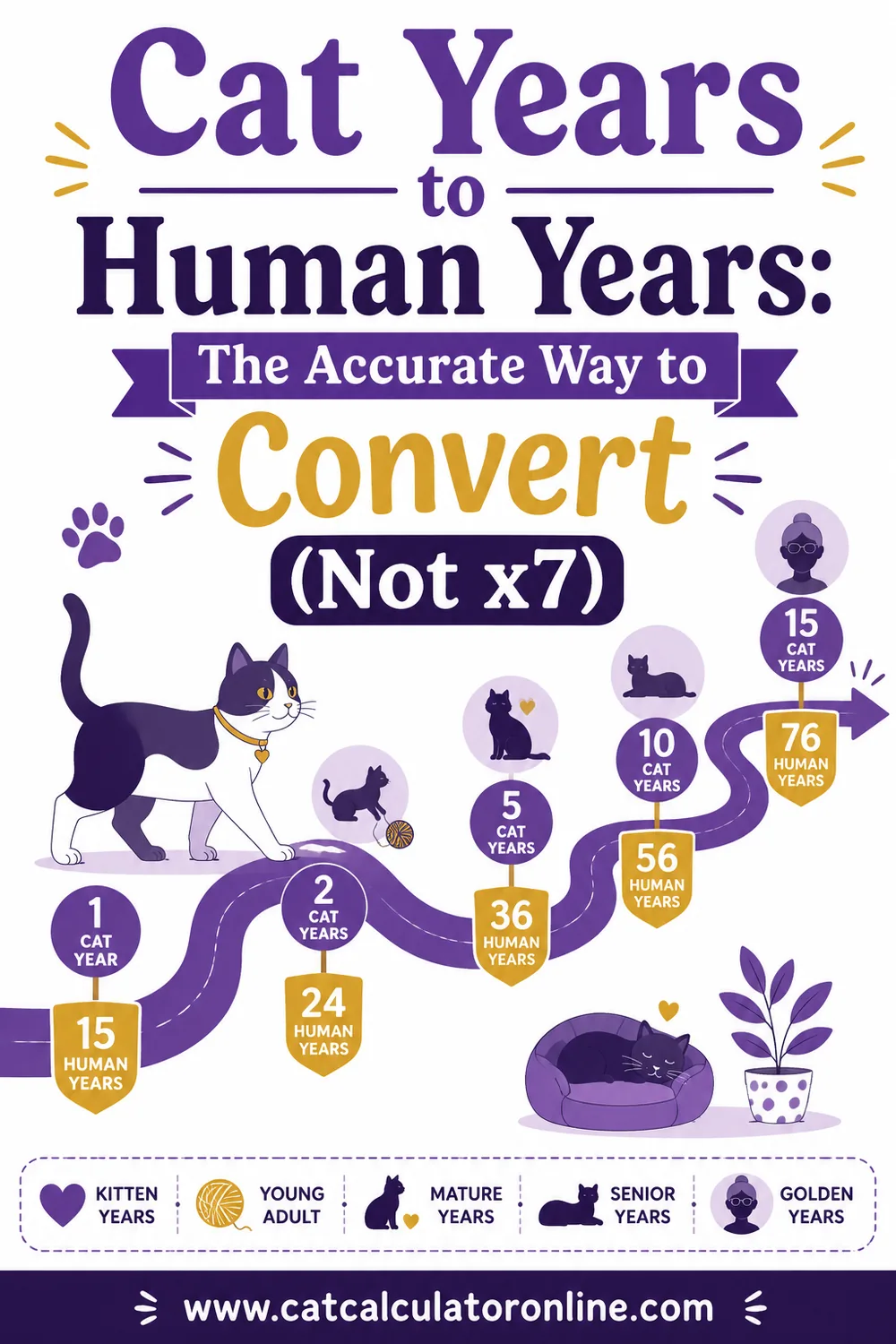
15 for year one, 9 for year two, 4 for every year after. By nine: 24 + (7 × 4) = 52.
| Cat's age | Human years | Life stage |
|---|---|---|
| 7 | 44 | Mature adult |
| 8 | 48 | Mature adult |
| 9 | 52 | Mature adult — final year |
| 10 | 56 | Senior |
| 11 | 60 | Senior |
| 12 | 64 | Senior |
| 14 | 72 | Senior |
| 16 | 80 | Senior |
Fifty-two is a reasonable analogue. Someone in their early fifties is not old, generally still does everything they used to, and is at the age where screening moves from sensible to expected. That's a fair description of a nine-year-old cat.
The years either side are covered in 8 cat years in human years and 10 cat years in human years, the full table in cat years to human years, and the method in how a cat age calculator works.
What Does a Healthy Nine-Year-Old Look Like?
Still substantially unchanged, with a few differences that are easy to attribute to personality rather than physiology.
Activity is lower than at five, and shouldn't be zero. Shorter play sessions, fewer of them, but a cat that still responds to a wand toy is showing you something useful.
Sleeping 15 to 18 hours across many short naps.
Weight ideally stable. By nine, a stable weight is genuinely good news. Slow gain is a manageable problem; unexplained loss is the one that warrants investigation.
Coat needs more help. Cats groom less as they age, and long-haired cats in particular start needing regular brushing to avoid matting over the back and hindquarters — the areas hardest to reach.
Jumping has usually changed. Most nine-year-olds have quietly adjusted: staging jumps via a chair, choosing the sofa over the wardrobe, taking a moment before committing. Owners almost always read this as preference. It's usually early joint change, and it's worth raising with a vet because it's treatable.
Some muzzle greying in dark-coated cats, and occasionally a slight haze to the eyes that is usually benign lenticular change rather than cataract.
What isn't normal at nine: weight loss, increased drinking, regular vomiting, a cat that stops jumping entirely, going beside the box rather than in it, or a coat that's become genuinely unkempt. Each of those is a reason to book rather than to observe.
Why Is Nine the Year to Deal With Joints?
Because arthritis in cats is common, badly under-diagnosed, and far easier to manage before a cat has stopped moving properly.
The scale of it. Radiographic evidence of degenerative joint disease is present in a large majority of cats by their early teens, and it's frequently detectable well before that. It is not a rare condition of very old cats; it's a common condition of middle-aged and older ones.
Why it gets missed. Cats don't limp in the way dogs do. A dog with a sore hip favors the leg visibly. A cat simply does less — jumps less, climbs less, plays less, grooms less — and every one of those looks like a personality change or "getting older".
The signs, specifically:
- Staging jumps through intermediate furniture instead of going straight up
- Hesitating and visibly measuring before a jump
- Landing heavily rather than silently
- Sleeping in lower places than before
- Reduced grooming over the lower back, hips and tail base, sometimes with matting there
- Going beside the litter box rather than climbing into it
- Irritability when stroked along the spine or hindquarters
- Less interest in play, which owners read as maturity
What can be done. More than most owners expect. Weight reduction if needed is the single biggest lever. Environmental changes — steps, low-sided boxes, warm soft beds, food and water at reachable heights — make an immediate difference. And there are veterinary pain management options for cats specifically, which have improved considerably. This is a conversation to have with your vet rather than something to manage with supplements bought online. The full picture is in arthritis in cats.
Why now. A nine-year-old with early joint change that's addressed keeps its mobility, muscle mass and confidence for years. The same cat at thirteen, having quietly stopped moving for four years, has lost muscle it can't easily rebuild.
What Should You Set Up This Year?
Six things, mostly cheap, all easier now than in two years.
1. Steps or a stool to favorite high places. Windowsill, bed, the top of the sofa. A cat that learns to use a step while it can still jump will use it happily when it can't.
2. A litter box with one low side. Cut a U-shape into a plastic storage tub if nothing suitable is on sale. This single change prevents a great deal of "he's started going next to the box".
3. Warm, soft beds in the usual spots. Older cats seek heat and appreciate cushioning over bony hips. Not a heated pad unless your vet suggests it — just somewhere warm and away from draughts.
4. Food and water at floor level or a low platform, so nothing requires a jump. And more water points than you think, since hydration matters increasingly.
5. Deal with the teeth if a dental is due. Anaesthesia at nine with normal bloodwork carries a modest risk. At twelve with early kidney disease it carries more, and the dental disease will be worse. If your vet has been mentioning it, this is the year.
6. Book the ten-year check as a proper senior workup, not a routine appointment. Full bloods, urinalysis, blood pressure, thyroid, weight trend and a dental assessment. Booking it as such tends to produce a more thorough visit.
And keep playing. Two short sessions a day. Activity at nine is what preserves the muscle that keeps a cat mobile at fourteen, and it's the thing most easily allowed to lapse.
What Should the Nine-Year Screening Show?
Worth knowing what "normal" means, because results at this age need interpreting rather than just reading.
Kidney values — creatinine, urea, and ideally SDMA. What matters is not only whether they're in range but where they sit relative to your cat's own previous results. A creatinine that has risen steadily while remaining "normal" is meaningful information.
Urine specific gravity. Cats concentrate urine strongly; a falling specific gravity is one of the earliest signs of declining kidney function and often changes before blood values do.
Total T4. Hyperthyroidism becomes increasingly likely from here, and a borderline result at nine is worth rechecking rather than dismissing.
Blood glucose, ideally interpreted with fructosamine if the cat was stressed, since stress alone raises feline blood glucose.
Blood pressure. Common, silent, and damaging. Worth asking for specifically.
Weight trend across three or more visits, which is frequently the most informative number in the whole file.
What to do with a "borderline" result. Recheck it rather than filing it. Many of the conditions of feline old age announce themselves as a value that drifts across two or three screenings before it crosses a threshold, and the drift is the diagnosis. A single reading tells you far less than a series does — which is the entire argument for having screened at seven and eight. The senior-stage checklist is in senior cat health checklist.
What Does the Run-Up to Senior Look Like?
Framing the year as preparation rather than as a milestone makes it far more useful.
Think of nine as the year you stop reacting and start anticipating. Everything on this page is something you could equally do at eleven — but doing it at nine means the cat adapts while it still has the mobility and confidence to learn new arrangements easily.
A cat that learns to use a step at nine treats it as part of the furniture. The same cat introduced to a step at thirteen, already sore and less confident, frequently ignores it and keeps attempting the jump — or stops going up at all.
A cat whose dental disease is treated at nine goes into its senior years with a comfortable mouth. One whose treatment is deferred spends four years eating around a sore tooth, loses weight because of it, and eventually has the procedure anyway with worse kidney values and more extractions.
A cat weighed monthly from nine has a trend line by eleven. One first weighed at twelve has a single number that means very little on its own.
None of this is dramatic, and that's the difficulty with it — there's no symptom prompting action, so it's easy to postpone indefinitely. The prompt has to be the birthday itself.
The honest summary of nine: your cat is well, will probably remain well for years, and this is the cheapest and easiest year to put the scaffolding in place. Doing it now costs an afternoon and perhaps one veterinary procedure. Doing it later costs considerably more, and some of it can't be recovered.
Frequently Asked Questions
How many human years is 9 cat years?
About 52. The method is 15 for the first year, 9 for the second and 4 for each year after — giving 24 at age two plus seven further years at four each.
Is a 9-year-old cat a senior?
Not quite. Under AAHA feline life-stage guidelines nine is the final year of the mature adult stage, with the senior stage beginning at ten. Nine is best treated as a preparation year.
Do cats get arthritis at nine?
Frequently, and it's badly under-diagnosed. Cats rarely limp — they simply do less. Staging jumps, choosing lower perches, reduced grooming over the hips and going beside the litter box are the common signs.
Should I change anything in the house for a 9-year-old cat?
Yes, and it's cheap. Steps to favorite high spots, a litter box with one low side, warm soft beds, and food and water that don't require jumping. Introducing these while a cat is still agile means it uses them readily later.
Is nine too old for a dental procedure?
No. Anaesthetic risk at nine with normal bloodwork is modest, and it increases with each year of delay while the dental disease worsens. If your vet has recommended a dental, this is a better year for it than twelve.
What should a 9-year-old cat's blood test cover?
Kidney values including SDMA, thyroid (total T4), blood glucose, liver enzymes and a complete blood count, plus a urinalysis with specific gravity and a blood pressure reading. Compare results against previous years rather than reading them in isolation.
Nine cat years is about 52 human years — the last year before the senior stage, and a preparation year rather than a milestone. Put the steps and the low-sided box in now, sort the teeth while anaesthesia is straightforward, and book the ten-year check as a proper senior workup. Convert any age with the cat age calculator.