How to Make Vet Visits Less Stressful
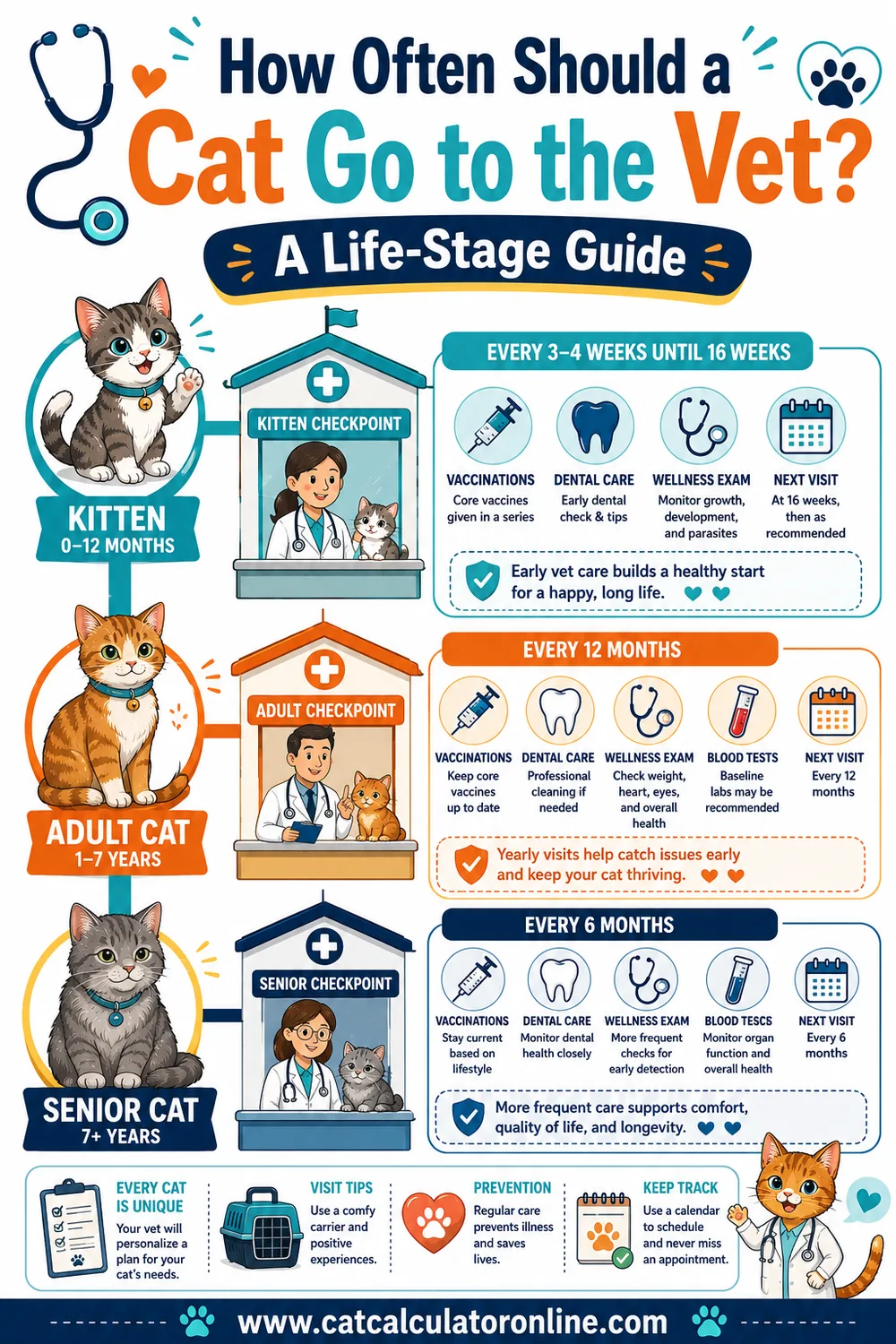
Most of the stress in a vet visit happens before you leave the house, and most of it comes from one object. The single highest-impact change you can make is to stop putting the carrier in the loft — leave it out permanently, as furniture, all year round. A carrier that appears twice a year, always followed by a car and a stranger with a thermometer, becomes a reliable warning sign, and a cat who has learned that warning disappears the moment she sees it. A carrier that has sat open in the living room with a blanket in it since February is just a box she sometimes sleeps in. Everything else on this page — the towel, the medication, the quiet appointment slot — helps, but that one change does more than the rest combined. Her life stage also sets how often she needs to go, and the free cat age calculator will tell you which stage she is in.

Why Vet Visits Are So Hard on Cats
The reasons are worth knowing, because each one points at a fix.
Cats are territorial in a way dogs are not. A dog’s world is its people; a cat’s world is a place. Removing her from her territory is the stressful event, before anyone touches her. That is why the journey matters as much as the appointment.
Everything at the practice smells wrong. Disinfectant, dogs, other cats’ fear pheromones, staff who have handled twenty animals that morning. A cat reads a room by scent and this one reads as dangerous.
She has usually learned the sequence. Carrier, car, table. Cats are excellent at spotting predictive patterns, and this one has three obvious steps. Break the pattern and you reduce the fear.
Fear looks like aggression. The cat who swipes on the table is not a difficult cat; she is a frightened one with no exit. Practices that handle cats well work with that rather than against it.
Avoiding the vet costs more than the visit. Owners who dread the trip put it off, and cats hide illness so well that a delayed check-up is often how a treatable problem becomes an expensive one. How often a cat should go to the vet rises to twice a year past about eleven, which makes the stress worth solving properly.
The Carrier: Leave It Out All Year
If you do nothing else from this page, do this.
Put it in the living room, open, with a blanket in it. Not the spare room, not the loft, not the garage. Somewhere she already spends time, with the door removed or tied open.
Feed her in it. Start with meals beside it, then just inside, then fully in. Two or three weeks of this rewrites what the object means.
Add treats to it at random. Drop a couple of biscuits in when you walk past. She will start checking it, which is precisely the relationship you want.
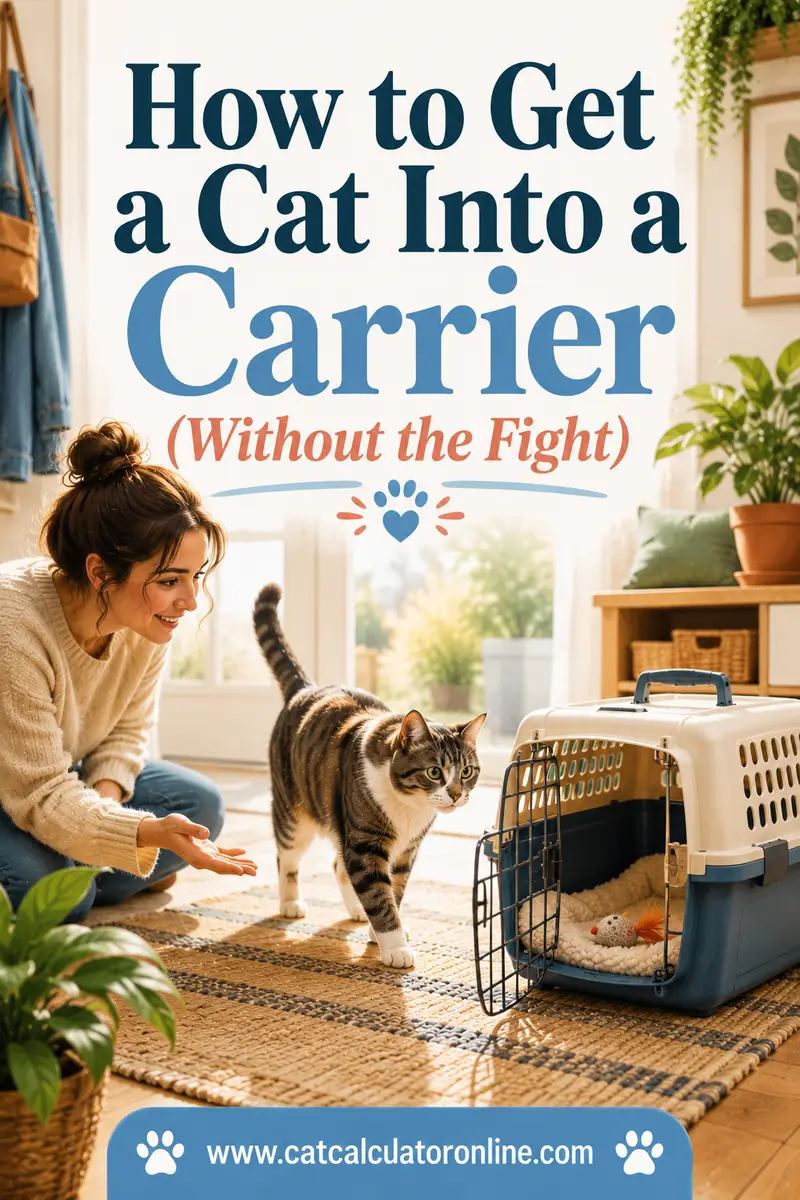
Choose a hard carrier with a removable top. The kind where the upper half unclips is the best design there is — she can be lowered in from above, and the vet can examine her sitting in the bottom half without anyone dragging her out. Front-opening-only carriers force a cat to be pushed in backwards, which almost every cat resists.
Line it with her own unwashed bedding. Her smell is what makes a space feel safe, and a freshly washed blanket smells of nothing.
Spray a pheromone product on the bedding 15 minutes before. Let it dry first. The evidence is modest rather than dramatic, but it is cheap and harmless. There is a full loading technique in how to get a cat into a carrier for the days when you are in a hurry.
The Hour Before You Leave
Most of the wrestling can be designed out.
Shut her in one room an hour ahead. Ideally the room with the carrier in it. Close the bedroom doors, block under-bed access, and do it before she has any reason to suspect anything. Chasing a cat around a house is the worst possible start.
Do not fast her for the day. A light meal three or four hours before is fine and helps if she gets car sick. Never withhold food for a whole day — cats develop fatty liver problems quickly when they stop eating, and a hungry cat is not a calmer one.
Keep high-value treats back. Shrimp, tuna, cooked chicken, squeezy treats. They are for the consulting room, and many cats will take them there even when frightened.
Load her bottom first, from above. Hold her under the chest and hindquarters, lower her in rear-first, and close the lid before she turns round. Calm and quick beats slow and apologetic.
Cover the carrier with a towel. Three sides, leaving the front partly open. Visual cover reduces the number of things she has to worry about.
Carry it level, with two hands. One hand under the base, one on the handle. A carrier swinging from one hand is a small earthquake for the cat inside it.
The Car Journey
Fifteen minutes of bad driving can undo two weeks of preparation.
Wedge the carrier on the floor behind a front seat. It cannot slide, tip or fly forward there. If it must go on a seat, run the seatbelt through the handle and around the body of the carrier.
Keep it flat and stable. Not on your lap, not in the boot with the shopping, not loose on a back seat.
Drive like there is a full cup of coffee on the dashboard. Gentle acceleration, early braking, slow corners. Motion sickness in cats is triggered by exactly the movements that make people queasy.
Keep the car cool and quiet. No radio, no phone calls, air conditioning on a low setting. Talk to her occasionally in a normal voice rather than a soothing one.
Practice journeys that end at home. Five minutes round the block, then back, then food. Do this three or four times and the car stops meaning the vet.
If she drools or vomits, mention it. Maropitant, prescribed by your vet, controls travel sickness well and is usually given a couple of hours before leaving.
Choosing and Using the Practice
Not all practices handle cats the same way, and you are allowed to ask.
Ask whether they have a cat-only waiting area or cat-only appointment times. Many now do. A separate space, or even a screen and a shelf away from the dogs, changes the wait completely.
Ask if you can wait in the car and be called. Almost every practice will agree to this. It is the simplest fix for a cat who unravels in a waiting room.
Look for a cat-friendly accreditation. Several veterinary bodies run schemes that certify practices on feline handling and facilities. It is a reasonable proxy for how the consultation will go.
Book the first appointment of the day or a quiet mid-morning slot. Fewer animals, less noise, and less chance of a long wait.
Ask for a double appointment for a senior or nervous cat. Rushed handling is stressful handling, and older cats need a longer conversation anyway — see caring for a senior cat.
Keep the carrier off the floor. On your lap or on a chair, covered. Floor level is where dogs are.
What to Ask For in the Consulting Room
You can shape the appointment more than most owners realize.
Ask them to take the top off the carrier. A good practice will examine a cat sitting in the bottom half with her own blanket under her. Most of the exam can be done that way.
Ask for minimal restraint. With cats, less handling usually produces less struggling. Scruffing has fallen out of favor and most feline-trained staff avoid it.
Bring your own towel from home. For the table, and for wrapping if she needs holding. Familiar scent again.
Say what you have noticed, concretely. "She has stopped jumping onto the bed since June" beats "she seems old". If something happens at home — coughing, a strange gait, a wobble — film it on your phone. A ten-second video is worth more than a paragraph of description.
Bring numbers. Her weight from home, how much she is eating and drinking, how many clumps you are scooping. Weight trends in particular are the single most useful data an owner brings.
Ask about pain, specifically. Cats hide it and owners under-report it. How to tell if a cat is in pain lists what to watch for, and a trial of pain relief is often revealing.
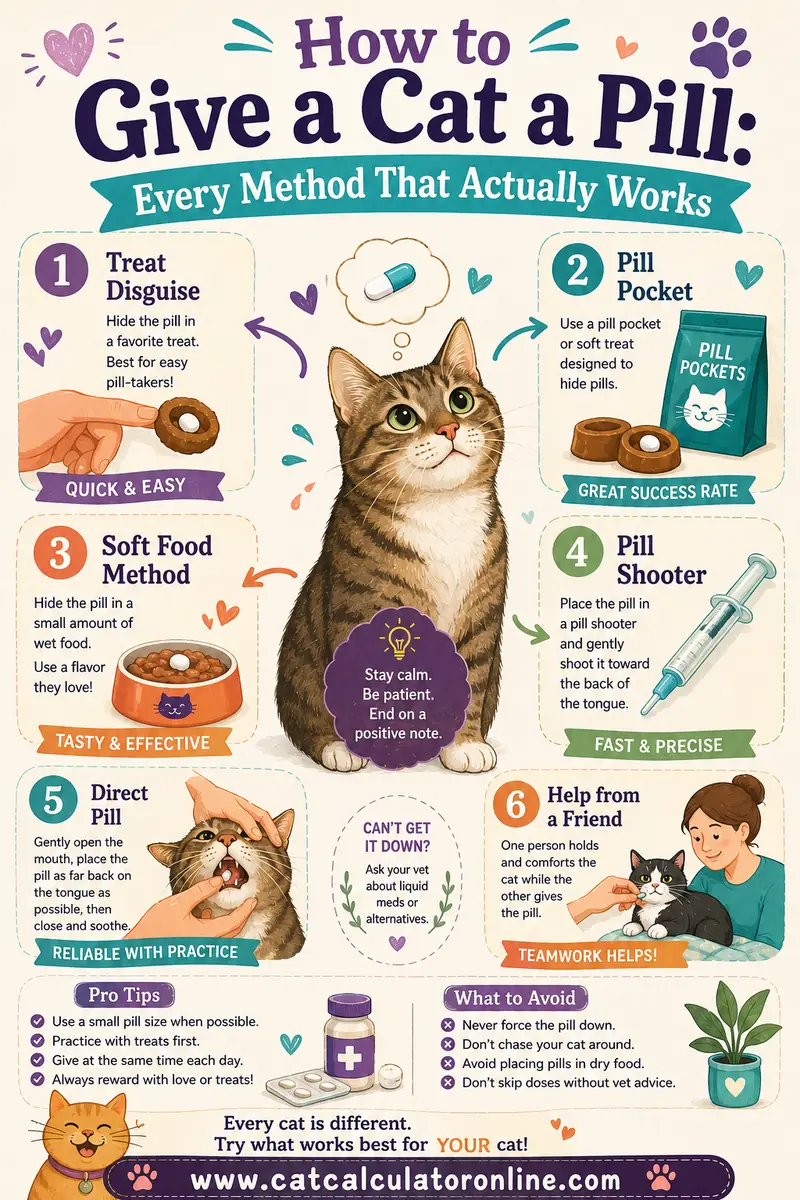
Ask how to give any medication before you leave. Have them demonstrate. Giving a cat a pill is far easier when someone has shown you once.
Pre-Visit Medication: What Actually Helps
This has changed a lot in the last decade, and many owners have not heard.
Gabapentin is now commonly prescribed before stressful visits. It is a mild anti-anxiety and pain medication rather than a knockout sedative, given as a capsule or liquid two to three hours before the appointment, dosed by weight.
It genuinely works for many cats. Owners often describe the difference as the same cat, but less bothered. It also makes the exam more accurate, because a rigid, frightened cat is hard to assess.
Trial the dose at home first. A quiet weekend, same dose, so you know what to expect. Mild wobbliness on the back legs is common and wears off.
Pheromone sprays help a little. On the bedding, 15 minutes ahead, allowed to dry. Modest effect, no downside.
Full sedation is a different decision. It is sometimes the right one for a genuinely fractious cat or a painful procedure, and it is a conversation to have in advance rather than at the desk.
None of it replaces the carrier work. Medication makes a prepared cat easier; it does not fix a carrier that only comes out of the loft twice a year.
The Whole Plan at a Glance
| When | What to do | Why it matters |
|---|---|---|
| All year | Carrier out, open, with bedding inside | Removes the warning signal entirely |
| 2–3 weeks before | Feed her in the carrier; short practice car trips | Breaks the carrier-car-vet pattern |
| Booking the appointment | Ask for a quiet slot, cat waiting area, or car call | Fewer dogs, less noise, shorter wait |
| Night before | Confirm any pre-visit medication timing with the vet | Gabapentin needs 2–3 hours to work |
| 3–4 hours before | Light meal, not a fast; hold back treats for the room | Reduces sickness without starving her |
| 1 hour before | Shut her in the carrier’s room, doors closed | No chasing, no hiding under beds |
| 15 minutes before | Pheromone on the bedding, towel over the carrier | Lets the spray dry; reduces visual stress |
| In the car | Carrier wedged on the floor, gentle driving | Stability prevents motion sickness |
| In the room | Ask for the top off and minimal restraint | Less handling means less struggle |
| Getting home | Quiet room, food, a few hours apart from other cats | Prevents non-recognition aggression |
Getting Home, and the Other Cat Problem
The visit is not over when you park the car.
Put the carrier down in a quiet room and open it. Then leave. Let her come out on her own and hide if she wants to. Most cats are back to normal within a few hours.
Offer food and water. A small meal is a good way to end the day on something positive.
Expect trouble from a resident cat. She comes home smelling of disinfectant, dogs and strangers, and to another cat in the house she is briefly a stranger. This is called non-recognition aggression and it catches owners completely off guard.
Keep them apart for a few hours. Separate rooms, door closed, so the returning cat can groom and re-scent herself.
Wipe both cats with the same towel. Cheeks, shoulders, base of the tail. It blends their smells and shortens the standoff.
Reintroduce through a door first. Feed them on either side of it, then open it when neither is reacting. If hissing continues past a day, go back to full separation and take it slowly.
Do something nice afterwards. Play, treats, a session with a wand toy. The last thing that happens should not be the worst thing that happened.
Frequently Asked Questions
How do I get my cat into the carrier without a fight?
Leave the carrier out all year with bedding inside so it stops predicting a journey, then shut her in that room an hour before. Use a hard carrier with a removable top and lower her in bottom-first from above rather than pushing her through a front door.
Can I give my cat something to calm her before the vet?
Ask your vet about gabapentin, which is widely used before stressful appointments and is a mild anti-anxiety medication rather than a sedative. It is given two to three hours before, dosed by weight, and should be trialled at home on a quiet day first.
Should I feed my cat before a vet appointment?
Give a light meal three or four hours beforehand rather than a full one, and never fast her all day — cats develop liver problems quickly without food. Save high-value treats such as chicken or shrimp to use in the consulting room itself.
Why does my other cat attack her after a vet visit?
She comes home carrying clinic smells instead of household ones, so her housemate no longer recognizes her. Keep them separated for a few hours, wipe both cats with the same towel to blend their scents, and let them meet again through a closed door first.
Are cat-friendly vet practices actually different?
Usually yes. They typically offer separate cat waiting areas or cat-only appointment times, staff trained in low-restraint feline handling, and examinations done in the base of the carrier. It is worth asking directly what a practice offers before booking.
My cat gets so stressed — can I just skip check-ups?
Skipping them costs more than it saves, because cats conceal illness until it is advanced. If travel is genuinely traumatic, ask about a home visit, a pre-visit medication plan, or a longer appointment rather than dropping the visit altogether.
Vet visits get easier when you attack the parts a cat can predict. Leave the carrier out all year with her blanket in it, feed her in it, and take a few practice drives that end back at your own front door — that alone changes most cats. On the day, shut her in one room early rather than chasing her, feed lightly instead of fasting, cover the carrier, and drive gently with it wedged on the floor. Ask the practice for a quiet slot and ask the vet to take the top off the carrier rather than lifting her onto a cold table. Talk to your vet about gabapentin if she is genuinely frightened. And when you get home, give her a few hours before the other cat gets a vote. Check her life stage with the free cat age calculator so you know how often she should be seen, and keep her vaccination schedule somewhere you will actually see it.