The Monthly Cost of Owning a Cat
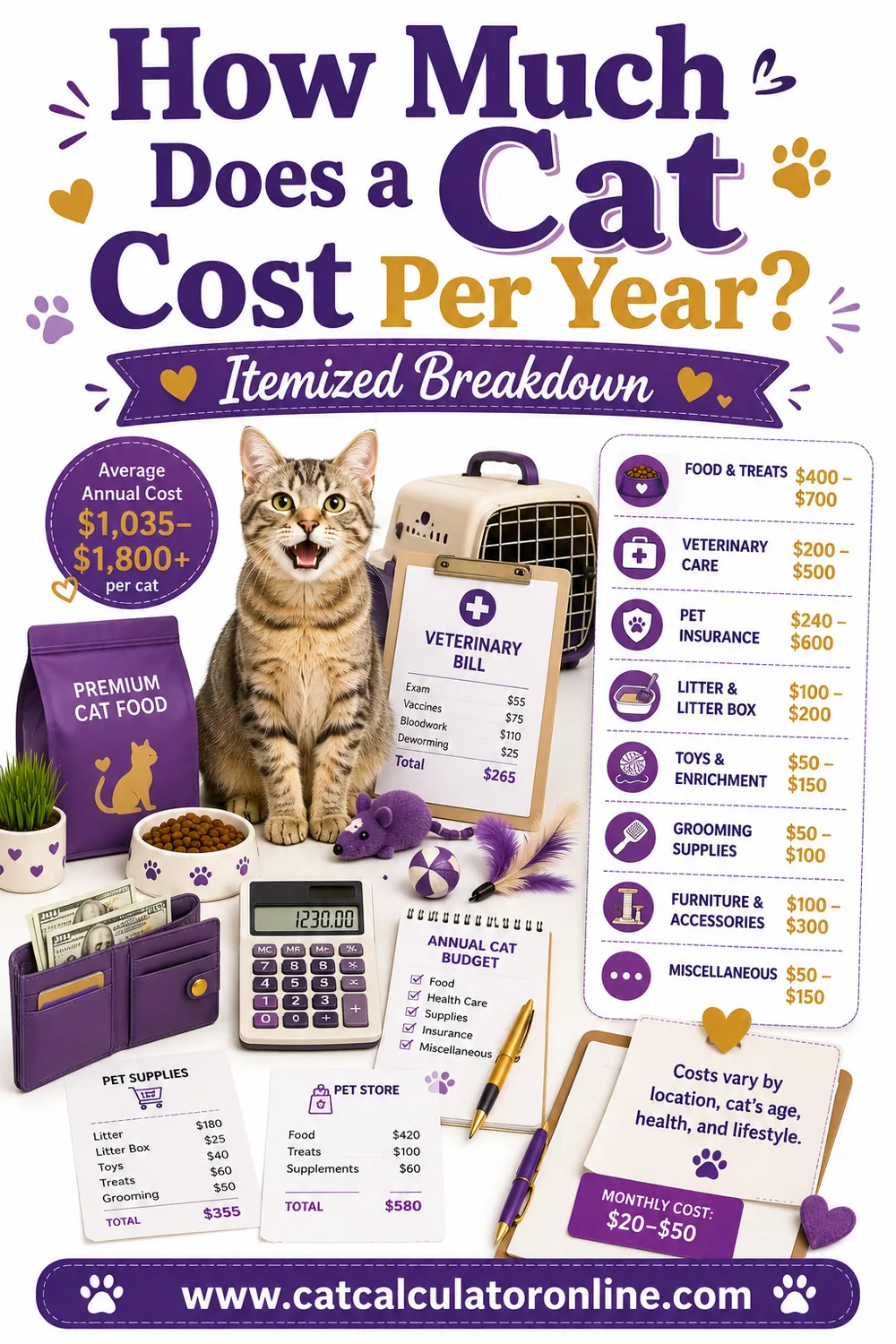
Most US cat owners spend between $60 and $120 a month on a healthy adult cat, with a typical figure around $85. Food and litter make up the recurring core, insurance is the biggest optional line, and veterinary care averages out to $20–$40 a month even though it arrives as occasional lumps rather than a monthly bill. That figure rises meaningfully once a cat passes eight or nine, and it's roughly double in a kitten's first year. Building the estimate from your own choices rather than an average is what makes it useful, which is what the cat cost calculator is for.
What Does a Cat Cost Per Month?
For a healthy adult cat, the monthly breakdown looks like this:
| Line | Low | Typical | High |
|---|---|---|---|
| Food | $20 | $35 | $55 |
| Litter | $10 | $18 | $30 |
| Routine vet care (averaged) | $15 | $25 | $40 |
| Parasite prevention | $5 | $10 | $18 |
| Insurance (optional) | $0 | $28 | $50 |
| Treats, toys, replacements | $5 | $10 | $20 |
| Monthly total | ~$60 | ~$85 | ~$120+ |
Two things distort this table if you read it carelessly.
Vet care isn't really monthly. You don't pay $25 in March. You pay $180 in one visit and nothing for eight months. Averaging it makes the budget usable, but the cash flow is lumpy, which is why a small reserve matters more than the average suggests.
Insurance is the swing line. At $0 you're carrying the risk yourself; at $50 you've bought a lot of protection. That single decision moves the monthly total by more than any other choice on the list.
Why Is Food the Biggest Line?
Because it's the only thing you buy every single month without exception, and because the price range between reasonable options is enormous.
- Dry food only: roughly $15–$30 a month. Cheapest, convenient, and fine for many cats — though it contributes less water, which matters for cats prone to urinary problems.
- Wet food only: roughly $40–$60 a month, more for premium brands. Higher moisture content, generally more palatable, considerably more expensive.
- A mix: where most owners land, around $25–$40 a month.
Portion size is driven by your cat's weight and activity, not by the bag's suggestion, which is usually generous. A typical 10 lb indoor cat needs roughly 200 calories a day — often less if neutered and sedentary — and overfeeding is both the most common budgeting error and the most common health one.
Prescription therapeutic diets are the line that catches people out later. A cat that develops kidney or urinary disease may need a therapeutic food costing $50–$90 a month, sometimes indefinitely. It's not a cost you can plan for at adoption, but it's common enough to be worth knowing exists. Full feeding costs are broken down in how much it costs to feed a cat.
How Much Should You Budget for Litter?
Between $10 and $30 a month for one cat, driven almost entirely by litter type.
Clay clumping litter is cheapest and most widely used. Crystal, wood pellet, paper and corn-based litters generally cost more, though some last longer per bag, which narrows the gap in practice.
Three things push the figure up:
- More cats. The standard guidance is one tray per cat plus one spare, and litter use scales roughly with cat count. Two cats is closer to $25–$50 a month.
- Full changes rather than scooping. Scooping daily and topping up uses considerably less than emptying the whole tray weekly.
- Premium formulations. Low-dust, lightweight and scented varieties carry a premium that's real but not enormous.
Buying in bulk is one of the few genuinely reliable savings here, provided you've settled on a litter your cat will actually use. Cats can be firm about texture, and a bulk purchase of something your cat refuses is a false economy.
What About Veterinary Care?
Averaged across a year, routine veterinary care for a healthy adult cat runs $20–$40 a month — but the money doesn't arrive that way.
A typical year involves one annual examination ($60–$90), core vaccine boosters ($50–$100), and parasite prevention spread through the year ($80–$150). That's $200–$350 annually for a cat with nothing wrong, arriving in two or three appointments.
Add dental care and the picture changes. A routine cleaning under anaesthesia runs $150–$400 and isn't needed every year, but treatment for diagnosed dental disease — extractions, tooth resorption — commonly costs $800–$2,000 and becomes more likely with age.
Then there's the category you can't average: the unexpected. A urinary blockage at $1,500–$3,000, a swallowed foreign body at $2,000–$4,000, a cancer diagnosis running well past $10,000. These aren't monthly costs and never will be, which is exactly why they need either insurance or a dedicated reserve rather than a budget line. Typical veterinary pricing is set out in cat vet costs explained.
Should Insurance Be a Monthly Line?
That's the biggest single decision in your monthly budget, and it's genuinely a judgement call.
Accident-and-illness cover for a healthy adult cat typically runs $25–$35 a month, rising steeply with age — $15–$25 for a kitten, $55–$110 for a senior. Over a sixteen-year life that totals roughly $6,000–$9,000.
The case for including it: cats are prone to expensive chronic conditions, most of which appear later in life, and the scenarios that genuinely threaten a household budget are precisely the ones insurance covers. Enrolling early also keeps every future condition coverable, since anything already in the medical record is excluded permanently.
The case against: it's a substantial ongoing cost, and a cat that stays healthy leaves you thousands of dollars down. A disciplined savings account is a legitimate alternative for owners who can genuinely build and keep one — the honest weakness being the early years, before the fund has grown.
What rarely works is the middle path of intending to save but not actually doing it. Current premium bands by age are in how much cat insurance costs per month.
How Does the Monthly Cost Change With Age?
Substantially, and the shape is closer to a U than a straight line.
Kitten (year one): roughly $110–$180 a month averaged, once one-off setup and veterinary costs are spread across twelve months. The most expensive year of a cat's life by a clear margin, as set out in the first-year kitten cost breakdown.
Young adult (1–6): the cheap years, around $60–$90 a month. Food, litter, one annual checkup, parasite treatment. Very little goes wrong.
Mature adult (7–10): creeping up to $80–$110. Twice-yearly checkups become sensible, senior screening bloodwork gets added, dental work becomes more likely, and insurance premiums start climbing.
Senior (11+): commonly $110–$200+, and higher with a chronic condition. Kidney disease management alone can run $1,000–$3,000 a year, and prescription diets, medication and repeat bloodwork all become regular rather than occasional.
The practical implication: budgeting from the young-adult figure and assuming it holds for sixteen years understates the total considerably. The senior years are where most of a cat's lifetime cost actually sits.
Does a Second Cat Double the Cost?
No — closer to 1.7×, and the difference is worth understanding before adding one.
Scales almost fully: food, litter, insurance, parasite prevention, routine vet care. Each cat eats, uses litter and needs its own vaccinations, and each is insured separately with its own deductible.
Scales partially or not at all: setup equipment beyond an extra litter tray and bowls, and your time. A scratching post, carrier and most toys serve two cats as well as one, though a second carrier is genuinely useful for vet trips.
So a second cat typically adds $50–$90 a month rather than the full $85. Multi-pet insurance discounts of 5–10% help slightly, though they reduce the premium rather than the deductibles — each cat still has its own to satisfy.
One caution: two cats also roughly doubles the probability that something goes wrong in a given year. The averages hold across many households; individual years are lumpier with two animals than one.
What Do the One-Off Costs Add to the Monthly Average?
Some real costs never appear in a monthly budget because they arrive once every few years — and leaving them out is why people's actual spending runs above their estimate.
Replacement equipment. Scratching posts get destroyed, beds wear out, carriers crack, litter trays get scratched rough and start holding smells. Across a cat's life that's perhaps $300–$600, or roughly $2–$4 a month averaged.
Boarding or a cat sitter. If you travel, this is a genuine cost: $20–$40 a day for a sitter, sometimes less for boarding. Two weeks of travel a year adds $25–$45 a month to the true average — more than food for some households, and almost always forgotten.
Moving house. New cat flap, possibly new furniture protection, and for some cats a settling-in period requiring pheromone diffusers or a vet consultation about stress.
Dental work. A cleaning under anaesthesia every few years at $150–$400 averages to roughly $5–$10 a month across a cat's life, and that's before any actual disease is treated.
End-of-life care. Uncomfortable to budget for and genuinely significant: euthanasia and cremation typically run $150–$500, and many policies don't cover it.
Adding these honestly pushes the "typical $85" closer to $100–$110 a month across a full lifetime for an owner who travels occasionally. That's not a reason to be discouraged — it's the difference between a budget that survives contact with reality and one that quietly overruns every year.
Is a Cat Cheaper Than People Expect, or More?
Both, depending on which part you look at, and the mismatch is worth naming because it's where most budgeting goes wrong.
Cheaper than expected: the day-to-day. Food and litter for a single cat genuinely do come to $30–$85 a month, and many people bracing for a large recurring bill find the routine costs modest. Cats need no walking service, no daycare, and considerably less equipment than a dog.
More expensive than expected: everything that isn't monthly. The first year at $900–$2,200. The senior years at double the adult rate. A single emergency at $2,000–$4,000. Dental work at $800–$2,000. These are the numbers that surprise people, and they're precisely the ones a monthly average conceals.
So the honest framing is that a cat is a low recurring cost with occasional large spikes, not a steady expense. Budgeting only for the recurring part leaves you exposed to the part that actually causes financial stress.
That's the practical argument for either insurance or a dedicated reserve, and it's why the question "can I afford a cat?" is better answered by "could I handle a $3,000 vet bill next month?" than by whether $85 fits comfortably in your monthly budget.
How Can You Reduce the Monthly Cost?
Five reliable savings that don't compromise your cat's welfare:
- Buy food and litter in bulk, once you know what your cat will reliably eat and use.
- Feed the right portion. Overfeeding wastes food and causes obesity, which costs far more later in diabetes and joint problems than it ever saved in kibble.
- Scoop daily rather than replacing litter wholesale. Uses noticeably less and keeps the tray more appealing, which reduces litter-box problems.
- Keep up preventive care. Vaccines, parasite treatment and dental checks are cheap relative to what they prevent, and several insurers require evidence of routine dental care before paying dental claims.
- Use low-cost clinics for routine work where available. Vaccination and neutering schemes are run by qualified vets and often cost half what a private practice charges.
What's usually a false economy: skipping the annual checkup, delaying dental treatment, or dropping insurance in the senior years — that last one exits precisely when the policy was priced to pay out.
What Does a Realistic Month Actually Look Like?
Averages hide the texture, so here are three real-shaped months for the same adult cat on a $85 typical budget.
A quiet month. You buy a bag of dry food and a sack of litter, top up flea treatment, and nothing else happens. Total: $48. Most months look like this, which is why owners often feel their cat costs less than the figures suggest.
An ordinary month with a vet visit. Same food and litter, plus the annual examination, booster vaccines and a fresh course of parasite prevention. Total: $205. Nothing has gone wrong — this is simply the month the averaged costs land in.
A bad month. Food and litter as usual, then your cat stops eating and turns out to have dental disease requiring two extractions under anaesthesia. Total: $1,340, or roughly $340 if you're insured with a $500 deductible already met.
All three are normal. The average of $85 is arithmetically true and describes none of them accurately.
This is the single most useful thing to understand about cat costs: the monthly figure is a planning tool, not a prediction. Set aside the average each month and most of it accumulates untouched through the quiet months, ready for the ones that aren't. Owners who budget only for the quiet months are the ones for whom an ordinary dental bill becomes a crisis.
Frequently Asked Questions
How much does a cat cost per month?
Most US owners spend $60–$120 a month on a healthy adult cat, typically around $85. Food and litter form the recurring core, insurance is the largest optional line, and routine vet care averages $20–$40 a month even though it arrives in occasional lumps.
Is owning a cat cheaper than owning a dog?
Generally yes. Cats eat less, need less equipment, rarely need boarding kennels or daycare, and cost roughly half as much to insure because their smaller size makes treatment cheaper. The gap narrows in the senior years, when feline chronic conditions become common.
What is the biggest monthly expense for a cat?
Food, unless you insure — in which case insurance often overtakes it, particularly for an older cat. Food typically runs $20–$55 a month depending on whether you feed dry, wet or a mix, while insurance ranges from $15 for a kitten to over $100 for a senior.
How much should I save for cat emergencies?
A reserve of $2,000–$3,000 covers most single emergencies, such as a urinary blockage or a swallowed foreign body. Serious illness can exceed that considerably — a full cancer treatment course can pass $10,000 — which is the main argument for insurance rather than savings alone.
Do indoor cats cost less per month?
Slightly, mainly through fewer accident-related vet visits, though some insurers don't price them differently at all. Indoor cats also tend to live longer, which means more total years of cost, and they're somewhat more prone to obesity-linked conditions such as diabetes.
How much does a senior cat cost per month?
Commonly $110–$200 or more, rising further with a chronic condition. Insurance premiums climb steeply past eleven, checkups become twice-yearly, and conditions like kidney disease add $1,000–$3,000 a year in bloodwork, prescription diet and medication.
The monthly figure is less useful than the shape behind it. Food and litter are steady and predictable, veterinary care is lumpy, and the whole total roughly doubles at both ends of your cat's life. Budget from your own food choice and insurance decision rather than an average, keep a reserve for the costs that refuse to be monthly, and check the full-year view in how much a cat costs per year or build your own in the cat cost calculator.