When Can Kittens Leave Their Mom? Why 8 Weeks Is the Minimum
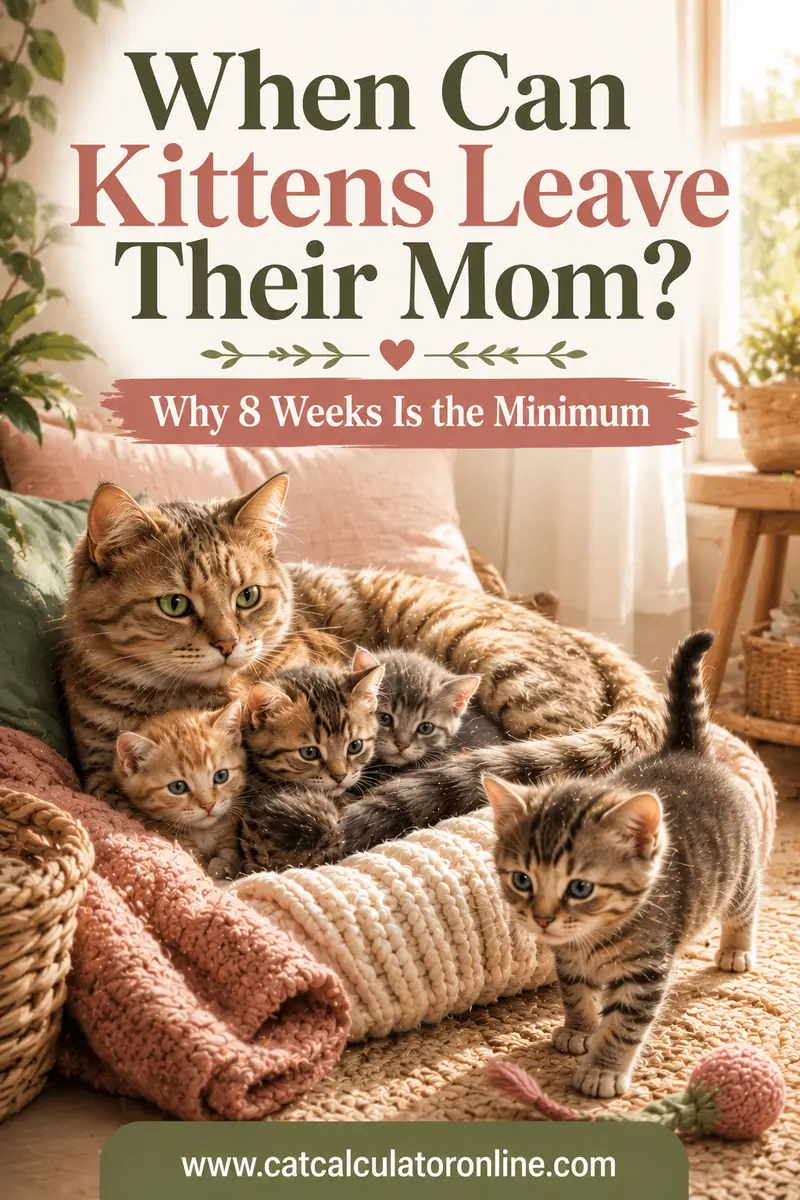
Kittens should stay with their mother for a bare minimum of 8 weeks — that's the legal minimum in many places — but 12 to 14 weeks is genuinely better. Those extra weeks with mom and littermates are when kittens learn bite control, litter habits, and how to be a well-adjusted cat, and kittens separated too early show noticeably more behavior problems later. Fully weaned isn't the same as fully ready.
If you're waiting on a kitten or already counting down the days, our free new kitten checklist covers everything to have ready before she comes home — and the kitten weight calculator will show you how big that tiny arrival is going to get.
🍼 Is this kitten ready to leave mom?
Tap the kitten’s age to find out:
Tap an age above to see if a kitten that age should leave mom.
When Can Kittens Leave Their Mother? The Quick Answer by Age
If you only need the short version, here it is. Find the kitten's age and read across:
| Kitten's age | Can she leave her mother? | Why |
|---|---|---|
| Under 6 weeks | No | Still nursing and can't fully care for herself. Only orphaned kittens should be apart from mom this young, with a vet involved. |
| 6–7 weeks | No, too early | Mid-weaning and mid-socialization. Separation now raises the risk of feeding and behavior problems. |
| 8 weeks | Minimum age | Weaned and litter trained, and the legal minimum in many places. Social learning is far from finished. |
| 10 weeks | Possible, but waiting helps | Doing well, but bite control and confidence are still being polished by mom and littermates. |
| 12–14 weeks | Yes, the ideal window | Weaned, socialized, litter trained, and usually partway through her kitten vaccines. |
| Over 14 weeks | Yes | No harm in waiting longer; mom naturally steps back from mothering on her own. |
Why Is 8 Weeks the Absolute Minimum?
Eight weeks is the earliest point at which a kitten can survive and function away from her mother — and the law in many places agrees. Numerous US states, and animal-welfare rules in several countries, make it illegal to sell or give away a kitten younger than 8 weeks.
The logic is biological. By 8 weeks, a healthy kitten:
- Is fully weaned — eating solid food reliably, no longer dependent on nursing.
- Can regulate her own body temperature — newborns can't, which is why they pile together.
- Uses a litter box — copied from watching mom, mostly established by now.
- Has had (or is due) her first vaccination — the first kitten shots typically start at 6–8 weeks.
So an 8-week-old kitten can leave. But notice what's missing from that list: everything social. Bite inhibition, play manners, confidence with people — that education is still in full swing at 8 weeks, and it's the part that determines what she's like to live with for the next decade and a half.
Think of 8 weeks as the floor, not the target.
Why Are 12 to 14 Weeks Even Better?
Because weeks 8 through 14 are when a kitten finishes learning how to be a cat — and mom and littermates are the only ones who can teach it.
Bite inhibition is the headline lesson. When a kitten bites a littermate too hard mid-play, the littermate squeals and stops playing. When she bites mom too hard, mom ends the game. Dozens of repetitions of that feedback loop teach a kitten exactly how much jaw pressure is "play" and how much is "ow." A kitten who misses those lessons often becomes the adult cat who bites hard in play and doesn't understand why you've stopped being fun.
The same window covers:
- Claw control — same feedback loop, different weaponry.
- Reading cat body language — how to signal "I want to play," "back off," and "truce," which matters for every cat she ever meets.
- Confidence and stress recovery — kittens bounce scary experiences off mom's calm. Handled, socialized kittens in this window become relaxed adult cats.
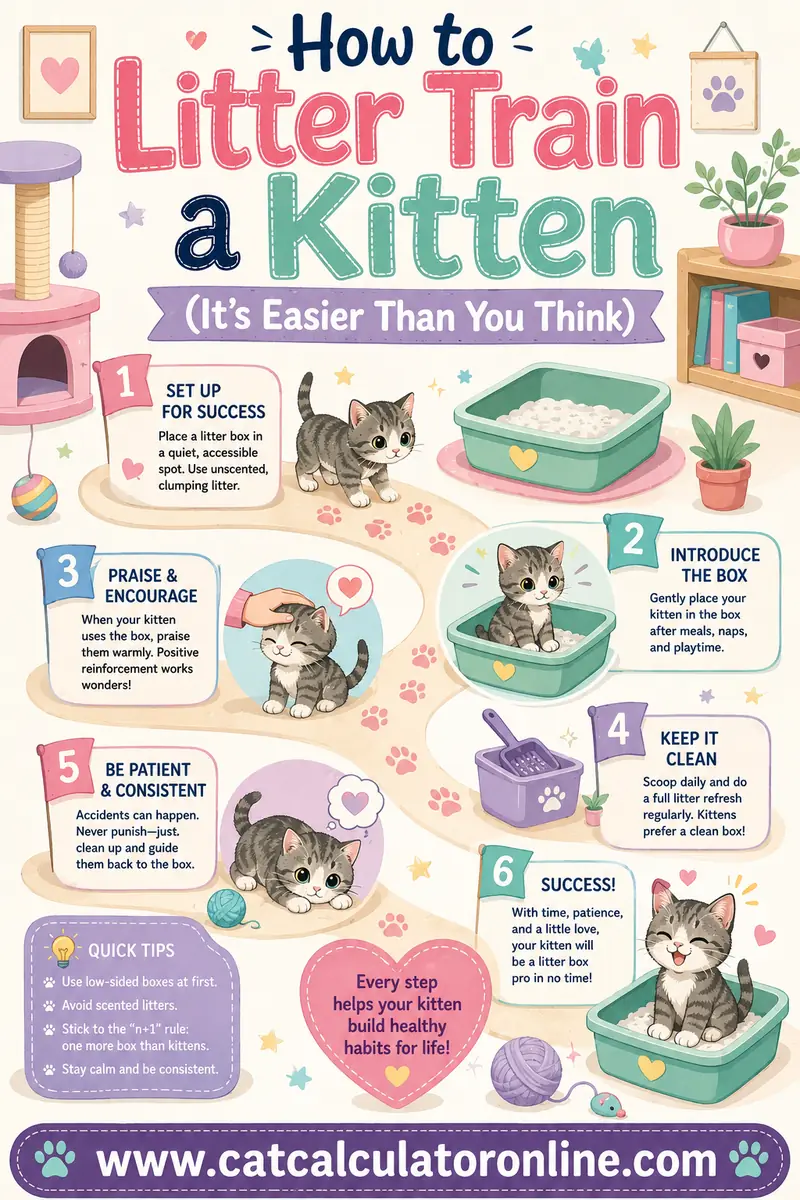
- Litter box reliability — habits get cemented, not just started. If yours needs a refresher after homecoming, how to litter train a kitten makes it painless.
- Vaccines on schedule — staying put through ~12 weeks usually means two rounds of the kitten vaccine course done before the stress of rehoming.
This is why reputable breeders almost universally hold kittens to 12–14 weeks — with pedigree cats it's the standard, not the exception. Shelters often rehome at 8 weeks for capacity reasons, which is understandable and workable; if you adopt at 8 weeks, you just inherit a slightly bigger share of the teaching job.
What Does a Kitten Learn Each Week With Mom?
Here's the education, week by week — and what's at stake if it gets cut short:
| Age | What she's learning with mom and littermates |
|---|---|
| 4 weeks | Weaning begins: first tastes of solid food. Wobbly play starts; litter box copying begins. |
| 5–6 weeks | Eating more solids, nursing less. Play fighting ramps up — first bite-pressure lessons from littermates. |
| 7–8 weeks | Weaning completes. Litter habits mostly solid. First vaccination due. Social play at full intensity. |
| 9–10 weeks | Bite and claw inhibition consolidate through hundreds of play repetitions. Confidence with handling grows. |
| 11–12 weeks | Cat body language fluency. Stress-recovery skills mature. Second vaccine round typically done. |
| 13–14 weeks | Polish: a socially fluent, confident kitten. The ideal homecoming window. |
Two takeaways from that table. First, weaning (done by ~8 weeks) finishes long before social learning does (~12–14 weeks) — which is exactly why "she's eating solid food" isn't the same as "she's ready to leave." Second, every row from 9 weeks onward is pure behavioral payoff: nothing on that list can be taught as well by a human as by a mother cat and a pile of siblings.
When Do Kittens Wean Off Their Mother's Milk?
Weaning starts around 4 weeks and finishes by about 8 weeks — and it's a gradual handover, not a switch.
At around 4 weeks, kittens start showing interest in whatever mom is eating, and their first teeth make solid food possible. Good practice is to offer a gruel of wet kitten food (sometimes loosened with kitten milk replacer) alongside continued nursing. Over the next month, the ratio shifts naturally: more solids, less milk, with mom increasingly walking away from nursing sessions — her own polite way of pushing the process along.
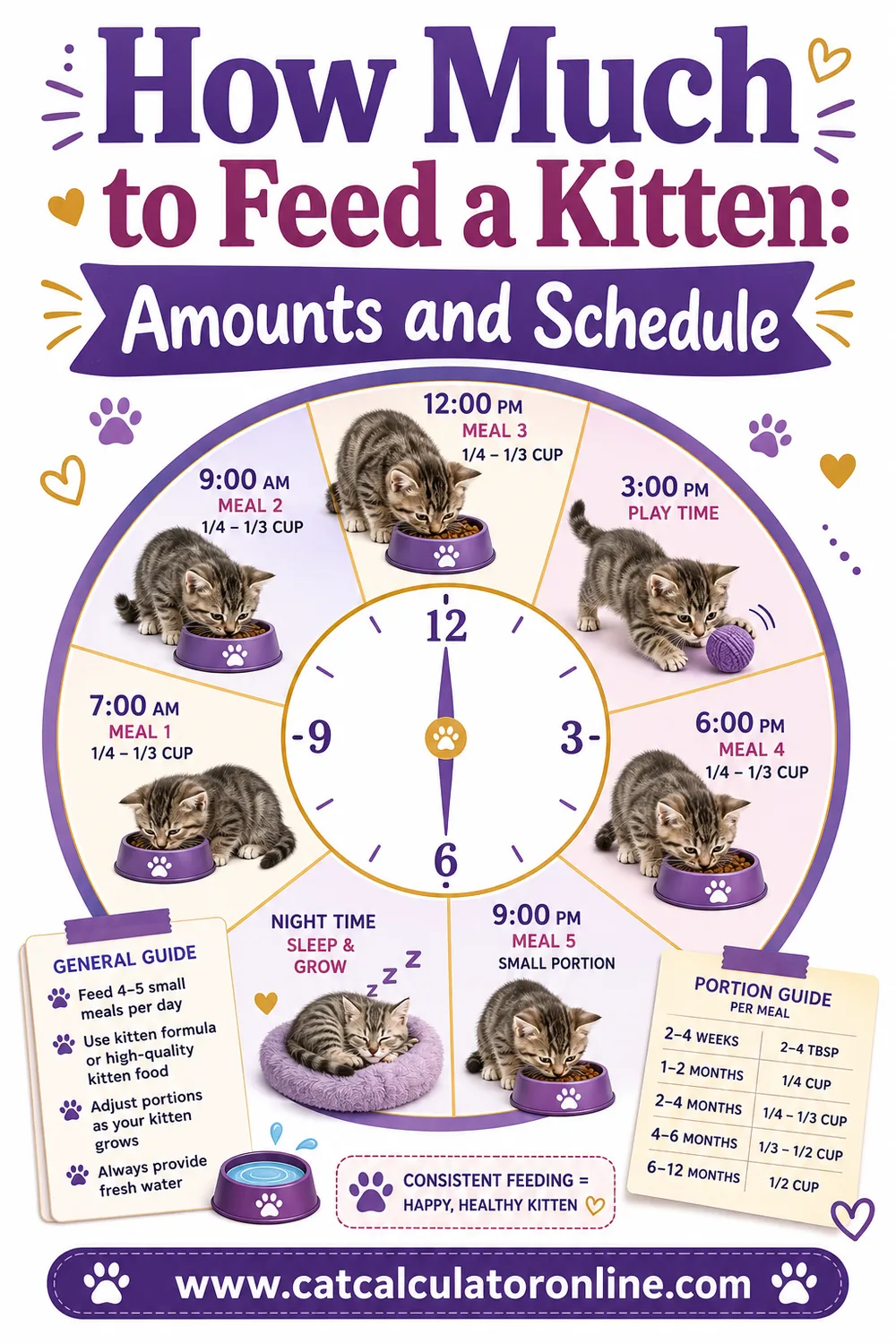
By 8 weeks, a healthy kitten eats solid kitten food for all her nutrition. If you're managing this stage, how much to feed a kitten covers portions during and after weaning, and the kitten feeding chart breaks down meals per day by age.
One firm rule for every stage of this process: never cow's milk. Kittens can't digest it properly and it reliably causes diarrhea — which in a kitten this small is genuinely dangerous. Milk replacer made for kittens is the only acceptable substitute.
What Happens If a Kitten Leaves Mom Too Early?
Sometimes nothing catastrophic — cats are resilient — but the odds tilt the wrong way, and the problems tend to be the long, annoying kind rather than the dramatic kind.
Kittens separated before 8 weeks, and to a lesser degree before 12, show higher rates of:
- Hard play-biting and scratching. The classic signature of missed bite-inhibition lessons. Often directed at hands and ankles, often lifelong without patient retraining.
- Anxiety and fearfulness. More hiding, more startle, slower recovery from stress. Early-separated kittens missed the "bounce it off mom" phase of confidence building.
- Compulsive behaviors. Wool-sucking and excessive suckling on blankets, clothes, or skin — strongly associated with early weaning.
- Litter box inconsistency. Habits that never fully cemented by example.
- Trouble with other cats. A kitten who never learned cat body language can misread every cat she meets, for life.
If you've already adopted an early-separated kitten — knowingly or not — don't panic. You can compensate for a lot: use toys (never hands) for play so biting gets no reward, end play instantly when teeth touch skin (mimicking what a littermate would do), handle her gently and often, and give her lots of safe new experiences before 14 weeks while her socialization window is still open. It's extra work, but it works.
What Does Research Say About Leaving Mom Early?
The "wait until 12 weeks" advice isn't just breeder tradition. Researchers and vets have looked at how early separation affects cats later in life, and the findings point the same way.
- Early weaning is linked to aggression and repetitive behaviors. A large 2017 study from the University of Helsinki, published in Scientific Reports, surveyed owners of thousands of cats. It found that kittens weaned before 8 weeks were more likely to show aggression and repetitive behaviors such as wool-sucking than kittens who stayed longer, and that cats weaned at 14 weeks or later were less likely to be aggressive.
- Kittens are most open to people when they are very young. Studies of kitten handling since the 1980s have shown that the most sensitive window for getting comfortable with humans is early, roughly between 2 and 7 weeks. That's why good breeders and foster homes handle kittens gently every day while they are still with mom. It also means a kitten should be getting people time with her litter, not instead of it.
- Mom's milk helps protect her kittens early on. Kittens get protective antibodies from their mother's first milk. That protection fades over the first few months, which is why the kitten vaccine series is spread out over several visits rather than given all at once.
Put together, the research supports the same advice as the rest of this guide: 8 weeks is the minimum, and 12 to 14 weeks gives a kitten the best start. If you have questions about a specific kitten, your vet is the best person to ask.
Vaccines and Health Checks Before Rehoming
Readiness isn't only about age. A kitten who stays with mom until 12 weeks usually goes home with part of her vaccine course and some basic health care already done. Here's what to expect, and what to ask about, when you pick her up:
| Age | Typical health care |
|---|---|
| 2–8 weeks | Deworming usually starts in the first few weeks and repeats every couple of weeks, on the vet's schedule. |
| 6–8 weeks | First core vaccine (often called FVRCP, which covers feline distemper and two common respiratory viruses). First vet check. |
| Every 3–4 weeks after | Booster shots continue until about 16 weeks of age or a little older. |
| Around 12–16 weeks | Rabies vaccine, depending on the vaccine used and local rules. |
| First vet visit at home | Many vets also recommend a FeLV/FIV test and a discussion about the feline leukemia vaccine, microchipping, and when to spay or neuter. |
When you collect your kitten, ask for written records of every vaccine and deworming treatment so far, plus the date the next one is due. Then book a vet visit for the first week or two at home. Our kitten vaccination schedule and cat worming schedule explain each step in more detail, and when to neuter a cat covers the spay and neuter timing.
Shelter, Rescue, Breeder, or Friend: Does It Change the Timing?
The biology is the same everywhere, but where a kitten comes from often changes when she's offered for adoption:
- Shelters and rescues often place kittens at about 8 weeks, frequently already spayed or neutered, vaccinated, and microchipped. Space is limited, and kittens in a busy shelter can pick up illnesses, so going home a little earlier can make sense. If you adopt at 8 weeks, plan to do extra gentle play training and socializing at home.
- Foster-based rescues sometimes keep kittens longer in a home setting with mom and littermates, which is a great middle ground.
- Breeders of pedigree cats usually keep kittens until about 12 to 13 weeks, and many breed registries and clubs expect this. A breeder who offers a kitten at 6 or 7 weeks is a red flag.
- A friend's or neighbor's litter is where kittens most often leave too early, usually because they look "big enough" at 6 weeks. If you can, ask to wait until at least 8 weeks, and ideally longer.
Not sure a seller is legitimate? See how to avoid a kitten scam and our list of questions to ask before you take a cat home.
When Can Kittens Leave a Feral or Stray Mother?
Kittens born to a feral mom are a special case. A feral mother cat usually can't be handled, and her kittens will grow up wary of people unless they get human contact early. Because the window for getting comfortable with people closes early, rescuers often take feral kittens into foster care sooner than the usual 8 weeks, once they are eating some solid food, so they can be socialized while they are still young. When possible, mom is trapped too, so she can be spayed and the kittens can finish weaning with her.
This is a judgment call that depends on the kittens' health, the mother's situation, and the weather, so it's best made with a local rescue or trap-neuter-return group and a vet. If you find kittens outside, watch from a distance first; mom is often nearby hunting and will come back. If you end up caring for young kittens without their mother, how to care for orphaned kittens and how to tell how old a kitten is will help you plan the next steps.
Indoor Life and Bigger Breeds
Two smaller things can also affect the timing:
- Indoor-only homes are the norm for kittens, and that's a good thing. A young kitten shouldn't go outdoors until she's fully vaccinated, so plan for an indoor setup with a safe room, toys, and climbing space from day one. See how to cat-proof your home.
- Large, slow-growing breeds such as Maine Coons grow for longer than most cats. Some breeders prefer to keep these kittens a little past 12 weeks, so a later homecoming date is normal and nothing to worry about.
What About Orphaned Kittens?
Sometimes there's no choice — mom is gone, and the timeline above goes out the window. Orphaned kittens can absolutely thrive, but they need a human to stand in for everything mom provided.
The essentials:
- Get a vet involved immediately. Bottle-raising is very doable but has real pitfalls; a vet will set the feeding plan, check for illness, and be your safety net. This is not a solo project.
- Kitten milk replacer only. Bottle-feed with a formula made for kittens, warmed, on the schedule your vet gives you — every 2–3 hours around the clock for newborns. Never cow's milk.
- Warmth is life. Young kittens can't hold their own body temperature. A heat source with a cooler escape zone is non-negotiable in the early weeks.
- Wean on the same schedule. Start offering gruel around 4 weeks, done by 7–8 weeks — the biology doesn't change just because a human holds the bottle.
- Over-invest in socialization. With no littermates to teach bite inhibition, you're the substitute: toys instead of fingers, instant end to play when bitten, gentle daily handling, and — gold star move — foster her alongside another kitten or tolerant adult cat if at all possible. A "big sibling" teaches lessons no human can.
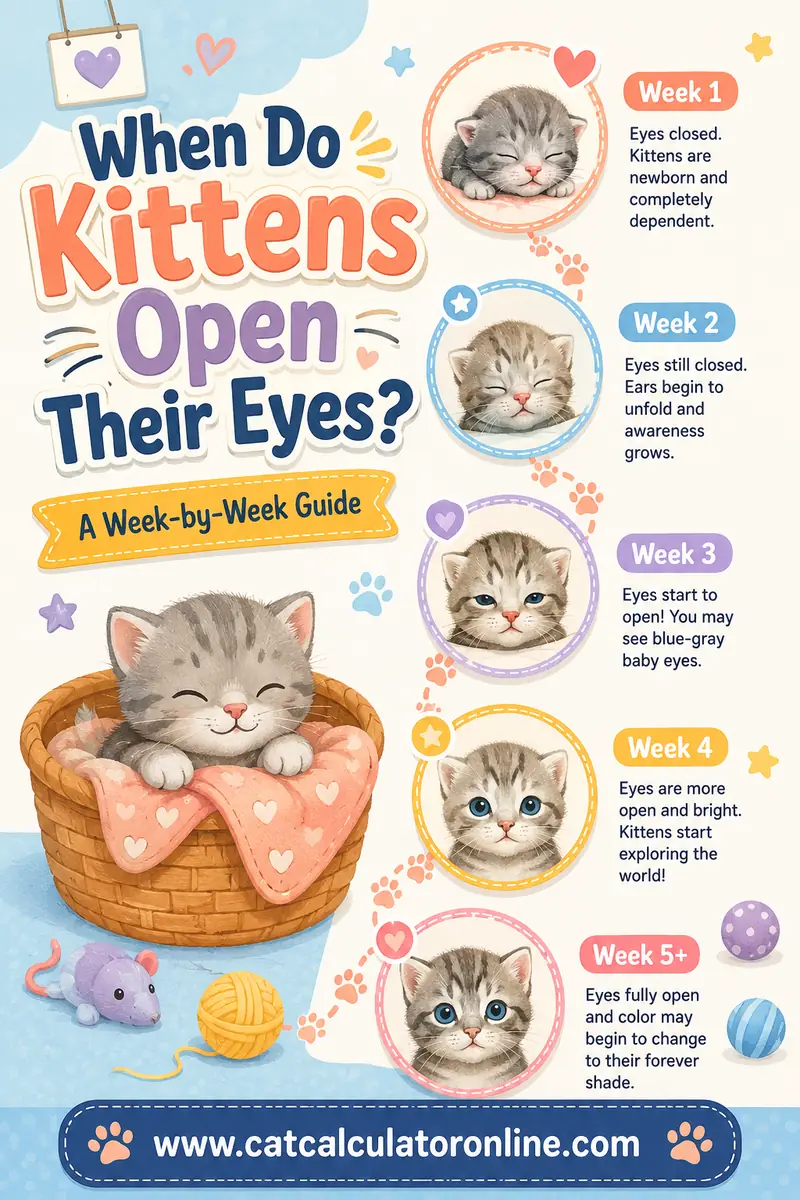
Orphans who get this care catch up remarkably well. If you're raising one from the eyes-closed stage, when do kittens open their eyes walks through the newborn milestones week by week.
How Do You Know a Kitten Is Ready to Come Home?
Age is the headline number, but readiness is a checklist. Before you take a kitten home, you want to be able to tick all of these:
- At least 8 weeks old — ideally 12+. If a seller offers you a 5- or 6-week-old kitten, walk away; it's a welfare red flag (and often illegal).
- Fully weaned and eating solid kitten food enthusiastically, with no bottle or gruel top-ups.
- Using a litter box reliably.
- First vaccination done, with paperwork, and a vet check on record.
- Confident and curious — approaches people, plays, recovers quickly from surprises. A kitten who's terrified of humans at 10 weeks needs more socialization time, not a car ride.
- A healthy weight for her age — a 12-week-old kitten should typically be somewhere around 3 pounds, give or take. You can sanity-check any kitten's weight against her age with the kitten weight calculator.
Then make sure you're ready too — food, litter setup, carrier, safe room, vet appointment booked. The new kitten checklist has the full list so homecoming day is exciting rather than chaotic.
FAQ
Can a kitten leave its mom at 6 weeks?
No — 6 weeks is too early. She's still mid-weaning and mid-socialization, and separating her now raises the risk of feeding problems, anxiety, and lifelong play-biting. In many places it's also illegal to rehome a kitten under 8 weeks. Wait at least two more weeks; more is better.
Is 8 weeks or 12 weeks better for adopting a kitten?
Twelve. Eight weeks is the survivable minimum — weaned, litter trained, first vaccine — but weeks 8–14 are when kittens learn bite control and social skills from mom and littermates. Kittens rehomed at 12–14 weeks are consistently better adjusted. That's why reputable breeders wait.
Do kittens miss their mother when they leave?
Briefly, yes — expect some crying and unsettled nights in the first few days, especially in the first week. Kittens adjust quickly with warmth, routine, play, and something that smells familiar (a blanket from the litter is a classic trick). By 12+ weeks, a well-socialized kitten transfers her attachment to you fast.
When do kittens stop drinking their mother's milk?
Weaning starts around 4 weeks and finishes by about 8 weeks, shifting gradually from nursing to solid kitten food. By 8 weeks a healthy kitten gets all her nutrition from solids. Orphans follow the same timeline using kitten milk replacer — never cow's milk.
What if I already have a kitten that was separated too early?
Compensate deliberately: play with toys instead of hands, end play the instant teeth touch skin, handle her gently every day, and expose her to new sights and people while she's under 14 weeks. Early-separated kittens can turn out wonderfully — they just need you to teach what the littermates would have.
Can a kitten stay with its mom too long?
Not really — there's no harm in a kitten staying 16 weeks or more, and mom will naturally ramp down the mothering herself. The only real consideration is practical: unneutered males should be separated from mom and sisters before puberty (around 5–6 months), since cats will breed within families.
Is 7 weeks too early for a kitten to leave her mother?
Yes. At 7 weeks most kittens are still finishing weaning and are in the middle of learning bite control and social skills from mom and littermates. In many places it is also illegal to sell or give away a kitten under 8 weeks. Waiting at least one more week, and ideally until 12 weeks, is much better for her.
Can a kitten leave its mother at 10 weeks?
A healthy, fully weaned 10-week-old kitten can go to a new home, and many do well. Two to four more weeks with mom and littermates still helps with bite control and confidence, so if the breeder or foster is happy to keep her until 12 weeks, it is worth the wait.
When can kittens leave a feral mother?
Feral kittens are often taken into foster care earlier than 8 weeks, once they are starting on solid food, because they need human contact while they are young to become friendly pets. This should be done with a local rescue or trap-neuter-return group and a vet, and the mother should be trapped and spayed too if possible.
Do kittens need vaccines before leaving their mother?
Ideally, yes. Most kittens get their first core vaccine at 6 to 8 weeks, with boosters every 3 to 4 weeks until about 16 weeks. A kitten going home at 12 weeks has usually had one or two rounds. Ask for written records and book a vet visit soon after homecoming to keep the schedule on track.
How old should kittens be before leaving mom?
At least 8 weeks old, and ideally 12 to 14 weeks. By 8 weeks kittens are weaned and litter trained, but the extra weeks with mom and littermates are when they learn the social skills that make them relaxed, gentle adult cats.
The Bottom Line
Eight weeks is the earliest a kitten should ever leave her mother — she's weaned, warm-blooded in her own right, and litter trained. But if you can wait until 12 to 14 weeks, wait. Those extra weeks of littermate rough-and-tumble are where bite control, confidence, and cat social skills come from, and they're the cheapest behavior insurance you'll ever get. Fully weaned isn't fully ready.
Counting down to homecoming? Get everything staged with the new kitten checklist, keep her meals on track with the kitten feeding chart, and plug her age and weight into the free kitten weight calculator to watch that tiny bundle grow into the cat she's going to be.