The Oldest Cats Ever Recorded
The oldest cat ever verified was Creme Puff, a tabby from Austin, Texas, who lived from 3 August 1967 to 6 August 2005 — 38 years and 3 days. That is more than double what a well-cared-for cat usually manages, and it has stood as the Guinness World Record for two decades. The strangest part of the story is that Creme Puff's owner, Jake Perry, also owned the previous record holder. Before you copy anything he did, though, hold on to one number: even now, a cat reaching 20 is doing exceptionally well, and 25 is remarkable. Curious how your own cat's age translates? Our cat age calculator does the conversion instantly.

Creme Puff, 38 Years And 3 Days
The headline record is old, well documented, and still unbeaten.
Creme Puff was born on 3 August 1967 and died on 6 August 2005, three days past her 38th birthday. She lived in Austin, Texas, with Jake Perry, and Guinness World Records lists her as the oldest cat ever. In human terms that is somewhere north of 165 years — the conversion charts simply run out before you get there.
She was a domestic cat, not a pedigree. No rare bloodline, no unusual breed, nothing you could go out and buy. That matters, because it means the record was not bought with genetics from a breeder.
She lived indoors, in a heavily enriched home. Perry's house was, by all accounts, built around his cats: climbing structures, a converted garage, a screened enclosure, and a constant human presence. That is the least glamorous and most transferable part of the story.
And there is a limit to what any single case proves. One cat reaching 38 tells you the biological ceiling is higher than we thought. It does not tell you how to get there, because a sample of one never can.
The Man Who Owned Two Record Holders
This is the detail that makes the story genuinely odd rather than just charming.
Before Creme Puff, the Guinness record belonged to Granpa Rexs Allen — also Jake Perry's cat. Granpa was a hairless rescue, generally described as a Sphynx or Devon Rex type, and he died in 1998 at around 34 years old. Two record holders, one household.
Two extreme outliers in one home is not a coincidence, and it is not proof of a secret either. It could reflect something real about how those cats were kept. It could equally reflect an owner who was unusually motivated to document ages carefully and submit them for verification, when most owners of very old cats never bother.
What is not in doubt is the environment. Perry neutered his cats, kept them indoors, gave them an enormous amount of stimulation and attention, and lived with them at close quarters for decades. Those are the same levers any owner has.
Both cats also had something no protocol can supply: luck. Avoiding cancer, kidney failure and heart disease for three decades involves a large amount of it.
Should You Copy Creme Puff's Diet? No
This is where the story usually goes wrong online, so it is worth being direct.
Perry reportedly fed his cats dry food supplemented with bacon and eggs, broccoli, asparagus, and a coffee with cream every couple of days. Some accounts add a drop of red wine. Those details get repeated as a longevity formula. They are not one.
Coffee is a bad idea for cats. Caffeine is genuinely toxic to them, and cats are much smaller than us, so the margin is thin. Alcohol is worse. Neither belongs in a feeding plan, whatever an anecdote from the 1970s says.
Some of the rest is harmless in small amounts, but it is not the cause. A little cooked egg or plain cooked broccoli will not hurt most cats. There is no mechanism by which either extends a life by fifteen years, and no evidence that they did here.
The correct reading of the diet story is that it is a coincidence, not a recipe. Cats are obligate carnivores who need animal protein and taurine, and any complete, life-stage-appropriate food covers that. Portion control matters far more than novelty ingredients.
Other Cats Who Reached Extreme Old Age
A handful of other cats have been verified, and rather more have been claimed.
Flossie is the most useful modern example. A tabby from the United Kingdom, born around December 1995, she was recognized by Guinness in November 2022 as the world's oldest living cat at 26 years and 329 days. She had passed through several owners and a rehoming charity, which is how her age could be traced at all.
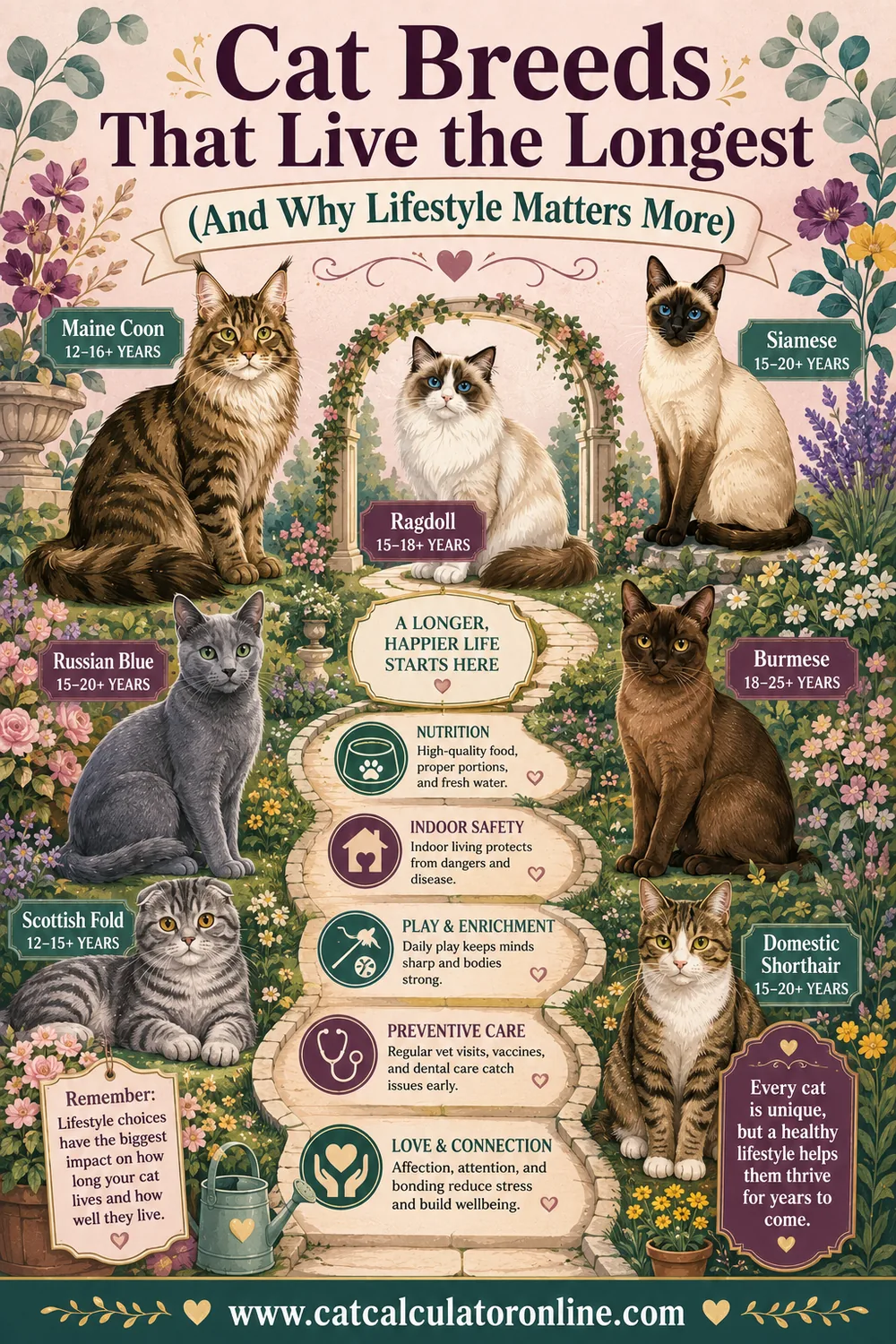
Scooter, a Siamese from Texas, was verified as the oldest living cat in 2016 at 30. Siamese and their relatives turn up disproportionately often in longevity lists, which fits what we know about the breed.
Then there are the claims. Rubble in Exeter was widely reported at 31 in 2020, Nutmeg at around 32, and a cat named Lucy in Wales at 39 — a figure that would break the record outright. None of those were verified to record standard.
| Cat | Age reached | Country | Status |
|---|---|---|---|
| Creme Puff | 38 years 3 days | USA | Verified — oldest ever |
| Granpa Rexs Allen | About 34 years | USA | Verified — previous record |
| Scooter (Siamese) | 30 years | USA | Verified as oldest living, 2016 |
| Flossie | 26 years 329 days | UK | Verified as oldest living, 2022 |
| Rubble | Reported 31 years | UK | Widely reported, not verified |
| Lucy | Claimed 39 years | UK | Claimed, not verified |
Why Very Old Cat Claims Are Hard To Verify
Being skeptical here is not pedantry. It is the reason the record has stood since 2005.
Most cats have no birth certificate. A cat who arrived as a stray, or came from a neighbor's unplanned litter, has an estimated birthday at best. Twenty years later, that estimate has hardened into a fact in the owner's memory.
Vets estimate age rather than know it. Teeth, coat and eyes give a rough bracket in a young cat and a very rough one in an old cat, and the error bars widen with every year. Our guide on telling a cat's age shows how loose those signals really are.
Record verification needs a paper trail from early life. Guinness wants documentation dating back to around the cat's birth — adoption records, early veterinary notes, registration papers. Almost nobody keeps that for a mixed-breed cat, which is why so many genuinely ancient cats never make a list.
So the honest position is this: a few cats have almost certainly lived past 30 without anyone being able to prove it, and a few celebrated claims are probably several years generous. Both things are true at once.
What Is Realistic For Your Cat?
Here is the number that actually applies to the animal in your house.
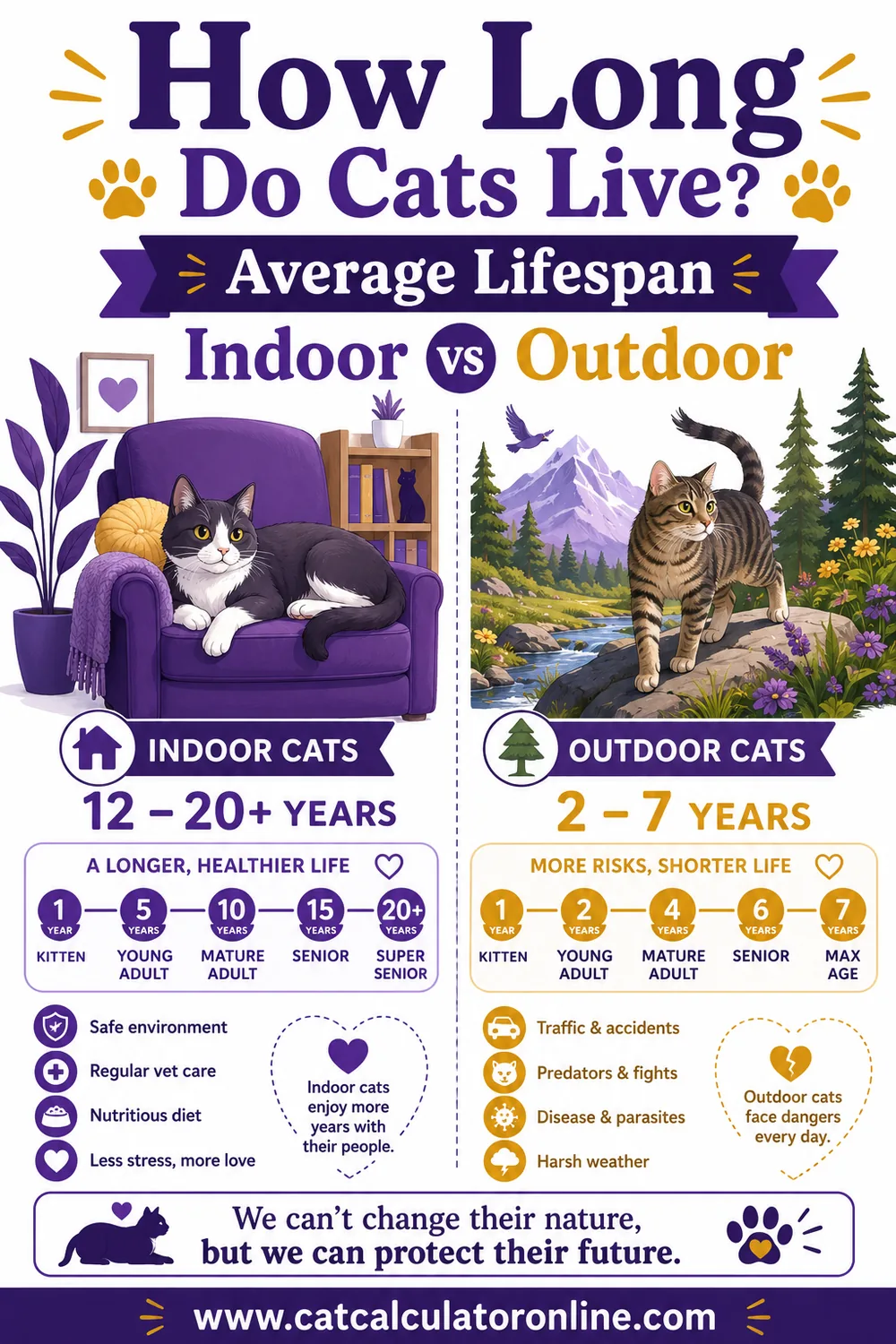
Indoor cats commonly live 12 to 18 years, and cats with free outdoor access average dramatically less — the difference being traffic, infectious disease and predation rather than any change in aging. Our page on how long cats live breaks down the full picture.
Twenty is the real milestone. A cat who reaches 20 has done exceptionally well and is roughly equivalent to a person in their late nineties. Past 25 you are in genuinely rare territory, and past 30 you are in record-book territory.
Breed shifts the odds a little. Siamese, Burmese and their relatives are consistently among the longest-lived, as our guide to the cat breeds that live the longest explains. Large breeds tend to sit lower. Mixed-breed cats do well for reasons covered in our piece on whether mixed-breed cats live longer.
But breed is a modifier and lifestyle is the driver. No pedigree compensates for a cat who crosses a busy road twice a day.
What The Record Holders Actually Have In Common
Strip out the anecdotes and the same short list is left every time.
They lived indoors, or somewhere effectively protected. Not one verified super-ager was a free-roaming outdoor cat. That is the least surprising and most important item on the list, and the size of that effect is set out in our guide to how long indoor cats live.
They were neutered. Neutered cats of both sexes outlive intact ones, and every record holder falls on the right side of that line.
They lived with someone who paid close attention. Owners who notice a half-pound of weight loss, or a cat who has stopped jumping onto the worktop, catch things early. That is worth more than any supplement.
They stayed lean and kept eating well into old age. Very old cats tend to lose muscle, and the ones who do best are those whose owners noticed and adjusted rather than assuming it was just age.
And they got lucky. Say it plainly, because the alternative is implying that owners of cats who died at 12 did something wrong. They usually did not.
Caring For A Cat Who Is Already Very Old
If your cat is heading into her late teens, the priorities shift.
Move to vet checks every six months with bloodwork. Kidney disease, an overactive thyroid and high blood pressure are all common past eleven, all treatable, and all silent until they are advanced. Blood, urine and a blood pressure reading find them early. This is the single highest-value habit, and it is covered in our guide on how to help your cat live longer.
Weigh her monthly and write it down. In a very old cat, losing weight is a symptom, not a success. A half-pound loss is roughly five percent of body weight and is invisible by eye.
Never withhold food from an old cat. A cat who stops eating for 24 hours or more can develop a dangerous liver condition, so a cat who is off her food needs a vet call rather than a wait-and-see.
Make the house easier. Low-sided litter boxes, steps up to the favorite chair, a warm bed at floor level, rugs on slippery floors, and help with grooming the spots she can no longer reach. Old cats stop jumping because of arthritis, and arthritis is very treatable.
Call the vet the same day for: sudden blindness or widely dilated pupils, open-mouthed breathing, straining in the litter box without producing urine, collapse, or a complete refusal to eat.
Frequently Asked Questions
What is the oldest cat ever recorded?
Creme Puff, a domestic cat from Austin, Texas, lived 38 years and 3 days, from 3 August 1967 to 6 August 2005. Guinness World Records still recognizes her as the oldest cat ever verified, and no cat has come close since.
Who owned the oldest cat in the world?
Jake Perry of Austin, Texas, owned Creme Puff. Unusually, he also owned the previous record holder, a hairless cat called Granpa Rexs Allen who died in 1998 at around 34. Both cats lived indoors in a heavily enriched home.
Did Creme Puff really drink coffee?
Her owner reported feeding bacon, eggs, broccoli, asparagus and coffee with cream. Do not copy it. Caffeine is genuinely toxic to cats and alcohol is worse. The diet is an anecdote from one household, not an explanation for the record.
What is the oldest living cat right now?
Titles change as cats die and new claims are verified. The most recent widely recognized holder was Flossie, a UK tabby confirmed by Guinness in November 2022 at 26 years and 329 days. Verification requires documentation from early life.
How old is a 30-year-old cat in human years?
Well past 130 in human-equivalent terms. Standard conversion charts use roughly four human years per cat year after the age of two, and most stop at 20 because so few cats go further. A 30-year-old cat is an extreme outlier.
Is it realistic for my cat to live past 20?
It is possible but uncommon. Indoor cats commonly reach 12 to 18 years, and reaching 20 marks an exceptionally long life. Indoor living, a lean body, dental care, neutering and twice-yearly senior vet checks give a cat the best chance.
Creme Puff's 38 years is a wonderful story and a terrible template. Nothing about her diet is worth imitating, and nothing about her breeding is available to buy. What is worth taking from the record book is the pattern underneath it: every verified super-ager lived indoors or somewhere protected, was neutered, and belonged to someone who noticed small changes early. Aim at 20 rather than 38, use the levers that actually work, and book that six-monthly senior check-up once your cat passes eleven. Find out where your own cat sits in human terms with the cat age calculator, and enjoy her while she is here.