5 Cat Years in Human Years
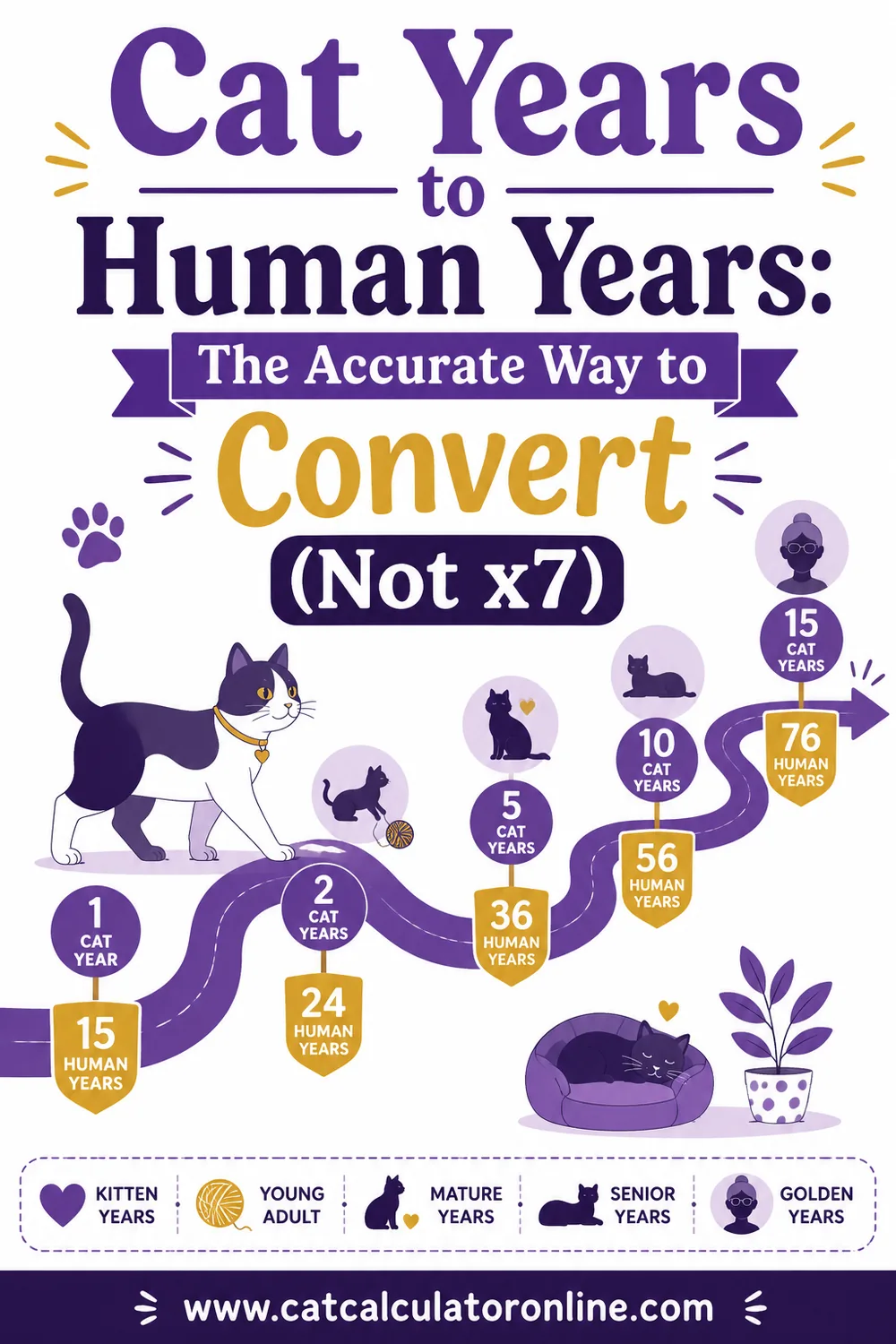
A five-year-old cat is about 36 in human years. Five is roughly the halfway point of an indoor cat's life — average lifespan is 13 to 17 years, so a five-year-old has done a third of it and is coasting through the easiest stretch. It's also the last year before things start to shift: at six a cat is approaching the mature adult stage, and at seven it's formally in middle age. This page covers the math, what the halfway mark actually means, and why five is the sensible year to stop assuming your cat will always be young. The cat age calculator handles any age instantly.
How Do You Get 36?
Three steps, and the third one covers every year from here to the end of a cat's life.
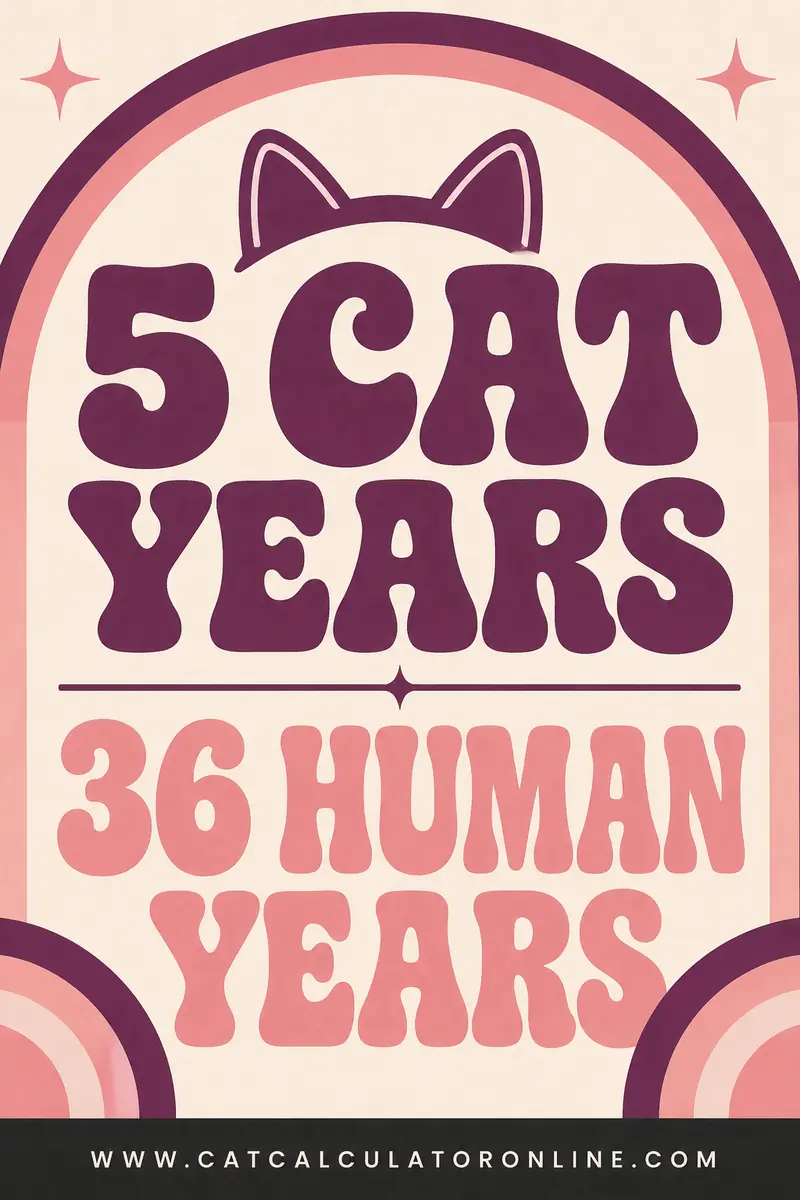
15 for year one. 9 for year two. 4 for every year after.
- Year 1 → 15
- Year 2 → 24
- Years 3, 4, 5 → 24 + (3 × 4) = 36
| Cat's age | Human years | Life stage |
|---|---|---|
| 3 | 28 | Young adult |
| 4 | 32 | Young adult |
| 5 | 36 | Young adult |
| 6 | 40 | Young adult |
| 7 | 44 | Mature adult |
| 8 | 48 | Mature adult |
| 10 | 56 | Senior |
| 13 | 68 | Senior |
Five is the last of the easy years. Nothing about the conversion changes, but the life stage does — six is the final year of young adulthood, and seven begins the mature adult stage, when screening becomes genuinely useful rather than optional.
Neighbouring ages are in 4 cat years in human years and 6 cat years in human years, the whole table in cat years to human years, and the method in how a cat age calculator works.
What Does the Halfway Mark Actually Mean?
Worth doing the arithmetic properly, because "halfway" is a loose word.
Indoor cats average 13 to 17 years, with a good number reaching 20. Take 15 as a working middle. A five-year-old cat is therefore about a third of the way through, not half — which is the more encouraging framing and the more accurate one.
Outdoor cats are a different picture entirely. Cats with unsupervised outdoor access average dramatically shorter lives — roads, other cats, disease and predation account for most of the difference. A five-year-old outdoor cat has already outlived a substantial share of its cohort. The comparison is set out in how long do indoor cats live.
In human terms, 36 is a reasonable analogue: an adult in good health, past youth, with a great deal of life ahead but no longer in a position to assume nothing will ever go wrong.
What that means practically. Up to five, the honest advice for a healthy cat is largely "keep doing what you're doing". From five onwards, the useful advice starts to include watching for things — weight trend, joint stiffness, drinking changes, dental disease — because these are the years when the conditions of old age quietly begin.
None of that means a five-year-old cat is old. It isn't, by any measure. It means the window for cheap, easy prevention is still open and won't be open indefinitely.
Why Is Weight the Defining Risk at Five?
Because feline middle-age spread starts in this window, and the trajectory is set here.
The pattern. Activity has been declining gradually since age two. Portions usually haven't changed. Treats have accumulated as a habit. The result is a slow gain that's invisible month to month and obvious across five years.
Why five specifically. Cats that are going to become overweight are typically well on the way by five or six. Reversing it later is genuinely harder — an older, heavier, arthritic cat is less able to exercise, and weight loss in cats must be gradual because rapid loss risks hepatic lipidosis, a serious liver condition.
The numbers that matter:
- A 4 kg cat gaining 100 g a year is 4.5 kg at ten — over 12% up, and enough to change its risk profile
- A cat at 20% over ideal weight has materially higher risk of diabetes, arthritis and urinary disease
- Losing weight safely means roughly 0.5–2% of body weight per week, no faster — which for a 5 kg cat is 25–100 g a week
What to do:
- Weigh monthly, record it, and look at the twelve-month trend rather than the month-to-month noise
- Feel ribs weekly; they should be easy to find under a thin covering
- Measure food rather than eyeballing it, and recalculate the portion whenever activity changes
- Treat treats as part of the daily ration, not as extra
- Keep two short play sessions a day, which does more for weight in an indoor cat than any diet food
If the trend is already up, talk to your vet rather than cutting food sharply yourself. Feline weight loss needs to be slow and monitored.
What Should You Start Watching For?
Not because a five-year-old cat is likely to be ill, but because knowing the baseline is what makes later changes visible.
Joints. Osteoarthritis is far more common in cats than owners realize and starts earlier than most expect. It rarely presents as limping — cats compensate. Watch instead for: choosing lower perches, hesitating before a jump, taking the sofa as a staging post to the windowsill, reduced grooming over the back and hips, or a slight reluctance to be handled around the spine.
Drinking. Note roughly what normal looks like. An increase is one of the earliest signs of kidney disease, diabetes and hyperthyroidism — and you can only notice an increase if you knew the starting point.
Litter box output. Volume and frequency. Larger, more frequent urination is the same early signal.
Appetite direction. An increase with weight loss is a classic hyperthyroid picture; a decrease is worth investigating in any cat.
Grooming quality. A coat that starts looking slightly unkempt is often the first sign of joint pain or dental discomfort, because both make grooming harder.
Teeth. Most cats have some periodontal disease by now. A thirty-second gum-line check twice a week catches it early.
Blood pressure, which you can't observe at home but can ask about. Feline hypertension is common, entirely silent, and damages the eyes and kidneys before anything visible happens. Some practices check it routinely from middle age; many don't unless asked.
None of these are alarms at five. They're the observations that make a difference at nine, and the habit is what matters. A cat that has been watched carefully from five gets its kidney disease caught at stage two rather than stage four, and that difference is measured in years.
Is Five a Turning Point for Costs?
In one specific way, yes — and it's worth knowing before the birthday rather than after.
Insurance gets harder from here. Premiums rise with age, and more importantly, anything diagnosed becomes a pre-existing condition excluded from any new policy. A cat insured at five with a clean history is straightforward; the same cat insured at nine after a dental extraction and a urinary episode is expensive and partially excluded.
If you're going to insure, five is roughly the practical deadline for getting reasonable terms on a comprehensive policy. That isn't a reason to buy insurance — plenty of owners self-insure by saving instead — but it is a reason to make the decision deliberately now rather than defaulting to "later".
Veterinary costs rise from the mature adult stage. Annual checks become twice-yearly at ten. Bloodwork becomes routine. Dental procedures become likely rather than possible. The costs are laid out in cat vet costs explained.
The alternative to insurance is a fund. Setting aside a fixed amount monthly from age five gives you a decade of accumulation before the years when it's most likely to be needed. The important part is that it's deliberate rather than hoped-for.
And the cheapest intervention remains free: keeping the cat at a correct weight, brushing its teeth, and getting it seen annually. Those three do more to control lifetime veterinary spend than any financial product.
How Does a Five-Year-Old Spend Its Day?
Useful to know, because deviation from the pattern is often the first sign anything is wrong.
Sleep takes 12 to 16 hours, broken into many short bouts rather than one long stretch. Cats are crepuscular — most active around dawn and dusk — so the deepest sleep tends to fall in the middle of the day and the middle of the night.
Grooming takes several hours, spread through the waking periods. A cat that grooms noticeably less is often uncomfortable somewhere; one that grooms a patch bare is usually stressed or itchy.
Eating happens in small frequent portions if food is available that way. A cat's natural pattern is roughly ten to twenty small meals a day — which is why free-fed cats graze and why sudden interest in one big meal is a change worth noticing.
Hunting behavior persists whether or not there's prey. Stalking, pouncing and the "chattering" at birds through a window are normal in a five-year-old and shouldn't have disappeared.
Territory patrol is real. Most cats have a circuit — windowsills, doorways, favored high spots — walked several times a day. A cat that stops using its high spots is worth watching, since it's often the first sign of joint discomfort.
Social contact varies enormously by cat and is stable by this age. What matters is not how sociable your cat is, but whether it has changed. A cat that used to greet you and now doesn't is telling you something.
The practical value: you don't need to track any of this formally. You need to know it well enough that when the pattern shifts at nine or eleven, you notice within days rather than months.
Frequently Asked Questions
How many human years is 5 cat years?
About 36. The calculation is 15 for the first year, 9 for the second, then 4 for each year after — so 24 at age two plus three more years at four each gives 36.
Is a 5-year-old cat middle-aged?
Not quite. Under AAHA feline life-stage guidelines a cat is a young adult until six, with the mature adult stage beginning at seven. Five is the last comfortable stretch of young adulthood.
Is five halfway through a cat's life?
Closer to a third. Indoor cats average 13 to 17 years, so a five-year-old typically has around two-thirds of its life ahead. Outdoor cats have considerably shorter average lifespans, which changes the picture significantly.
Why does weight matter so much at five?
Because feline middle-age weight gain typically establishes itself between two and six, and it's much easier to correct now than later. Weight loss in cats must be gradual, and an older arthritic cat is less able to exercise its way back.
Can cats get arthritis at five?
Yes — joint change often begins earlier than owners expect and rarely shows as obvious limping. Watch for choosing lower perches, hesitating before jumps, and reduced grooming over the back and hips.
Is five too late to insure a cat?
Not too late, but it's roughly the practical deadline for good terms. Premiums rise with age and anything already diagnosed becomes a pre-existing exclusion, so a clean history at five gets far better cover than the same cat at nine.
Five cat years is about 36 human years — the last of the genuinely easy years, and the right moment to start watching rather than assuming. Weight, joints, drinking and teeth are the four things worth a baseline now, because every one of them matters more at ten. Convert any age with the cat age calculator.