Why Do Cats Bite? The Real Reasons and How to Stop It
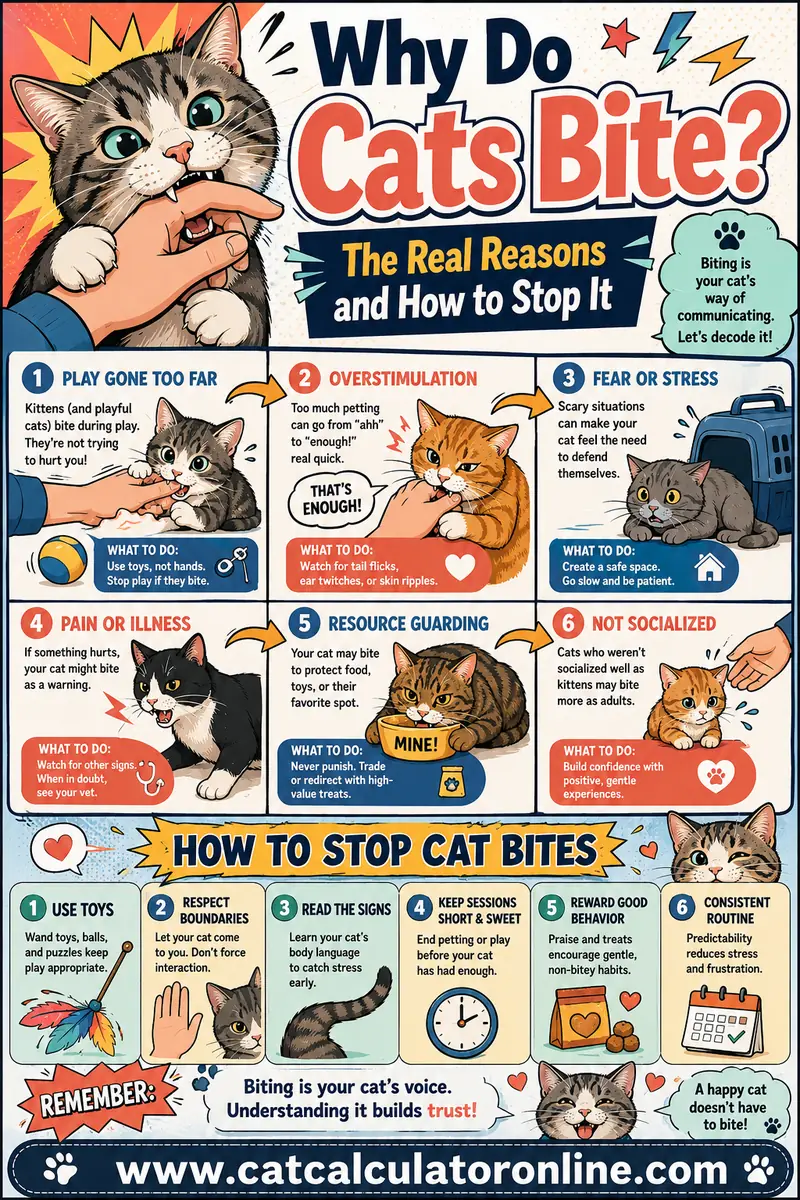
Cats bite for six main reasons: play aggression, overstimulation during petting, redirected aggression from something else, fear, pain, and gentle "love bites" that aren't really bites at all. Almost none of it is spite or bad temper — biting is communication, and in nearly every case your cat gave you a warning first.
Learning to spot that warning is the whole game. If you'd also like to know how old your cat is in human years — which matters, because play biting in a kitten and sudden biting in a senior are very different problems — our free cat age calculator tells you in one tap.
🐾 Why did she bite? Tap the situation
Tap a situation above to see what’s really going on.
1. Play Aggression: The Kitten Problem That Follows Cats Into Adulthood
This is the most common cause of biting in young cats, and it's almost always something humans accidentally taught.
Kittens learn bite inhibition from their littermates and their mother. A kitten bites too hard during a wrestling match, the other kitten shrieks and stops playing, and the biter learns exactly how much pressure is acceptable. Kittens separated from their litter too early, or hand-raised as singletons, often miss that lesson entirely.
Then there's the human contribution: wiggling fingers under a blanket, letting a kitten chase your hand, tickling her belly until she grabs it. That's fun for about four months. At ten months, with adult teeth and adult muscle behind it, the same behavior breaks skin.
Signs it's play, not aggression
- Ears forward, pupils dilated, whiskers pushed forward
- Bouncy, sideways movements and a tail held up
- Pouncing from behind furniture, ambushing ankles
- Grabbing with front paws and bunny-kicking with the back feet
- No hissing, no growling, no flat ears
That last point matters. A playing cat looks excited. An angry cat looks tense and makes noise.
How to fix it
Never use your hands as toys. Not once, not with a tiny kitten, not "just this time." Every article on raising cats says this and it's still the single most-ignored piece of advice in cat ownership. A wand toy or a kicker toy keeps your skin out of the prey category.
Give her a real hunting outlet. Two sessions of ten to fifteen minutes a day with a wand toy, ending with a catch and a small meal, satisfies the sequence she's built to run. A cat with nowhere to hunt hunts your feet.
Go still and boring the instant teeth land. Pull away slowly, stop moving, stand up, and leave the room without a word. Yanking your hand back triggers the chase reflex and makes it worse.
Consider a second cat if she's young and alone. A well-matched playmate absorbs an enormous amount of predatory energy. Our new kitten checklist covers the setup.
2. Petting-Induced Overstimulation: "He Was Enjoying It, Then He Bit Me"
Every cat owner knows this one. She's on your lap, purring, clearly happy. Ninety seconds later she's clamped onto your wrist. It feels like a betrayal, and it isn't — it's a limit you didn't see her hit.
Repeated stroking builds up sensory input. For some cats that becomes uncomfortable quickly, especially along the back, near the base of the tail, and on the belly. Purring doesn't cancel that out; cats can be enjoying something and reach their ceiling within the same minute.
The warning signs that come first
Almost nobody gets bitten without warning. They just miss it. Watch for:
| Warning sign | What it means | How long you have |
|---|---|---|
| Tail tip twitching, then thumping | Irritation building | Stop now — you have seconds |
| Skin rippling along the back | Sensory overload | Stop immediately |
| Ears rotating back or out to the sides | Tolerance running out | Stop and remove your hand |
| Body going suddenly still and tense | She's deciding | Freeze, then withdraw slowly |
| Head turning toward your hand | Tracking the target | Stop touching her |
| A low tail flick or a short, sharp exhale | Final warning | Already overdue |
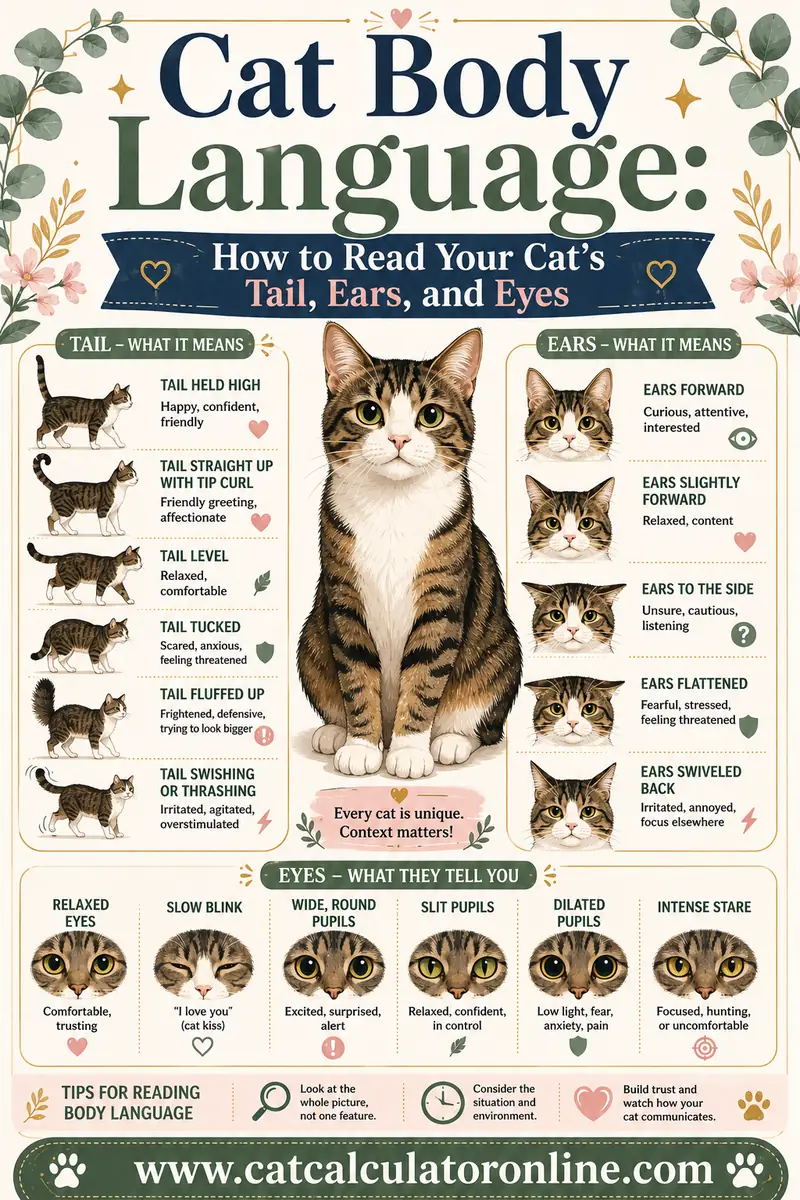
The signal to burn into memory is the tail. A cat's thrashing tail means the opposite of a dog's wagging one — it's agitation, not delight. Full details on that and the rest of her signals are in cat body language.
What to do about it
- Learn her number. Many cats have a fairly consistent tolerance — eight strokes, thirty seconds, whatever it is. Stop a little before it.
- Stick to the safe zones. Cheeks, chin, the base of the ears, and the top of the head are where cats groom each other. Backs, bellies, and tail bases are riskier.
- Stop while she still wants more. Ending on a good note keeps her tolerance high over time. Pushing past the limit lowers it.
- Don't pin or hold her. A cat who can leave freely bites far less than one who feels trapped.
3. Redirected Aggression: When You're Just the Nearest Thing
This is the one that genuinely confuses people, because it looks completely unprovoked.
Your cat sees another cat through the window. She can't reach it. The arousal has to go somewhere, and you happen to walk past. She turns and bites you hard — a cat who has never bitten anyone in her life.
Common triggers include a cat outside the window, an unfamiliar smell on your clothes, a loud noise, a vet visit, or a scuffle with another cat in the house. It also happens between housemate cats: two cats who lived peacefully for years can fall out badly after one of them is startled by something outside.
What to do: separate rather than intervene. Don't reach for a redirected cat — you'll be bitten again. Leave the room, dim the lights, and give her forty minutes to an hour to come back down. Adrenaline takes time to clear.
Prevention: block visual access to the trigger. Frosted window film on the lower half of the glass, removing outdoor feeders near windows, and discouraging neighborhood cats from the garden solve most cases.
Never punish redirected aggression. She isn't angry with you and she isn't in full control of it.
4. Fear and Defensive Biting
A frightened cat bites as a last resort. Cats almost always prefer to leave — biting means her exits were blocked.
You'll see the whole picture before it happens: flattened ears, huge pupils, a crouched body, a tucked or puffed tail, hissing, growling, and often a paw swipe first. Cats are exceptionally clear about this. The problem is that people keep reaching in anyway.
What to do: stop moving toward her, turn slightly side-on, avoid direct eye contact, and give her a clear route out of the room. Never corner her, never scoop her up mid-panic, and don't try to comfort a terrified cat by holding her.
Fear biting is common at the vet, during nail trims, in carriers, and around unfamiliar visitors. Slow, patient desensitisation — leaving the carrier out permanently, feeding meals in it, handling paws for two seconds at a time — works far better than force.
5. Pain: The Cause You Can't Afford to Miss
A cat who suddenly starts biting needs a vet check. This deserves its own line because it's the reason people most often overlook.
Cats hide pain instinctively, and a bite is one of the few times the pain becomes visible. Arthritis in an older cat makes being lifted or stroked along the spine genuinely hurt. Dental disease makes head handling unbearable. Ear infections, abscesses, urinary problems, and skin conditions all produce the same pattern: a normally tolerant cat who now objects to being touched.
Suspect pain when:
- A cat with no history of biting starts within days or weeks
- She bites when touched in one specific area but not elsewhere
- The biting comes with hiding, reduced grooming, or reluctance to jump
- She's over seven and getting grumpier generally
- Appetite, litter box habits, or sleeping spots have changed too
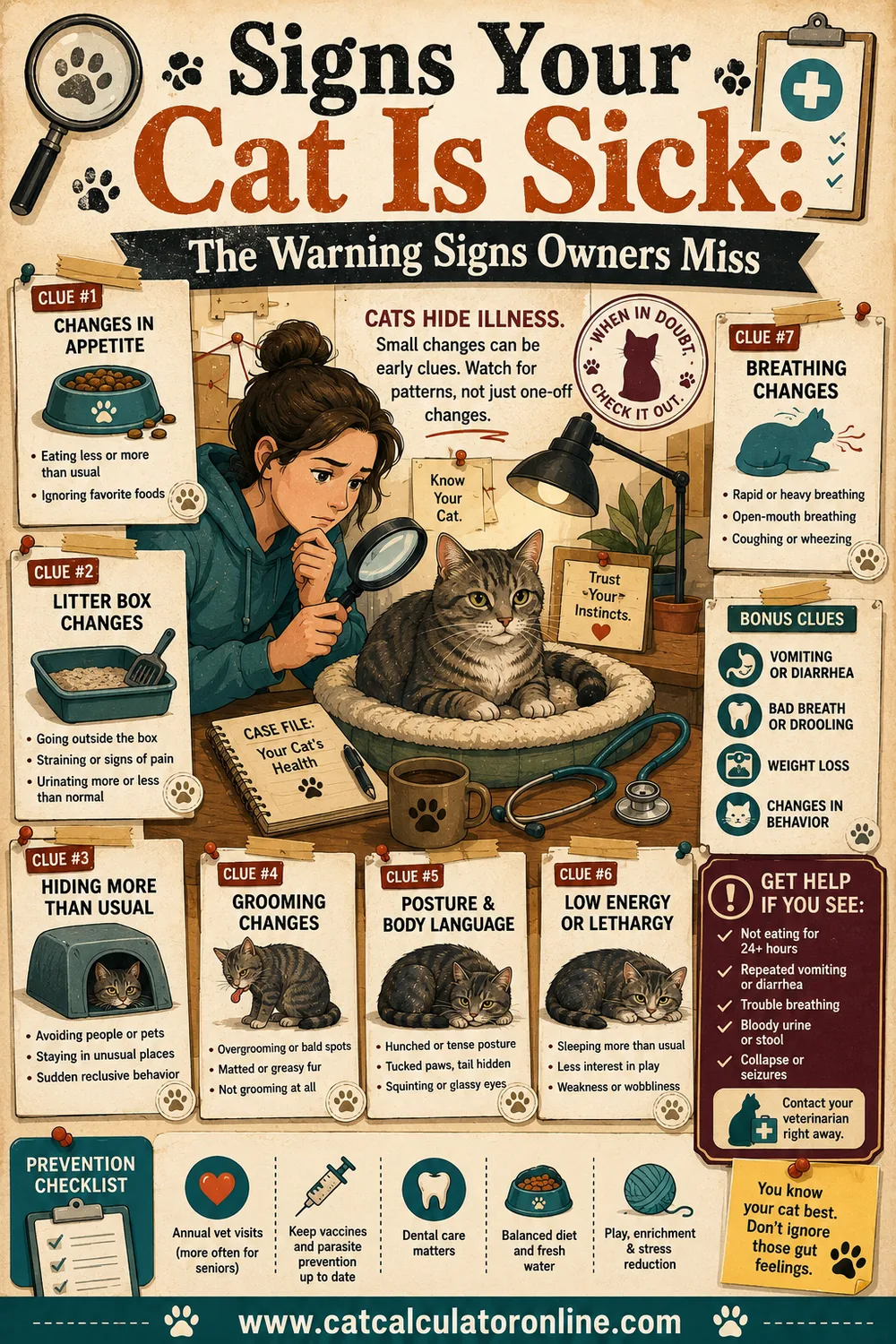
Signs your cat is sick covers the fuller picture, and how often should a cat go to the vet explains what a normal check-up schedule looks like. Any behavior change in a cat is a medical question until a vet says otherwise.
6. Love Bites and Grooming Nibbles
Not every mouth on your hand is a bite.
Some cats deliver gentle, pressure-free nibbles while being petted or while grooming you. It's a social grooming behavior — cats use their teeth on each other during allogrooming, nibbling at the fur around the neck and head. When your cat does it to you, she's including you in that.
You'll know the difference immediately. Love bites are soft, brief, often accompanied by purring and licking, with relaxed ears and a loose body. There's no grabbing and no bunny-kicking.
If you'd rather she didn't, just redirect calmly — move your hand, offer a toy instead. Don't scold her for it; it's affection.
What Never to Do
Some standard human reactions actively make biting worse.
- Never hit, flick, tap the nose, or scruff. It doesn't teach restraint. It teaches that hands are dangerous and unpredictable, which increases defensive biting.
- Don't use a spray bottle. Same problem. Cats rarely connect the punishment to the behavior — they connect it to you.
- Don't yell. Sudden loud noise raises arousal, and arousal is what caused the bite.
- Don't yank your hand away fast. Rapid movement is prey movement. Go still instead and she'll usually let go.
- Don't push through the warning signs. "She'll get used to it" isn't how cats work.
- Don't play with hands, ever. Including with kittens. Especially with kittens.
A Note on Cat Bites and Your Health
This part is practical rather than behavioral, and it matters.
Cat teeth are thin and sharp, so a bite makes a small, deep puncture that seals over quickly and traps bacteria underneath. Cat bites that break the skin get infected far more easily than most people expect, and bites to the hand, near a joint, or on someone with a weakened immune system are higher risk.
If a cat bite punctures your skin, see a doctor. Wash it thoroughly with soap and running water first, but don't wait to see whether it gets infected. This is standard medical advice, not an overreaction, and prompt treatment prevents a genuinely nasty problem.
FAQ
Why does my cat bite me when I pet him?
Almost always petting-induced overstimulation. Repeated stroking builds sensory input until it becomes uncomfortable, and a purring cat can still hit that limit within a minute. Watch for a twitching tail, rippling skin along the back, or ears rotating back — then stop before the bite.
Why does my cat bite me for no reason?
There's nearly always a reason you didn't see. The three most common hidden causes are redirected aggression from something outside the window, pain from an undiagnosed problem, and warning signals that were missed. A cat who newly starts biting should see a vet.
How do I stop my kitten from biting my hands?
Never let hands be toys, redirect every grab onto a wand toy, and go completely still and boring the moment teeth touch skin — then leave the room. Add two daily play sessions to burn her hunting energy. Consistency across everyone in the household matters more than any single technique.
Are cat love bites different from real bites?
Yes. Love bites are soft, quick, pressure-free nibbles that come with purring, licking, relaxed ears, and a loose body. Real bites involve grabbing, sustained pressure, flat ears, and often a stiff body or bunny-kicking back legs.
Should I punish my cat for biting?
No. Hitting, nose-tapping, scruffing, and spray bottles all increase fear and defensive biting, and cats generally associate the punishment with you rather than with the behavior. Prevention, redirection, and ending the interaction calmly are what actually work.
Do I need to see a doctor for a cat bite?
If it punctures the skin, yes. Cat bites create deep, narrow wounds that close over and trap bacteria, so they become infected easily — especially on the hands. Wash the wound thoroughly and get it looked at promptly rather than waiting.
The Bottom Line
Cats bite because they're overstimulated, playing too rough, frightened, redirecting arousal from something else, or hurting — not because they're spiteful. Every one of those has a warning attached, and the tail is usually the first thing to tell you. Learn to read it, stop before the limit, and keep your hands out of playtime.
And take sudden biting seriously. A cat whose behavior changes is often a cat who's unwell. Check her age in human years with our free cat age calculator, then read cat body language so you never miss the warning again.