How to Stop a Cat Scratching Furniture
The honest version first: you cannot stop a cat scratching, and you should not try. What you can do — reliably, usually within a two weeks — is move it. The single change that fixes most cases is a post that is at least 30 in (75 cm) tall, heavy enough not to wobble under a determined cat, wrapped in sisal, and placed right up against the piece of furniture she already scratches. Not in the corner, not in the spare room. Against the sofa arm she has already chosen. Almost every unused scratch post in Britain fails on height, stability or location, and usually all three. The rest of this page is the detail around that one move. If you would like to know how old the culprit is in human terms while you shop, the free cat age calculator does it in a tap.
The Five-Minute Version
If you read nothing else, do these six things in this order.
1. Buy a post that passes the wobble test. Push the top of it firmly sideways. If it moves, she will not use it. Weight in the base is what you are paying for.
2. Make it tall enough. At least 30 in (75 cm) for an average adult cat, and taller for a large breed. She should be able to reach above her head with her front paws while her back feet are on the floor.
3. Put it where the damage is. Against the sofa arm, beside the door frame, over the shredded bit of carpet. Location beats every other factor.
4. Cover the old spot for a few weeks. A throw, a piece of double-sided tape or a plastic sofa protector. You are removing the option, not punishing her.
5. Make the new post rewarding. Catnip on it, wand toy played across it, a treat every time she uses it. Never take her paws and rub them on it.
6. Trim her claws every two to four weeks. It halves the damage while the new habit is forming.
Give it two to three weeks. Most cats switch within a two weeks when all six are done together. Doing two of the six rarely works.
Choosing a Post She Will Actually Use
Most scratch posts are sold to humans on the basis of looking tidy, which is exactly why they fail.
| Feature | What she needs | Common failure |
|---|---|---|
| Height | 30 in (75 cm) minimum, more for big breeds | Kitten-sized posts sold for adult cats |
| Stability | No movement under full body weight | Light plastic bases that rock |
| Material | Sisal rope or sisal fabric; cardboard for horizontal | Soft carpet that does not shred |
| Orientation | Match what she already scratches | Vertical post for a rug scratcher |
| Base width | Wide and heavy, or wall-fixed | Narrow base that tips |
| Number | One per cat, plus one, in different rooms | A single post for three cats |
Sisal fabric outlasts sisal rope. Rope unravels and loosens; woven sisal fabric wears more evenly and keeps its grip.
Cardboard is excellent for horizontal scratchers, cheap, and genuinely popular with cats. It makes a mess, and that is the trade.
Wall-mounted panels solve the wobble problem completely, and suit small flats where a floor post is in the way.
Do not buy a carpeted post if she scratches carpet. It teaches that carpet is the correct surface, which is the opposite of what you want.
A cat tree does several jobs at once. Height, scratching and a lookout post — how to pick one is in the cat tree buying guide.
Placement Beats Everything Else
This is where nearly every well-intentioned attempt goes wrong.
Put the post where she already scratches, not where you would like it. A perfect post in the wrong room is furniture. A mediocre post against the damaged sofa arm gets used.
Then move it gradually. Once she has used it consistently for a couple of weeks, shift it a few inches a week toward where you want it. Stop if she goes back to the sofa.
Add one near where she sleeps. Cats scratch within seconds of waking, so a post beside her favorite bed intercepts the first scratch of the day.
Add one by the door you come home through. Greeting scratching is a real pattern and it needs a target.
Spread them through the house. One per cat plus a spare, in the rooms she actually uses.
In multi-cat homes, avoid dead ends. A post in a corner that a cat can be trapped in will be avoided by the less confident cat, which is also relevant to stopping cats fighting.
Making the Sofa Temporarily Boring
You are not trying to punish her. You are removing one option for long enough that the other becomes a habit.
Double-sided tape is the most effective single deterrent. Cats dislike sticky paws intensely. Wide-tape products made for this exist, and ordinary carpet tape works on many fabrics — test a hidden patch first.
A tightly tucked throw removes the texture. Smooth fabric with no purchase is much less rewarding to scratch.
Plastic sofa protectors work and look awful. They are a three-week measure, not a permanent decoration.
Aluminum foil suits some cats and not others. Cheap to try, and about half of cats ignore it.
Citrus and menthol sprays are weakly supported. Some cats avoid them, plenty do not, and they can stain fabric. Do not rely on a spray as your main plan.
Clean the marked spot with an enzyme cleaner. It removes her scent so the site is less obviously hers, though this only helps alongside a proper alternative.
Take the covers off after two to three weeks. If she goes straight back, the post has failed a test above — usually stability or placement.
Teaching Her the New Post
Cats do not follow instructions, but they do follow rewards.
Play at the post, not on it. Drag a wand toy up and over the sisal so her claws catch it. That first accidental scratch is the moment the habit starts.
Use catnip or silvervine. Rub it into the surface. Roughly two thirds of cats respond to catnip, and many that do not respond to silvervine instead.
Reward every use, immediately. A treat or a scratch under the chin within a second or two of her using it. Timing matters far more than the size of the reward.
Never carry her to it or move her paws. It is the fastest way to make a cat hate an object, and it feels like restraint to her.
Scratch it yourself. Dragging your own fingernails down it makes the sound and leaves a visual mark, and many cats copy it straight away.
Do not replace a well-used post. Battered means scent-marked, and scent-marked means she will keep using it. Add a second one instead of throwing away the first.
Claw Trimming and Nail Caps
Neither stops the behavior, and both reduce the damage considerably during the changeover.
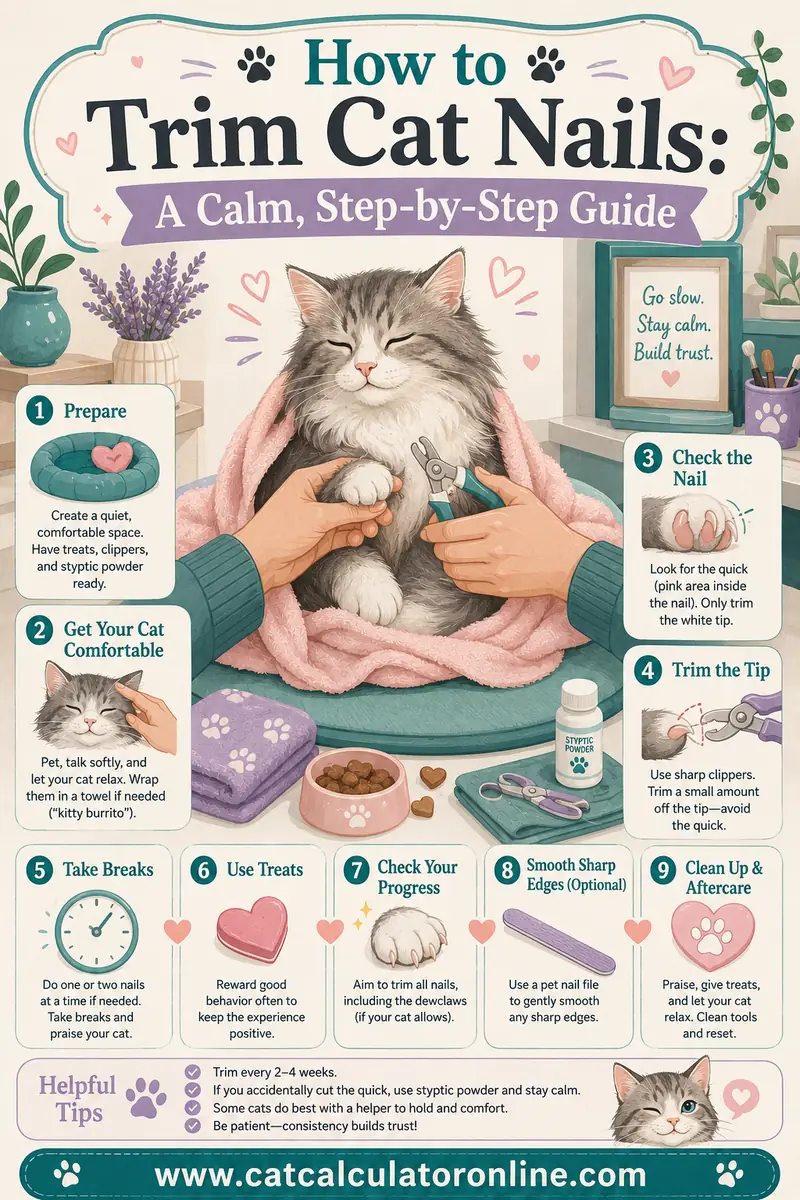
Trim every two to four weeks. Front claws are what matter. Take only the clear hooked tip and stay well clear of the pink quick inside.
Do one or two claws at a time. A cat who has never been trimmed will not sit through ten. Little and often beats a wrestling match, and the full method is in how to trim cat nails.
Blunt claws still scratch, they just catch less. Expect less snagging on upholstery rather than no interest in it.
Vinyl nail caps are a legitimate option. They glue over the claw, last four to six weeks, and stop damage while a new habit forms.
Caps need a cooperative cat and correct fitting. Ask your vet nurse to show you the first time. They are not suitable for outdoor cats, who need their claws for escape and defense.
Declawing is not on this list for a reason. It amputates the last bone of every toe, is illegal in the UK, and causes lasting pain and litter box problems. The detail is in why cats scratch furniture.
Pheromones, Sprays and What the Evidence Says
Worth being straight about which products earn their price.
Synthetic facial pheromone diffusers help with stress-driven marking, and results are modest and variable. They are best thought of as a support for a behavior plan, not a treatment on their own.
Scratch-attractant pheromone products exist, designed to make a post more appealing. Evidence is limited and availability comes and goes.
Catnip is cheap and works for most cats that respond to it. Reapply weekly, since the effect fades.
Deterrent sprays are the weakest category. Effects are short-lived and inconsistent between cats.
Motion-activated air deterrents do work, and they add fear, which can increase marking elsewhere. Prefer physical covering.
No product substitutes for a good post in the right place. If you buy one thing, buy the heavy post.
When Redirection Is Not Enough
If you have done all six steps properly for a month and nothing has changed, the problem is probably not the furniture.
Look for a trigger. A new cat, a strange cat visible through a window, a house move, a new baby, building work. Marking increases when territory feels uncertain.
Block the view of outdoor cats. Frosted film on the lower half of the window, and removing bird feeders near the glass, settles many cases within a two weeks.
Check the resources in a multi-cat home. One tray, one bowl and one bed per cat, plus a spare, in separate places. Competition drives marking hard.
Scratching plus spraying or tray accidents is a different problem. That combination points to genuine stress and is worth a conversation with your vet, who can refer you to a qualified behaviorist.
Rule out pain in an older cat. A cat scratching lower down than she used to, or with thick overgrown claws, may have sore joints.
Call your vet if she is licking or chewing her paws, limping, has bleeding or broken claws, or if the scratching comes with hiding, appetite change or litter box problems. General home setup is covered in how to cat-proof your home, and enrichment ideas in keeping an indoor cat entertained.
Frequently Asked Questions
How do I get my cat to use a scratching post instead of the sofa?
Put the post directly against the spot she already scratches, make sure it is at least 30 in (75 cm) tall and does not wobble, cover the sofa spot with a throw or double-sided tape for two to three weeks, rub catnip on the post and reward every use immediately.
What smell stops cats scratching furniture?
Citrus and menthol sprays deter some cats, but the effect is inconsistent and short-lived, and they can stain fabric. Double-sided sticky tape is far more reliable, because cats dislike the sensation on their paws. Treat any spray as a minor addition to a proper redirection plan.
Does spraying my cat with water stop her scratching?
No. It stops the behavior only while you are watching, teaches her to scratch when you are out, and makes her wary of you. Fear also increases scent marking, so punishment can raise the total amount of scratching. Redirection to a better post works far more reliably.
How long does it take to stop a cat scratching furniture?
Most cats switch within two to three weeks when the post is tall and stable, placed at the damaged spot, made attractive with catnip and play, and the old surface is temporarily covered. If a month passes with no change, the usual causes are a wobbly post or the wrong location.
Are nail caps safe for cats?
Vinyl caps glued over the front claws are considered safe for indoor cats and last around four to six weeks. They need correct sizing and fitting, so ask a vet nurse to demonstrate first. They are not suitable for cats with outdoor access, who need their claws to climb and defend themselves.
Should I get a second scratching post?
Yes. The general rule is one scratching site per cat plus one spare, placed in different rooms — particularly beside her bed and near the door you come home through. Never throw away a battered post either; the scent she has built up on it is what keeps her using it.
The whole thing comes down to out-competing your sofa, which is a better scratching surface than most posts sold in pet shops. Tall enough for a full stretch, heavy enough not to move, wrapped in sisal, and standing against the exact spot she has already chosen — that is the fix, and the rest is support: catnip and play to introduce it, a throw or double-sided tape over the old spot for a few weeks, a claw trim every two weeks, and a reward the moment she uses the right thing. Give it two to three weeks before you judge it, and if nothing shifts, look for a territorial trigger rather than buying another post. Check your cat's age in human years with the free cat age calculator while you are at it.