10 Cat Years in Human Years
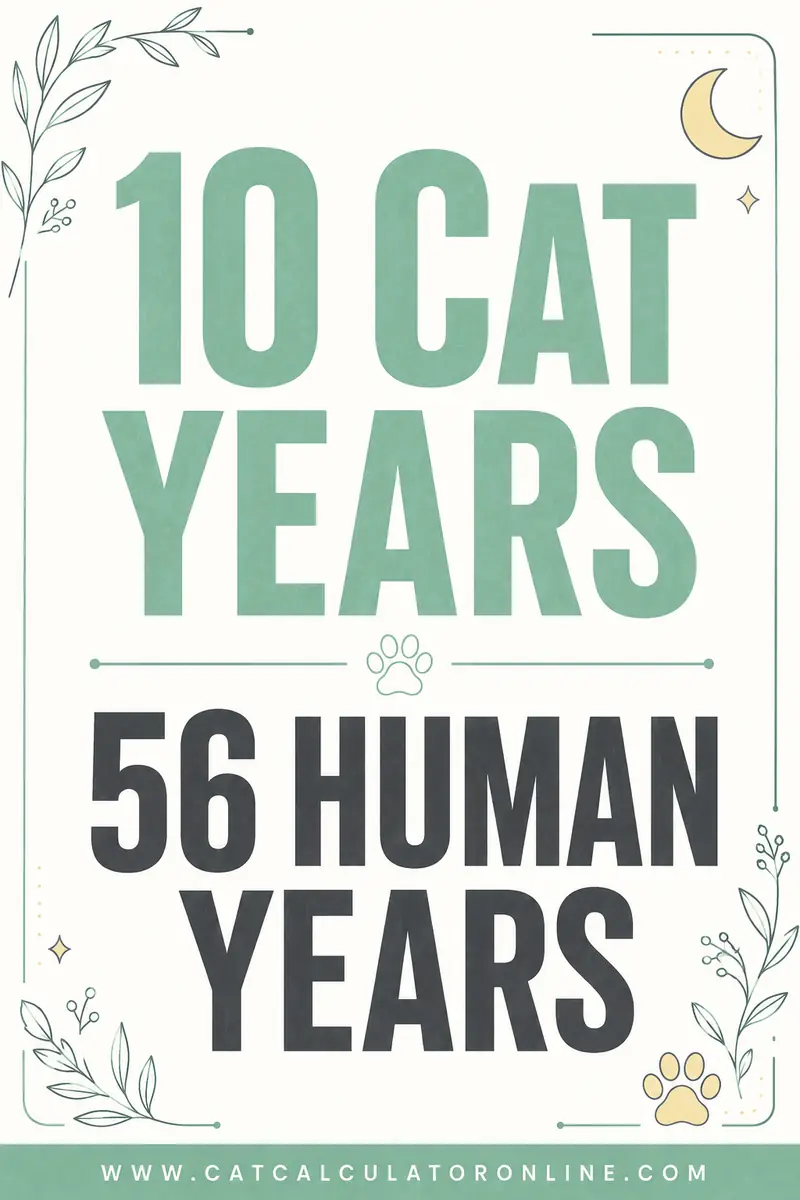
A ten-year-old cat is about 56 in human years, and ten is the birthday that carries the most weight in the whole conversion. Under AAHA feline life-stage guidelines a cat becomes a senior at ten — and unlike the boundary at seven, this one comes with a concrete change: veterinary check-ups move from annual to twice yearly. The reason is straightforward. A year in a senior cat's life is the equivalent of four human years, so an annual check is like a person in their late fifties being seen once every four years. This page covers the math, what the senior stage actually involves, and what to monitor from here. Any age converts with the cat age calculator.
How Do You Get 56?
The same arithmetic, now applied eight times.
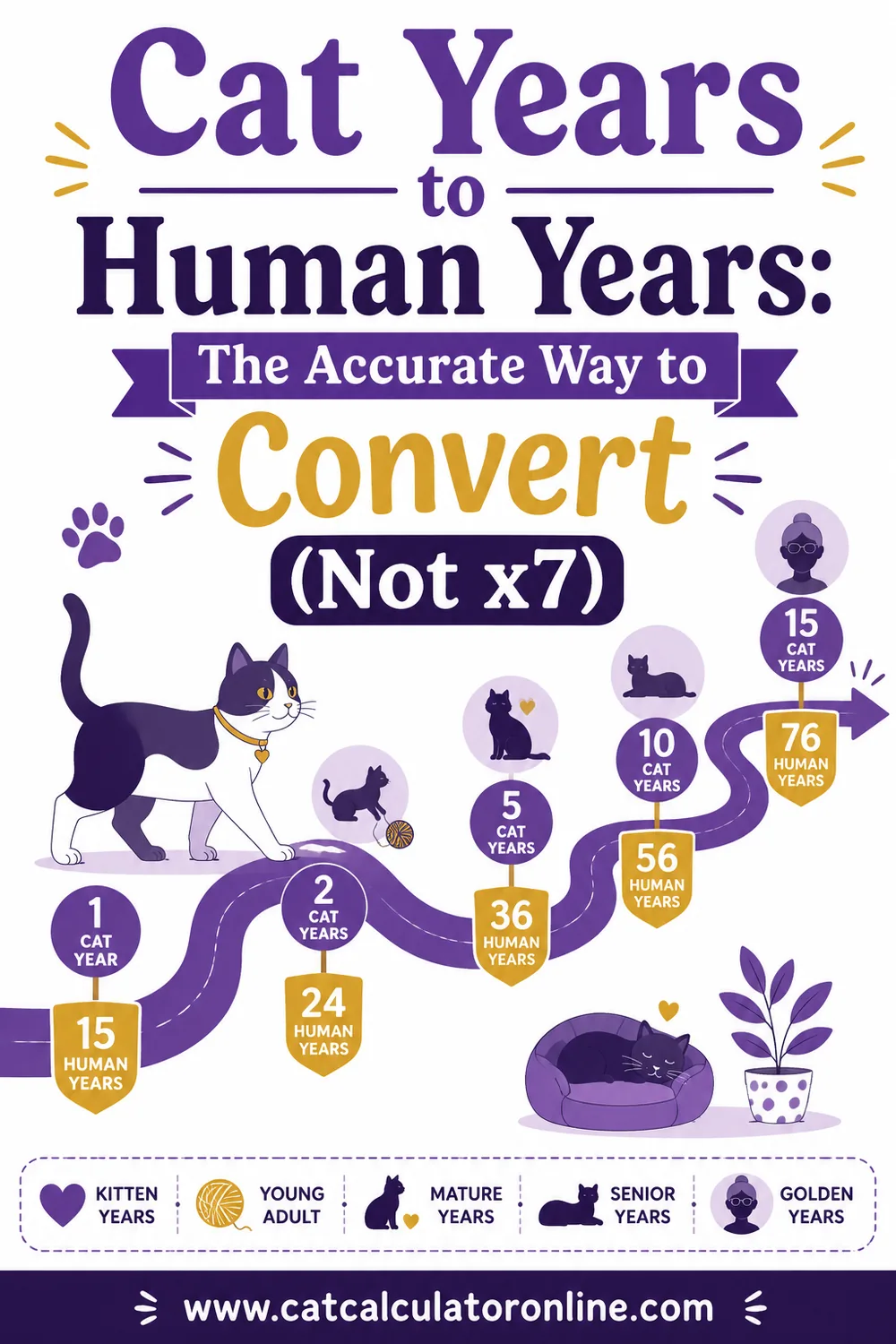
15 for year one, 9 for year two, 4 for every year after. By ten: 24 + (8 × 4) = 56.
| Cat's age | Human years | Life stage |
|---|---|---|
| 8 | 48 | Mature adult |
| 9 | 52 | Mature adult |
| 10 | 56 | Senior |
| 11 | 60 | Senior |
| 12 | 64 | Senior |
| 13 | 68 | Senior |
| 15 | 76 | Senior |
| 18 | 88 | Senior |
The arithmetic behind twice-yearly checks. Each cat year is worth four human ones. Six months of a senior cat's life is therefore roughly two human years — which makes a six-monthly check-up genuinely equivalent to a person being seen every couple of years, and an annual check equivalent to every four. Put that way, the recommendation stops sounding like an upsell.
The neighbouring ages are in 9 cat years in human years and 11 cat years in human years, the full table in cat years to human years, and the method in how a cat age calculator works.
What Does "Senior" Actually Mean?
Less than the word suggests, and more than owners usually act on.
It does not mean old, frail or declining. Indoor cats average 13 to 17 years and a substantial number reach 20. A ten-year-old cat frequently has five to ten years ahead, in good health, doing everything it did at six.
It does mean the monitoring changes. The senior stage is defined by risk rather than by appearance, and the practical consequences are specific:
- Twice-yearly veterinary examinations rather than annual
- Bloodwork and urinalysis at least yearly, often at each visit
- Blood pressure measured routinely
- Weight tracked monthly at home, not just at appointments
- Environmental adjustments for joints becoming standard rather than optional
Why the shift matters. Cats deteriorate quietly and quickly relative to human timescales. A cat can develop and progress a significant condition within the twelve months between annual checks, in a way a middle-aged person generally can't. Halving the interval genuinely halves how long something can go undetected.
What senior doesn't require: senior food as a default, supplements without a diagnosis, or treating the cat as fragile. A healthy ten-year-old should still be played with, still jump, and still be expected to do things. The checklist for this stage is in senior cat health checklist.
Which Conditions Matter Most From Here?
Five, and knowing their early signs is the most useful thing an owner of a senior cat can do.
Chronic kidney disease. The most common serious diagnosis in older cats. Cats typically lose a large proportion of kidney function before any outward sign appears, which is precisely why screening rather than symptom-watching is the approach. Early signs are increased drinking and urination, gradual weight loss and a duller coat. Managed early with diet and monitoring, cats often live well for years — the detail is in chronic kidney disease in cats.
Hyperthyroidism. Common from middle age onward. The classic picture is eating more while losing weight, often with restlessness, increased vocalisation and a poor coat. Very treatable.
Diabetes mellitus. Increased drinking, increased urination, increased appetite with weight loss. Strongly linked to excess weight, and some cats achieve remission when caught early.
Hypertension. Silent, common in older cats, and it damages the retinas and kidneys before anything visible happens. Some cats present having gone suddenly blind. A blood pressure reading takes minutes.
Arthritis. Present in a large majority of cats by their teens. It shows as doing less rather than limping, and it responds well to weight management, environmental changes and veterinary pain relief.
The pattern across all five: each is far more manageable when found through routine testing than when found because the cat became visibly unwell. That is the entire argument for the senior schedule.
What Should You Monitor at Home?
The vet sees your cat twice a year. You see it every day, and most senior diagnoses start with an owner noticing something.
Weight, monthly, written down. This is the single most useful home measurement. Kitchen scales work — weigh yourself, then yourself holding the cat, and subtract. A steady downward trend of a hundred grams a month is highly significant and completely invisible to the eye.
Water intake. Not precisely, but roughly — is the bowl emptying faster than it used to? Increased thirst is the earliest and most reliable signal of the three big endocrine and renal conditions.
Litter box output. Larger urine clumps, more of them, or straining. Also constipation, which becomes common in older cats and is genuinely uncomfortable.
Appetite direction, and particularly appetite that has increased while weight has fallen.
Grooming and coat. A senior cat that stops maintaining its coat is usually telling you that something hurts — joints or mouth.
Mobility. Where does it sleep now compared with a year ago? Does it still get to the windowsill? Does it stage jumps?
Night behavior. Increased night-time vocalisation in a senior cat has several possible causes — hypertension, hyperthyroidism, hearing loss, cognitive change — and is worth investigating rather than accepting.
Take a photo from above every few months. Body shape changes too gradually to see day to day, and photographs are far more honest than memory about when the change began. Same angle, same spot, same lighting — it takes ten seconds and it will settle an argument with yourself in a year's time.
Keep a single page of normals. Weight, usual daily food, roughly how much water goes down, how many times the box is used, and any medication. If your cat needs an emergency appointment, or someone else has to look after it, that page is worth more than anything you could recall under pressure.
Does Daily Care Change at Ten?
Somewhat, and the changes are practical rather than medical.
Warmth. Older cats feel the cold more and seek out heat. A warm, soft, draught-free bed in a favorite spot is genuinely appreciated and helps stiff joints.
Access. Steps to high places, a litter box with a low entry, food and water without a jump. If these aren't in place from nine, put them in now.
More litter boxes, in more places. A senior cat shouldn't have to cross the house or climb stairs to reach one. An extra box on each floor prevents a great many accidents that get misread as behavior.
Grooming help, particularly for long-haired cats. Brush a few times a week and check for mats over the hips and tail base, which is where a cat that grooms less will develop them first.
Hydration. Wet food if you aren't already using it, plus multiple water points and ideally a fountain. This is the most useful dietary change at this stage for most cats.
Nail checks. Senior cats scratch less and their claws overgrow, sometimes into the pad. Check monthly.
Play, still. Shorter and gentler, but daily. Activity preserves muscle, and muscle is what keeps a fourteen-year-old cat mobile.
Food: a healthy senior cat doesn't automatically need a senior diet. What it needs is enough good-quality protein to maintain muscle, adequate moisture, and a portion that holds its weight steady. If a specific condition is diagnosed, a therapeutic diet may become appropriate — but that's a response to a diagnosis, not to a birthday.
How Should You Think About a Senior Cat's Remaining Years?
Worth addressing directly, because the word "senior" prompts a lot of unnecessary worry.
The arithmetic is encouraging. Indoor cats average 13 to 17 years. A healthy ten-year-old is therefore typically looking at another three to seven years, and often more — cats reaching 18, 19 and 20 are common enough that no vet is surprised by them. In human terms, a ten-year-old cat at 56 has roughly the outlook of a healthy person in their mid-fifties.
What determines the range is largely what's already happened. Weight through the middle years, dental care, whether the cat has lived indoors, and whether conditions were caught early or late. Very little of it is genetic luck, which is the encouraging part — the levers were real and most owners had access to them.
What still matters from here: keeping weight steady, keeping teeth comfortable, keeping the cat moving, keeping it hydrated, and turning up to the twice-yearly checks. That list doesn't change for the rest of the cat's life, and it's short enough to actually do.
What changes is the tolerance for delay. At four, a symptom you watch for two weeks before booking usually costs nothing. At ten, two weeks of a cat eating less is two weeks of weight loss, and cats decompensate faster than their apparent robustness suggests. The threshold for phoning the vet should come down noticeably at this stage.
And the thing worth saying plainly: most ten-year-old cats are not ill, not declining, and not near the end of anything. They are middle-aged animals with a label attached for scheduling purposes. The label exists so that the monitoring keeps up with the biology, not because something has gone wrong.
Frequently Asked Questions
How many human years is 10 cat years?
About 56. The calculation is 15 for the first year, 9 for the second and 4 for each year after — giving 24 at age two plus eight further years at four each.
Is a 10-year-old cat old?
It's officially a senior under AAHA guidelines, but senior isn't the same as old. Indoor cats average 13 to 17 years and many reach 20, so a healthy ten-year-old often has years of good life ahead.
Why do senior cats need twice-yearly vet visits?
Because a cat year is roughly four human years. Six months of a senior cat's life is equivalent to about two human years, so an annual check is comparable to a person in their late fifties being seen once every four years.
What should a senior cat's check-up include?
A full physical examination, blood panel including kidney values and thyroid, urinalysis with specific gravity, blood pressure measurement, weight compared against the trend, and a dental assessment.
Does a 10-year-old cat need senior food?
Not automatically. A healthy senior cat needs good-quality protein to maintain muscle, adequate moisture, and a portion that holds weight steady. Therapeutic diets are a response to a diagnosis rather than to an age.
What's the most useful thing to track at home?
Monthly weight, recorded. A steady decline is one of the earliest and most reliable indicators of illness in a senior cat, and it's completely invisible to the eye until a great deal has been lost.
Ten cat years is about 56 human years, and it's the one birthday that genuinely changes the routine: twice-yearly checks, annual bloods and urine, blood pressure measured, and weight tracked at home every month. Senior is a monitoring label rather than a prognosis — most ten-year-old cats have years ahead. Convert any age with the cat age calculator.