How to Stop Cats Fighting
Most "fighting" between cats in the same home isn't fighting at all — it's play, and it looks alarming to us because cats play by ambushing and biting. The fights that matter are quieter and uglier: flattened ears, screaming, fur coming out, and one cat that won't come out from under the bed afterwards. Real conflict between housemates is almost always about resources and territory rather than personality clashes, which is genuinely good news, because resources are something you can change. This page covers how to tell the two apart, how to break up a fight without getting hurt, and what actually resolves ongoing tension. On the cost side of a multi-cat household, the cat cost calculator is a useful reality check.

Is It Play or Real Fighting?
The distinction owners most often get wrong, in both directions.
| Play | Real aggression | |
|---|---|---|
| Noise | Silent, occasional chirp | Hissing, growling, screaming |
| Ears | Forward or neutral | Flattened back |
| Claws | Sheathed | Out |
| Body | Loose, bouncy | Stiff, puffed up, arched |
| Roles | Swap — each takes turns chasing | One-sided; one cat always retreating |
| Afterwards | Both relaxed, may groom | One hides, both tense |
| Injuries | None | Scratches, bite wounds, fur pulled out |
| Pauses | Frequent breaks | Sustained |
Play looks violent and is fine. Cats stalk, pounce, grab, bunny-kick and bite in play, and it's how they exercise and maintain their relationship. If it's silent, reciprocal and nobody is hiding afterwards, leave them to it.
The middle ground: play that escalates. Common between a young cat and an older one, where the youngster keeps going past the point the adult wants. It starts as play and ends in a hiss. The fix is redirecting the young cat's energy rather than treating it as aggression — more interactive play, more often.
The one to take seriously is the quiet version that isn't fighting at all: one cat sitting in a doorway, staring, so the other can't reach the litter box or food bowl. There's no noise and no contact, and it's genuine bullying. It produces stressed, house-soiling, spraying cats and owners who report that their cats "get on fine".
How Do You Break Up a Fight Safely?
Never put your hands between fighting cats. Cat bites are deep, become infected quickly, and frequently need antibiotics and sometimes surgery. A hand between two fighting cats is a hand that gets bitten by both.
What to do:
- Make a loud noise — clap, bang a saucepan, drop a book. Startle rather than frighten
- Throw a towel or cushion near them, not at them
- Put a barrier between them — a large piece of cardboard, a cushion, an open umbrella
- Spray water as a last resort, though it adds stress and some cats associate it with you
- Separate them into different rooms the moment they break
- Leave them apart for several hours, sometimes a day, until both are fully calm
Don't try to comfort either cat immediately. An aroused cat can redirect onto the nearest available target, including you. Give them time.
Afterwards: check both cats over carefully once calm. Cat bite wounds are small punctures that seal over and abscess within days. Any puncture, limp, swelling or lethargy in the days after a fight is a vet visit — abscesses are common and need treating.
Redirected aggression is worth knowing about. A cat that sees something frustrating through a window — often a cat outside — may attack whoever is nearest. The same happens when one cat comes back from the vet smelling wrong. In both cases the cats aren't really fighting each other; separate them, let arousal drop over hours or days, and reintroduce gradually.
Why Do Cats Fight?
Almost always about resources, territory or fear, rarely about temperament.
Resource competition. Too few litter boxes, food bowls, resting places or high perches. This is the most common cause and the easiest to fix.
Territory. Cats maintain territories and time-share space. A home without enough separate areas forces constant negotiation.
A rushed introduction. Bringing a new cat straight in is the single most common origin of long-running conflict. Introductions should take weeks — see how to introduce a new cat.
Outdoor cats. A cat visible through a window causes frustration that gets redirected onto a housemate.
Social maturity. Cats that got on as kittens sometimes fall out between two and four years old as they mature. This surprises owners and is normal.
Pain or illness. A cat in pain is less tolerant and may lash out. Sudden fighting between long-term companions is a vet question first.
Unneutered cats. Entire cats fight far more. Neutering everyone is basic.
Not enough space or height. Cats resolve tension by moving vertically. A home with nothing off the floor forces confrontation.
A change in the household. A new baby, a new partner, building work, a house move, or a change in your working hours can all unsettle an established relationship. Cats read the household as a whole, and stress arriving from outside the pair frequently comes out as conflict between them.
What Actually Fixes It?
Work through these in order.
Rule out pain. Any sudden change in tolerance between established cats warrants a vet check for both.
Multiply and separate resources. Litter boxes at one per cat plus one, in different rooms. Separate feeding stations, ideally out of sight of each other. Water away from food. Several beds, posts and hiding places. Details in how many litter boxes per cat.
Add vertical space. This is the highest-value physical change in most multi-cat homes. Shelves, cat trees and window perches let cats avoid each other without leaving the room, and a tall tree can defuse a tense household on its own — see cat tree buying guide.
Remove the outdoor trigger. Frosted film at ground level, furniture moved away from windows, a microchip cat flap so strange cats can't enter.
Increase individual play. Two short wand-toy sessions per cat per day, separately. It burns the energy that fuels escalation and improves each cat's confidence.
Feed on a schedule, separately. Free-feeding from a shared bowl is a permanent low-level competition.
Use a pheromone diffuser designed for multi-cat households. Not a cure, and a reasonable part of a plan.
Never punish either cat. Shouting, spraying water or physical correction increases stress and makes conflict worse — the same reason punishment backfires with spraying.
Check you're not simply over capacity. If resources are right and tension persists, the number of cats for the space may be the problem — how many cats is too many covers that honestly.
How Do You Spot Tension Before It Becomes a Fight?
Cats communicate discomfort long before anything audible happens, and owners who learn to read it can defuse situations early.
Watch the eyes and ears. A hard, unbroken stare is a threat. Ears rotating sideways or flattening, pupils dilating, and whiskers pulled back all signal a cat that's uncomfortable.
Watch the tail. A low, fast-flicking tail is irritation. A puffed tail is fear or arousal. A relaxed cat holds its tail loosely, often upright when approaching another cat it likes.
Watch who moves. In a settled household, cats pass each other easily. If one consistently changes route, waits, or turns back when the other appears, that relationship isn't working.
Watch the timing. Tension often clusters — at feeding time, around dusk, when a particular cat comes in from outside, or when the household is out. Noticing the pattern usually reveals the trigger.
Watch where they sleep. Cats who genuinely get on will rest in contact or close together, and groom one another. Cats who merely tolerate each other keep a consistent distance and sleep in separate zones. Both are workable; the second needs more resources and more space to stay stable.
Watch the litter boxes. Changes in use — a cat suddenly using only one box, or going outside them — are frequently the first hard evidence of social pressure, before any visible conflict.
Intervene early and gently. When you see a stare or a block, don't shout. Call one cat away, throw a toy, or put food down elsewhere. Interrupting the build-up costs nothing and stops the pattern establishing.
When Should You Separate and Start Over?
Sometimes the relationship has broken down badly enough that management isn't enough, and a full reintroduction is the answer.
Do it when: there's been a serious fight with injuries, one cat is hiding constantly or has stopped eating, house soiling has begun, or aggression is escalating rather than easing.
How it works:
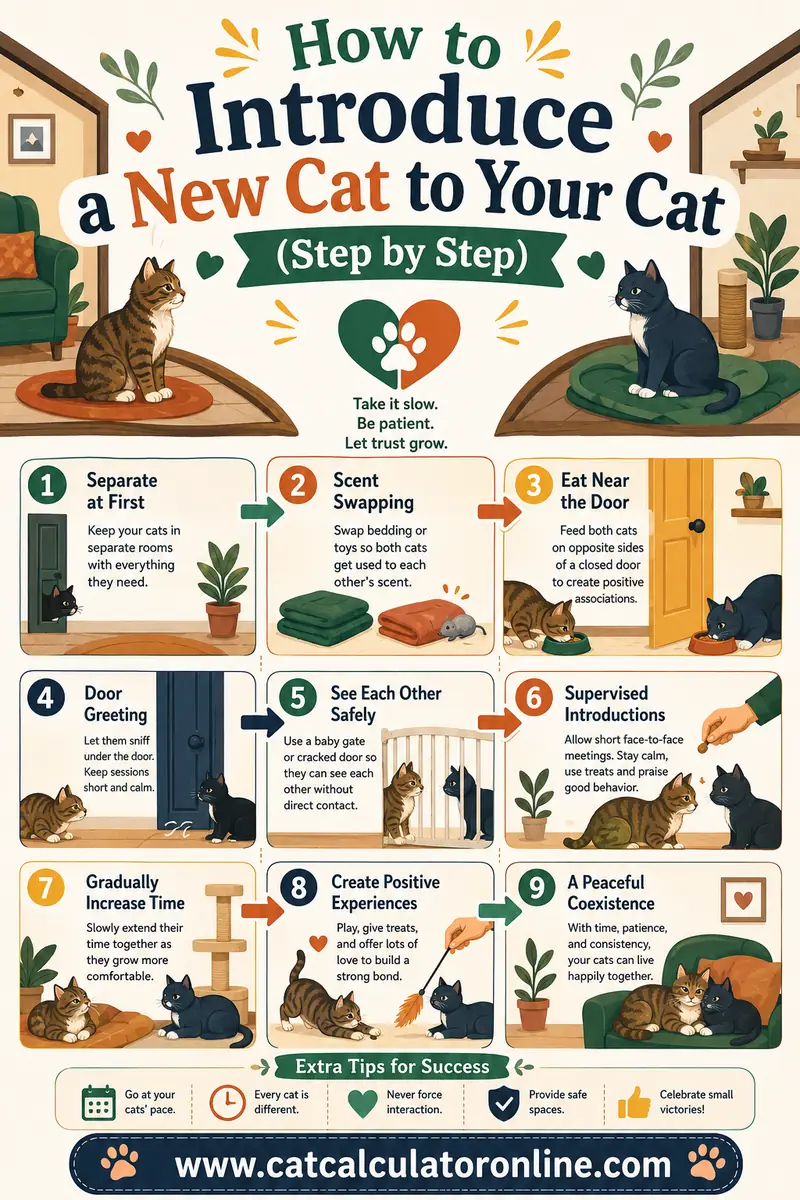
- Complete separation in different rooms, each with its own food, water, litter box and bed. Days to weeks
- Scent swapping — rub a cloth on one cat's cheeks and leave it in the other's space; swap bedding; rotate which cat has which room
- Feeding either side of a closed door, gradually moving the bowls closer
- Visual contact through a barrier — a glass door or a stacked baby gate — for short, positive sessions
- Supervised time together, starting at a few minutes, always ending before anything goes wrong
- Full access only once sessions are consistently relaxed
Expect it to take weeks. Rushing is what caused the problem the first time.
Get professional help if: injuries are occurring, one cat's welfare is clearly suffering, or you've worked at it for two months without progress. A qualified feline behaviourist is worth the money, and medication is occasionally appropriate alongside behavioral work.
And accept the honest outcome that some cats never live comfortably together. Permanent separation within a home, or rehoming one cat, is sometimes the kindest available answer. It isn't a failure — it's recognizing that these are territorial animals who didn't choose each other. While you're reorganising the space, it's worth reviewing safety generally in how to cat proof your home.
Frequently Asked Questions
Are my cats playing or fighting?
Play is silent, reciprocal and relaxed — ears forward, claws in, roles swapping, both fine afterwards. Real fighting involves hissing or screaming, flattened ears, claws out, one cat consistently retreating, and one hiding afterwards.
How do I break up a cat fight?
Never use your hands — cat bites are deep and infect quickly. Make a loud noise, put a barrier like a cushion or piece of cardboard between them, then separate them into different rooms for several hours until both are fully calm.
Why have my cats suddenly started fighting?
Common causes are a medical problem in one cat, redirected aggression after seeing a cat outside or returning from the vet smelling unfamiliar, social maturity between two and four years old, or a change in the household. Sudden conflict between long-term companions warrants a vet check.
Will my cats work it out themselves?
Play, yes. Real aggression usually escalates without intervention, because the underlying cause — competition, fear or territory — doesn't resolve on its own. Waiting it out generally produces a chronically stressed cat rather than a truce.
How long does reintroducing cats take?
Several weeks, sometimes a couple of months. Full separation, then scent swapping, then feeding either side of a door, then supervised visual contact, then short sessions together. Rushing any stage is what causes the problem in the first place.
Should I punish the cat that starts fights?
No. Punishment increases stress and makes aggression worse, and cats don't connect it with the behavior. Address the cause instead — more resources, more vertical space, separate feeding, and individual play sessions.
One reassurance: multi-cat conflict looks intractable from inside it, and most of it isn't. Households where cats have been screaming at each other for months frequently settle within weeks of adding boxes, adding height, and feeding separately. The relationship rarely needs fixing directly — the environment does.
Sort out the resources first: boxes, bowls, beds and height, all multiplied and spread out. That resolves a large share of multi-cat conflict on its own. Keep your hands out of any real fight, treat sudden aggression as a medical question, and give a full reintroduction the weeks it needs. See what a multi-cat household actually costs to run properly with the cat cost calculator.