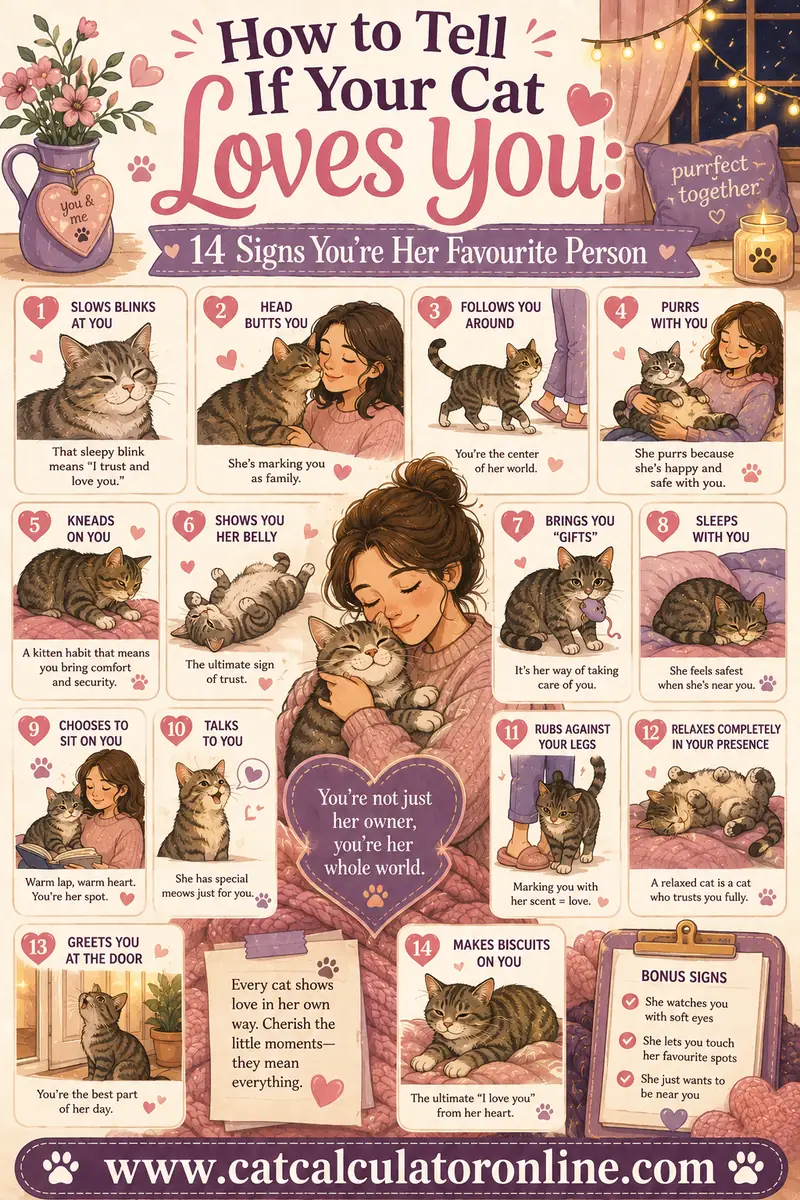
How to Tell If Your Cat Loves You: 14 Signs You're Her Favorite Person
Yes, your cat loves you — and there's research behind that, not just wishful thinking. A 2019 study at Oregon State University ran cats through a secure-base test, the same style of experiment used with human infants and dogs, and found that about 65% of cats showed a secure attachment to their owner — a rate comparable to what's seen in babies and dogs. Cats form real bonds. They just announce it very differently.
The signals are subtle, and most of them are easy to miss until someone points them out. Slow blinks, head bumps, a tail held straight up, a cat sleeping with her back to you — those are all statements. Once you can read them, your cat gets noticeably more expressive overnight.
Below are the 14 clearest signs, what each one actually means, and an honest note about cats who show affection in quieter ways. And if you'd like to know how old your cat is in human years while you're here, our free cat age calculator does it in one tap — bonding behavior genuinely shifts across a cat's life stages.
🐾 Does your cat do this? Tap to see what it means.
Pick any behavior you recognize:
Tap a behavior above to see what your cat is telling you.
First: Do Cats Actually Bond With People?
They do, and it's been measured.
The Oregon State research used a version of the secure-base test, a long-established method in attachment science. A cat spends time in an unfamiliar room with her owner, the owner leaves, and then returns. What researchers look at is the reunion — does the cat treat the owner as a "secure base," settling and then going back to exploring, or does she stay clingy or avoidant?
Roughly 65% of the cats tested showed secure attachment. That figure sits in the same range as results found in human infants and in dogs. In other words, the average cat isn't emotionally indifferent to her human. She's using you as a safety anchor in exactly the way an attached animal does.
That study is worth knowing about because of how stubborn the "cats are aloof and only want food" myth has been. It isn't supported. Cats bond — the signals are just quieter and more easily missed than a dog throwing itself at the door.
The 14 Signs at a Glance
| Sign | What she's doing | What it means |
|---|---|---|
| Slow blink | Slowly closing and opening her eyes at you | A trust signal — she's comfortable being defenceless near you |
| Head bunting | Pressing her forehead or cheek into you | Depositing facial pheromones; marking you as safe and familiar |
| Cheek rubbing | Rubbing the side of her face on your leg or hand | Same scent-marking; blending her smell with yours |
| Tail straight up | Approaching with tail vertical, often with a tip hook | A confident, friendly greeting reserved for cats and people she likes |
| Tail wrap | Curling her tail around your arm or leg | The cat version of a light touch on the shoulder |
| Kneading | Pushing paws rhythmically into you or a blanket | Deep contentment; a comfort behavior from kittenhood |
| Purring near you | Rumbling while settled beside or on you | Usually contentment — read it alongside a loose, relaxed body |
| Following you | Moving room to room with you | Social attachment; she wants proximity, not just food |
| Sleeping on or near you | Choosing your bed, lap, or the spot at your feet | High trust — sleep is when she's most vulnerable |
| Allogrooming | Licking your hand, hair or face | Social grooming, reserved for her family group |
| Trilling or chirping | A short rising warble as she approaches | A friendly greeting sound, first used between mother and kittens |
| Bringing gifts | Toys, socks, or actual prey | Sharing with her social group — you're in it |
| Showing the belly | Rolling over in front of you | A trust display, not always a rub invitation |
| Meowing at you specifically | Vocalising toward you and not at other cats | Adult cats mostly reserve meowing for humans they interact with |
The Slow Blink: The Clearest Signal There Is
If you learn one thing from this article, learn this one.
A slow blink is your cat looking at you and deliberately, unhurriedly closing and reopening her eyes. Sometimes it's a full close. Sometimes it's just a soft narrowing.
Why it matters: closing your eyes near another animal is a small act of defencelessness. A cat who's uneasy keeps her eyes wide and locked on. A cat who's relaxed lets them drift shut. Doing it while looking directly at you is a message — I'm not worried about you.
Better still, research has looked at whether humans can use this deliberately, and slow-blinking at a cat has been found to increase the chance she slow-blinks back and even makes her more receptive to approaching an unfamiliar person. This is a two-way channel you can actually use.
How to do it: soften your face, avoid a hard stare, look slightly toward her, close your eyes slowly, hold for a beat, open slowly. Then look away a little. Don't force eye contact — in cat language, a fixed unblinking stare reads as a challenge.
It's the closest thing there is to saying "I love you" in a language your cat already speaks.
Head Bunting and Cheek Rubbing
When your cat presses her forehead into your shin, or drags her cheek along your hand, she's doing something specific: depositing scent.
Cats have scent glands around the cheeks, chin, forehead and lips. Rubbing those areas on something transfers facial pheromones onto it. Cats do this to doorframes, chair legs, other cats they get along with, and to people they've accepted.
The effect is a shared group scent. In a colony, cats who rub on each other end up smelling similar, and that shared smell is part of how they recognize who's family. When your cat bunts you, she's writing you into that group.
There's another detail worth appreciating: to bunt you, she has to lower her head and stop watching you. That's not something a cat does around anything she's unsure of.
Tail Language: The Easiest Thing to Read
The tail is the fastest read on a cat's mood, and one position in particular is a straightforward compliment.
- Tail straight up on approach. A confident, friendly greeting. Often there's a small hook or quiver at the tip — that quiver is a happy-to-see-you flourish. Cats greet cats they like this way, and they greet favorite humans the same.
- Tail wrapping around you. Curling the tail around your arm, leg or another cat is affiliative contact. Think of it as the cat equivalent of a hand on your arm.
- Tail relaxed and gently swaying while she's near you: comfortable and content.
- Tail low, tucked, puffed, or lashing hard: not affection. That's uncertainty, fear or irritation, and it's a moment to give her space rather than pick her up.
That last point matters. Reading affection accurately also means knowing when your cat is not saying it, and respecting that is a big part of why some cats become more affectionate over time.
Kneading, Purring and the Kittenhood Carry-Overs
Some of the warmest signals in a cat's repertoire are behaviors that started in the first weeks of life and never went away.
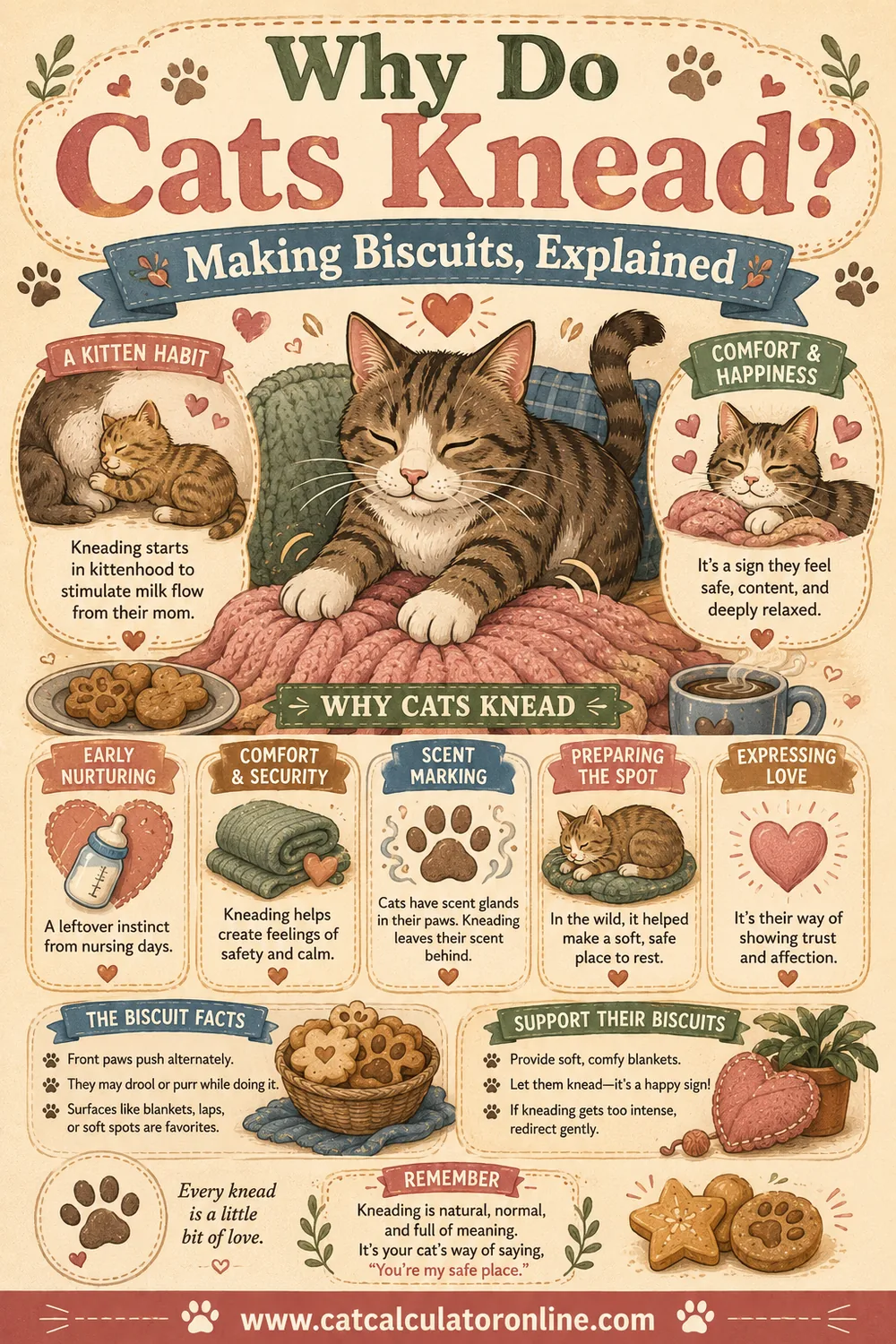
Kneading — the rhythmic push-pull of the front paws — begins with nursing kittens stimulating milk flow. Adult cats keep doing it on soft surfaces and on people when they're deeply relaxed. A cat who settles on your lap and starts kneading has associated you with the safest feeling she knows. (The claws are an unfortunate side effect, not a message. A blanket on your lap solves it.) There's more on this in why do cats knead.
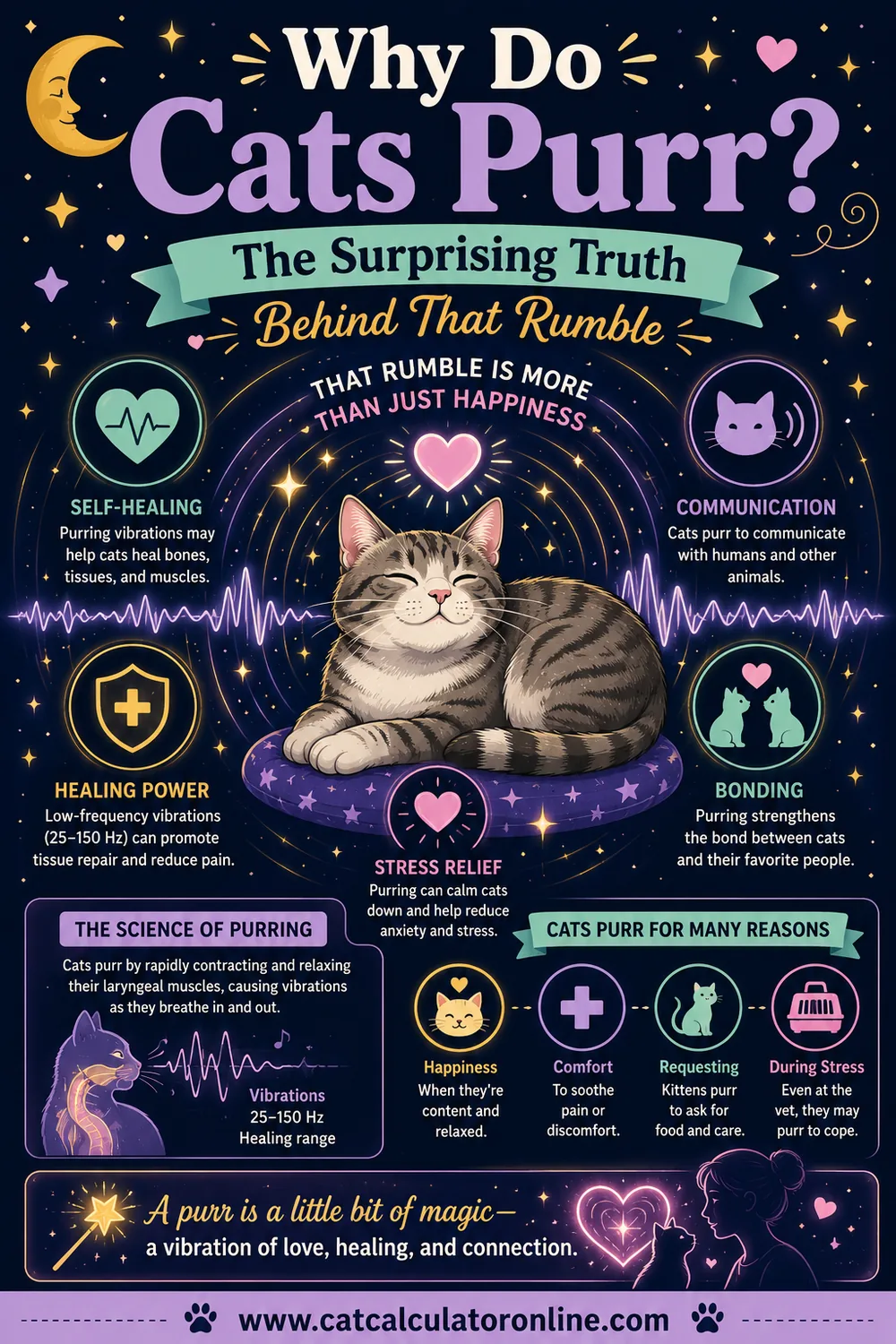
Purring usually accompanies contentment when she's settled beside you — but purring alone isn't proof of happiness. Cats also purr when stressed, unwell or in pain, so read it alongside her body: loose posture, soft eyes and relaxed ears mean the purr is the happy kind. Why do cats purr goes into the full picture.
Meowing at you is the strangest one of all. Adult cats barely meow at each other. The meow is largely something cats developed for communicating with humans, and a cat who meows at you specifically has learned that you're worth talking to.
Sleeping Near You: The Highest-Trust Signal
Cats sleep a lot — often 12 to 16 hours a day — and sleep is when any animal is most exposed. Where a cat chooses to do it says a great deal.
A cat who sleeps on your lap, against your legs, on your pillow, or curled at the foot of your bed has decided you're not a risk. She could be on top of the wardrobe with a clear view of every exit. She picked you instead.
A few variations, all meaningful:
- Sleeping with her back to you. Not a snub. She's using you as the safe side and watching the room.
- Sleeping touching you. Physical contact during sleep is about as unguarded as a cat gets.
- Sleeping in the doorway of the room you're in. A compromise — proximity plus a good vantage point. Still a vote for you.
- Napping in your chair the moment you leave. Your scent is comforting — a compliment shaped like an inconvenience.
Allogrooming, Trilling and Gifts
Allogrooming — social grooming between cats — is reserved for individuals in the same social group. Cats who groom each other are family, in cat terms. So when your cat licks your hand, your fingers, or your hair, she's applying that same behavior to you. Her tongue is rough because it's built for coat maintenance, and she is genuinely trying to maintain you.
Trilling and chirping — that short, rising, warbly sound — starts as a call between a mother cat and her kittens. Adult cats keep using it as a friendly greeting toward individuals they're fond of. If your cat trills when she walks into the room and sees you, that's a hello with warmth in it.
Gifts are the sign owners struggle with most, understandably. A cat who brings you a toy, a sock, a hair tie — or something formerly alive — is doing something cats do within their social group. It isn't a criticism of your hunting ability. Try not to react with horror; a calm removal and a redirect toward play works better. (If your cat hunts outdoors, a collar bell and keeping her in at dawn and dusk both reduce the delivery rate.)
Showing the belly deserves its own note. Rolling over and exposing the stomach in front of you is a genuine trust display — the belly is a cat's most vulnerable area. But it is very often not a request for a belly rub. Many cats will grab your hand if you take it as one. Enjoy the display, scratch her chin or cheeks instead, and let her offer more if she wants to.
Every Cat Shows It Differently
This is the part that matters most, and it's the reason a lot of owners quietly worry.
If your cat doesn't do half the things on this list, it doesn't mean she isn't attached to you. Affection expression varies enormously between individual cats, and a reserved cat is not an unloving cat.
Things that shape how demonstrative a cat is:
- Early life. Kittens handled gently and often between roughly two and seven weeks of age tend to be more comfortable with people as adults. A cat who missed that window may be more cautious for life without being any less bonded.
- History. Rescued, feral-born or previously mistreated cats often take months to relax, and their affection may always run quieter.
- Personality. Some cats are simply low-key. It's temperament, not a verdict on you.
- Breed tendencies. Siamese, Burmese and Ragdolls skew demonstrative and vocal. Russian Blues, British Shorthairs and Chartreux often prefer companionable proximity to lap-sitting.
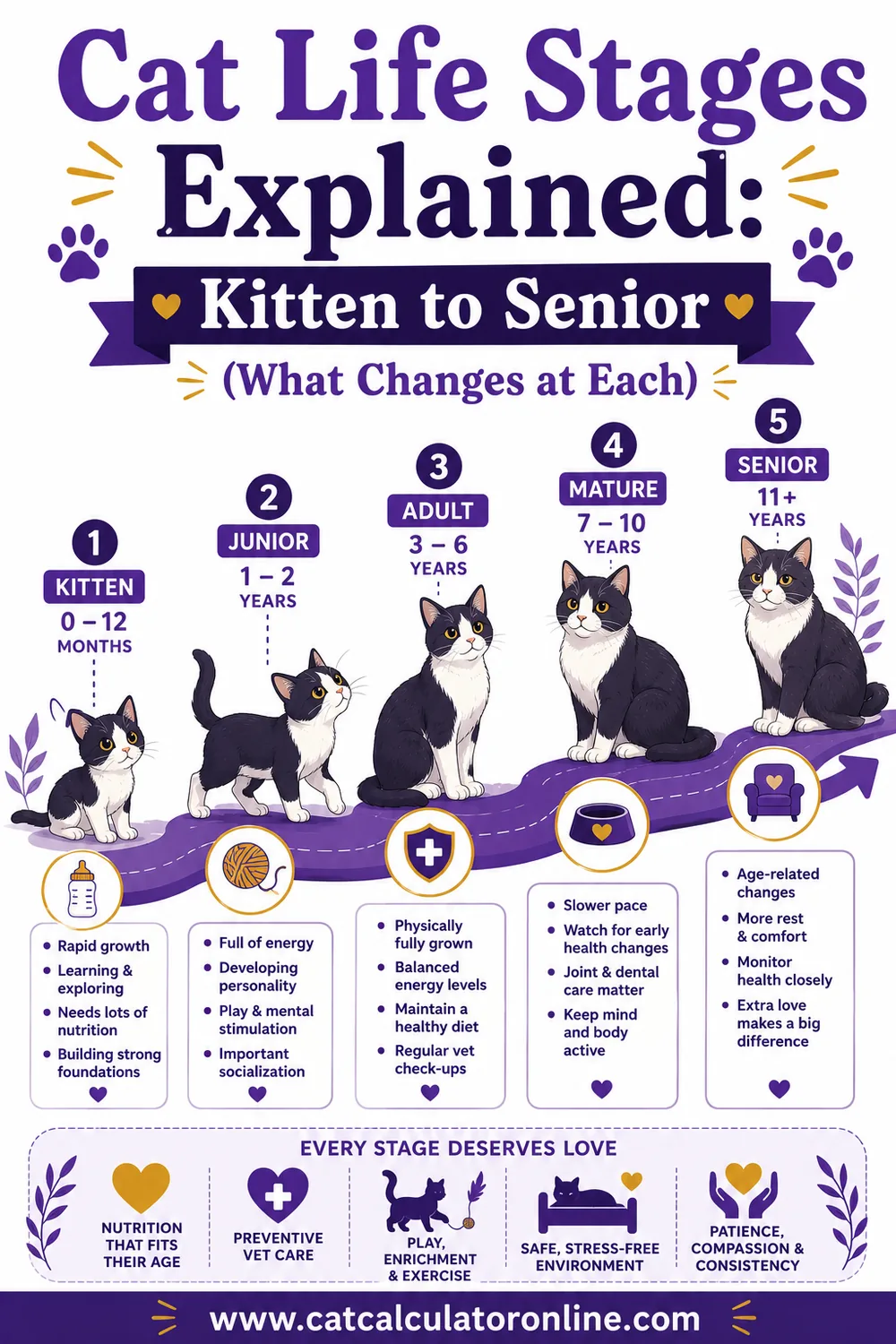
- Age. Kittens are physical and chaotic. Adults settle. Seniors often become more affectionate and more contact-seeking, partly for warmth and comfort. See cat life stages explained.
Watch for the quieter dialect instead. Sitting in the same room without interacting is a genuine signal. Choosing to be within a few feet of you all evening is a signal. Relaxing enough to sleep — even across the room — while you're there is a signal. Eating while you're nearby, coming to check on you when you sneeze, waiting outside the bathroom door: all of it counts.
How to build the bond with a reserved cat
- Let her come to you. Sit down, get low, and don't reach. Being ignored by a human is unexpectedly attractive to a wary cat.
- Slow blink often. It costs nothing and it's read clearly.
- Play daily. Wand toys are the most reliable bonding tool there is — a hunt-catch-eat sequence before a meal works especially well.
- Be predictable. Consistent feeding and playing times make a cat feel safe, and safety comes before affection.
- Offer vertical space. Shelves, cat trees and high perches give a nervous cat a way to be present without being exposed.
- Respect the "no." Stopping when her tail twitches or ears rotate back is what teaches her you're a safe person to be close to. Owners who back off get more affection over time, not less.
When a Change in Affection Means Something
Here's the health note worth taking seriously: a sudden change in your cat's affection is worth a vet check.
Cats hide illness well, and a shift in social behavior is often the first thing an owner notices. Flag it with your vet if you see:
- A cuddly cat who suddenly withdraws, hides, or stops greeting you.
- A cat who stops jumping onto your lap or the bed — often pain or arthritis rather than mood.
- A previously independent cat who becomes unusually clingy or vocal.
- Grumpiness or swiping when touched somewhere specific.
- Any of the above alongside changes in appetite, thirst, litter tray habits, weight or grooming.
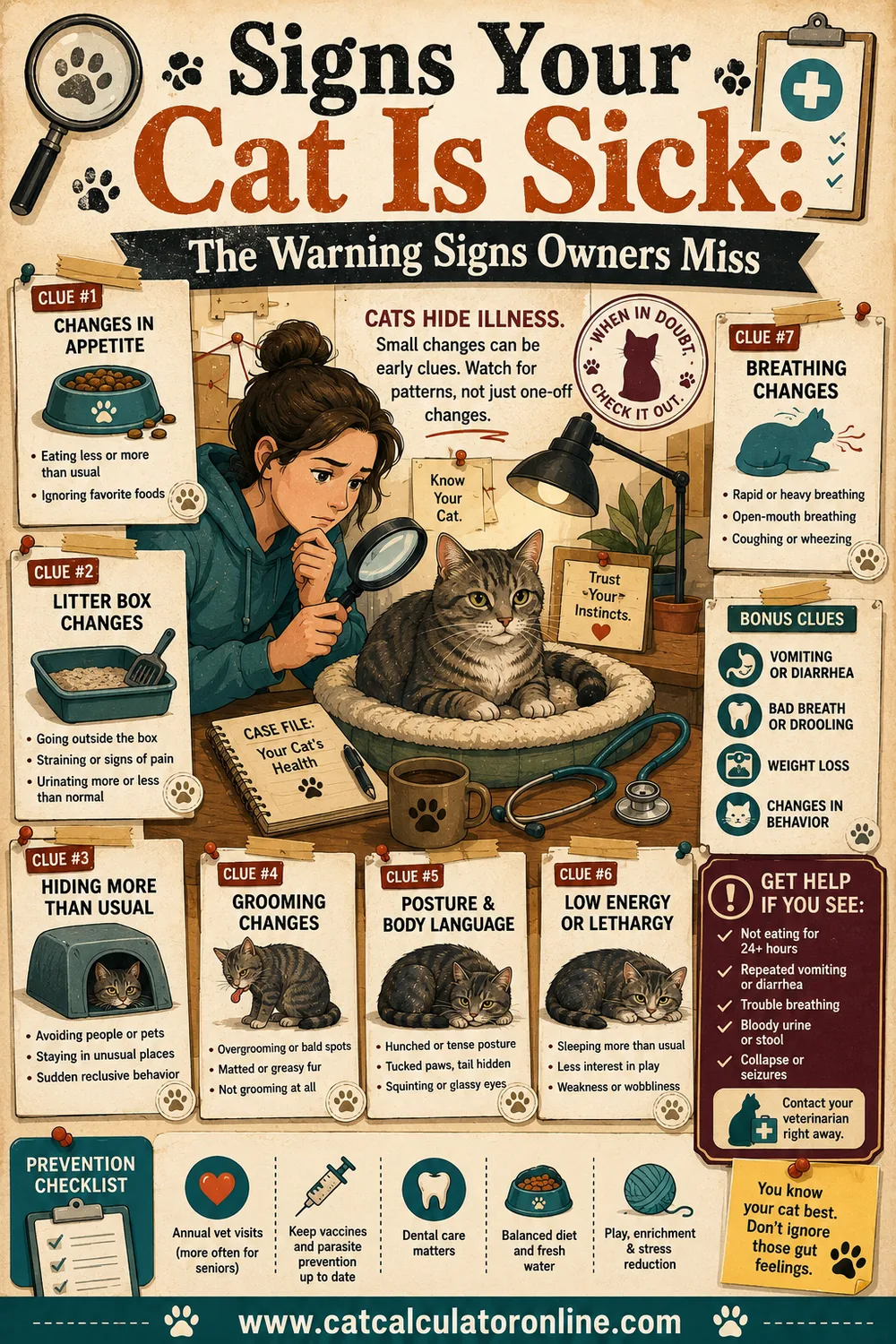
None of those are diagnoses — they're reasons to book an appointment. Our guides to signs your cat is sick and signs your cat is getting old go through the changes worth watching.
FAQ
Do cats really love their owners, or do they just want food?
They form genuine attachment bonds. A 2019 Oregon State University study using the secure-base test found roughly 65% of cats showed secure attachment to their owner, a rate comparable to that seen in human infants and dogs. Food matters to cats, but it doesn't explain following you between rooms, sleeping on you, or greeting you with a tail-up trill.
What does it mean when my cat slow blinks at me?
It's a trust signal. Closing her eyes near you means she doesn't consider you a threat, and research supports slow-blinking back as a way to build rapport — cats are more likely to slow-blink in return and to approach a person who does it. Soften your gaze, close slowly, open slowly, and look slightly away.
Why does my cat head-butt me?
Head bunting deposits facial pheromones from scent glands on her cheeks and forehead onto you. It's how cats mark members of their social group, so she's effectively labeling you as safe and familiar. She also has to lower her head and stop watching you to do it, which is its own vote of confidence.
Is my cat showing her belly asking for a rub?
It's a trust display first and foremost — the belly is a cat's most vulnerable area, so exposing it means she feels safe. Many cats still don't want it touched, and will grab your hand if you try. Scratch her chin or cheeks instead and let her decide how much contact she wants.
My cat isn't cuddly. Does she still love me?
Almost certainly. Affection varies hugely between cats, and early handling, past experience, breed and temperament all shape how demonstrative a cat is. Watch for the quieter signals — sitting in the same room, sleeping while you're present, tail-up greetings, following you around — which are just as real as lap-sitting.
Should I worry if my cat suddenly becomes less affectionate?
Yes, it's worth a vet check. Cats hide illness well, and a change in social behavior is often the earliest sign something's wrong. Withdrawal, hiding, no longer jumping up, or new clinginess — especially alongside changes in appetite, thirst or litter tray habits — deserve a professional look.
The Bottom Line
Your cat has an entire vocabulary for saying she's attached to you, and almost none of it looks like a dog's. The slow blink, the head bunt, the tail held straight up, the kneading, the licking, the trill when you walk in, and the simple decision to fall asleep beside you — those are all statements, and the attachment research backs up what they suggest.
If your cat is one of the quiet ones, look for proximity instead of contact. Being chosen as the person she wants to be near is the same message in a softer voice.
Want to understand her a little better? Try our free cat age calculator to see how old she is in human years, then read why do cats purr and cat life stages explained to know what's coming next in your life together.