What to Feed a Pregnant Cat
The whole answer fits in one sentence, and most owners have never heard it: move her onto kitten or growth food from around the fourth or fifth week of pregnancy, and keep her on it right through nursing. Not a "pregnancy formula", not adult food with extras stirred in — ordinary kitten food, because it is more calorie- and protein-dense than adult maintenance food and that is exactly what she needs. Her intake climbs steadily from there, and by peak lactation she may require two to three times her normal calories, at which point free-feeding is usually the sensible approach. The cat food calculator gives you a baseline to scale from.
Why Kitten Food Rather Than Adult Food?
The reasoning is simple once the numbers are in front of you.
Energy density. Kitten and growth diets pack more calories into the same volume. A queen in late pregnancy has a uterus full of kittens pressing on her stomach — she physically cannot eat her way to the required intake on a low-calorie adult food.
Protein. Growth diets carry higher protein levels, which supports both fetal development and milk production. Cats are obligate carnivores with a high baseline protein requirement, and pregnancy raises it further.
Calcium and phosphorus in balance. A complete growth diet already contains the minerals a queen needs at the correct ratio. That is the reason not to add supplements on top.
It works for the kittens too. Once they start sampling solids at three to four weeks, they will eat from her bowl. If the bowl already contains kitten food, weaning arranges itself.
"Pregnancy formula" is mostly marketing. Some brands sell one; in practice it is a growth diet under a different name. A well-formulated kitten food from a reputable manufacturer does the job.
Wet, dry or both is a secondary question. All-wet, all-dry and mixed feeding can all work. Wet food adds water intake, which matters during lactation. The clean approach is to use complete kitten food in whichever format she actually eats.
When Exactly Should You Switch?
Timing is more forgiving than the internet suggests, but there is a right window.
Around week four to five. Before that, the kittens are tiny and her energy needs are close to normal. Switching in week one achieves nothing except an unnecessarily fat queen.
Do it gradually, over five to seven days. Mix an increasing proportion of the new food into the old. Abrupt changes cause diarrhea, which nobody wants in a pregnant cat. The method is in how to switch cat food.
If she is already on kitten food — a young queen who was mated early, which happens more than people expect — no change is needed.
If she is underweight at the start, talk to your vet about switching sooner.
If she is obese at the start, do not use pregnancy as a diet. Restricting a pregnant queen risks the litter, and obesity raises the risk of uterine inertia, so the answer is veterinary advice rather than a home calorie cut.
Stay on the growth diet through the whole of lactation, and only move back to adult food once the kittens are fully weaned at around eight weeks. Switching her back at the birth is the classic mistake — that is precisely when her requirement peaks.
How Much Should She Eat, Week by Week?
Intake climbs steadily rather than jumping, which is different from the pattern in dogs.
Weeks 1 to 3: essentially normal. Do not increase anything.
Weeks 4 to 6: appetite rises noticeably. Feed to appetite on the growth diet rather than measuring rigidly.
Weeks 7 to 9: she may be eating around 1.25 to 1.5 times her pre-pregnancy intake. Appetite often dips slightly in the last day or two before labor, which is expected.
Total weight gain across the pregnancy is roughly 2 to 4 lb (1 to 2 kg), depending on litter size — a substantial fraction of a 9 lb (4 kg) cat.
Nursing weeks 1 to 4: the steep climb. By peak lactation, around weeks three to four after the birth, she may need two to three times her maintenance calories, and a queen with a large litter sits at the top of that range.
Weeks 5 to 8 of nursing: demand falls as the kittens eat more solid food themselves.
Baseline figures to scale from are in how many calories does my cat need.
| Stage | Diet | Intake vs normal | How to feed |
|---|---|---|---|
| Weeks 1–3 pregnancy | Adult maintenance | ~1x | Usual meals |
| Weeks 4–5 | Transition to kitten food | ~1.1x | Mix over 5–7 days |
| Weeks 6–7 | Kitten food | ~1.25x | 3–4 meals a day |
| Weeks 8–9 | Kitten food | ~1.5x | 4–5 small meals |
| Final 24 hours | Kitten food | Often reduced | Leave food available |
| Nursing weeks 1–2 | Kitten food | 2x | Free access |
| Nursing weeks 3–4 | Kitten food | 2–3x | Free access, top up often |
| Nursing weeks 5–8 | Kitten food | Falling back | Kittens sharing the bowl |
| After weaning | Back to adult food | ~1x | Transition over a week |
Why Do Small, Frequent Meals Matter Late On?
A mechanical problem with a straightforward fix.
There is no room. By week eight the uterus occupies a large share of the abdomen and the stomach cannot expand as it normally would. A big meal becomes uncomfortable and often uneaten.
Four or five small meals get more food into her than two large ones. Split whatever she is having across more sittings.
Leaving dry food down helps if she grazes, since she may eat at odd hours when it suits her.
Warm wet food smells stronger, and smell is what drives feline appetite far more than taste. Warming a pouch to body temperature is a genuinely effective trick for a queen who has gone picky.
Put the food near her. In late pregnancy and after the birth she may be reluctant to leave her nest. Food, water and a litter tray within a few steps solves it.
A brief drop in appetite in the last day before labor is normal. A drop earlier in pregnancy, or a full 24 hours with nothing eaten at any stage, is not — call the vet. Cats that stop eating risk hepatic lipidosis within days, and a pregnant or nursing queen is the worst possible candidate for it. Never withhold food to make a fussy cat eat. The causes worth ruling out are in why will my cat not eat.
What About Supplements?
The strongest "do not" on this page.
No calcium supplements during pregnancy. This is not caution for its own sake. Extra dietary calcium suppresses the hormonal machinery that mobilises calcium from bone, so when milk production suddenly demands large amounts, the queen cannot respond. That raises the risk of eclampsia — dangerously low blood calcium, usually one to four weeks after birth, presenting as restlessness, tremors, stiffness and collapse. It is a true emergency. Supplementing to prevent it makes it more likely.
No vitamin or mineral top-ups on a complete diet. A properly formulated growth food already meets the requirement, and excesses of fat-soluble vitamins accumulate.
No cod liver oil or vitamin A products. Excess vitamin A in pregnancy is associated with developmental problems.
No raw liver in quantity, for the same reason.
Taurine matters, but the food handles it. Any complete cat food contains adequate taurine. Home-prepared diets are where deficiency risk lives, which is a good reason not to invent one during a pregnancy.
The one exception is veterinary direction. If your vet prescribes a supplement for a specific reason, follow it. Otherwise, a complete kitten food and fresh water is the entire nutritional plan.
What Should a Pregnant Cat Not Eat?
The usual toxic list applies, with a couple of pregnancy-specific additions.
Raw meat and raw fish. Raw diets carry Toxoplasma, Salmonella and Listeria risk. Toxoplasma is the pregnancy-relevant one, both for her and for anyone pregnant in the household handling the bowls. This is not the time to start a raw diet.
Raw egg white contains avidin, which binds biotin, and carries a salmonella risk.
Cow's milk. Most adult cats are lactose intolerant and it causes diarrhea. It has no place in a pregnancy diet, and it is not a calcium plan.
Onion, garlic, chives and leeks, in any form, including powders in leftovers.
Chocolate, caffeine, alcohol, grapes and raisins, and anything containing xylitol.
Bones and rich table scraps, which cause obstructions and digestive upsets she does not need now.
Dog food. It lacks the taurine and protein levels cats require, and is even less adequate for a pregnant queen.
Home-cooked "supportive" diets improvised from recipes online. Balancing a growth diet is genuinely difficult, and this is the worst moment to get it wrong.
How Does Feeding Change After the Kittens Arrive?
Lactation, not pregnancy, is the real nutritional event.
Keep her on kitten food. The commonest mistake is switching back to adult food at the birth, exactly when requirement peaks.
Free-feeding is usually appropriate now. Leave food available continuously and top it up often. A queen nursing five kittens is running the highest energy demand she will ever face.
Two to three times maintenance calories at peak, around weeks three and four after the birth.
Water, constantly and in several places. Milk production drives thirst hard, and dehydration reduces milk supply.
Wet food helps by adding water alongside calories.
Expect her to lose a little condition even when eating well. Marked weight loss, or a queen who looks gaunt, warrants a vet check.
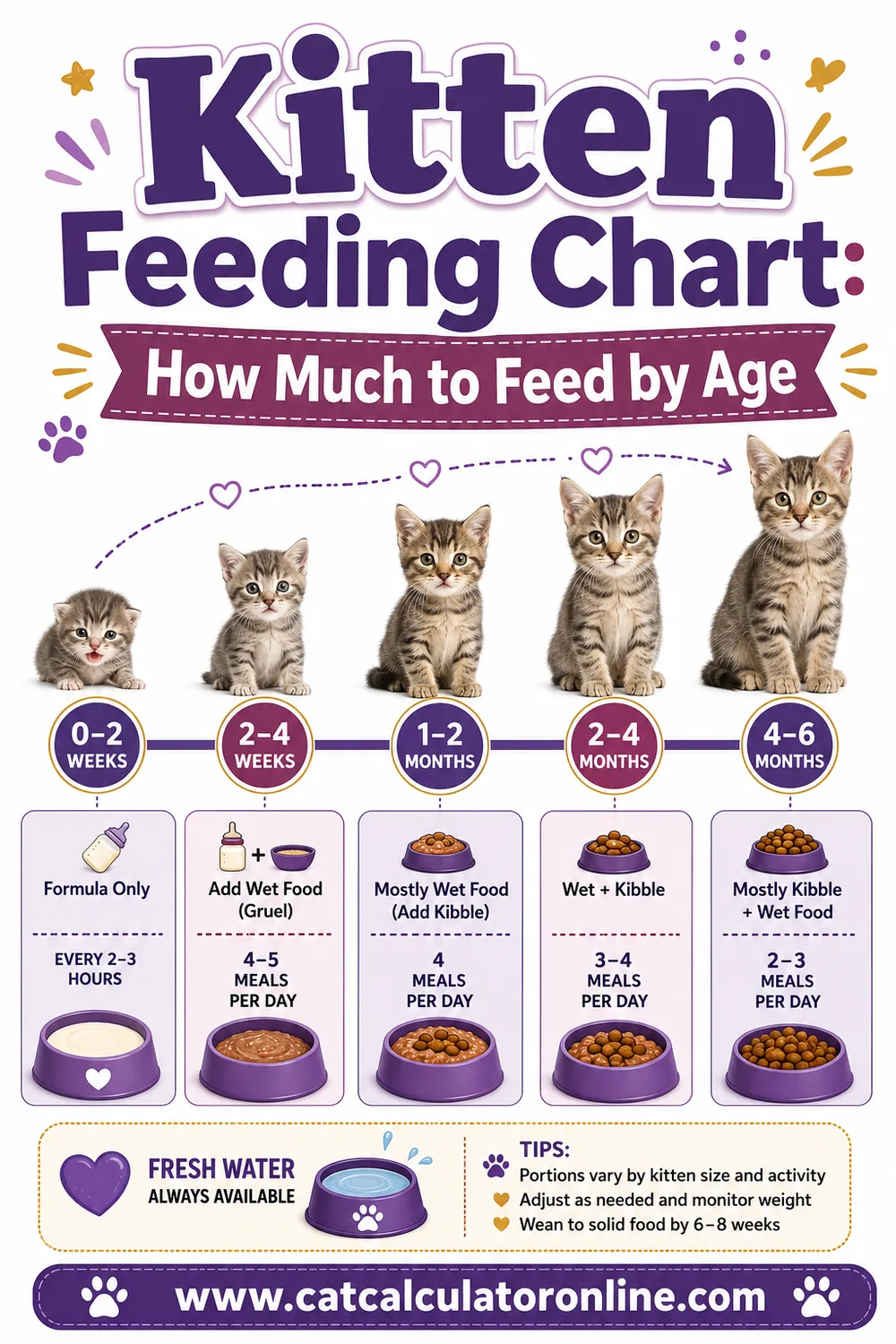
The kittens will start sharing her bowl at three to four weeks. That is the natural beginning of weaning, and it is why having kitten food in the bowl already is so convenient. The process is in how to wean kittens, with quantities in the kitten feeding chart.
Move her back to adult food once the kittens are weaned, over about a week, or she will steadily gain weight on a growth diet she no longer needs.
What Practical Setup Makes Feeding Easier?
Small logistics that make a real difference across nine weeks and eight more.
Shallow, wide bowls. Deep bowls press on the whiskers and put many cats off. This matters more when appetite is already fragile.
More than one feeding station. One by the nest, one in her usual spot.
Separate water from food if she prefers it — many cats do — and use several bowls rather than one large one.
Buy the kitten food before week four. Running out mid-transition means an abrupt change and a queen with diarrhea.
Stick to one brand and format through the whole period. Variety is not a virtue here.
Weigh her weekly on the same scales, and record it. Steady gain is the reassurance; loss is the flag.
Track the kittens' weights daily once they arrive — roughly 90 to 110 g (about 3 to 4 oz) at birth, gaining most days. Kitten weight is the most sensitive indicator that her milk supply is adequate.
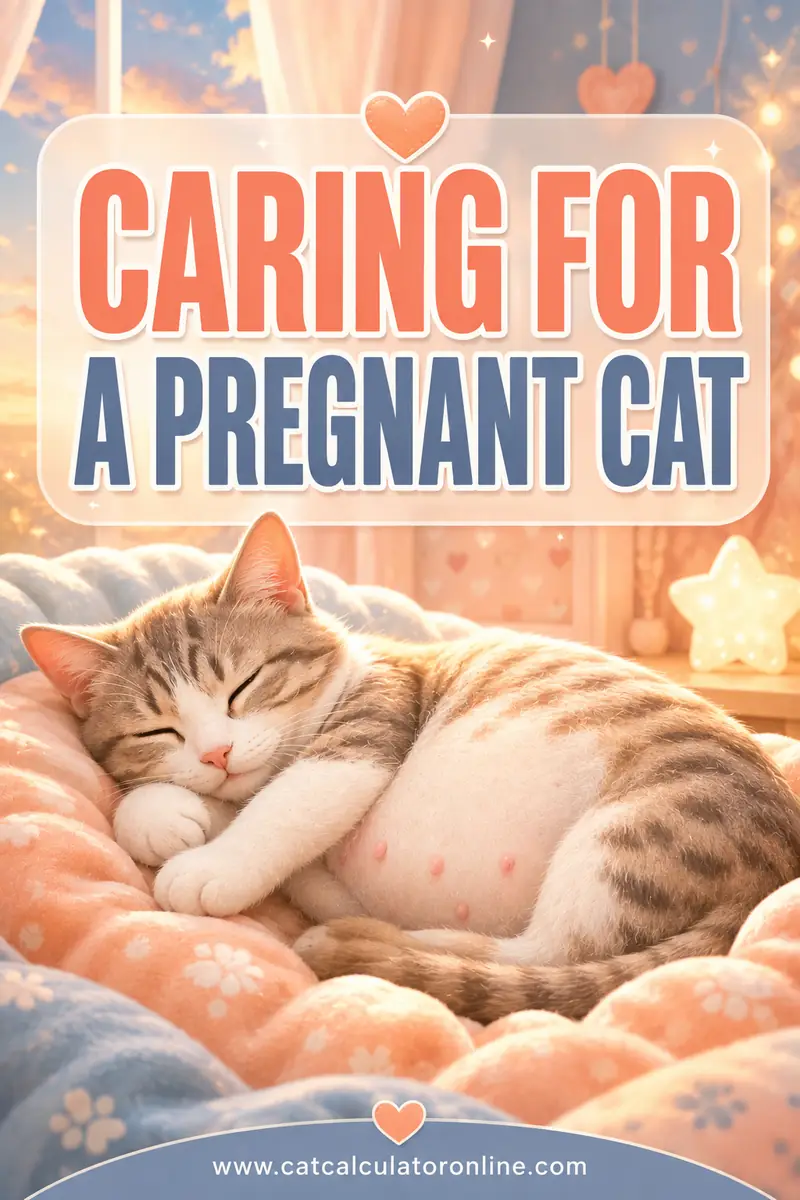
Keep her routine dull. No new flavors, no treats to "build her up", no experiments. The wider care plan sits in caring for a pregnant cat.
Frequently Asked Questions
Should I feed a pregnant cat kitten food?
Yes. From around the fourth or fifth week of pregnancy, switch her onto a complete kitten or growth diet and keep her on it throughout nursing. It is more calorie- and protein-dense than adult maintenance food, which is exactly what a pregnant and then lactating queen needs.
How much should a pregnant cat eat?
Intake climbs gradually: roughly normal for the first three weeks, about 1.25 times by week seven, and around 1.5 times by late pregnancy. Feed to appetite on a growth diet rather than measuring rigidly, and split it into four or five small meals late on.
Do pregnant cats need calcium supplements?
No, and giving them causes harm. Extra calcium suppresses the queen's own calcium-mobilising hormones, increasing the risk of eclampsia during nursing. A complete kitten food already provides calcium and phosphorus in the correct ratio. Only supplement if your vet specifically directs it.
How much does a nursing cat need to eat?
At peak lactation, around three to four weeks after the birth, she may need two to three times her maintenance calories, with larger litters at the top of that range. Free access to a kitten diet is usually the right approach, alongside plenty of fresh water.
Can a pregnant cat eat wet food only?
Yes, provided it is a complete kitten or growth diet. Wet food adds useful water intake, which helps during lactation. Because it is less calorie-dense by weight than dry food, she will need a decent volume, so split it into several meals a day.
My pregnant cat has stopped eating — what should I do?
Call your vet. A brief mild appetite dip in early pregnancy, and a short drop in the final 24 hours before labor, are both common. A full 24 hours with nothing eaten at any other point is not, and cats risk hepatic lipidosis within days of not eating.
Feeding a pregnant cat is one decision made at the right moment and then held. Around week four or five, move her onto a complete kitten or growth diet over five to seven days, and leave her on it until the kittens are weaned at about eight weeks. Feed to appetite, split late-pregnancy meals into four or five small ones, and switch to free access once she is nursing, when she may need two to three times her usual calories. Fresh water everywhere, no supplements without veterinary advice — calcium especially — and no raw diets. Weigh her weekly, weigh the kittens daily, and use the cat food calculator to set the baseline you scale from.