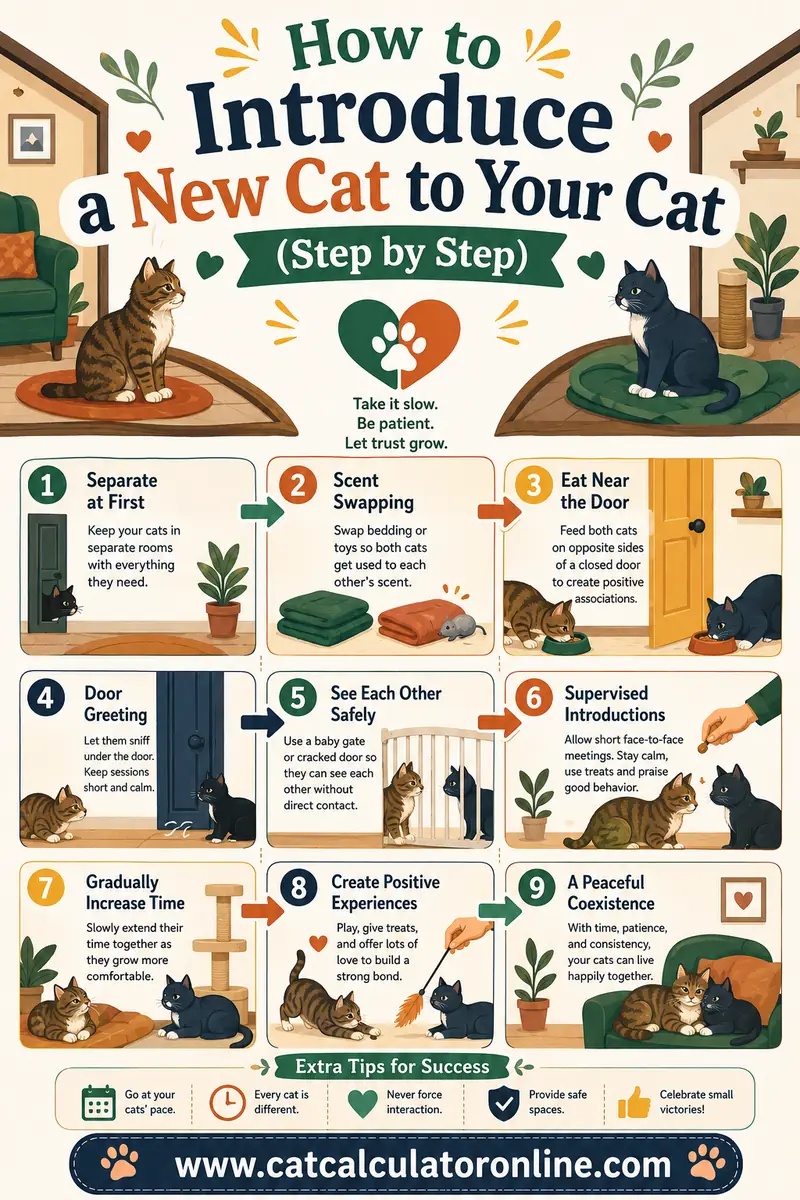
How to Introduce a New Cat to Your Cat (Step by Step)
The safe way to introduce a new cat to your existing cat is slowly — think days to weeks, not minutes. Start the newcomer in a separate room, swap scents between the cats before they ever see each other, then move to sight without contact, and finally to short, supervised face-to-face meetings that you gradually make longer. Never just put two cats in a room together and hope for the best, and never let them "fight it out." Rushing is the single biggest reason introductions go wrong.
Patience pays off here. A slow introduction done right can turn into a lifelong friendship, or at least a peaceful coexistence, while a rushed one can create tension that lasts for years. If your new arrival is a kitten, our new kitten checklist helps you get the rest of the setup ready too.
🐈 Cat introduction step finder
Tap each stage to see what to do:
Tap a step above to see what to do.
Why You Have to Go Slow
Cats aren't naturally pack animals the way dogs are. In the wild, an unfamiliar cat is competition for territory, food, and safety — so your resident cat's first instinct when a stranger appears is caution, not welcome. Throwing two cats together forces them to sort out that threat on the spot, which usually means fear, fighting, or a standoff that poisons the relationship from day one.
A slow introduction works because it lets each cat get used to the other in stages, without ever feeling cornered or threatened. Scent comes first, then sight, then contact — the same order cats would naturally use to size each other up, but controlled and safe. Each step lets them build positive associations before the stakes get higher.
How long does it take? Anywhere from a few days to several weeks, and occasionally longer. Kittens and young cats often adjust faster; adult cats, cats who've never lived with another cat, and more territorial personalities take more time. Let the cats set the pace. Moving to the next step should always be about how calm they are, not about your schedule.
Before the New Cat Comes Home
A little preparation makes the whole process smoother. Get these things sorted before the newcomer walks through the door:
- A separate room the new cat can call its own — a spare bedroom, office, or bathroom works. It needs a door that closes.
- A full set of resources for that room: litter box, food, water, a bed, and at least one hiding spot like a box or covered bed.
- Extra litter boxes and bowls for the rest of the house, so your resident cat isn't suddenly sharing.
- A vet check for the new cat before it meets your existing cat, to rule out anything contagious.
- Calm timing. Don't start an introduction the week you're moving house, hosting guests, or otherwise turning the home upside down.
Having all this ready means the new cat can settle straight into a safe space, and your resident cat's routine barely changes at first. That stability is half the battle.
Step 1: Set Up a Separate Room
For the first few days, the new cat lives entirely in its own room behind a closed door. This gives the newcomer a safe base to decompress in — a new home is overwhelming, and a whole house is far too much at once — and it lets your resident cat register that something has changed without any direct confrontation.
Make sure that room has everything the new cat needs: litter box, food, water, a comfortable bed, and places to hide. Spend calm time in there with the newcomer, but let it come to you. Some cats settle in a day; others hide under the bed for a while. Both are normal.
Meanwhile, your resident cat keeps the run of the rest of the house. The two cats will already know about each other through the door — sniffing, the occasional paw underneath, maybe some vocalizing. That's fine. They're gathering information safely, which is exactly the point.
Step 2: Swap Scents
Scent is how cats recognize each other, so before they ever lay eyes on one another, you want each cat to become familiar with the other's smell — and to associate it with good things. This is the step people most often skip, and it's one of the most important.
A few ways to swap scents:
- Rub a soft cloth or sock gently on one cat's cheeks (where their scent glands are), then leave it in the other cat's space to investigate. Do this in both directions.
- Swap bedding or blankets between the two spaces so each cat sleeps surrounded by the other's scent.
- Rotate the cats. Let the new cat explore the main house for a bit while the resident cat goes into the new cat's room. This spreads scent both ways and lets the newcomer learn the layout without a confrontation.
The real trick is feeding both cats on opposite sides of the closed door. Put a bowl down for each cat near the door, far enough that they'll still eat comfortably. Over days, move the bowls a little closer. This teaches both cats that the other's presence and smell means something wonderful — dinner — is about to happen. It's simple and it works.
Step 3: Let Them See Each Other
Once both cats are eating calmly near the door and seem relaxed about the other's scent, it's time for controlled visual contact — seeing each other without being able to fight or flee into each other.
Good ways to allow sight without full contact:
- Crack the door open a couple of inches (wedge it so it can't swing wide) so they can glimpse each other.
- Use a baby gate or two stacked in the doorway.
- Hang a screen or use a mesh pet barrier so they can see and smell but not touch.
Keep these sessions short at first and pair them with something positive — treats, a meal, or play on each side of the barrier. You're aiming for both cats to see each other and stay calm. A little curiosity is great. Some hissing or a puffed tail early on is normal and not a reason to panic.
If either cat reacts with intense fear or aggression — yowling, lunging at the barrier, refusing to eat — that's a sign you've moved a bit fast. Close the door, go back to scent swapping for a few more days, and try again. There's no prize for rushing.
Step 4: Short Supervised Meetings
When the cats can see each other through a barrier and stay relaxed, you're ready for face-to-face time in a shared space — always supervised, always short at first.
Here's how to run these first meetings well:
- Pick a neutral, open area where neither cat feels trapped and both have escape routes.
- Have distractions ready — treats, wand toys, a meal — to keep the mood positive and give the cats something to do besides stare each other down.
- Keep it brief. A few minutes is plenty for the first session.
- End on a good note. Stop the session while both cats are still calm, before anyone gets tense or overstimulated. You want the last memory of each meeting to be a good one.
- Gradually extend the time over days as the cats grow comfortable, until they can share space peacefully without supervision.
Never leave two newly introduced cats alone together until you're confident they're genuinely comfortable. And if a meeting goes sideways — real aggression, not just a hiss — calmly separate them (a towel, a cushion, or herding them apart, never your bare hands between them) and go back a step. Slow and steady wins.
Give Each Cat Its Own Resources
A huge amount of cat conflict comes down to competition over resources. If two cats have to share one litter box, one food bowl, and one favorite windowsill, you've built tension into the household. The fix is simple: make sure there's enough of everything to go around, so no cat has to compete or guard.
| Resource | The rule | Why it matters |
|---|---|---|
| Litter boxes | One per cat, plus one extra (the "n+1" rule) | Prevents box-guarding and litter-box stress; a blocked box can cause accidents |
| Food and water | Separate feeding stations in different spots | Stops one cat controlling access to food |
| Vertical space | Cat trees, shelves, perches | Lets cats share a room by using height; avoiding conflict by stacking, not crowding |
| Hiding spots | Multiple per cat | Gives a nervous cat somewhere to retreat instead of fighting |
| Beds and resting spots | Plenty, spread out | Removes competition over prime napping real estate |
For the litter box side of this, our guide on how many litter boxes per cat explains the n+1 rule in detail — and getting it right heads off one of the most common problems in multi-cat homes, a cat peeing outside the litter box.
Warning Signs to Watch For
Part of a good introduction is knowing the difference between normal friction and a real problem. Some tension is expected; certain signs mean you should slow down.
Normal and OK:
- Hissing or growling in the early stages
- A puffed tail or arched back when they first see each other
- Cautious curiosity, watching from a distance
- One cat wanting more space than the other
Signs to back up a step:
- Flattened ears, hard staring, or stalking one cat toward the other
- One cat blocking access to food, water, the litter box, or a doorway
- A cat that stops eating or stops using the litter box
- Hiding constantly or seeming shut down and stressed
- Full-on fighting — screaming, tumbling, fur flying
If you see the back-up signs, there's no shame in it — just return to an earlier step and go slower. Learning to read cat body language makes this much easier, because you'll catch rising tension before it boils over.
A few things to never do: never punish either cat for hissing or swatting (it just adds fear and stress), never force the cats together, and never let them "fight it out" in the belief they'll sort out a pecking order. Cats don't work that way — a bad fight can create a rivalry that's very hard to undo.
When It's Taking a Long Time
Some cats become fast friends. Others take weeks of patient work. And a few never truly bond — they simply learn to coexist, keeping to their own areas and tolerating each other. That's a perfectly acceptable outcome. Not every pair of cats will curl up together, and a calm, peaceful truce is a real success.
If progress stalls or tension stays high, a few things can help. Keep resources plentiful and spread out. Give each cat quality one-on-one time and play so neither feels displaced. Maintain predictable routines, since stability lowers stress. Vet-recommended calming aids, such as pheromone diffusers, can take the edge off during the transition — ask your vet what's appropriate.
And if two cats are genuinely fighting, injuring each other, or one is so stressed it's stopped eating or using the litter box, talk to your vet or a qualified cat behaviorist. Persistent conflict sometimes has a medical or behavioral root that a professional can help untangle. Kittens and younger cats generally adapt more readily; you can see where each of yours sits developmentally in our cat life stages explained guide.
FAQ
How long does it take to introduce two cats?
Anywhere from a few days to several weeks, and sometimes longer. Kittens and easygoing cats often adjust quickly, while adult or territorial cats need more time. Let the cats' comfort set the pace rather than sticking to a fixed schedule.
Can I just put the two cats together and let them work it out?
No. Forcing cats together or letting them "fight it out" is one of the worst things you can do, and it often creates lasting hostility. A gradual introduction — separate room, scent swapping, sight, then supervised meetings — is far more likely to succeed.
Is it normal for cats to hiss when they first meet?
Yes. Hissing and growling in the early stages are normal ways cats set boundaries, and they usually fade as the cats grow comfortable. It only becomes a concern if it escalates to stalking, blocking access, or real fighting, in which case you should slow down.
How many litter boxes do I need for two cats?
Follow the n+1 rule: one litter box per cat plus one extra, so two cats need three boxes. Placing them in different spots prevents one cat from guarding a box and reduces stress-related accidents.
How do I introduce a new kitten to an older cat?
Use the same slow process, but expect the kitten to have more energy than your older cat wants. Give the older cat plenty of high perches and quiet retreats to escape to, keep early meetings short, and never let the kitten pester an older cat that's had enough.
What if my cats never get along?
Some cats only ever coexist rather than bond, and that's a fine outcome. Keep resources separate and plentiful, maintain routines, and consider vet-recommended calming aids. If there's ongoing fighting or a cat stops eating or using the box, consult your vet or a cat behaviorist.
The Bottom Line
Introducing a new cat is all about going slow and controlling the order things happen in: separate room first, then scent swapping, then sight without contact, then short supervised meetings that grow longer over time. Give each cat its own litter boxes, feeding stations, hiding spots, and vertical space so there's nothing to fight over, and watch body language to know when to advance or back up.
Some hissing early on is normal; stalking, blocked access, or a cat that stops eating means slow down. Never force it, never let them fight it out, and remember that a calm coexistence is a win. If a kitten is joining your home, get the rest of the essentials sorted with our new kitten checklist and keep tabs on its growth with the free kitten weight calculator.