Cat Body Condition Score Explained
Body condition score, or BCS, is a 9-point scale vets use to judge whether a cat is carrying the right amount of fat — where 5 out of 9 is ideal. It's assessed by feel and by eye rather than by weight, which is why it works equally well for a 7 lb Siamese and an 18 lb Maine Coon. Each point above 5 represents roughly 10% over ideal body weight, so the score converts directly into a target. You can learn to score your own cat in a couple of minutes, and pairing it with the cat ideal weight calculator turns a rough impression into an actual number to work toward.
What Is a Body Condition Score?
It's a standardised way of describing how much body fat a cat is carrying, assessed by feeling the ribs and looking at the cat's shape from above and from the side.
The most widely used version in veterinary practice is the 9-point scale, where 1 is emaciated, 5 is ideal and 9 is severely obese. Some practices use a 5-point version where 3 is ideal; the principle is identical, just with coarser gradations.
The key insight is that BCS measures condition, not mass. A number on a scale tells you nothing without context — 12 lb is obese for a Devon Rex and lean for a Maine Coon. BCS asks a better question: regardless of breed or frame, does this cat have the right amount of fat on it?
That's why vets record BCS at every visit alongside weight. The two together tell a story neither tells alone. A cat holding steady at 11 lb but rising from BCS 5 to BCS 7 has lost muscle and gained fat — a genuinely important finding that the scale alone would miss entirely.
What Does Each Score Mean?
| Score | Condition | What you feel and see |
|---|---|---|
| 1 | Emaciated | Ribs, spine, hips starkly visible. No body fat. Severe muscle loss |
| 2 | Very thin | Bones easily visible, minimal muscle, no fat cover |
| 3 | Thin | Ribs easily felt and slightly visible, obvious waist, minimal abdominal fat |
| 4 | Slightly lean | Ribs very easy to feel with minimal fat, clear waist, obvious tuck |
| 5 | Ideal | Ribs easy to feel under thin fat, visible waist, slight abdominal tuck |
| 6 | Slightly overweight | Ribs felt with light pressure, waist faint, belly slightly rounded |
| 7 | Overweight | Ribs hard to feel under moderate fat, waist barely visible, belly rounded |
| 8 | Obese | Ribs not felt without firm pressure, no waist, obvious abdominal distension |
| 9 | Severely obese | Ribs not palpable, heavy fat over back and limbs, marked distension |
The middle of that table is where most cats sit, and where small differences matter most. The gap between 5 and 7 doesn't look dramatic in a photo, but it represents roughly 20% excess body weight — proportionally more than it sounds on an animal weighing 10 lb.
How Do You Score Your Own Cat?
Three checks, and you need all three. Take a minute while your cat is standing and relaxed.
1. Feel the ribs. Place both hands flat on either side of the ribcage and run them backward with light pressure. The reference point most vets use: at an ideal score, feeling your cat's ribs should be roughly like feeling the bones on the back of your own hand — present, distinct, covered by a thin layer.
- Bones feel sharp and uncovered → 3 or below
- Easy to feel with a thin covering → 4–5
- You have to press → 6–7
- You can't find them → 8–9
2. Look from above. Standing over your cat, look for an inward curve behind the ribcage. A clear waist means 4–5. A faint one means 6. A straight or outward-bulging outline means 7 or above.
3. Look from the side. The belly should tuck slightly upward from ribcage to hind legs. Level means overweight; sagging below the ribcage means obese.
Two practical notes. Long-haired cats need the hands-on check — coat completely conceals outline, and a Maine Coon or Persian can look substantially heavier or leaner than it is. And ignore the primordial pouch, the loose swinging flap low on the belly. It's normal anatomy present in lean cats too, and mistaking it for fat is the most common home-scoring error. The at-home method is covered in more detail in is my cat overweight.
Why Is BCS Better Than Weight Alone?
Four reasons, and together they explain why vets rely on it.
It works across every breed and frame. No chart can tell you whether 13 lb is right for your cat. BCS answers that directly by assessing the cat in front of you.
It gives you a target, not a verdict. Because each point above 5 is roughly 10% excess, a score converts into a number. A cat at BCS 7 weighing 12 lb is carrying about 20% too much, implying an ideal near 10 lb. That's an actionable goal rather than a vague "he could lose a bit".
It catches changes weight misses. An older cat losing muscle while gaining fat can hold a steady weight while its condition deteriorates significantly. BCS sees this; the scale doesn't.
It doesn't need equipment. You can do it at home, monthly, in a minute, without a struggle to get a cat onto scales.
The honest limitation: it's subjective. Two people can score the same cat a point apart, and owners tend to under-score their own cats — a well-documented tendency to see an overweight pet as normal, partly because overweight cats have become so common that they look normal. Having your vet score your cat once gives you a calibration point to judge against afterward.
There's a second limitation worth knowing. BCS assesses fat, not muscle, and the two can move independently. A young athletic cat and an older cat that has lost muscle but gained fat can both score 5, despite being in quite different shape. That's why the score is best read alongside weight history and, in older cats, a separate assessment of muscle mass. No single number captures a cat's condition completely — but of the available single numbers, BCS is comfortably the most informative.
What Should You Do at Each Score?
BCS 1–3 (underweight). See a vet promptly rather than simply feeding more. Weight loss in cats is much more often a symptom than a feeding failure — hyperthyroidism, kidney disease, diabetes, dental pain and intestinal disease all cause it. This is particularly important in cats over eight.
BCS 4. Generally fine, especially for an active or younger cat. Worth monitoring so it doesn't slide further down.
BCS 5. The target. Keep doing what you're doing: measured meals, counted treats, regular play, and a monthly check so you notice drift early.
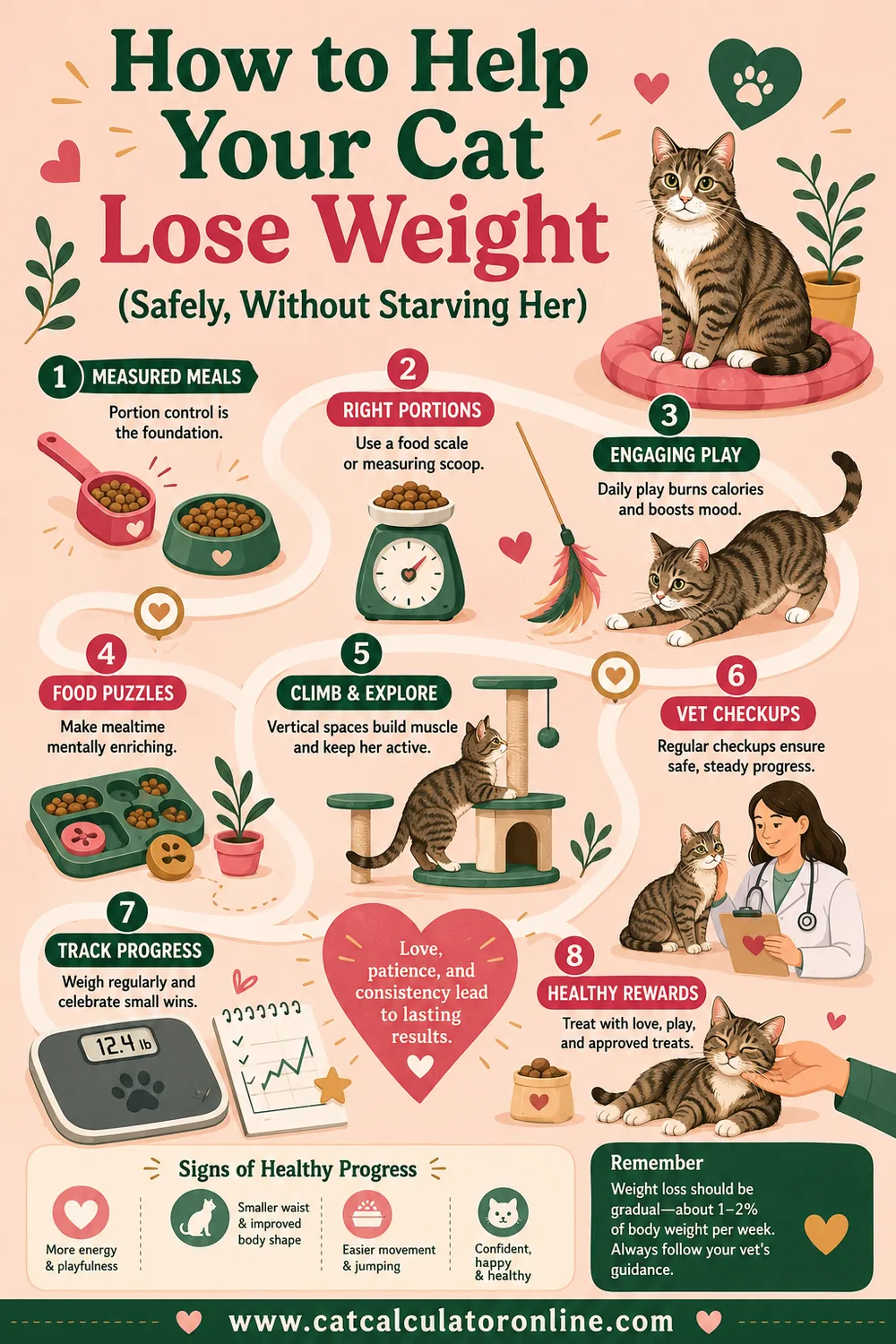
BCS 6–7. The most common finding, and the most worthwhile to act on. Modest, gradual weight loss meaningfully reduces the risk of diabetes, arthritis and urinary disease. Speak to your vet, set a target, and expect it to take months rather than weeks — the plan is in how to help your cat lose weight.
BCS 8–9. Needs a proper veterinary plan rather than a home diet. At this level there may be associated conditions to manage, mobility is often affected, and the weight-loss program needs monitoring. Do not attempt rapid restriction.
At every score above 5, the rule is the same: slow and vet-supervised. Cats are unusually vulnerable to hepatic lipidosis — a serious liver condition triggered by rapid weight loss or a sudden drop in food intake. Safe loss is roughly 0.5–2% of body weight per week.
It's worth being clear about why cats differ from dogs here, because owners often transfer dog logic across. When a cat's calorie intake drops sharply, the body mobilises fat faster than the liver can process it, and fat accumulates in liver cells until the organ starts to fail. A cat that simply refuses a new diet food for a few days can trigger it. This is the reason vets insist on gradual food transitions and monitored weight loss in cats specifically — it isn't excessive caution, and a cat that stops eating for more than a day or two needs to be seen rather than waited out.
How Does BCS Convert Into an Actual Target Weight?
This is where the score becomes genuinely practical rather than descriptive, and the arithmetic is simple enough to do in your head.
Because each point above 5 represents roughly 10% excess, you can work backward from your cat's current weight:
| Current BCS | Excess body weight | If your cat weighs 12 lb, ideal is about |
|---|---|---|
| 6 | ~10% | 10.9 lb |
| 7 | ~20% | 10.0 lb |
| 8 | ~30% | 9.2 lb |
| 9 | ~40% | 8.6 lb |
The formula is current weight ÷ (1 + excess percentage). So a 14 lb cat at BCS 8 works out at 14 ÷ 1.3, or roughly 10.8 lb.
Two cautions on using this. The 10%-per-point rule is a rule of thumb, not a measurement — it gives you a sensible starting target rather than a precise prescription, and your vet may adjust it based on frame and muscle. And for cats at BCS 8 or 9 the estimate becomes less reliable, which is another reason those cases need professional input.
Where the conversion earns its keep is in planning. A 12 lb cat at BCS 7 targeting 10 lb needs to lose 2 lb. At a safe rate of roughly 0.5–2% of body weight per week — call it 1–2 oz — that's a project of around four to six months. Knowing that upfront prevents the two most common failures: giving up at week six because nothing seems to be happening, and cutting food too hard out of impatience. Detailed breed-by-breed targets are in the healthy weight range for cats.
How Often Should You Check?
Monthly at home, and at every vet visit.
Monthly is frequent enough to catch a trend and infrequent enough to avoid reacting to noise. Weight and condition drift slowly in cats — a pound gained across a year is invisible day to day and significant by the end.
A simple habit that works: score your cat on the first of each month, write the score and weight in a note on your phone, and take a photo from above and from the side. The photos are surprisingly useful, because they remove the gradual-change blindness that makes it hard to see your own cat objectively.
Check more often — every week or two — if your cat is on an active weight-loss plan, if it's recovering from illness, or if it's over eleven, when unexplained loss becomes more likely and matters more.
Bring your records to appointments. A vet seeing "BCS 6, 11.4 lb, up from 10.9 lb three months ago" has considerably more to work with than "he looks about the same to me".
Does Body Condition Change With Age?
Yes, and in a predictable pattern worth anticipating.
Kittens and young cats are usually lean, scoring 4–5, because growth burns energy. Kittens shouldn't be scored on the adult scale in the same way — a growing cat's proportions change constantly. Growth tracking is a better tool at this stage, as in the cat weight chart by age.
Young adults (1–6) are where gain typically begins, especially after neutering, which lowers energy requirements by roughly 20–30% while portions often stay the same. Most cats that become overweight start doing so here.
Mature adults (7–10) frequently sit at their heaviest. This is the stage where intervention pays off most, because the associated conditions haven't usually appeared yet.
Senior cats (11+) commonly start losing weight and muscle. A senior dropping from BCS 6 to 5 without a deliberate diet is not a success story — it's a reason to see a vet. Age-related muscle loss also means an older cat can score 5 while being frailer than a young cat at the same score.
That late-life reversal is the most important thing to understand about BCS over time. Through middle age you're watching for gain; past eleven you're watching for loss, and loss is the more urgent finding.
There's also a muscle dimension the fat score doesn't capture. Many vets assess muscle condition separately, feeling over the skull, shoulder blades, spine and hips for muscle mass. An older cat can be carrying plenty of fat while losing significant muscle — a combination that scores acceptably on BCS alone but represents a genuine decline. If your senior cat's spine and shoulder blades feel more prominent than they used to while the belly stays round, that's worth raising with your vet even if the body condition score hasn't moved.
Frequently Asked Questions
What is a normal body condition score for a cat?
Five out of nine on the standard scale. At BCS 5 you can easily feel the ribs under a thin layer of fat, see a visible waist when looking down from above, and see a slight upward tuck of the belly from the side.
How do I calculate my cat's ideal weight from its BCS?
Each point above 5 represents roughly 10% over ideal body weight. A cat at BCS 7 is carrying about 20% excess, so a 12 lb cat at that score has an ideal weight near 10 lb. Confirm the target with your vet before starting any weight-loss plan.
Is a body condition score better than weighing my cat?
They're complementary, and vets record both. BCS works across every breed where a weight chart can't, and it catches muscle loss that a steady weight would hide. Weight is more objective and better for tracking change, so use them together.
Can I score my cat's body condition myself?
Yes — feel the ribs with flat hands, look from above for a waist, and look from the side for a belly tuck. Owners do tend to under-score their own cats, so having your vet score once gives you a calibration point to compare against.
What if my cat scores 8 or 9?
That needs a veterinary plan rather than a home diet. Severely overweight cats often have associated conditions, and rapid weight loss risks hepatic lipidosis, a serious liver problem. Your vet will set a safe rate of loss and monitor progress.
Why is my cat's belly hanging down if the score says ideal?
That's almost certainly the primordial pouch — a normal flap of loose skin low on the abdomen present in nearly all cats, including very lean ones. It swings freely when your cat walks. Judge condition by the ribs and waist instead.
Body condition score is the most useful weight tool cat owners have, because it asks the right question: not how much does this cat weigh, but is this cat carrying the right amount of fat. Learn the three checks, score monthly, write it down, and treat any score above 5 as a slow project rather than a quick fix. Get a target weight from the cat ideal weight calculator, then match the portions using how many calories does my cat need.