Indoor vs Outdoor Cat: Which Is Better? Should I Let My Cat Outside?
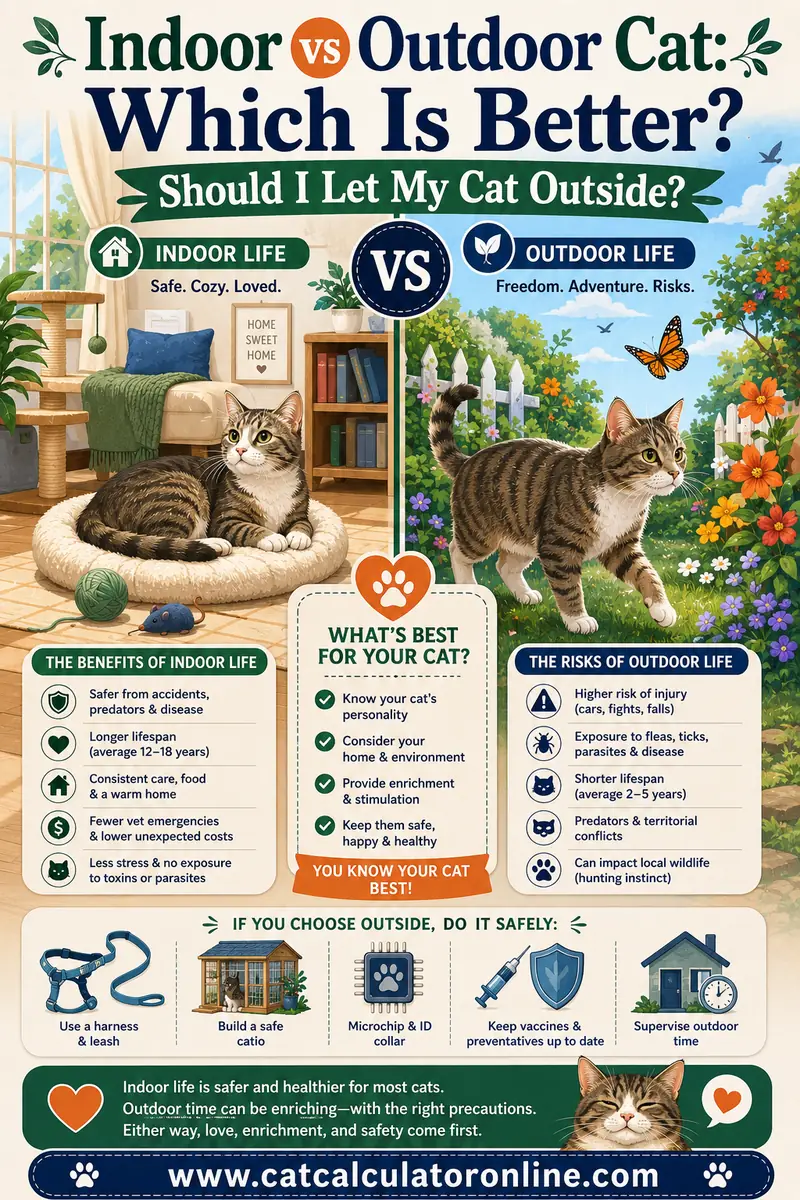
The clearest fact in this whole debate: indoor cats live far longer than outdoor cats — typically 13 to 17+ years indoors versus just 2 to 5 years for cats that roam freely outside. Traffic, predators, disease, poisons, and simply getting lost are the killers that cut outdoor lives short. That's the honest headline. The honest counterpoint is that outdoor access offers natural stimulation and exercise, and a bored, under-enriched indoor cat can develop stress and obesity. The modern answer most vets land on isn't strictly one or the other — it's "indoor plus enrichment," or safe, supervised outdoor access.
The Short Answer
If you're optimizing purely for a long, safe life, indoor is the clear winner — the lifespan gap is too large to ignore, and nearly every leading cause of early feline death is an outdoor hazard. Indoor cats are protected from cars, predators, contagious disease, and poisons, which is why they routinely reach their mid-teens and beyond.
But "safe" and "happy" aren't automatically the same thing. A cat kept indoors with nothing to do can become bored, stressed, or overweight — problems that shorten and sour a life in their own way. That's why the real recommendation isn't "lock the door," it's "keep your cat indoors and give it the enrichment, or the safe outdoor access, that satisfies its instincts." Do both and you get the long life without the boredom.
The Lifespan Gap Is Real — and Large
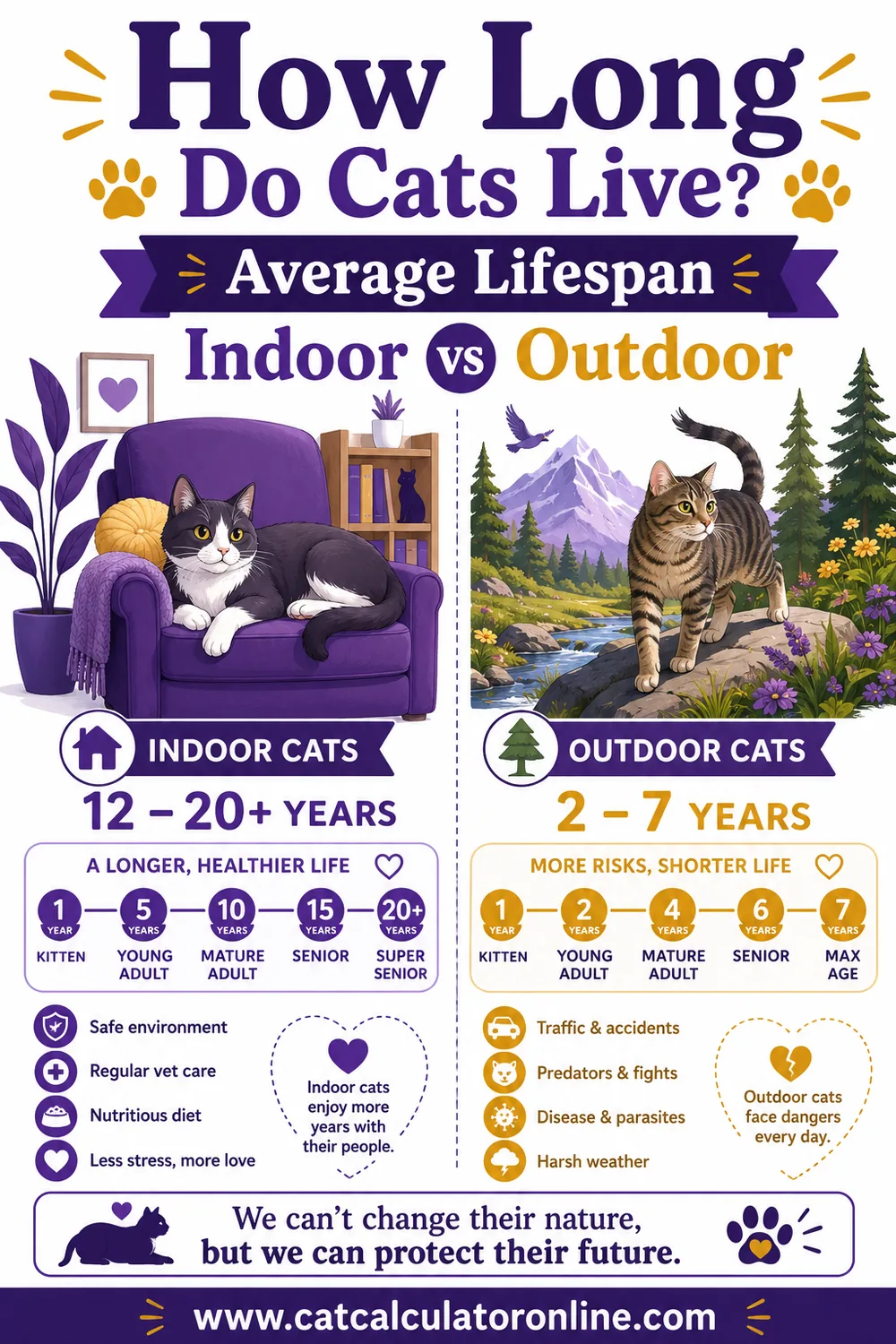
There's no soft way to put this: free-roaming outdoor cats live dramatically shorter lives. Estimates for cats that roam unsupervised often land around 2 to 5 years, while indoor cats commonly reach 13 to 17 years, and many live to 18–20+.
The gap isn't about indoor air or comfort — it's about hazards. Outdoor cats face a daily gauntlet of dangers that indoor cats never meet, and it only takes one bad encounter. A single moment near a road, one fight with an infected cat, one taste of antifreeze, and a healthy young cat's life ends years early.
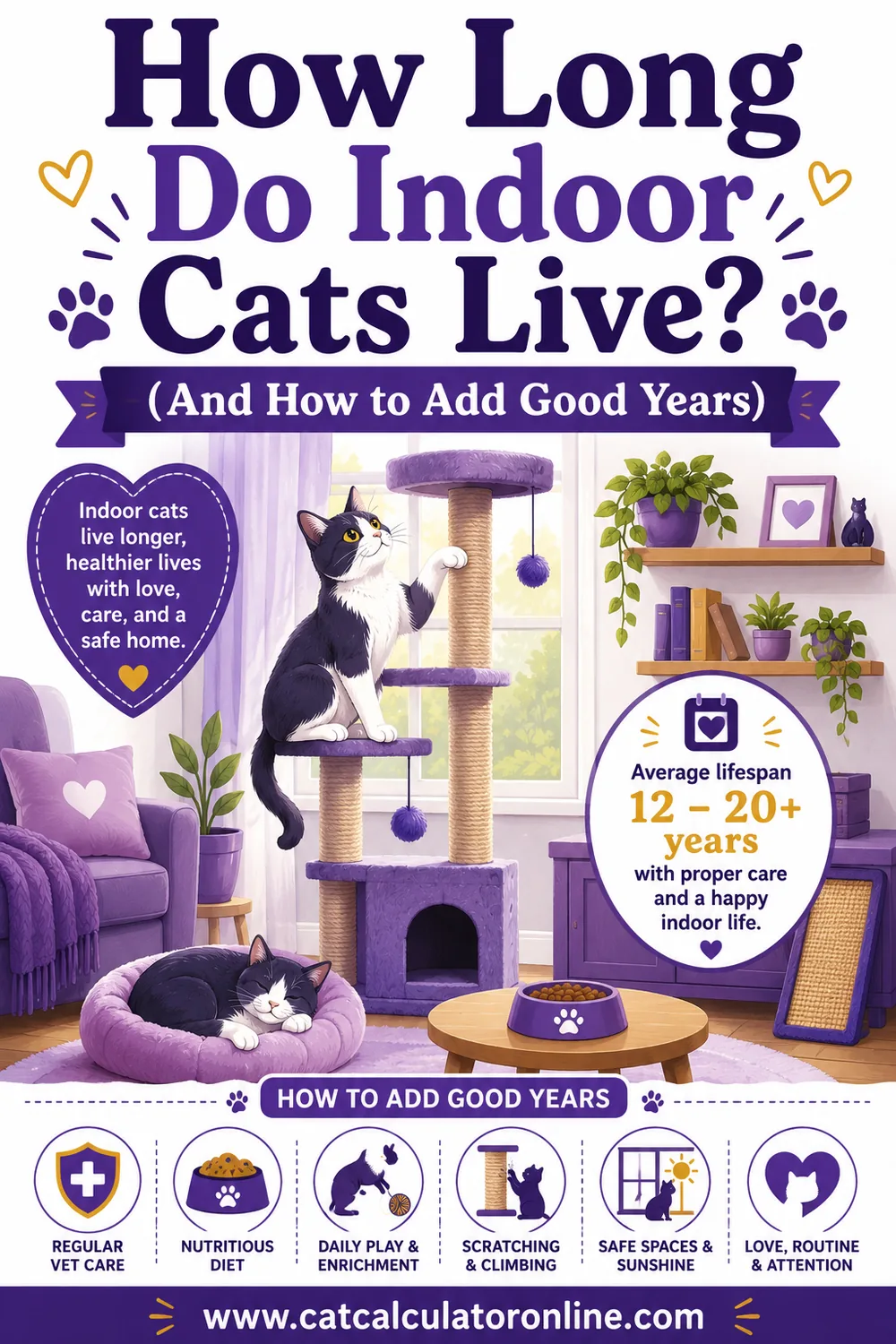
Our detailed look at how long indoor cats live breaks the numbers down further, and how long cats live covers the full range across lifestyles. If longevity is your priority, the data points one direction.
What Actually Kills Outdoor Cats
It helps to be specific about the risks, because "it's dangerous out there" is easy to wave away until you see the list:
- Traffic. Cars are one of the leading causes of death for outdoor cats. Even a street-smart cat can misjudge once.
- Predators and other animals. Coyotes, dogs, birds of prey, and other wildlife hunt or attack cats depending on where you live.
- Disease. This is the quiet one. Feline leukemia (FeLV) and feline immunodeficiency virus (FIV) spread through bites and fights between cats — exactly what outdoor cats get into. Both are serious and incurable.
- Poisons. Antifreeze, rodenticides, slug pellets, and toxic plants are all out there, and cats are curious and small.
- Fights and injuries. Territorial scraps cause abscesses, wounds, and vet bills — and transmit the diseases above.
- Getting lost or stolen. An outdoor cat can wander too far, get shut in a shed or vehicle, or simply not come home.
- Parasites. Fleas, ticks, and worms are far more common in cats that roam.
None of this means outdoor cats are doomed — plenty live full lives. But every item on that list is a risk an indoor cat essentially never faces, and together they explain the lifespan gap entirely.
The Honest Case for Outdoor Access
Fairness demands the other side, because it's real. Outdoors is a cat's ancestral environment, and it delivers things a living room struggles to match.
A garden or neighborhood offers constant natural enrichment: real prey to stalk, smells to track, textures to climb, sun to bask in, and space to sprint. That stimulation keeps a cat mentally sharp and physically active in a way that's genuinely hard to replicate indoors.
The flip side of indoor safety is that a bored, under-enriched indoor cat has real problems of its own. Without outlets for hunting and climbing, some cats become stressed, over-groom, develop litter-box issues, or — very commonly — gain weight. Feline obesity is widespread among indoor cats, and it brings diabetes, joint disease, and a shorter life with it. An indoor cat isn't automatically a healthy cat; it's a cat whose enrichment is now your responsibility.
So the outdoor argument isn't really "let them roam free" — it's "cats need stimulation and exercise, and outdoors provides it by default." The good news is you can provide it indoors too, or give outdoor access safely.
Cats and Wildlife: The Part Owners Forget
There's a factor beyond your own cat's welfare: free-roaming cats are a significant predator of wildlife. Domestic cats are efficient hunters, and outdoor cats collectively kill large numbers of birds, small mammals, reptiles, and amphibians each year.
A well-fed pet cat still hunts — the instinct isn't about hunger. So even a cat that "only goes out in the garden" contributes to local wildlife pressure, particularly for ground-nesting and fledgling birds.
For many owners this tips the scales toward indoor living or contained outdoor access, especially in areas with sensitive or declining bird populations. It's not a guilt trip — it's simply part of the honest ledger. Keeping a cat indoors, or in a catio, protects the neighborhood's wildlife as a bonus to protecting your cat.
Indoor vs Outdoor: The Full Comparison
Here's the whole picture in one place:
| Factor | Indoor cat | Outdoor / free-roaming cat |
|---|---|---|
| Average lifespan | 13–17+ years | ~2–5 years |
| Traffic risk | None | High |
| Predators & fights | None | Present |
| Disease exposure (FeLV/FIV) | Very low | High |
| Poisons & toxins | Low (control the home) | High |
| Getting lost | None | Real risk |
| Natural stimulation | Needs you to provide it | Abundant by default |
| Exercise | Needs encouragement | Usually plentiful |
| Obesity risk | Higher if under-stimulated | Lower |
| Wildlife impact | None | Significant |
| Ongoing cost | Lower vet/parasite bills | Higher (injuries, parasites) |
The pattern is clear: indoors wins decisively on safety, longevity, and wildlife, while outdoors wins on natural stimulation and exercise. Every one of those outdoor advantages, though, can be delivered indoors or through safe, contained access — which is exactly what the middle path does.
The Modern Answer: The Middle Path
You don't have to choose between a bored indoor cat and a short-lived outdoor one. The approach most vets now recommend gives you most of the outdoor benefits with a fraction of the risk:
- A catio. An enclosed "cat patio" — a screened porch, a mesh window box, or a purpose-built outdoor enclosure — lets your cat feel the breeze, watch birds, and lounge in the sun with zero traffic, predators, or escape risk. It's the single best-of-both-worlds solution.
- Leash and harness training. Many cats learn to walk on a harness, giving them supervised outdoor time on your terms. Start indoors, go slow, and let the cat set the pace — some love it, some never take to it.
- A cat-proofed garden. Fence toppers, cat-proof fencing systems, and secure enclosures can turn a yard into a safe roaming zone. It's an investment, but it converts your garden into a giant catio.
- Supervised outdoor time. Simply being out in a secure yard while you're present cuts many of the worst risks, since you can intervene before trouble starts.
These options acknowledge regional differences too. In some countries, outdoor access is the cultural norm and indoor-only feels unusual; in others, indoor-only is standard and free-roaming is frowned upon. The middle path travels well across both — it respects a cat's need to experience the outdoors without accepting the full outdoor risk.
How to Keep an Indoor Cat Happy
If you go indoor-only, the enrichment is on you — and it's very doable. A well-enriched indoor cat isn't a deprived cat; it's a safe cat with a rich life. Focus on these:
- Vertical space. Cats live in three dimensions. Cat trees, wall shelves, and tall perches multiply the usable space in any room and let a cat climb, survey, and feel secure up high.
- Daily play. Ten to fifteen minutes, once or twice a day, with a wand toy or feather teaser satisfies the hunt-catch-kill instinct. This is the single biggest lever against boredom and weight gain.
- Window perches. "Cat TV" is real — a perch by a window with a bird feeder outside gives hours of engaged watching. It's cheap, easy enrichment.
- Puzzle feeders and food puzzles. Making a cat work for food engages its brain and slows fast eaters. It turns a passive meal into an activity.
- Scratchers. Multiple posts and pads, both vertical and horizontal, protect your furniture and let a cat stretch, mark, and de-stress naturally.
- Rotate toys. Put some toys away and swap them weekly so "old" toys feel new again. Novelty beats quantity.
- Routine and attention. Predictable feeding and play times, plus daily interaction, keep an indoor cat secure and engaged.
Do this and the two biggest indoor downsides — boredom and obesity — largely disappear. A cat with vertical territory, a daily hunt, and a window full of birds is a content cat, not a caged one.
Can You Move an Outdoor Cat Indoors?
Yes, though it takes patience if your cat is used to roaming. Transition gradually: build up the indoor enrichment first (climbing, play, window perches, puzzle feeders) so there's plenty to come home to, then reduce outdoor time in stages rather than all at once.
Expect some protest — vocalizing at the door is common at first. Redirect that energy into play, keep the routine consistent, and consider a catio or harness walks as a compromise that eases the shift. Most cats adjust within a few weeks once the indoor environment gives them enough to do. Watch for stress signs during the change, and if a cat seems genuinely unwell rather than just unsettled, our guide to signs your cat is sick helps you tell the difference.
FAQ
Do indoor cats really live longer than outdoor cats?
Yes, substantially. Indoor cats commonly live 13 to 17+ years, while free-roaming outdoor cats often live just 2 to 5 years. The difference comes down to hazards — traffic, predators, disease, and poisons — that indoor cats almost never encounter. It's the single strongest argument for keeping cats indoors.
Is it cruel to keep a cat indoors?
Not if you enrich the space. An indoor cat with vertical territory, daily play, window perches, and puzzle feeders lives a safe and stimulating life. Cruelty isn't the four walls — it's a barren environment with nothing to do. Provide outlets for climbing, hunting, and watching, and an indoor cat thrives.
What is a catio?
A catio is an enclosed outdoor space for cats — a screened patio, a mesh window box, or a purpose-built enclosure — that lets a cat enjoy fresh air, sunshine, and bird-watching without the risks of free roaming. It's widely considered the best-of-both-worlds solution, combining outdoor stimulation with indoor-level safety.
Should I let my cat outside?
It depends on your priorities and your area. Free roaming offers natural stimulation but cuts lifespan sharply and impacts local wildlife. Most vets recommend keeping cats indoors with enrichment, or giving safe access via a catio, harness walks, or a cat-proofed garden — you keep most of the benefits without the biggest risks.
How do I stop my indoor cat getting bored or fat?
Play with it daily for 10–15 minutes using a wand toy, add vertical space and window perches, use puzzle feeders to make it work for food, and rotate toys to keep them fresh. Boredom and obesity are the two main indoor risks, and consistent play plus portion control handle both. See how much a cat costs per year to budget for enrichment gear.
Which cats live the longest?
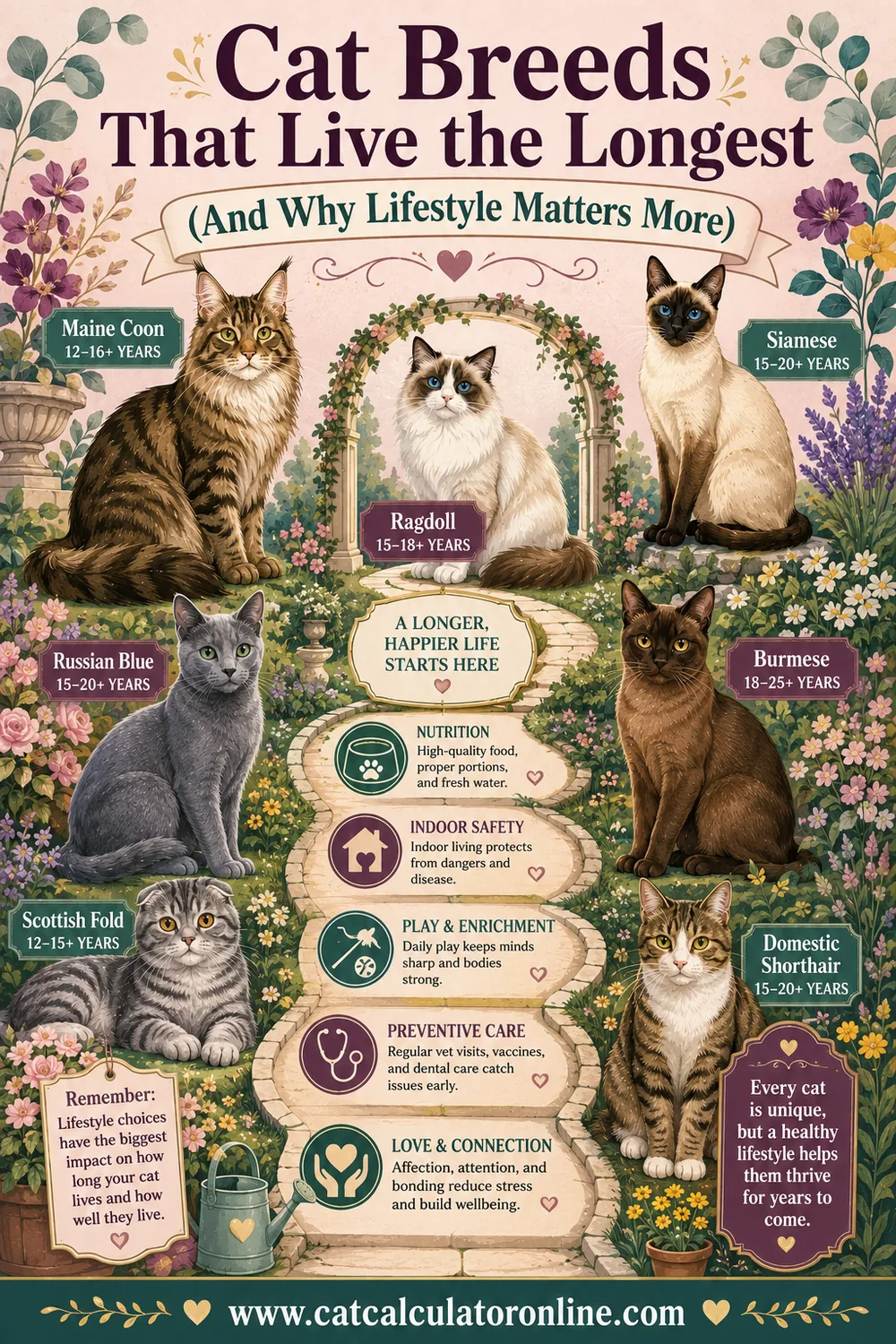
Indoor cats live longest overall, and some breeds are especially long-lived — several routinely reach their late teens or twenties with good care. Lifestyle matters more than breed, though: an indoor cat of any breed usually outlives an outdoor one. Our guide to cat breeds that live the longest covers the top contenders.
The Bottom Line
On the numbers, indoor living wins clearly — it can more than double or triple a cat's lifespan by removing the traffic, disease, predators, and poisons that end outdoor lives early, and it spares local wildlife too. The catch is that safety alone isn't enough: an indoor cat needs enrichment to avoid boredom and weight gain. The best answer for most cats is "indoor plus enrichment," or safe outdoor access through a catio, harness walks, or a cat-proofed garden — the long life without the dull one. Regional norms differ, and there's no shame in either tradition, but if you're weighing it fresh, the healthiest path is a well-stimulated indoor cat. See how the years add up with our free cat calculators, and dig deeper into how long indoor cats live.