When Can Kittens Eat Solid Food?
Kittens can start on food from a dish at around three and a half to four weeks, and should be eating solid food almost exclusively by seven to eight weeks — but "solid" at four weeks means kitten food moistened into a warm gruel, not kibble in a bowl. The single most common mistake is trying dry food too early, because a four-week kitten has incisors and canines but no functional back teeth and cannot chew. The second most common is offering cow's milk, which is not appropriate at any age. Getting the timing right sets appetite, digestion and litter tray habits for the whole of kittenhood. Portion figures for the weeks that follow are in the cat food calculator.
The Short Answer
The dates, without hedging.
Three and a half to four weeks is when food can first be offered in a dish, as a warm gruel.
Seven to eight weeks is when a kitten should be getting essentially all of its calories from solid food and no longer nursing.
Twelve weeks is the point by which most kittens handle dry kibble comfortably, although wet food remains perfectly appropriate.
Twelve months is when kitten food is normally swapped for adult food, since a kitten needs a growth diet for the whole first year.
Nothing solid before about three and a half weeks. Before that a kitten cannot lap properly, cannot chew, and has a digestive system set up for milk.
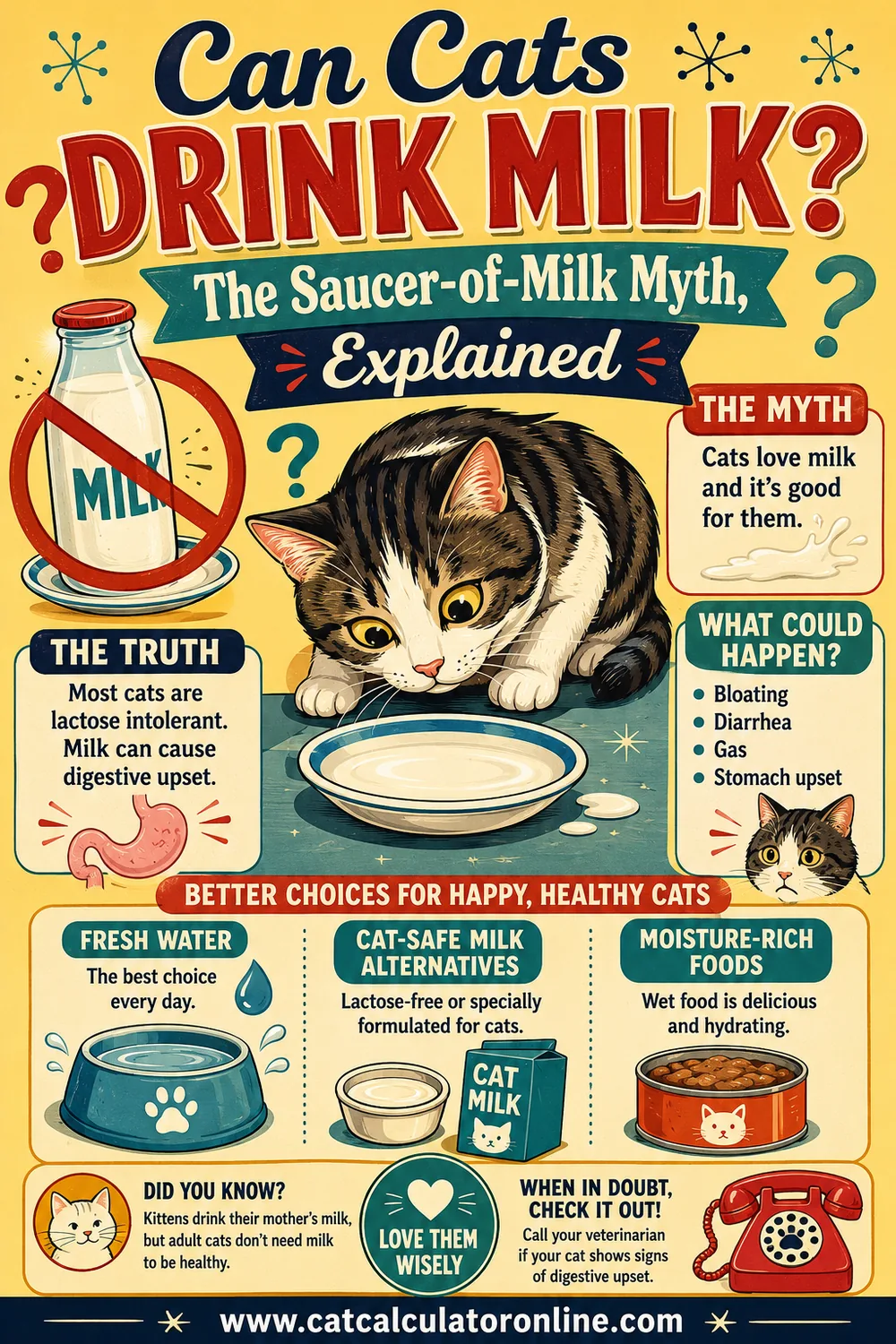
And no cow's milk at any point on that timeline — the reasons are in can cats drink milk.
How to Tell a Kitten Is Ready
Age is the guide; the kitten confirms it.
It can walk steadily to a dish. Weaning and walking arrive together at around three to four weeks, and a kitten that still wobbles across the nest is not ready to eat from a bowl.
It has front teeth. Incisors erupt at two to three weeks and canines at three to four. Teeth appearing is the physical signal that the mouth is changing over.
It shows interest in the queen's food. Kittens routinely try to steal from their mother's bowl a few days before anyone offers them their own, and that is the clearest go-ahead you will get.
It is lapping rather than only suckling. Lapping is a learned skill and the first attempts are messy, but a kitten that puts its face into liquid and gets some in is ready.
It is still nursing, and should be. Starting solids does not mean stopping milk. Nursing continues alongside for another three to four weeks.
Orphaned kittens follow the same schedule, timed from your best age estimate rather than a known birth date.
What Food to Actually Use
The choice is narrower than the pet shop aisle suggests.
A complete kitten food, wet or dry, labeled for growth. Kitten formulations carry more protein, more fat, more calcium and phosphorus, and crucially more taurine and DHA than adult food. Adult food does not meet a growing kitten's needs.
Wet kitten food is the easiest starting point, because it blends into gruel without a food processor and smells strongly enough to interest a four-week kitten.
Dry kitten food works too, soaked in warm water or kitten milk replacer for 15 to 20 minutes until it can be mashed with a fork.
Kitten milk replacer is the liquid of choice for making up the gruel in the first week or two of weaning, then plain warm water as the mixture thickens.
Warm it to roughly body temperature. Cold food from the fridge is refused by kittens who have only ever had milk at 100°F (38°C).
What not to use: cow's milk, goat's milk, lactose-free milk, adult cat food, dog food, baby rice, plain meat alone, or any homemade mixture as the main diet. Human baby food is often free of taurine and can contain onion powder.
Once past weaning, the choice between wet, dry and both is covered properly in how much to feed a kitten.
Consistency and Amounts Week by Week
The thing most people want is a table, so here it is.
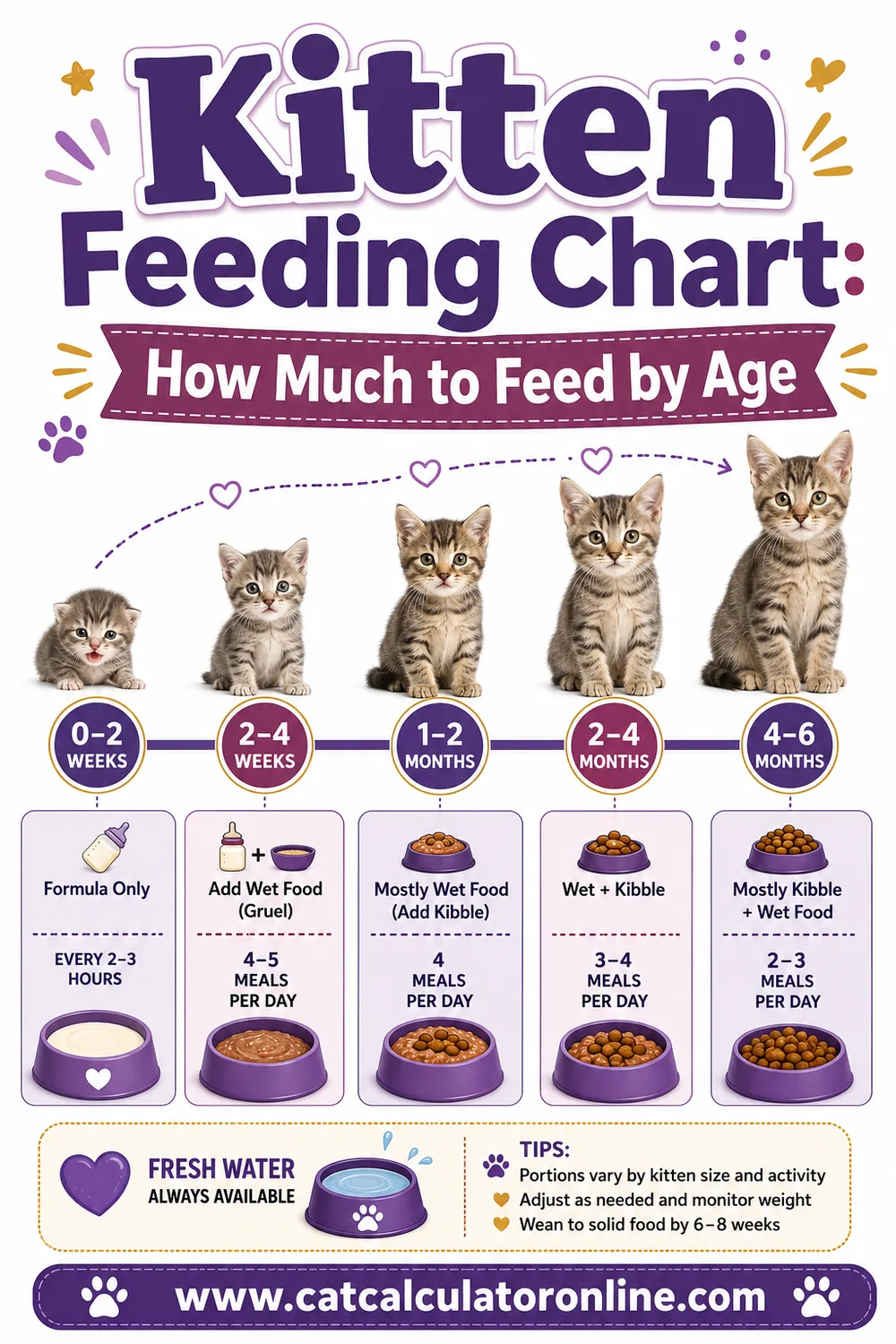
| Age | Food consistency | Meals per day | Milk source | Notes |
|---|---|---|---|---|
| 0–3.5 weeks | None | — | Queen or replacer every 2–3 h | Milk only |
| 3.5–4 weeks | Soupy gruel | 4–5 offers | Nursing freely | Most food ends up worn |
| 4–5 weeks | Thick gruel | 4–5 | Nursing, reducing | Real calories start counting |
| 5–6 weeks | Mashed wet food | 4 | Nursing less | Introduce a water bowl |
| 6–7 weeks | Wet food, barely moistened | 4 | Occasional nursing | Soaked kibble alongside |
| 7–8 weeks | Full kitten food | 4 | None | Weaning complete |
| 8–16 weeks | Kitten food, wet or dry | 3–4 | None | Growth phase, feed generously |
| 4–12 months | Kitten food | 2–3 | None | Switch to adult at 12 months |
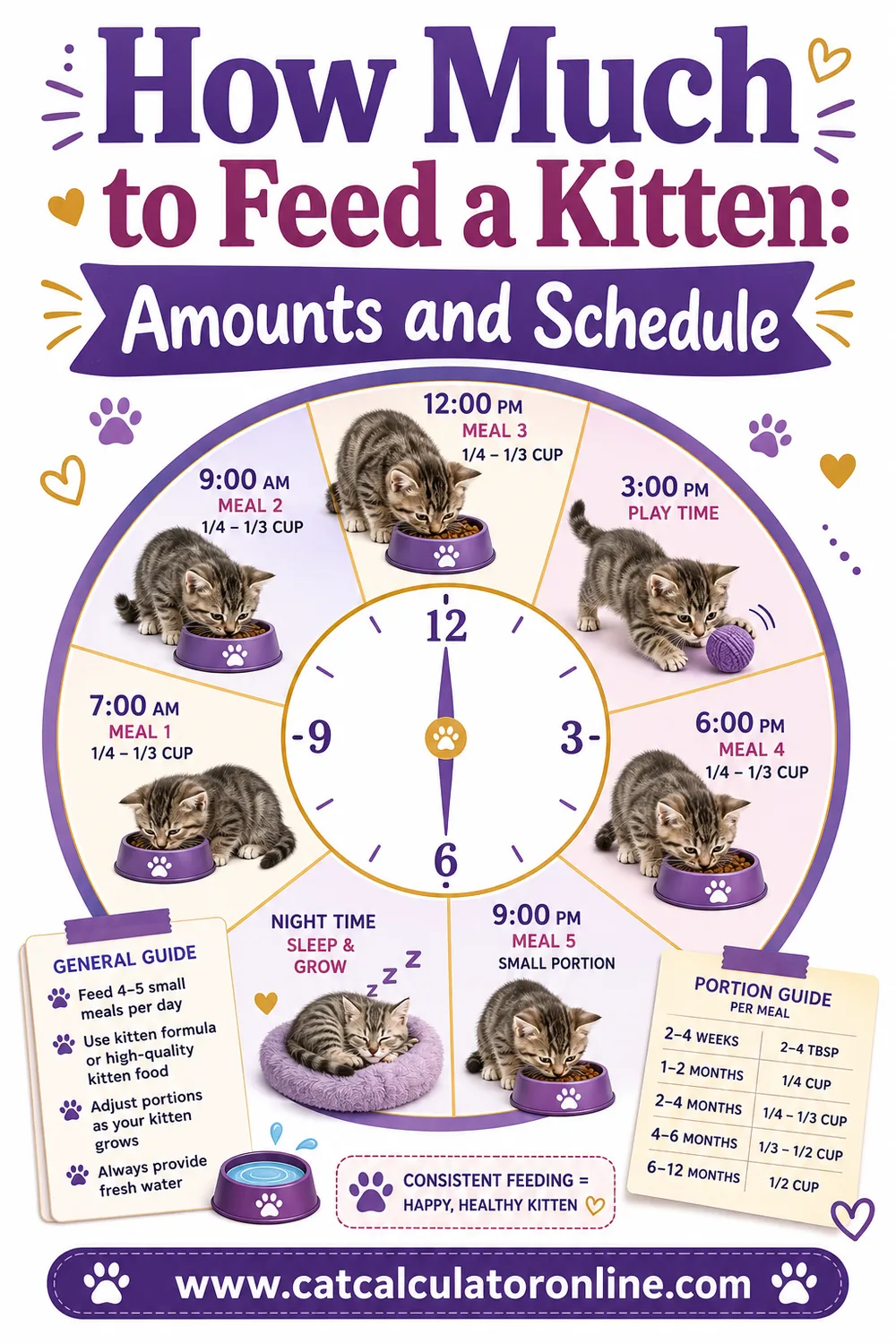
Kittens under four months should not be rationed tightly. They have small stomachs, high energy needs and very little reserve, so frequent meals matter more than exact grams. Age-specific amounts are in kitten feeding chart.
Water goes down as soon as solids start. A weaning kitten stops getting its fluid from milk and needs a shallow, stable bowl within reach.
Why Earlier Does Not Work
Worth understanding rather than just obeying.
The back teeth are not there yet. Premolars erupt from about four to six weeks, so a four-week kitten has nothing to grind with — the full eruption sequence is in when do kittens lose their baby teeth.
Lapping is a skill that develops around three to four weeks. Younger kittens push their faces into liquid, inhale some and get very little down.
Digestive enzymes are set up for milk. Lactase activity is high in the newborn and the enzymes for handling solid food increase over the weaning period, which is why the transition is gradual rather than sudden.
Aspiration is a real risk. A kitten too young to lap can inhale gruel, and aspiration pneumonia in a three-week-old is frequently fatal.
And there is no benefit. Queen's milk is a better food than anything you can offer at that age, and early weaning is associated with more behavioral problems later, not fewer.
The exception is an orphan with no milk source at all, and even then the answer is kitten milk replacer rather than early solids.
Why Later Does Not Work Either
The other failure mode, and less discussed.
A kitten still on milk alone at six weeks is falling behind on calories. Queen's milk production peaks around three to four weeks and declines afterwards, while the kittens' requirements keep climbing.
The queen suffers. Kittens with sharp teeth nursing at seven or eight weeks cause real discomfort and drain a queen who is often already thin.
Food acceptance narrows. Kittens exposed to a variety of textures and flavors during weaning are markedly less fussy as adults, and the window for that is largely between four and eight weeks.
Litter tray habits lag. Solid food and tray use develop together, and a kitten still on milk is not producing what makes the tray meaningful.
Rehoming gets delayed. A kitten cannot go to a new home until it is reliably eating on its own, which is one of the reasons eight weeks is the floor discussed in when can kittens leave their mom.
If a kitten is not eating solids by five to six weeks, that is a reason to check it over rather than to keep waiting — and a vet call if it is also not gaining weight.
The Mess Is Part of It
Genuinely, and worth setting expectations.
Kittens walk into the dish. They stand in it, sit in it, and wear the gruel. This is how they discover the food is food, and it is not a sign you have done anything wrong.
Use a very shallow, wide dish — a saucer or a jam jar lid — so a four-week kitten can reach the middle without climbing in.
Feed on a wipeable surface with newspaper or a towel underneath, and expect to clean afterwards.
Clean the kittens after each meal with a warm damp cloth, or let the queen do it, which she generally will. Dried food in the coat causes matting and skin soreness.
Take uneaten food away after 20 to 30 minutes. Moist food spoils quickly at room temperature, and bacterial upset in a five-week kitten is serious.
Fresh dish, fresh batch, every meal. Do not top up or reuse.
Common Problems and What They Mean
The handful of things that actually come up.
Not interested at all. Very common at the first two or three attempts. Put a dab on your finger or on the kitten's nose so it licks it off. Warm the food more. Try again at the next meal rather than pushing.
Diarrhea after starting solids. Usually the transition is going too fast, or the food is too rich, or portions are too large. Thin the gruel back and slow down. Diarrhea lasting beyond a day in a kitten this small needs a vet, because dehydration arrives quickly.
Constipation. Often too little liquid as the gruel thickens. Add more water and make sure a drinking bowl is available.
One kitten falling behind. The confident ones dominate the dish. Feed the smallest separately for a few meals and weigh daily.
Vomiting straight after eating. Usually gorging. Offer smaller amounts more often. Repeated vomiting is a vet matter.
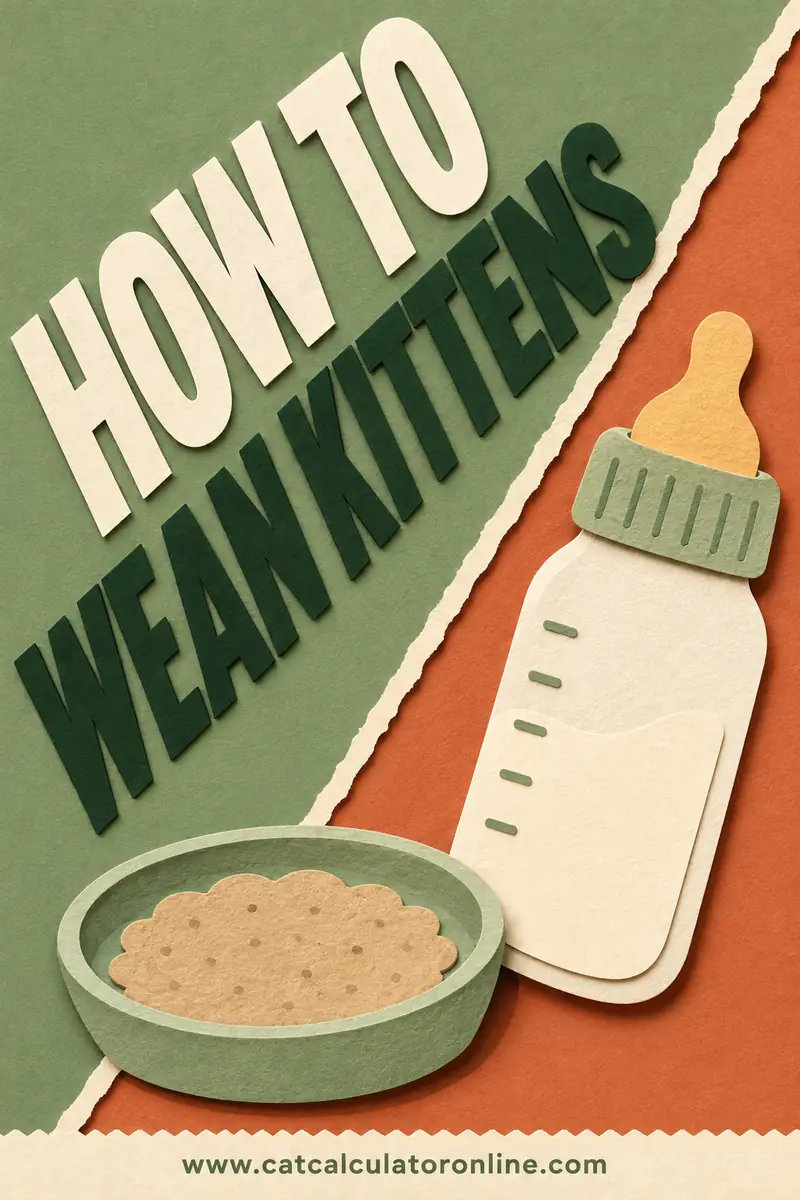
Still nursing at eight weeks. Common and not urgent, but the practical steps to finish the job are in how to wean kittens.
After Weaning: The Rest of the First Year
Because the question does not end at eight weeks.
Four meals a day until about four months, then three, then two from around six months. Small stomachs and high demand make frequency matter.
Kitten food for the full twelve months. Large breeds such as Maine Coons may stay on it to eighteen months on veterinary advice, since they keep growing.
Do not restrict food in a growing kitten. Kittens under six months are not usually at risk of obesity from feeding to appetite, and underfeeding at this stage has lasting consequences.
Fresh water always available, more important still if the kitten is on dry food.
Introduce variety early — different textures, wet and dry, a few different proteins — while the kitten is between about six and sixteen weeks and most open to novelty.
Any food change should take about a week, mixing increasing amounts of the new food into the old, including the eventual switch to adult food at twelve months.
Frequently Asked Questions
At what age can kittens start eating solid food?
From about three and a half to four weeks, offered as kitten food moistened into a warm gruel rather than as dry kibble. Nursing continues alongside, and kittens are normally fully on solid food by seven to eight weeks.
What solid food should I give a four-week-old kitten?
A complete wet kitten food blended with warm water or kitten milk replacer to a soupy consistency, warmed to about body temperature. Soaked and mashed dry kitten food works equally well. Adult cat food does not meet a kitten's needs.
Can kittens eat dry food at 4 weeks?
Not unsoaked. Premolars do not erupt until four to six weeks, so a four-week kitten cannot chew kibble. Soak it in warm water for 15 to 20 minutes and mash it, and offer dry kibble properly from around eight to twelve weeks.
Can I give a kitten cow's milk when weaning?
No. Cow's milk is unsuitable at any age: it commonly causes diarrhea and it does not contain what a kitten needs to grow. Use kitten milk replacer for the liquid in the gruel, then plain warm water as it thickens.
My kitten walks in its food — is that normal?
Completely. Kittens stand in the dish, wear the food and lick it off themselves, and that is part of how they work out that it is food. Use a very shallow dish and wipe them down with a warm damp cloth afterwards.
What if a kitten will not eat solid food?
Warm the food, thin it, and offer it on your finger or dab it on the kitten's nose. Refusal at the first few attempts is normal. If a kitten is still not eating solids by five to six weeks, or is not gaining weight, have it checked.
The workable timeline is simple: milk only until about three and a half weeks, warm gruel from three and a half to four, progressively thicker food through five and six, and a fully weaned kitten on solid kitten food by seven to eight weeks. Use a complete kitten food rather than adult food, never cow's milk, put a water bowl down as soon as solids start, and accept that the first two weeks is messy by design. Feed four meals a day through the early months and stay on kitten food for the full year. Work out the daily portion with the free cat food calculator.