3 Cat Years in Human Years
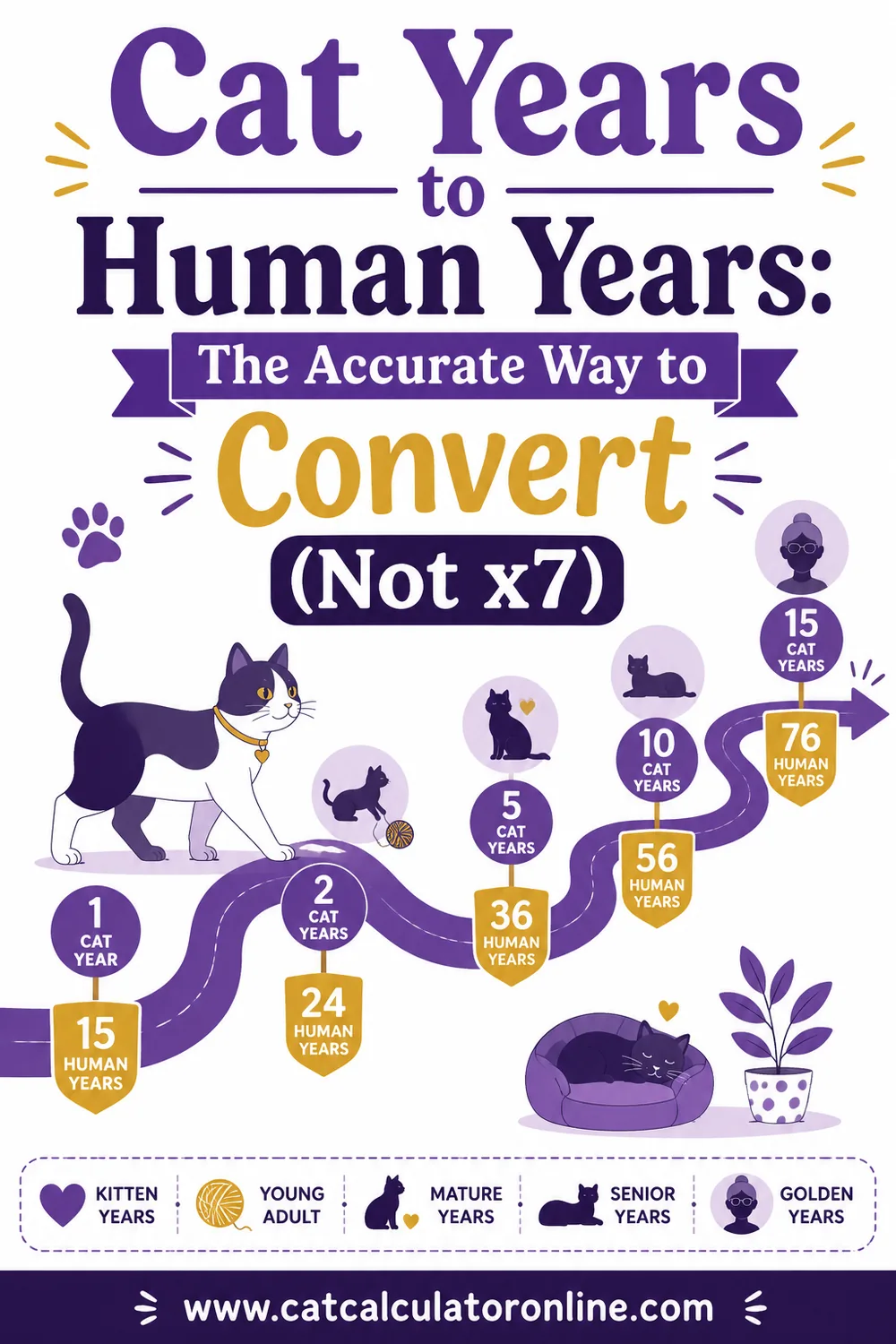
A three-year-old cat is about 28 in human years. This is the first birthday where the simple pattern applies — 24 at age two, then four more for every year after — and it's the point at which a cat settles into what is usually the healthiest stretch of its life. It's also, less happily, the age by which the majority of cats already show signs of dental disease, which makes three a quietly important birthday. This page covers the math, what a cat in its prime is actually like, and the two health habits worth locking in now. For your own cat, the cat age calculator handles any age.
How Do You Get 28?
The calculation is complete by now, and from here it never changes again.
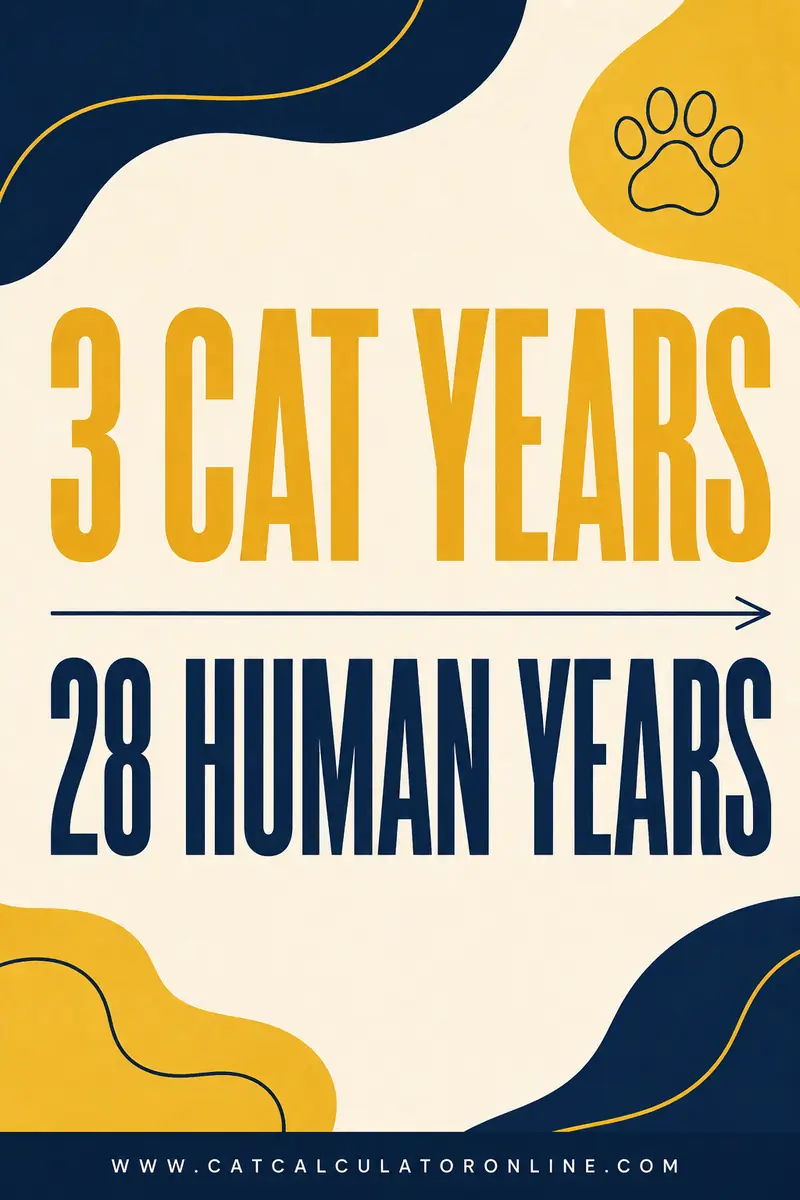
The method: 15 for the first year, 9 for the second, then 4 for every year after.
- Year 1 → 15
- Year 2 → 15 + 9 = 24
- Year 3 → 24 + 4 = 28
From three onwards, the shortcut is trivial. Take 24, add four for every year past two. A five-year-old is 24 + 12 = 36. A ten-year-old is 24 + 32 = 56. You can do any age in your head.
| Cat's age | Human years | Cat's age | Human years |
|---|---|---|---|
| 1 | 15 | 10 | 56 |
| 2 | 24 | 12 | 64 |
| 3 | 28 | 14 | 72 |
| 4 | 32 | 15 | 76 |
| 5 | 36 | 16 | 80 |
| 6 | 40 | 18 | 88 |
| 7 | 44 | 20 | 96 |
Why the flat four? Because after the second birthday there are no further developmental milestones to account for. A cat is simply an adult accumulating years, and the increment reflects the ratio of feline to human adult lifespan rather than any specific biological event. The reasoning is unpacked in how a cat age calculator works, and the year before in 2 cat years in human years.
What Is a Three-Year-Old Cat Like?
At its physical best, and behaviourally about as easy as cats get.
Condition is at its peak. Muscle tone is good, the coat is glossy and well maintained, joints move freely, and energy is high but controlled. A three-year-old cat that's grooming properly, moving fluidly and holding a steady weight is showing you what its healthy baseline looks like — and that's worth photographing and noting, because it's the reference point against which you'll judge changes at ten and fourteen.
Behavior is settled but not sedate. The adolescent unpredictability has gone. Play is purposeful — stalking, pouncing, chasing — rather than the frantic bouncing of a one-year-old. Most cats at three have a clear daily routine, favorite sleeping spots, and a predictable relationship with the household.
Sleep is around 12 to 16 hours a day, which is normal and not a sign of laziness. Cats are crepuscular, so the waking hours cluster around dawn and dusk.
Social patterns are fixed. A cat that greets visitors at three will greet visitors at ten. One that hides will keep hiding. This isn't a failure of socialization you can now fix — it's simply who the cat is, and the practical response is to arrange the household around it rather than to keep trying to change it.
Large breeds may still be filling out. Maine Coons, Ragdolls, Norwegian Forest Cats and Savannahs often reach true final size somewhere between three and four, so a three-year-old of those breeds can still gain frame and muscle without gaining fat.
Why Does Age Three Matter for Teeth?
Because it's the point at which dental disease becomes the norm rather than the exception, and almost nobody notices.
The scale of it: the majority of cats show signs of periodontal disease by three years old. It's one of the most commonly diagnosed conditions in cats, and it's substantially under-treated because cats are exceptionally good at concealing oral pain. A cat with a painful mouth will usually keep eating, keep purring, and give almost no outward sign until the disease is advanced.
What to look for:
- Bad breath — not "normal cat breath". A genuinely unpleasant smell means bacterial activity
- A red line where the gum meets the tooth
- Yellow or brown deposits, especially on the large back teeth
- Drooling, pawing at the mouth, or chewing on one side
- Reluctance to have the head or mouth touched
What to do at three:
- Look at the gum line twice a week. Lift the lip, check both sides, take thirty seconds. This catches problems months before symptoms appear
- Brush most days with cat-specific toothpaste — never human toothpaste, which contains fluoride and sometimes xylitol
- Ask your vet to assess the mouth at the annual check, and ask specifically rather than assuming it's been done
- Consider VOHC-approved dental treats as a supplement, not a substitute
Why now rather than later: a healthy mouth is far easier to maintain than a diseased one is to fix, and a cat that accepts brushing at three will usually accept it for life. Starting once there's pain is dramatically harder. The full picture is in dental disease in cats.
What Should You Be Doing at This Age?
The three-year-old plan is short, and the point is consistency rather than intervention.
Weigh monthly and write it down. A cat that gains 200 grams a year looks unchanged from one month to the next and is 20% overweight in five years. The scale sees what your eye can't, and fur hides a great deal.
Feel the ribs and check the waist. You should find ribs easily under a thin covering and see a slight tuck behind the ribcage from above. If you have to press to find ribs, the cat is carrying too much.
Play twice a day. Ten minutes each, with a wand toy, ending with a catch so the sequence completes properly. This isn't optional enrichment — it's the main lever you have on weight, behavior and stress in an indoor cat. The detail is in how much playtime does a cat need.
Keep the annual vet check. For a healthy three-year-old it's brief, and its value is in establishing the pattern of normal results.
Watch the litter box. Volume, frequency and any straining. Urinary problems are common in cats and the box is where you notice them first.
Check water intake. Cats are poor drinkers by evolutionary design, and chronic mild dehydration contributes to the urinary and kidney problems that dominate later life. Wet food, a water fountain, and bowls away from the food all help.
Don't over-manage. A healthy young adult cat needs good food in the right quantity, water, a clean box, play, and to be left alone the rest of the time. Three is not an age that requires supplements, special diets or intervention in the absence of a specific problem — and a great deal of money gets spent on products that solve nothing a correct portion and daily play wouldn't.
Is a Cat's Age Really Comparable to a Human's?
Worth pausing on, because the conversion is more useful as a framing device than as a fact.
What the number is doing. It maps a cat's life stage onto a human timeline so you can reason about it intuitively. "Twenty-eight" tells you a three-year-old cat is a healthy young adult with most of its life ahead — which is genuinely informative in a way "three" isn't, because most people have no instinct for what three means in cat terms.
What it isn't doing. It isn't claiming that a three-year-old cat's cells, organs or metabolism resemble a 28-year-old human's. Cats and humans age along different biological paths, at different rates, with different failure modes. A cat's kidneys, for instance, deteriorate on a schedule that has no human parallel — which is why kidney disease is the defining condition of old cats and not of old people.
Where the analogy holds up well. Broad life stages — infancy, adolescence, young adulthood, middle age, old age — line up sensibly, and the practical implications follow. Knowing your cat has just entered middle age genuinely should change what you do.
Where it breaks down. Individual variation is enormous. Two three-year-old cats can be in visibly different condition depending on weight, dental health, diet and whether they live indoors. The conversion has no way to capture that, and the cat in front of you always matters more than the number.
A more useful mental model than "my cat is 28" is "my cat is a healthy young adult in the middle of its best years, and what I do now determines how the later ones go." Same information, better decisions.
What Comes Next?
Three more years of young adulthood, then the first real transition.
| Age | Human years | What changes |
|---|---|---|
| 3 | 28 | Physical peak; dental habits matter |
| 4 | 32 | Steady; weight vigilance |
| 5 | 36 | Steady; last of the easy years |
| 6 | 40 | Approaching mature adult |
| 7 | 44 | Mature adult begins — screening starts |
| 10 | 56 | Senior — twice-yearly checks |
Between three and six, very little changes structurally. This is the plateau, and it's the reason so many owners are surprised when things shift at seven or ten — nothing had changed for years, and then it did.
What makes the difference across that plateau is almost entirely weight, dental care and activity. Three cats of identical genetics at three years old can be in visibly different condition at ten purely on the strength of those three factors.
The next age up is covered in 4 cat years in human years, and the complete table across every age is in cat years to human years.
Frequently Asked Questions
How many human years is 3 cat years?
About 28. The calculation is 15 for the first year, 9 for the second and 4 for each year after — so 15 + 9 + 4 = 28 by the third birthday.
Is a 3-year-old cat middle-aged?
No. Under AAHA feline life-stage guidelines a cat is a young adult from one to six years, with the mature adult stage starting at seven. A three-year-old is in the early part of its healthiest stretch.
Why is age three important for a cat's teeth?
Because the majority of cats show signs of dental disease by three, and cats conceal oral pain extremely well. Establishing brushing and a twice-weekly gum-line check while the mouth is still healthy is far easier than starting once there's discomfort.
How much should a 3-year-old cat sleep?
Around 12 to 16 hours a day is normal. Cats are crepuscular, so waking activity clusters around dawn and dusk. Sleeping considerably more than usual, or seeming lethargic when awake, is worth a vet conversation.
Do cats still need play at three years old?
Yes, daily. A settled cat is not a sedentary one, and two ten-minute interactive sessions a day are the single most effective lever on weight, behavior and stress in an indoor cat.
Are large breeds still growing at three?
Often, yes. Maine Coons, Ragdolls, Norwegian Forest Cats and Savannahs frequently reach final size between three and four years old, so continued filling out at this age is normal for those breeds.
Three cat years is about 28 human years, and it's where the math becomes simple: 24 at two, plus four a year thereafter. It's also the birthday to take teeth seriously, because most cats already have the beginnings of dental disease and none of them will tell you. Work out any age instantly with the cat age calculator.