When Do Cats Stop Growing? A Complete Age-by-Age Guide
Most cats reach close to their full adult size by 10 to 12 months and finish filling out — adding muscle and a little chest and frame — by around 18 months. The big exception is large breeds like Maine Coons and Ragdolls, which keep growing slowly until they're 3 to 4 years old. So if your one-year-old cat still looks a bit lanky, that's usually normal.
If what you really want to know is how big your kitten will get, our free kitten weight calculator uses her current age and weight to predict her adult size in seconds. This guide covers the rest: what happens at each stage, why some cats grow for years, and how to tell when your cat is genuinely done.

📏 Where is your cat in her growth?
Tap your cat’s age to see what stage she’s in:
Tap an age above to see the growth stage.
How Fast Do Kittens Actually Grow?
Faster than almost anything else in your house. A newborn kitten weighs around 3.5 ounces — about the same as a deck of cards — and in a healthy litter she'll roughly double that in her first week or two.
From there the pace barely lets up. Through the first eight weeks, steady daily gains are the single best sign that a kitten is thriving, which is why breeders and fosterers weigh kittens every day. By two months, most kittens have quadrupled their birth weight or better.
Then comes the sprint. Between roughly 2 and 6 months, kittens go through the fastest-gaining stretch of their entire lives. This is the stage where you swear she's bigger every time you come home from work — because she genuinely is. Legs lengthen, the tail catches up, baby teeth fall out and adult teeth come in.
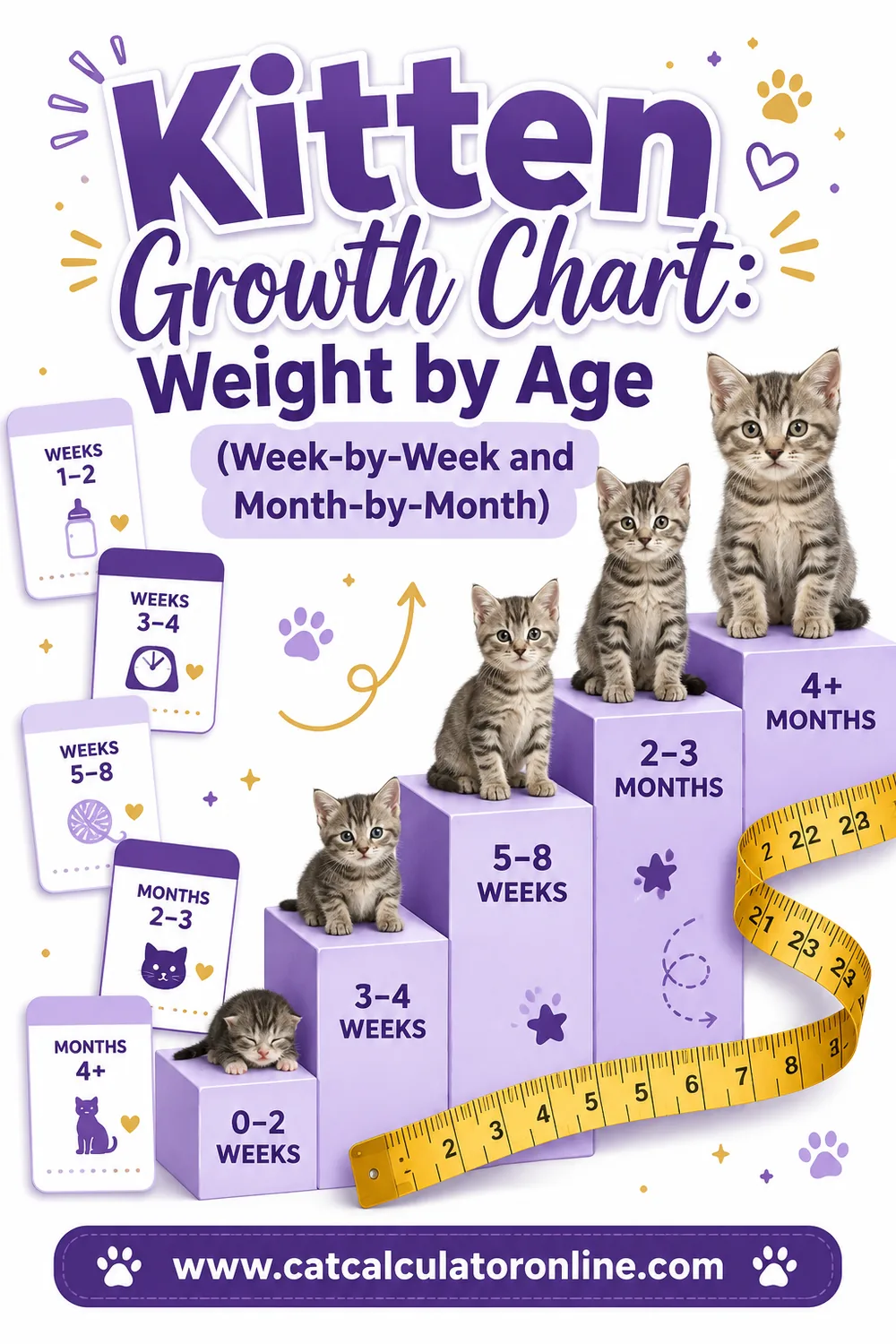
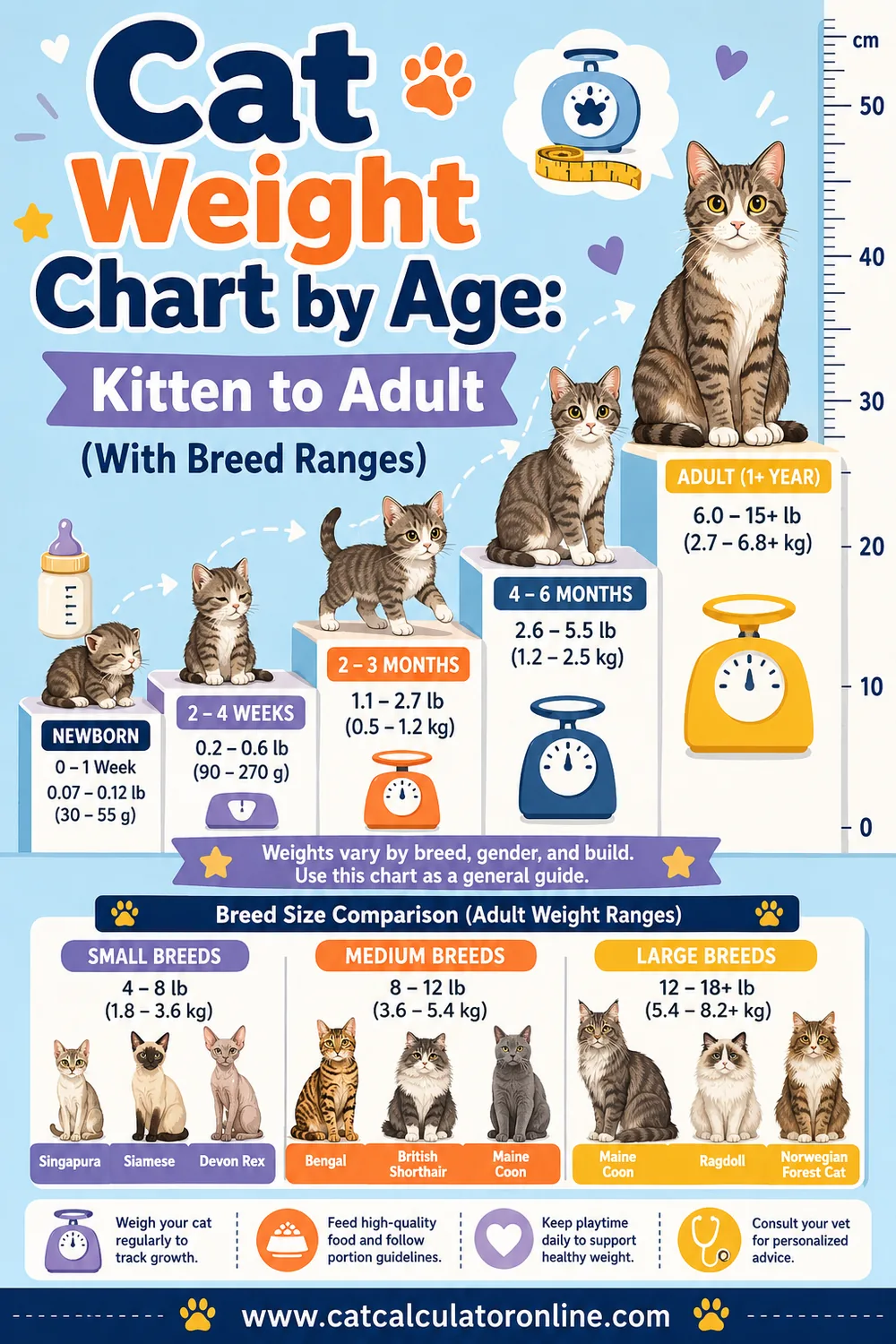
After six months, the curve bends. Growth continues, but it's slower and less dramatic — more like a teenager gradually turning into an adult than a puppy-pile kitten inflating by the week. Our kitten growth chart shows the typical weight ranges month by month if you want to see where your kitten sits.
What Happens at Each Growth Stage?
Here's the whole arc in one table, from birth to fully grown:
| Age | What's happening |
|---|---|
| Birth – 8 weeks | Rapid early growth. Eyes open, walking, weaning begins around 4 weeks. Weight should climb steadily every day. |
| 2 – 6 months | The fastest gains of her life. Adult teeth come in, limbs lengthen, she may reach roughly half her adult weight around 4 months. |
| 6 – 12 months | Growth slows noticeably. Frame is mostly set; she's reaching near-adult height and length. Sexual maturity arrives before physical maturity. |
| 12 – 18 months | Filling out. Muscle, chest and a broader face develop even though she isn't getting taller. Most cats finish here. |
| 18 months – 4 years | Large breeds only. Maine Coons, Ragdolls, Norwegian Forest Cats and similar keep slowly adding size and substance until age 3–4. |
Two things are worth pulling out of that table. First, sexual maturity comes long before physical maturity — many cats can reproduce at 5–6 months, when they're still very much kittens themselves. Second, the 12–18 month "filling out" phase is real growth, not weight gain: an athletic one-year-old and the same cat at two can look meaningfully different through the chest and face, especially in males.
Why Do Maine Coons and Ragdolls Keep Growing for Years?
Size, mostly. The bigger the finished product, the longer it takes to build.
A typical domestic shorthair finishes at 8–12 pounds and can wrap up growth inside 18 months. A male Maine Coon may end up 18–25 pounds — roughly double the mass — and his body simply takes longer to get there. Breeders of the big breeds routinely describe their cats as maturing at three, sometimes four years old, and it's not an exaggeration: the skeleton finishes first, then muscle and that famous broad chest keep developing.
The breeds known for extended growth include:
- Maine Coon — the classic slow-maturing giant; many aren't fully developed until 3–4 years.
- Ragdoll — large, heavy-boned, and typically not finished until around 4.
- Norwegian Forest Cat — similar timeline to the Maine Coon.
- Siberian — often quoted at up to 5 years to reach full maturity.
- British Shorthair — not a giant, but a slow developer; often 3 years to full breadth.
If you have a mixed-breed kitten with unusually big paws and a long body, she may follow a slower curve too. Big paws aren't a guarantee of a big cat — but a kitten tracking well above the typical line on a cat weight chart by age usually keeps tracking above it.
How Do Growth Plates Work?
Growth plates are the reason growth stops rather than just slowing forever, so they're worth two minutes of your time.
Every long bone in a kitten's body — legs, spine, tail — has soft cartilage zones near the ends called growth plates. New bone forms at these plates, which is literally how the bone gets longer. While the plates are open, the cat grows. As she matures, hormones trigger the plates to harden into solid bone, one by one, in a fairly predictable order.
Once a growth plate closes, that bone is finished. Forever. No food, supplement, or wishful thinking reopens it.
The practical takeaways:
- Closure is progressive, not overnight. Different bones close at different times across months, which is why growth tapers off gradually rather than stopping on a birthday.
- Open plates are softer than bone. That's one reason young cats' injuries are treated seriously — a fracture through a growth plate can affect how the bone finishes.
- Big breeds' plates stay open longer. That's the mechanical explanation for the Maine Coon's multi-year timeline.
Does Neutering Stunt a Cat's Growth?
No — and this myth deserves a clear debunking, because it sometimes makes owners hesitate over a genuinely important decision.
Neutering doesn't stunt growth. If anything, the effect runs slightly the other way: sex hormones are part of the signal that tells growth plates to close, so cats neutered before puberty tend to have their growth plates close a little later. The measurable result is that early-neutered cats can end up marginally longer-limbed than they would have otherwise. In practice the difference is small enough that you'd struggle to spot it without calipers.
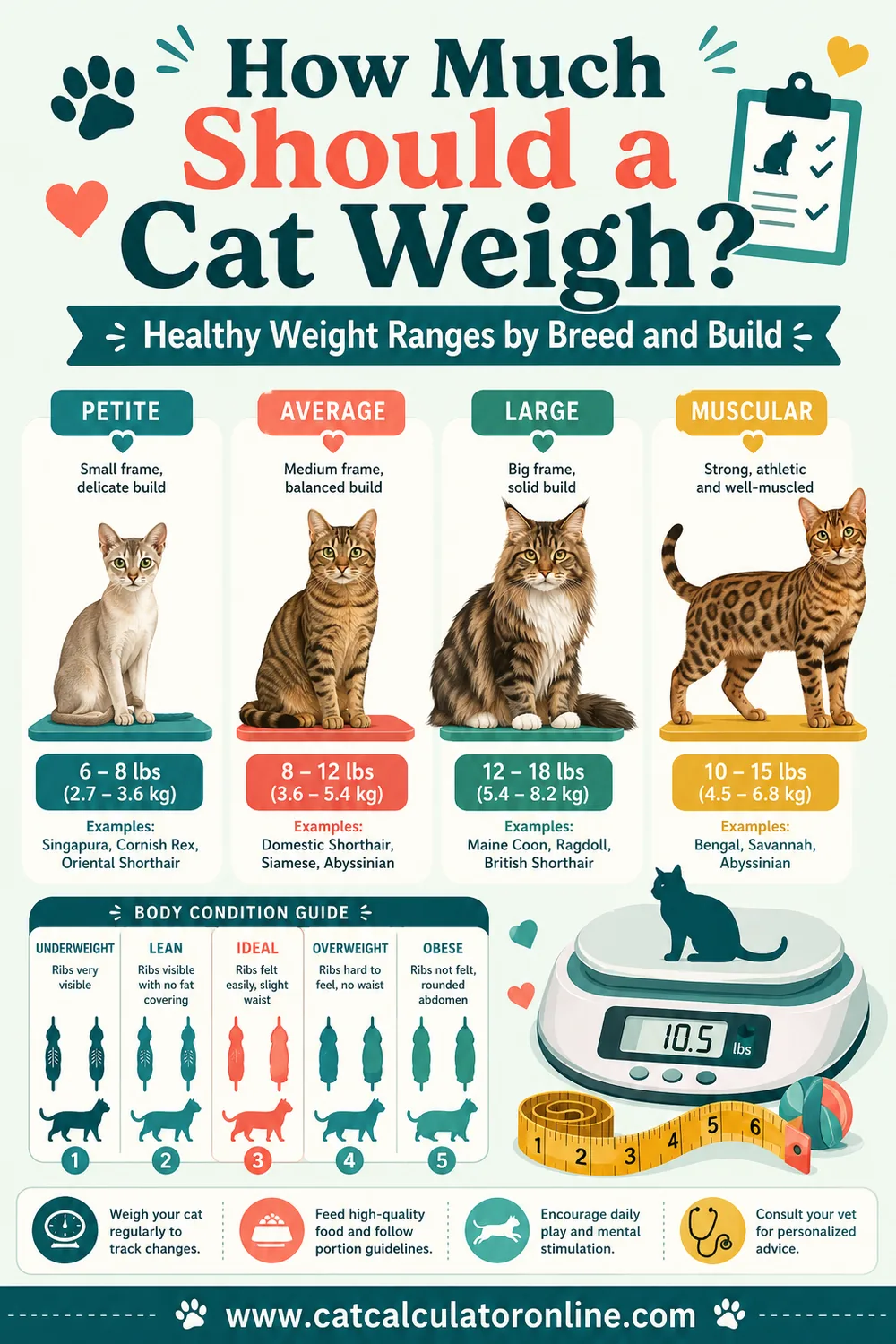
What neutering does change is metabolism. A neutered cat's energy needs drop, and if the food bowl doesn't adjust, weight creeps on. So if your neutered cat is "growing" after 18 months, it's almost certainly sideways rather than upward — check her against how much a cat should weigh rather than assuming it's late development.
Talk to your vet about the right timing for your kitten. Common practice is around 4–6 months, and your vet will factor in breed, size, and health. Growth is not a reason to delay.
How Big Will My Cat Get?
The honest answer: it depends on genetics more than anything you control. But there are useful ways to estimate.
The typical range. Most adult domestic cats land between 8 and 12 pounds, with females generally lighter than males. Small breeds like the Singapura can be healthy at 5–6 pounds; the giants run 15–25.
The 4-month rule of thumb. A frequently used breeder shortcut says a kitten's weight at around 16 weeks, doubled, approximates her adult weight. It's rough — it undershoots for large breeds and can wobble for early-neutered males — but it puts you in the right neighborhood.
Look at the parents. If you know the size of mum and dad, you know a lot. Toms contribute plenty of size genetics, which is why a modest-looking queen can produce surprisingly large sons.
Paws and tail. Kittens grow into their extremities. Noticeably oversized paws and a long tail at four months often signal there's a bigger frame coming.
The easiest option is to skip the mental arithmetic: enter her age and current weight into the free kitten weight calculator and it'll estimate her adult size for you, then keep checking back as she grows.
How Can You Tell When Your Cat Has Finished Growing?
There's no ping when the last growth plate closes, but a few signs tell you the process is over:
- Her weight has plateaued. Weigh her monthly (step on a scale holding her, then without her, and subtract). Three months of stable weight in a young adult on consistent food usually means growth is done.
- She's stopped getting longer or taller. Frame growth is easier to see against a fixed reference — a favorite perch, a doorway she stretches against.
- Her face has matured. Kittens have rounded, soft features; adults, especially males, develop a broader face and (in intact toms) heavier jowls.
- She's aged out of the window. A normal-sized cat past 18 months, or a large breed past 4 years, is done growing by definition.
One caution: a sudden plateau in a kitten under 8–10 months isn't maturity, it's a flag. Kittens should gain steadily until the curve flattens naturally. A young kitten whose weight stalls or drops needs a vet visit, not a bigger food bowl. This is exactly why tracking weight against a kitten growth chart is worth the 60 seconds a month it takes.
What Should You Feed a Cat That's Still Growing?
Growth runs on protein and calories, and kitten food exists because growing bodies need more of both — plus specific nutrients like DHA for brain and eye development — than adult maintenance food provides.
The simple rules:
- Kitten food until roughly 12 months. Large breeds benefit from kitten or "all life stages" food longer — often to 18 months or more — because they're still building. Your vet can tailor the switch date.
- Don't ration a young kitten. Under about six months, kittens are burning fuel at a ferocious rate, and most self-regulate reasonably well. Our kitten feeding chart breaks down amounts and meal frequency by age.
- Do watch portions after neutering and after 12 months. The metabolic slowdown is real, and the transition from "growing machine" to "adult who loves snacks" is where weight problems start.
- Never supplement to force growth. You can't make a cat bigger than her genes intend — you can only make her rounder. Extra calcium and additives can actively cause harm in growing animals.
If you're unsure whether your cat's current weight is on track for her age, compare her against the ranges in how much should a cat weigh.
FAQ
At what age is a cat fully grown?
Most cats reach near-adult size by 10–12 months and finish filling out by about 18 months. Large breeds — Maine Coons, Ragdolls, Norwegian Forest Cats, Siberians — continue growing slowly until 3–4 years old.
Do male cats grow longer than females?
They grow bigger, and often slightly longer in duration too. Males typically end up 2–4 pounds heavier than females of the same breed, and the extra muscle and broader face keep developing through the filling-out phase into the second year.
Can you tell how big a kitten will get?
You can estimate. Doubling a kitten's weight at about 16 weeks gives a rough adult figure, parents' sizes are a strong clue, and big paws suggest a big frame. For a quicker answer, a kitten weight calculator predicts adult size from age and current weight.
Does neutering affect how big a cat gets?
It doesn't stunt growth. Early neutering slightly delays growth-plate closure, which can leave a cat marginally longer-limbed — a minor effect. The bigger post-neuter risk is weight gain from a slower metabolism, so watch portions.
Is my 1-year-old cat still growing?
Probably a little. At 12 months most cats are at or near full size but still filling out with muscle through 18 months. If she's a large breed, she may have years of slow growth left. Weight gain after 18 months in a normal-sized breed is usually fat, not frame.
Why is my cat small for her age?
Genetics is the most common reason — small parents make small cats. But a kitten who has stopped gaining, or an adult who is underweight rather than petite, should see a vet. Parasites, poor early nutrition, and illness can all suppress growth.
The Bottom Line
Cats do most of their growing in a hurry — the sprint from 2 to 6 months — then coast to near-adult size by their first birthday and finish filling out around 18 months. Maine Coons, Ragdolls and the other big breeds play a longer game, maturing slowly until age 3 or 4. Neutering won't stunt any of it, and once the growth plates close, her size is settled for life.
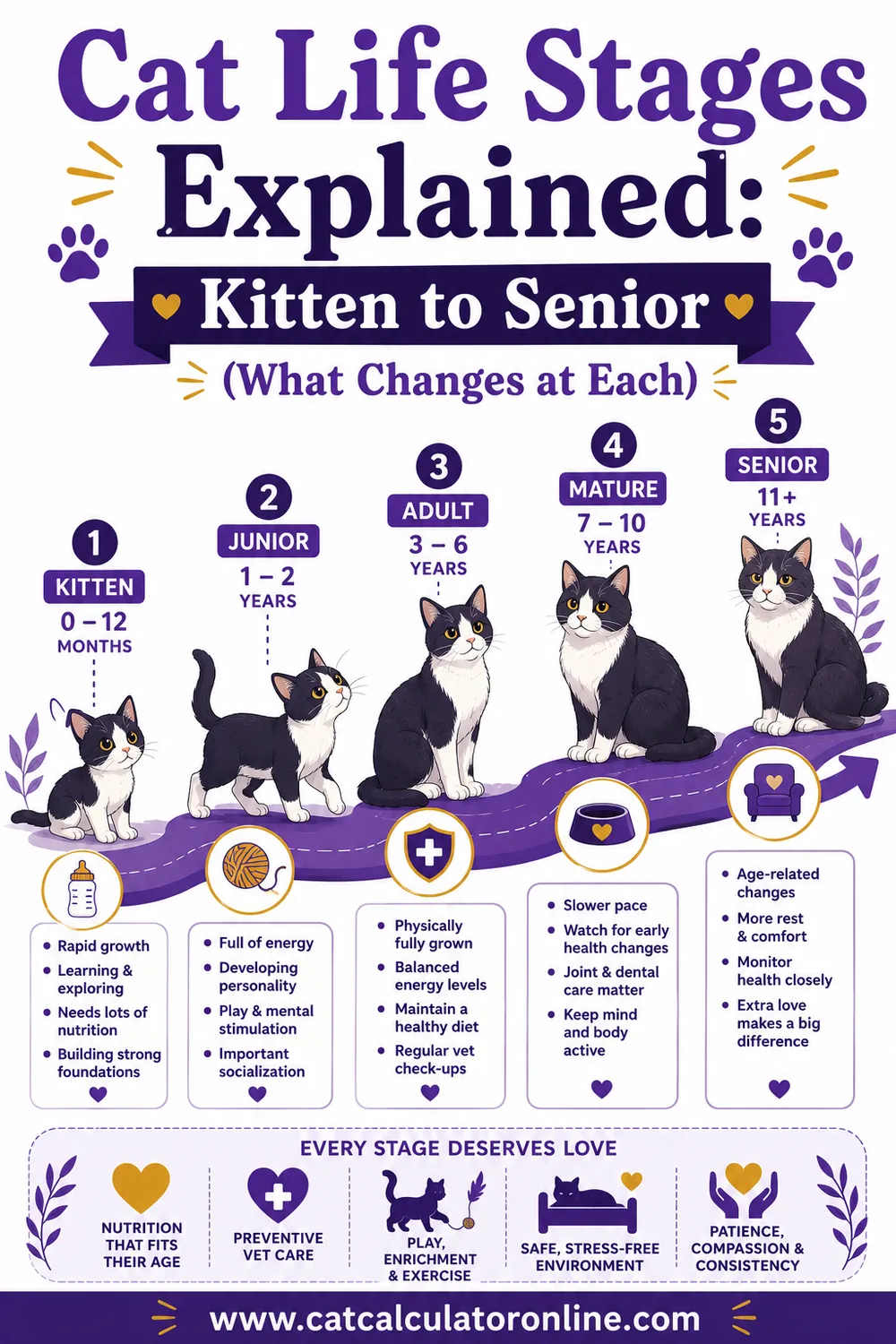
Want to know where your kitten will end up? Enter her age and weight into the free kitten weight calculator for an adult-size prediction, check her progress against the kitten growth chart, and see what comes after growing up in cat life stages explained.