How Much Does a Maine Coon Cost?
A pet-quality Maine Coon kitten from a registered US breeder costs $1,200 to $3,000, and show or breeding lines run $2,500 to $4,000 or more. But the purchase price is the smaller half of the story. A Maine Coon is a big cat that keeps growing until it is three to five years old, so it eats more, weighs more on every dose-by-weight treatment, and is screened and insured as a breed with known heart and hip risks. Budget roughly $900 to $1,800 a year to keep one, on top of what you pay for the kitten. Build the yearly figure around your own choices in the cat cost calculator.
What Does a Maine Coon Kitten Cost?
Here is the market as it actually looks in the US, with the reason behind each band.
| Source | Typical price | What you get |
|---|---|---|
| Registered breeder, pet quality | $1,200–$3,000 | Papers, vaccinations, chip, neutering contract |
| Registered breeder, show quality | $2,500–$4,000+ | Same cat, closer to the written standard |
| Breeding rights included | $3,000–$6,000+ | Rarely sold, and only to established breeders |
| Unregistered "Maine Coon" kitten | $400–$900 | No papers, no verified parentage, usually no testing |
| Breed rescue | $150–$500 | Adult cat, neutered, vaccinated, known personality |
| General shelter, Maine Coon mix | $25–$250 | Full-sized fluffy cat, no pedigree |
| Retired breeding cat | $0–$500 | Adult, neutered on rehoming, often free to a good home |
Region moves these more than most breeds. Coastal cities sit at the top of every band, the Midwest at the bottom. Color and pattern move them too — silver, smoke and some solid colors attract premiums, though color has no bearing on health or temperament.
The unregistered row is the one to think about hardest. A long-haired tabby with tufty ears is not necessarily a Maine Coon, and without papers there is no way to know. If the pedigree matters to you, the papers are the pedigree.
Why Is There Such a Wide Price Range?
Two Maine Coon kittens can look identical and be priced $1,500 apart. Four things explain nearly all of that gap.
Pet versus show quality. The split is cosmetic. Ear set slightly wide, a coat a shade off, a tail a touch short, a white spot in the wrong place. None of it affects health, size or how the cat behaves at home. A pet-quality kitten is usually 40–60% cheaper and is exactly the same cat to live with.
How much screening the parents have had. The biggest honest cost in a well-bred litter, and the one you cannot see in a photo. Details in the next section.
Bloodlines and reputation. Cats from lines with show titles or a long healthy track record command more, and their breeders still have waiting lists.
What is included. Two vaccinations rather than one, a microchip, four weeks of starter insurance, registration papers, a health guarantee and a return-to-breeder clause all cost the breeder money.
The same forces set prices across every pedigree — the wider comparison is in kitten prices by breed, and the breeds that sit above the Maine Coon are in the most expensive cat breeds.
What Health Tests Should the Parents Have Had?
This is the part worth being firm about, because Maine Coons have specific, well-documented inherited risks and the tests for them are established.
HCM screening — both a DNA test and a scan. Hypertrophic cardiomyopathy thickens the heart muscle and is the most common heart disease in cats. Maine Coons carry a known gene variant (MyBPC3 A31P) that can be DNA tested once, for around $50–$100. But — and this matters — a clear DNA test does not mean a clear heart. Cats without the variant still develop HCM. So a responsible breeder also has both parents scanned by echocardiogram, ideally by a veterinary cardiologist, at $300–$600 per cat, and repeats it annually or every other year while the cat is breeding. Ask for the date of the most recent scan, not just the fact of one.
Hip dysplasia X-rays. Maine Coons are among the few cat breeds where hip dysplasia is common enough to screen for. Sedated radiographs graded by a scheme such as OFA or PennHIP cost $250–$500 per cat.
Spinal muscular atrophy (SMA). A one-off DNA test. Affected kittens develop weakness in the hind legs from a few months old.
Pyruvate kinase deficiency (PK def). Another one-off DNA test, for an inherited form of anemia.
Ask to see the certificates in the parents' registered names, with dates. "Our lines are healthy" is not a test result. A breeder doing all of this properly is spending $600–$1,500 a year per breeding cat, which is precisely why the cheap Maine Coon is cheap.
Why Does a Maine Coon Take Years to Reach Full Size?
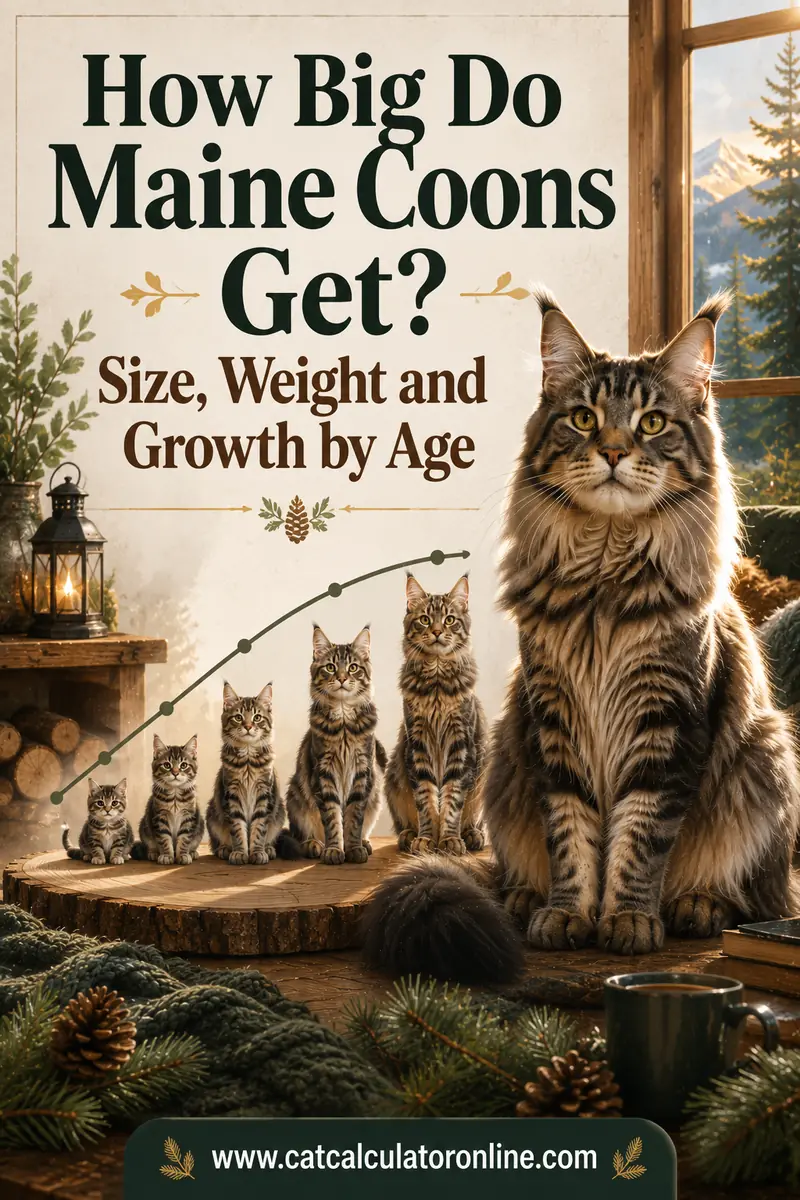
Most cats finish growing at about twelve months. Maine Coons keep filling out until three to five years old, and that changes how you budget for one.
The growth is not steady. The frame — length, leg bone, the rough shape of the cat — is largely laid down in the first year or so. What continues for years afterwards is muscle, chest depth, the width of the head, and the full ruff and britches of coat. A two-year-old Maine Coon often looks like a lanky adolescent and then thickens noticeably over the following two years.
Three practical consequences.
Your food bill keeps rising after the first birthday. A cat still gaining muscle at three is still eating like it. Portion by current body condition rather than by a fixed number set when the cat was one.
Do not panic-feed a slim youngster. A rangy fourteen-month-old Maine Coon is normal, not underweight. Overfeeding a large-framed cat to fill it out faster puts weight on joints that are already carrying more than most cats' joints do, and Maine Coons are a breed where hip problems matter.
Kit for the eventual size, not the current one. Litter boxes, the carrier and the cat tree all need to suit a cat that may end up 15–20 lb (6.8–9.1 kg). Buying twice is the expensive way to learn this. Full size ranges are in how big Maine Coons get.
What Does It Cost to Feed a Maine Coon?
More than an average cat, but less than the size difference suggests, because calorie needs scale with body weight rather than exploding with it.
A neutered adult Maine Coon of 16 lb (7.3 kg) at a healthy weight typically needs roughly 250–350 kcal a day, against about 180–220 kcal for a 10 lb (4.5 kg) mixed-breed cat. That is around a third more food, not double.
In money, expect:
- Dry food only: $20–$40 a month
- Mixed wet and dry: $30–$60 a month
- Wet food only, premium brands: $50–$90 a month
The number that actually decides your bill is calories, not breed, and portions should be set on your cat's current weight and body condition. The cat food calculator will do the arithmetic for the food you are using.
One breed-specific note on feeding: some Maine Coons struggle with narrow, deep bowls because their heads and whiskers are wide. A shallow, wide dish is a fifteen-dollar fix for a cat that keeps dragging food out onto the floor.
Two smaller costs come with the size and catch people out. Litter runs at the top of the normal range — a large cat produces more waste, so budget $15–$30 a month rather than $10–$20, and buy the biggest tray you can find. Storage boxes sold for under-bed use make better Maine Coon trays than most purpose-built ones, which are built for a 10 lb cat. And anything dosed by weight costs more: flea and worming treatments are priced in weight bands, so a 16 lb cat sits in a dearer band than a 9 lb one for the whole of its life. It is only a few dollars a month, but it is a few dollars every month for fifteen years.
How Much Are Vet Care and Insurance for a Maine Coon?
Routine care costs about the same as for any cat. Insurance does not.
Insurance runs $30–$70 a month for accident-and-illness cover on an adult Maine Coon, against roughly $15–$35 for a mixed-breed cat of the same age. Insurers price by breed because claim histories differ, and the Maine Coon's association with heart disease and hip dysplasia puts it in a dearer band. The breed-by-breed pattern is in cat insurance cost by breed.
Two timing points that save real money. Premiums are at their lifetime low in the first year, so insuring a kitten costs far less than insuring the same cat at eight. And any condition already noted in the medical record is permanently excluded, so insuring before the first vet visit rather than after is genuinely worth doing.
Routine care is ordinary: $200–$500 a year for vaccinations, parasite treatment and an annual check. Add a dental clean at some point, typically $300–$900.
The breed-specific risk is the one to hold a buffer for. Managing diagnosed heart disease involves an initial cardiology workup at roughly $500–$900, then medication and repeat scans. It is not inevitable — plenty of Maine Coons never develop it — but it is the scenario the budget should survive.
What Does a Maine Coon Cost Per Year and Over a Lifetime?
Here is the whole picture, using the middle of each range.
| Cost | Year one | Each following year |
|---|---|---|
| Kitten purchase | $1,200–$3,000 | — |
| Neutering | $50–$500 | — |
| Vaccinations and worming | $150–$300 | $80–$200 |
| Setup: carrier, trays, post, tree | $250–$600 | $50–$150 |
| Food | $300–$700 | $300–$700 |
| Litter | $150–$350 | $150–$350 |
| Insurance | $250–$600 | $350–$850 |
| Grooming tools or professional grooming | $30–$300 | $30–$300 |
| Total | $2,400–$6,300 | $960–$2,550 |
Over a typical Maine Coon lifespan of twelve to fifteen years, the running cost alone lands somewhere around $15,000–$30,000, which dwarfs the purchase price several times over. That is the argument for thinking about the yearly figure rather than the sticker. The general monthly breakdown for any cat is in the monthly cost of owning a cat.
Can You Get a Maine Coon Without Paying Breeder Prices?
Yes, and the routes are more available than people expect.
Breed rescue. Maine Coon rescues operate across the US and take in cats from breakups, bereavements, allergies and changes in circumstances. Fees are typically $150–$500, and the cat arrives neutered, vaccinated and with a known adult personality.
Retired breeding cats. Queens and studs are usually retired around five or six and rehomed as pets, often free or for a nominal fee, neutered before they leave. You get a well-socialized adult and skip both the price and the kitten chaos.
General shelters. Maine Coon mixes turn up regularly. You do not get papers, and you may not get the full size, but you get a large fluffy cat for a $25–$250 adoption fee that includes neutering, vaccination and a microchip.
An older kitten from a breeder. Kittens that were held back as show prospects and did not develop as hoped are sometimes released at six to twelve months at a reduced price, fully vaccinated and often already neutered.
What is not a route is the $500 unregistered "Maine Coon" from a classified ad. That price cannot cover the screening, so either it has not been done or the cat is not what the advert says. Before committing anywhere, work through the questions to ask before you take a cat home.
Frequently Asked Questions
How much does a Maine Coon kitten cost in the US?
A pet-quality kitten from a registered breeder typically costs $1,200–$3,000, and show or breeding-quality kittens $2,500–$4,000 or more. Breed rescues rehome adult Maine Coons for roughly $150–$500, and retired breeding cats are often free or nominal.
Why are Maine Coons so expensive?
Because responsible breeding is expensive: annual heart scans, hip X-rays and DNA tests on both parents can cost $600–$1,500 per breeding cat per year. Add high demand, registration, keeping kittens to 12–14 weeks, and the price follows.
What health tests should a Maine Coon breeder have done?
Both parents should have a DNA test for the MyBPC3 HCM variant, a recent echocardiogram from a veterinary cardiologist, hip X-rays graded under a recognized scheme, and DNA tests for spinal muscular atrophy and pyruvate kinase deficiency. Ask for certificates in the parents' names.
How much does it cost to keep a Maine Coon per year?
Roughly $960–$2,550 a year after the first, covering food, litter, insurance, routine veterinary care and grooming. Year one is higher at $2,400–$6,300 because it includes the kitten, neutering and setup equipment. Food runs about a third more than for an average-sized cat.
At what age is a Maine Coon fully grown?
Between three and five years. The skeleton is mostly set in the first year, but muscle, chest width, head size and the full coat continue developing well beyond that. A lean, lanky two-year-old Maine Coon is normal and should not be overfed to fill out faster.
Is a cheap Maine Coon kitten a bad sign?
Usually, yes. A kitten priced well below $1,000 from a supposed breeder generally means no heart or hip screening, no registration papers, or no verified parentage. Genuine bargains exist through breed rescues and retired breeding cats, where the low price comes with a full explanation.
The kitten price is the visible number, but it is not the important one. What decides whether a Maine Coon is affordable is the twelve to fifteen years afterwards: about a third more food than an average cat, insurance in a higher breed band, and a real chance of heart or joint costs somewhere along the way. Pay for screened parents rather than show points, insist on scan dates and certificates in the parents' names, and consider a breed rescue or a retired breeding cat if the kitten price is the obstacle. Then put your own numbers into the cat cost calculator before you join a waiting list.