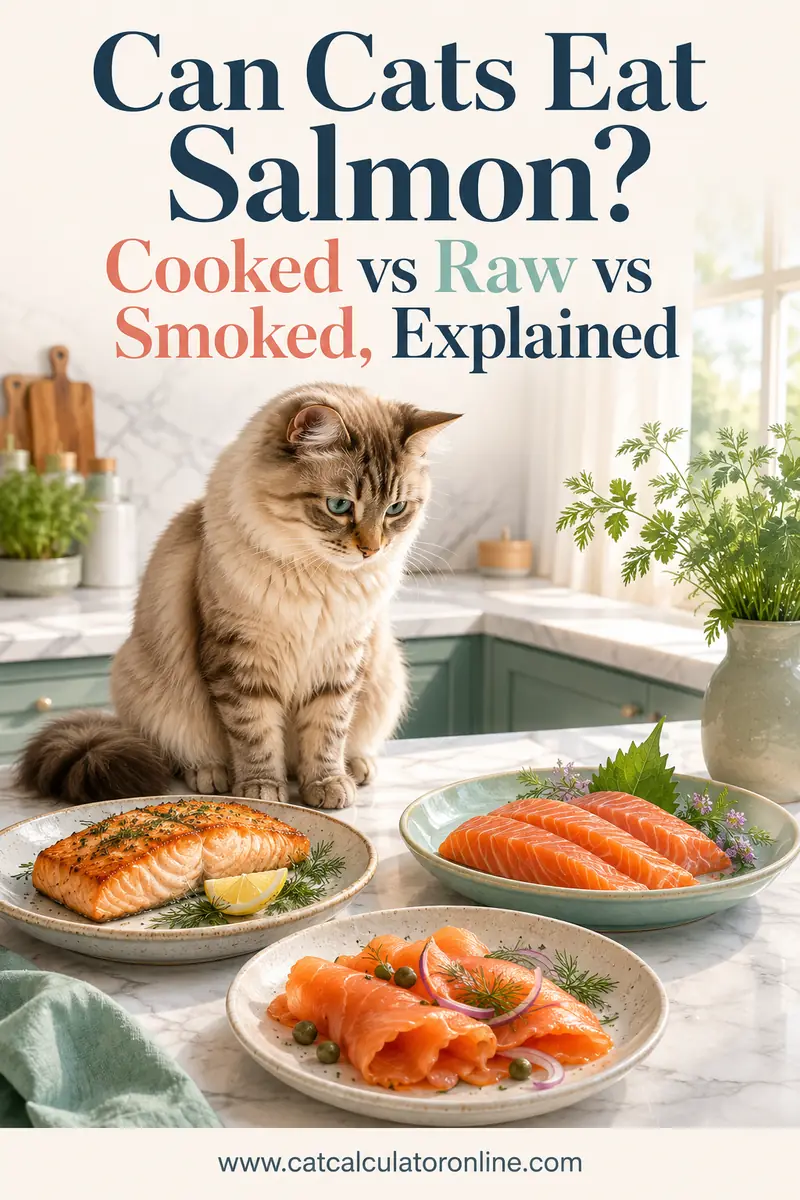
Can Cats Eat Salmon? Cooked vs Raw vs Smoked, Explained
Yes — cats can eat salmon, as long as it's cooked, plain, and boneless. A small piece makes a genuinely good occasional treat: it's rich in protein and omega-3 fatty acids, and most cats adore it. The catch is the word "occasional" — salmon isn't nutritionally complete, and the raw, smoked, and seasoned versions on your plate come with real risks.
So before you slide a flake off your fork, it's worth knowing which forms of salmon are fine, which ones aren't, and how much is actually sensible for a cat her size. Our free cat food calculator can tell you her daily calorie target in seconds, which makes the "how much" part easy.
🐟 Which salmon is safe for my cat?
Tap a type to see the verdict:
Tap a salmon type above to see whether it’s safe for a cat.
Work out your cat’s daily portions with the free calculator →
Is Salmon Actually Good for Cats?
In its plain cooked form, yes — salmon has real things going for it as a treat.
Cats are obligate carnivores, which means their bodies are built to run on animal protein. Salmon delivers exactly that, along with omega-3 fatty acids (EPA and DHA), the same fats that make fish oil a common ingredient in commercial cat food. Omega-3s support skin and coat health and play a role in managing inflammation.
Salmon also brings B vitamins and minerals like potassium and selenium along for the ride. And from your cat's point of view, none of that matters — she wants it because it smells incredible and tastes like something a carnivore should be eating.
Two honest caveats before the celebration starts:
- Treat-level good, not diet-level good. Salmon on its own is missing nutrients a cat must have daily. It's a supplement to a complete diet, never a replacement for one.
- The benefits assume plain and cooked. Every risk in this article comes from the other versions — raw, smoked, canned in brine, seasoned, or full of bones.
If your cat already eats a salmon-flavored commercial food, she's getting the good parts in balanced form every day. A fresh cooked flake on top is a bonus, not a need.
Why Can't Cats Eat Raw Salmon?
Raw salmon looks like the "natural" option, and sushi-loving owners ask about it constantly. It's a no, for three separate reasons.
Parasites. Wild salmon can carry parasites, including flukes and tapeworm larvae. Freezing and proper cooking kill them; a raw fillet from the fish counter hasn't necessarily had either treatment done to a standard that protects a pet.
Bacteria. Raw fish can carry Salmonella and Listeria. Cats can get sick from these, and they can also shed the bacteria and pass them to the humans in the house — a particular concern in homes with young children, elderly family members, or anyone with a weakened immune system.
Thiaminase. This is the sneaky one. Some raw fish contains thiaminase, an enzyme that destroys thiamine (vitamin B1). One raw bite won't cause a deficiency, but a cat who's regularly fed raw fish can gradually run short of B1 — and thiamine deficiency is serious, causing neurological signs like wobbliness, a downward-curled neck, and seizures. Cooking deactivates the enzyme, which is one more reason cooked wins.
What about sushi-grade salmon? "Sushi-grade" is a marketing term, not a food-safety guarantee, and it addresses parasites more than bacteria. A tiny stolen shred of sashimi is unlikely to hurt a healthy adult cat, but it shouldn't be an offered treat, and it should never be a habit.
What About Smoked, Cured, or Seasoned Salmon?
This is where most real-world sharing goes wrong, because the salmon in most kitchens isn't a plain fillet — it's lox on a bagel, a garlic-butter dinner, or a teriyaki glaze.
Smoked and cured salmon is off the table entirely. Curing works by drawing moisture out with salt, which means smoked salmon, lox, and gravlax are extremely salty for their size. A cat weighing 4 kg (about 9 lb) is working with a tiny body; a salt load that's a rounding error for you is significant for her. Too much sodium causes excessive thirst and urination, vomiting, and in serious cases sodium ion poisoning with tremors or seizures. Cold-smoked fish also isn't fully cooked, so the raw-fish risks come along too.
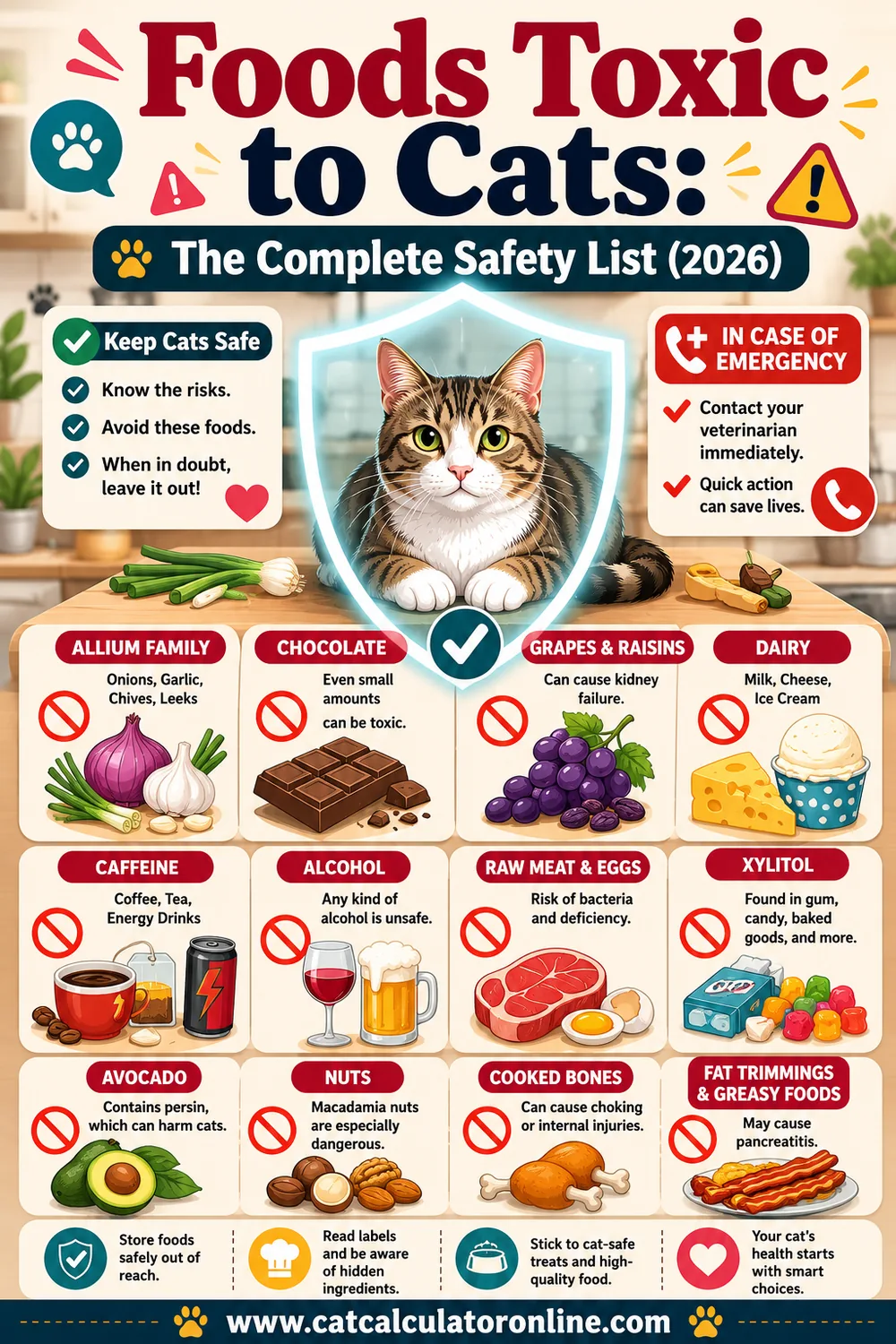
Seasoned salmon depends on the seasoning — and it's usually bad news. Garlic and onion, in any form (fresh, powder, in a marinade), are toxic to cats and damage red blood cells. They headline the list in our guide to foods toxic to cats. Butter and oils add fat that commonly triggers vomiting and diarrhea. Heavy salt, sugar-laden glazes, and spice rubs all cause problems of their own.
The practical rule: if the salmon was prepared for humans to enjoy, assume it's not shareable. Only a piece cooked plain — no salt, no fat, no seasoning — passes.
Can Cats Eat Canned Salmon?
Sometimes, with conditions attached. Canned salmon varies enormously, so the label does the deciding:
- Packed in water, no salt added: the only version worth considering. Drained well, a small amount occasionally is fine for most healthy cats.
- Packed in brine: skip it. Brine is salt water, and the fish has soaked in it.
- Packed in oil: skip it. The extra fat is a stomach-upset generator, and the calories add up fast in an animal this small.
Even with the right can, check the flakes with your fingers. Canned salmon often includes soft cooked bones — they're generally softer than fresh bones, but with a cat it's still smarter to crumble the meat and remove any obvious fragments.
One more thing worth saying: canned salmon for humans and salmon-based canned cat food are completely different products. The cat food version is nutritionally complete and balanced for daily feeding; the human version is a treat at best.
How Should I Prepare Salmon for My Cat?
If you want to do it properly, here's the whole method — it's easier than most fish recipes because you're leaving everything out.
- Start with a boneless fillet. Skin on or off is fine for cooking; remove the skin before serving if it's oily or seasoned.
- Cook it plain. Bake, poach, steam, or grill with nothing added — no oil, no butter, no salt, no lemon, no garlic. Plain poaching in water is the easiest.
- Cook it through. The flesh should be opaque and flake easily. Fully cooked kills parasites and bacteria and deactivates thiaminase.
- Check for bones twice. Run your fingers through the flaked fish. Pin bones are thin, sharp, and easy to miss.
- Cool it and serve small. A piece roughly the size of a thumbnail is a proper cat portion, not a human one.
Here's the quick-reference version:
| Salmon type | Safe for cats? | Why |
|---|---|---|
| Plain cooked, boneless | Yes — in moderation | Protein and omega-3s with no additives |
| Salmon-based complete cat food | Yes — daily | Balanced for feline nutrition |
| Canned in water, no salt, drained | Occasionally | Acceptable if bones are checked and portions stay small |
| Raw or sushi-grade | No | Parasites, bacteria, and thiaminase (destroys vitamin B1) |
| Smoked, lox, gravlax, cured | No | Very high salt; often not fully cooked |
| Canned in brine or oil | No | Excess sodium or excess fat |
| Seasoned, sauced, or buttered | No | Garlic and onion are toxic; fats upset the stomach |
| Bones and heads | No | Choking and injury hazard |
How Much Salmon Can a Cat Have?
The rule that governs every treat applies here: treats of all kinds should make up no more than 10% of your cat's daily calories. The other 90% needs to come from a complete cat food, because that's where the taurine, vitamins, and mineral balance live.
For a typical adult cat, the 10% budget is small — often somewhere in the neighborhood of 20 to 25 calories a day, depending on her size and activity. In salmon terms, that's a piece about the size of your thumbnail, not a dinner portion. Once or twice a week is a sensible rhythm; daily fish is more than an "occasional treat" and starts to crowd out balanced food.
The honest way to get this right is to know your cat's actual daily calorie target, because a lean 3.5 kg cat and a big-boned 6 kg cat have very different budgets. Our cat food calculator works it out from her weight and life stage, and the treat math falls out of that number.
Signs you've overdone the fish over time: she starts refusing her regular food and holding out for salmon, she's gaining weight, or her stomach rebels. Fish is famously habit-forming for cats — a fish-only holdout is a real (and avoidable) phenomenon.
Can Salmon Replace Cat Food?
No, and this is the mistake that causes actual harm rather than just an upset stomach.
Plain salmon is a great protein, but it isn't a balanced feline diet. A cat fed mostly on cooked fish fillets will run short of nutrients she can't do without:
- Taurine — cats can't make enough of their own, and deficiency damages the heart and eyes. Complete cat foods are supplemented with it; a plate of salmon isn't.
- Calcium — meat and fish flesh are heavy on phosphorus and light on calcium. A meat-only diet quietly weakens bones over time.
- Vitamins A, D, E and thiamine — the balance a cat needs doesn't exist in fillet form.
There's also the variety problem. A cat who eats salmon every day is one recall, one price spike, or one flavor aversion away from a feeding crisis. Commercial complete foods — including salmon-flavored ones — solve all of this by design.
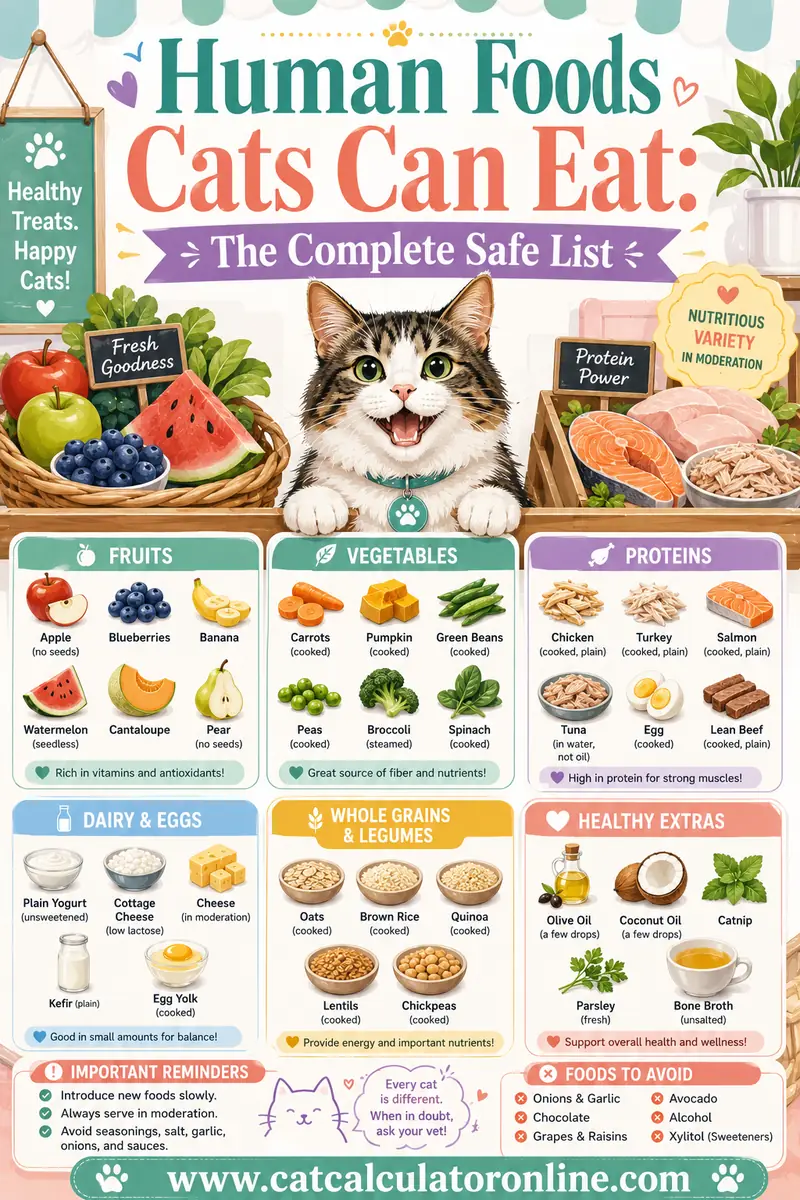
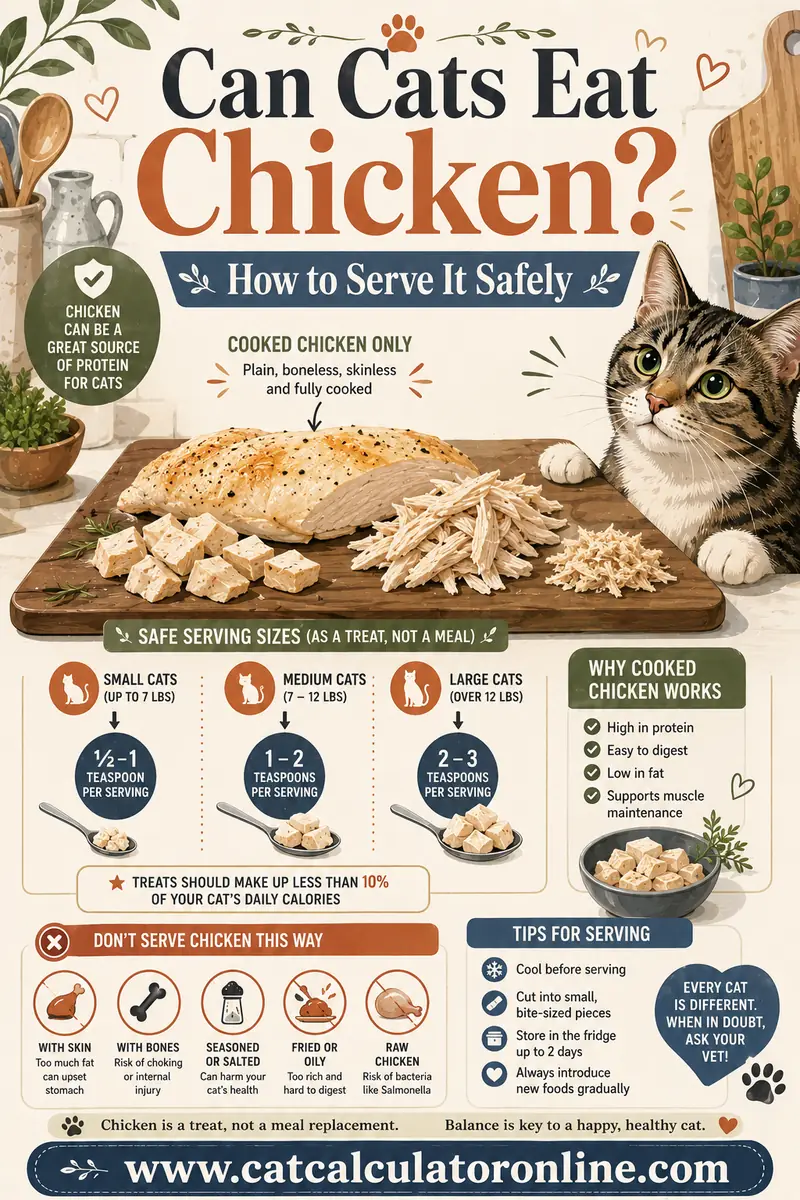
Think of it this way: salmon is the dessert course of a cat's world. Delightful, motivating, and completely wrong as the whole menu. If you're wondering what else can share treat duty, plain cooked chicken is the other classic, and our guide to human foods cats can eat covers the full shareable list.
What If My Cat Ate Raw or Smoked Salmon?
First, don't panic — a single small theft is rarely an emergency for a healthy adult cat. What you do next depends on what and how much she got.
A small stolen bite of raw salmon: watch her for the next couple of days. Vomiting, diarrhea, lethargy, or refusing food are your cues to call the vet. Mention it was raw fish so they can consider parasites and bacteria.
Smoked or cured salmon: the concern is salt. A tiny shred is usually just a "watch her" situation, but a larger amount — think a whole slice of lox or more, especially in a small cat — is worth a call to your vet. Excessive thirst, vomiting, wobbliness, or tremors mean call immediately.
Seasoned salmon with garlic or onion: call your vet even if she seems fine. Allium toxicity damages red blood cells and signs can take days to appear, so this one isn't a wait-and-see.
A swallowed bone: gagging, pawing at the mouth, drooling, or repeated retching mean a vet visit now. If she seems fine, watch her eating and litter box habits for a couple of days.
If vomiting shows up and you're not sure whether it's connected, our guide to why your cat is throwing up walks through what's routine and what's a red flag. When in doubt, a phone call to your vet costs nothing and settles it.
Is Salmon Better Than Tuna for Cats?
They're similar in spirit — both are fish, both drive cats wild, both are treat-only foods — but salmon edges it in a couple of ways.
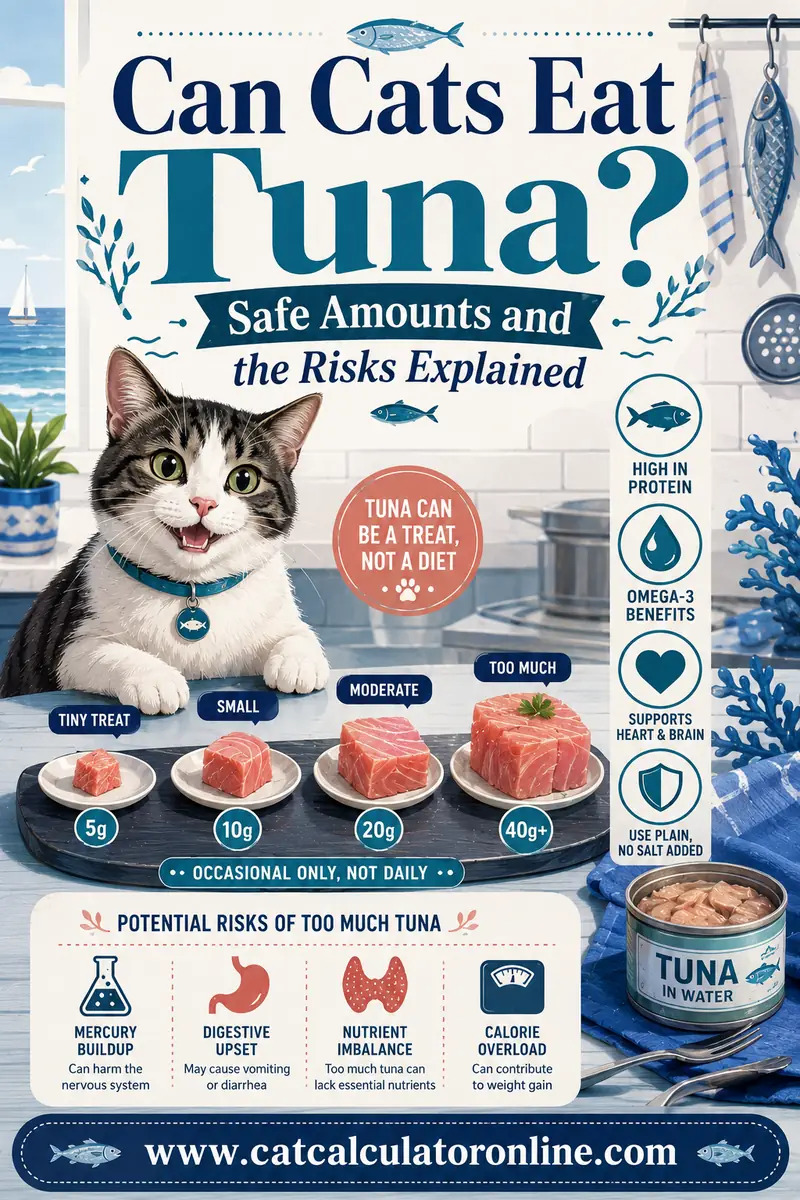
Salmon generally carries more of the omega-3 payoff per portion, and it sits lower on the food chain than the big tuna species, which matters because large predatory fish accumulate more mercury over their lifetimes. Tuna, especially albacore, is one of the higher-mercury fish, which is one more reason it belongs in the occasional-treat category rather than the rotation.
Neither fish should be a daily event, and the same rules apply to both: cooked or properly canned, plain, no brine, small portions. We've covered the tuna side in detail in can cats eat tuna — including the tuna-addiction problem that fish-loving cats are famous for.
FAQ
Can cats eat cooked salmon every day?
It's not a good idea. Even plain cooked salmon isn't nutritionally complete, and daily fish can crowd out balanced food, build a picky fish-only habit, and blow past the 10% treat-calorie limit. Keep it to small portions once or twice a week.
Can kittens eat salmon?
A tiny flake of plain cooked salmon is fine for a weaned kitten, but kittens have small stomachs and big nutritional demands, so their calories should come almost entirely from a complete kitten food. Skip raw and smoked entirely — a kitten's smaller body makes every risk bigger.
Can cats eat salmon skin?
Cooked plain salmon skin isn't toxic, but it's fatty and often carries the most seasoning and oil from cooking. If the fillet was cooked truly plain, a small piece of cooked skin is okay occasionally; if there's any oil, salt, or crisping fat involved, leave it off. Raw skin follows the raw-fish rules: no.
Is smoked salmon ever okay as a rare treat?
No. The salt content is the problem, and it doesn't scale down well — smoked salmon is salty by design, and cats are small. There's no preparation trick that fixes it, so keep the lox for your bagel and offer plain cooked salmon instead.
Why is raw salmon bad for cats if wild cats eat raw fish?
Wild cats mostly eat freshly caught prey, parasites and all, and they pay for it with shorter, harder lives. Store-bought raw fish adds handling and storage bacteria to the parasite risk, and regular raw fish feeding introduces the thiaminase problem — an enzyme that destroys vitamin B1 over time. Cooking removes all three risks at once.
My cat ate salmon and threw up — should I worry?
A single vomit after a rich new food is common and usually resolves on its own — rich fish, fast eating, or an unaccustomed stomach can all do it. Repeated vomiting, lethargy, refusing food, or vomiting alongside diarrhea are reasons to call your vet, especially if the salmon was raw, smoked, or seasoned.
The Bottom Line
Salmon earns its reputation as a cat-approved treat — but only in one form. Plain, cooked, boneless, unseasoned salmon is a safe and genuinely nutritious occasional extra, packed with the protein and omega-3s a carnivore's body appreciates.
Everything else on the salmon spectrum fails the test: raw brings parasites, bacteria, and the vitamin-B1-destroying enzyme thiaminase; smoked and cured versions carry far too much salt; brine, oil, butter, garlic, and glazes each add their own problem; and bones are a hazard in any form.
Keep salmon inside the 10% treat budget, keep the other 90% as complete cat food, and you get the best of both — a thrilled cat and a balanced diet. To find out what her daily portions should actually look like, run her numbers through our free cat food calculator, and keep the list of foods toxic to cats bookmarked for the next "can she eat this?" moment.