When Do Kittens Open Their Eyes? A Week-by-Week Guide
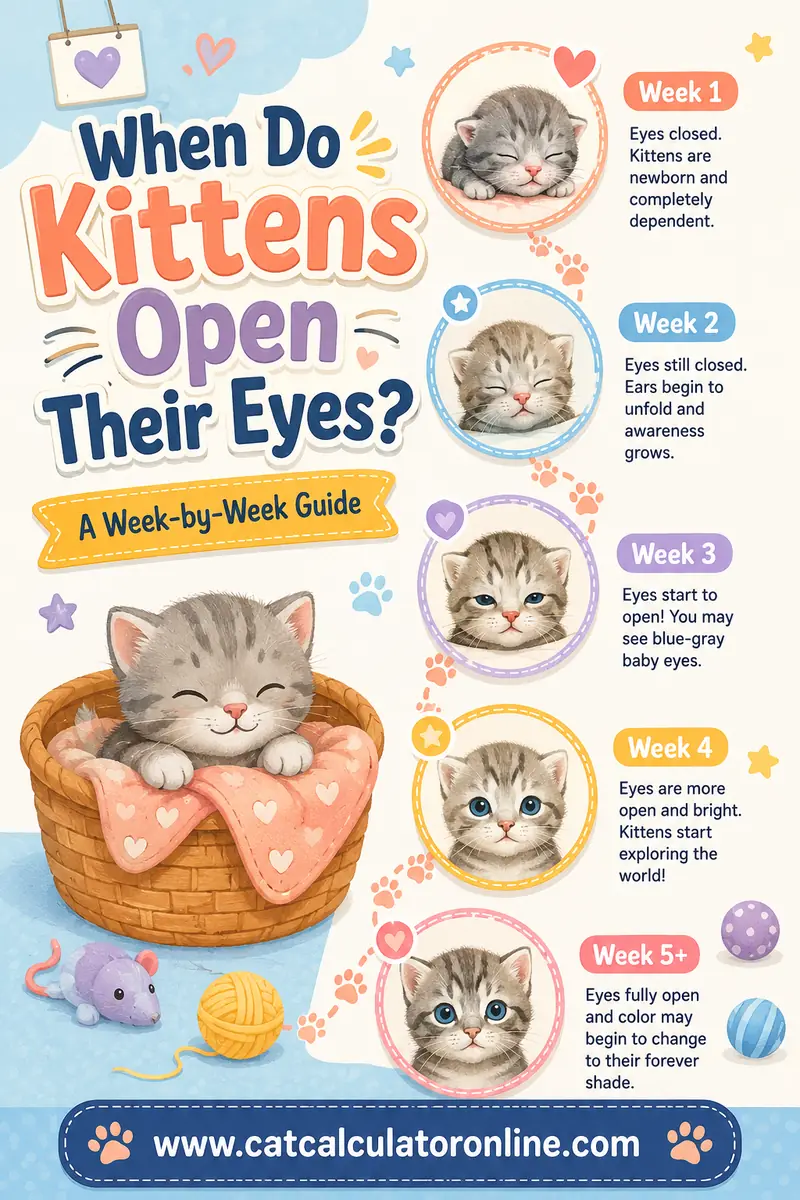
Kittens open their eyes at about 7 to 14 days old, and most have both eyes fully open by day 10. They're born completely blind and deaf, so those first two weeks are spent doing almost nothing but nursing, sleeping, and staying warm against mom and their littermates. Don't rush the process or try to help the eyes open — they'll do it on their own when the kitten is ready.
If you're caring for a litter or you've found newborns, one of the most useful things you can do is track their weight and their milestones. Our free kitten weight calculator helps you check whether a kitten is growing on schedule, which is one of the clearest signs a young kitten is healthy.
🐱 Kitten milestone finder
Tap a kitten’s age to see what’s happening that week:
Tap an age above to see the milestone.
The Short Answer: 7 to 14 Days
Newborn kittens keep their eyes shut for the first week or so of life. The eyelids are fused together at birth to protect the developing eyes, and they separate on their own timeline — usually starting somewhere between day 7 and day 10, with both eyes fully open by around day 14.
There's normal variation here. Some kittens open their eyes a little early, some a little late, and even littermates won't always match. A kitten whose eyes are still shut at day 14 isn't necessarily in trouble, but it's worth keeping an eye on and mentioning to a vet if the whole litter is running behind.
The one thing you should never do is try to pry a kitten's eyes open. The eyes and the tissue around them are still developing, and forcing them can cause real damage. Let nature set the pace.
Kittens Are Born Blind and Deaf
It surprises a lot of first-time carers, but newborn kittens can't see or hear at all. Both the eyes and the ear canals are sealed at birth. For roughly the first two weeks, a kitten experiences the world almost entirely through touch, warmth, and smell.
This is why a newborn litter stays piled together against mom. They can't regulate their own body temperature yet, so they rely on her heat and on huddling with siblings. They find her by scent and by feel, latch on, nurse, and sleep — and that cycle is basically all a healthy newborn does.
It also explains why the mother cat is so protective and why moving a newborn litter or handling them too much in the first week can be stressful for everyone. If you're helping a queen with her babies, less is usually more in those early days.
Week-by-Week Development Timeline
Here's how a kitten's first eight weeks typically unfold. Individual kittens vary, so treat this as a map, not a stopwatch.
| Age | What's happening |
|---|---|
| Birth | Blind and deaf, eyes and ears sealed, nursing constantly, can't regulate temperature |
| Week 1 | Umbilical cord falls off, birth weight roughly doubles (~110g → ~220g), still can't see or hear |
| Week 2 | Eyes open (usually by day 10), vision blurry, eyes are blue, kitten is wobbly |
| Week 3 | Ear canals open, first baby teeth appear, kitten starts walking |
| Week 4 | Weaning begins, litter-box instinct appears, play starts, eye color may begin to change |
| Weeks 5–7 | Critical socialization window, active play, climbing, learning from mom and littermates |
| Week 8 | Fully weaned, ~1.5–2 lb, ready for first vaccines, can be rehomed (8–12 weeks, ideally 12) |
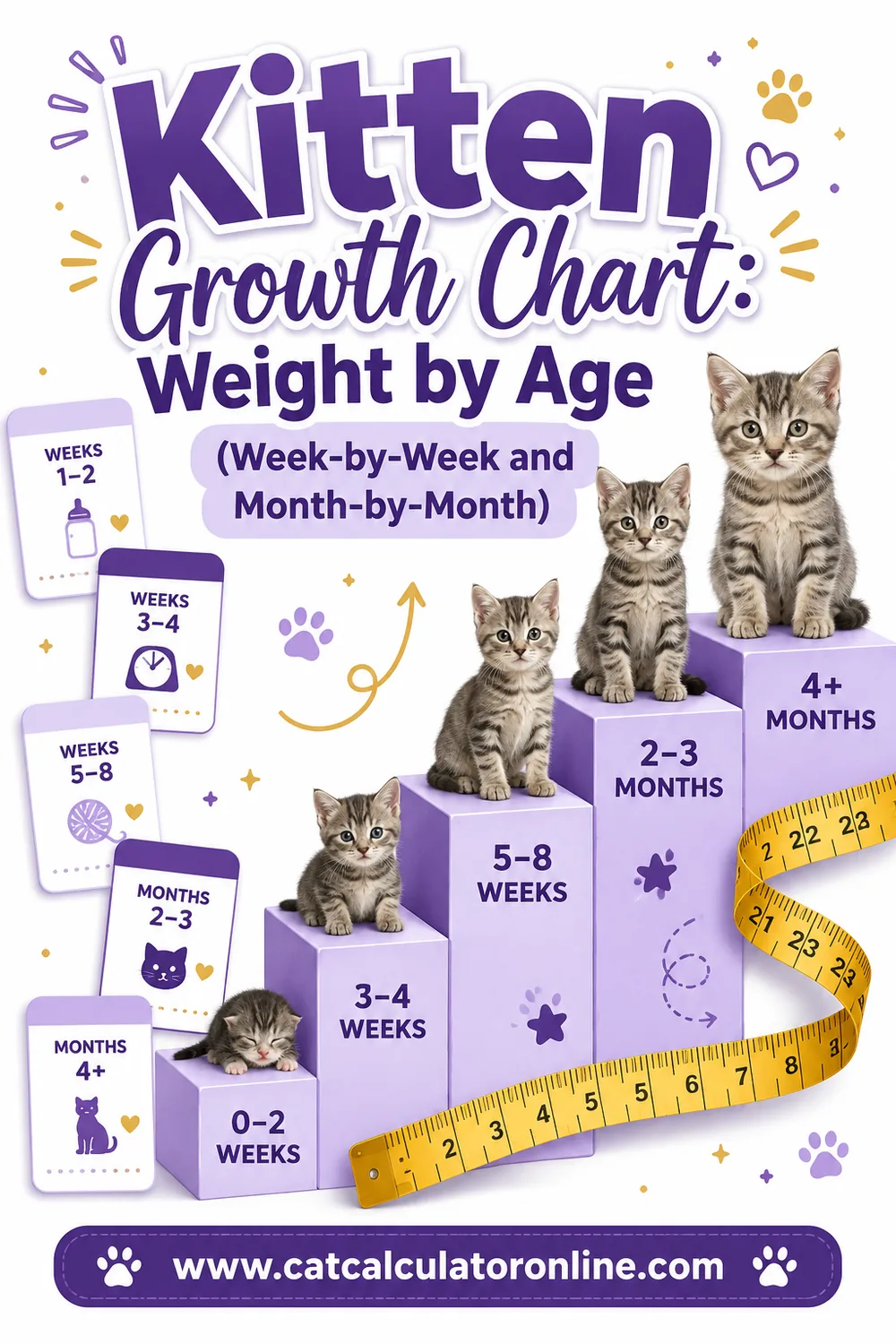
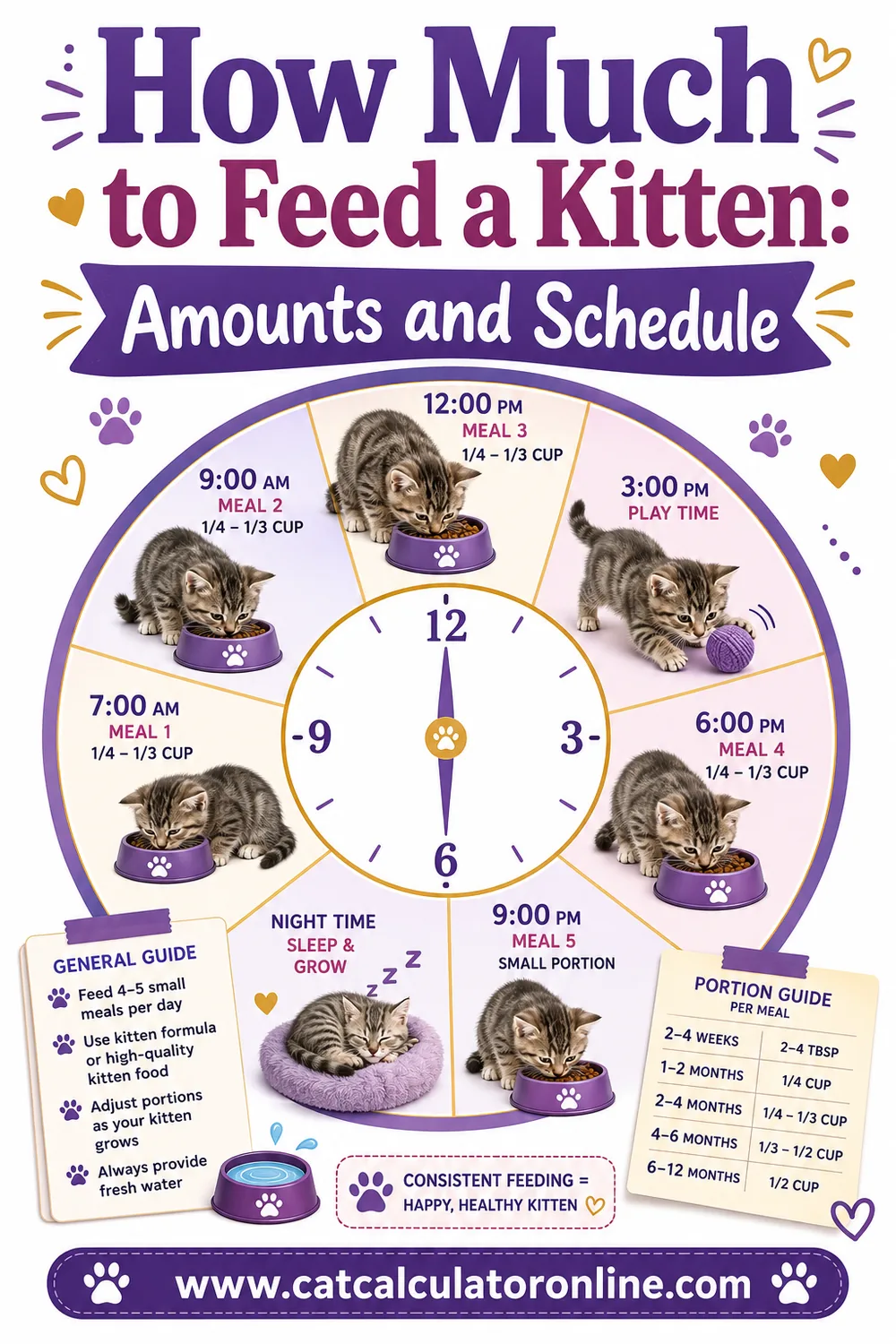
For a closer look at the numbers side of this, our kitten growth chart breaks down expected weight at each week, and how much to feed a kitten covers the shift from nursing to solid food.
Why Newborn Kittens Have Blue Eyes
When a kitten's eyes first open, they're almost always a cloudy blue. That's not the kitten's final eye color — it's just the color every kitten starts with before the pigment develops.
Around 6 to 7 weeks of age, the true eye color begins to come in, and it can shift to green, gold, copper, amber, or stay blue depending on the cat's genetics. Some breeds, like Siamese and Ragdolls, keep blue eyes for life. Most cats settle into their adult eye color by a few months old.
So if you're looking at a litter of wide-eyed blue-eyed kittens, you're seeing a temporary stage. The blue tells you they're young — it doesn't tell you what color they'll be as adults.
Ears, Teeth, and First Steps
Vision isn't the only thing coming online in those early weeks. A kitten's development runs on a fairly predictable schedule:
- Hearing (weeks 1–2): the ear canals open around one to two weeks, and by week three most kittens are clearly responding to sound.
- Teeth (around week 3): the tiny needle-sharp baby teeth start pushing through, which is part of what makes weaning possible a week or so later.
- Walking (weeks 3–4): kittens graduate from a belly-crawl to a wobbly walk, then to running and climbing as their coordination catches up.
- Litter instinct (around week 4): kittens naturally start to seek out a litter substrate around the time they begin eating solid food.
By the time all of this has happened, you've got a mobile, curious, playful little cat instead of a helpless newborn — usually within about a month.
Kitten Eye Development Day by Day
The week-by-week table above gives the big picture. Here is a closer look at just the eyes, from the sealed lids of a newborn to the adult eye color that shows up weeks later. Every kitten runs on its own clock, so use these ranges as a guide rather than a deadline.
| Age | What the eyes look like | What the kitten can do |
|---|---|---|
| Days 1–5 | Eyelids sealed shut; the eyes are still developing behind them | Nothing visual yet; finds mom by smell and touch |
| Days 6–8 | A thin slit often appears, frequently starting near the inner corner | May react to a sudden change in light |
| Days 8–10 | One or both eyes partly open; many kittens have both open by day 10 | Sees light and dark and rough shapes |
| Days 10–14 | Both eyes fully open, cloudy blue, a little hazy | Blurry vision; sensitive to bright light |
| Week 3 | Eyes clearer, still blue | Starts tracking movement and noticing littermates |
| Weeks 4–5 | Eyes bright and alert | Uses sight to play, pounce, and find the litter box |
| Weeks 6–7 | Adult eye color may start to show through the blue | Vision much sharper; judges distance better when jumping |
| Weeks 8–12 | Color keeps shifting toward green, gold, copper, or stays blue | Sees much like an adult cat |
| A few months old | Adult eye color has usually settled | Full-grown vision |
Notice that the eyes open gradually rather than all at once. A narrow slit on day seven and fully open eyes on day twelve is a completely normal pattern. It is also common for one eye to open a day or two before the other.
Kitten eye color timeline
All kittens start with blue eyes because the pigment that gives adult eyes their color has not formed yet. As it develops, usually from around six to seven weeks, the blue gives way to the cat's true color. The change happens slowly over the next several weeks, so you may see a greenish or grayish in-between stage before the final shade settles. Breeds known for blue eyes, like Siamese and Ragdolls, keep them for life.
Kitten Eyes Not Opening? Signs of Trouble and When to Call the Vet
Most kittens open their eyes without any help. Occasionally, though, something goes wrong, and newborns can get sick quickly, so it pays to know the warning signs. Call a vet promptly if you notice any of these:
- Swelling or bulging behind closed eyelids. Pus can build up behind lids that haven't opened yet, a newborn eye infection vets call ophthalmia neonatorum. It needs treatment, not waiting.
- Crust, discharge, or goo around the eyes, whether they are open or closed.
- Eyes stuck shut again after they had already opened, usually from dried discharge.
- Still closed well past two weeks, especially if littermates opened theirs days ago.
- Redness, squinting, or constant watering once the eyes are open.
- A cloudy or white spot on the surface of the eye, or one eye that looks different from the other.
- The third eyelid showing (a pale film across the inner corner) that doesn't go away.
Safe ways to help while you wait for the vet
- Never pry the eyelids apart. Forcing them can damage the eye. This is the one rule that never changes.
- Wipe gently with warm water. If there is crust on the lids, soften it with a clean cotton pad or soft cloth dampened with warm (not hot) water.
- Wipe from the inner corner outward, and use a fresh pad for each eye so you don't spread infection from one eye to the other.
- Skip human eye drops and home remedies. Only use eye medication a vet has prescribed for the kitten.
- Keep the nest clean, warm, and dim. Fresh bedding cuts down on germs, and soft lighting is kinder to newly opened eyes.
If you are caring for kittens without their mother, eye problems are just one of many things to watch. Our guide to caring for orphaned kittens covers feeding, warmth, and toileting, and newborn kitten care week by week lays out what to do at each stage.
When Can Kittens See Clearly?
Opening the eyes and seeing well are two different milestones. When a kitten first opens its eyes, the world is a soft blur. The eyes and the parts of the brain that process vision are still maturing, so at two weeks a kitten mostly notices light, shadow, and movement close by.
Vision sharpens quickly from there. By three to four weeks, kittens follow a moving toy and recognize their littermates by sight. By five to six weeks, they judge distances well enough to pounce, climb, and leap onto low furniture, though the occasional misjudged jump is part of growing up. Over the next weeks their vision keeps improving until it works much like an adult cat's.
This is why play really takes off at around four weeks. Once kittens can see what they are chasing, the wrestling and pouncing begin. You can follow the matching movement milestones in when do kittens start walking, and the full picture in our kitten growth stages week by week guide.
Using the Eyes to Guess a Kitten's Age
If you have found a litter and don't know how old the kittens are, their eyes are one of the quickest clues. Pair this with weight for a better estimate.
| What you see | Likely age |
|---|---|
| Eyes sealed shut, ears folded flat | Under about 1 week |
| Eyes starting to open, a slit or partly open | About 1 to 2 weeks |
| Eyes open and cloudy blue, wobbly crawling | About 2 to 3 weeks |
| Clear blue eyes, walking, first teeth | About 3 to 4 weeks |
| Eyes alert, playing and pouncing | About 4 to 6 weeks |
| Eye color changing from blue | About 6 to 8 weeks and up |
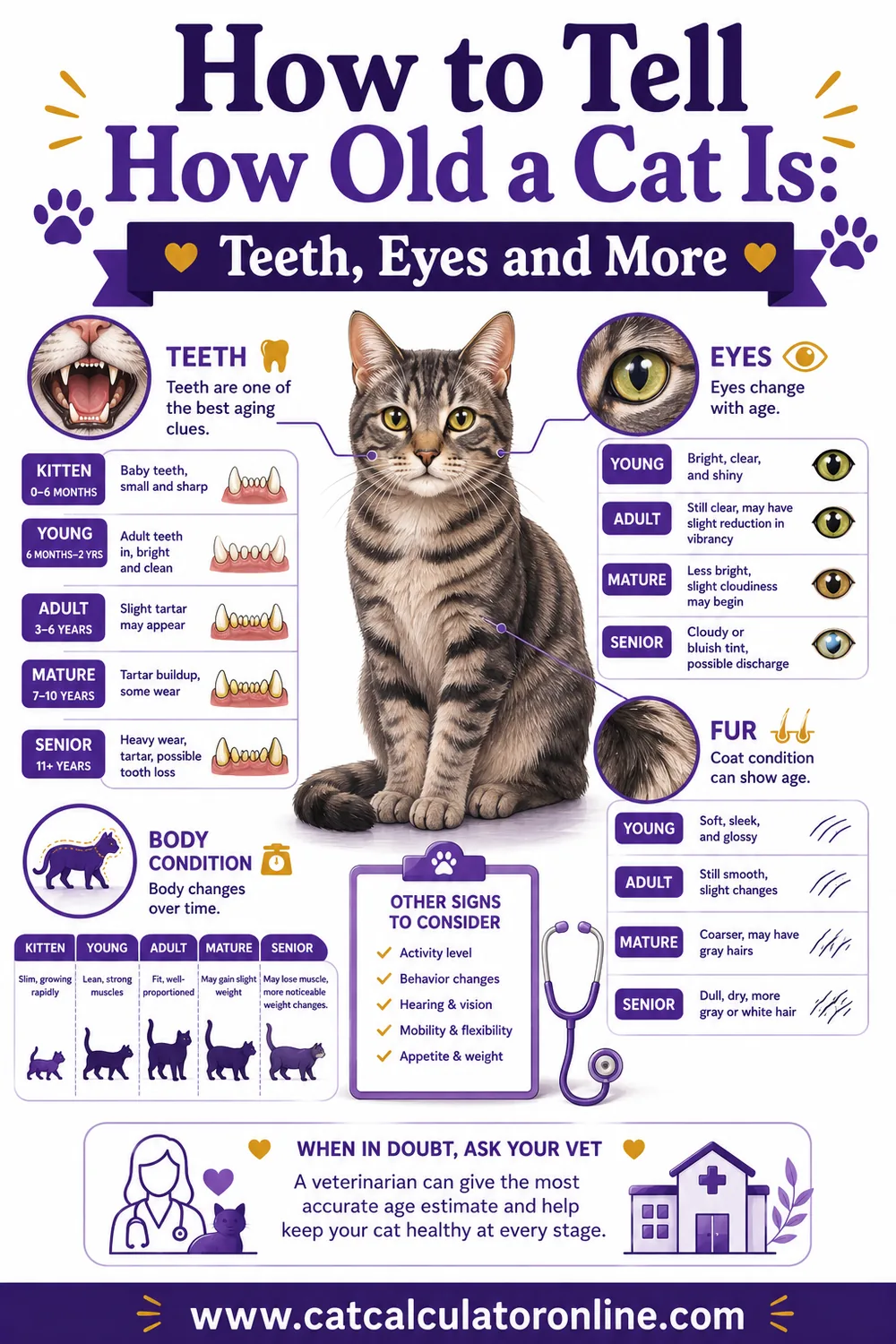
For more age clues, from teeth to coat, read how to tell how old a kitten is. Once you have a rough age, the kitten weight calculator shows whether the kitten's weight fits.
How to Estimate a Kitten's Age
If you've found a stray litter and have no idea how old they are, these milestones work in reverse as a rough age guide. Eyes still shut means under two weeks. Eyes open but ears just starting to work points to around two to three weeks. Walking, playing, and baby teeth suggests three to four weeks and up.
Weight is another clue, though it's less exact because it depends on the breed and on how well the kittens have been fed. Our guide to how to tell a cat's age walks through the physical signs in more detail, and once your kitten is older, the cat life stages explained guide covers what comes after kittenhood.
If you're not sure and the kittens seem very young, a quick vet visit is the safest move. Newborns can go downhill fast, and a professional can age them accurately and check they're healthy.
Don't Separate a Kitten From Mom Too Early
Because kittens hit their milestones so quickly, it's easy to assume they're ready to leave mom sooner than they are. They're not. Kittens should stay with their mother and littermates until at least 8 weeks, and ideally closer to 12 weeks.
Those extra weeks matter for more than nutrition. During the socialization window of roughly weeks 5 to 7, kittens learn crucial lessons from mom and siblings — bite inhibition, how to play without hurting each other, how to use a litter box, and how to be comfortable around others. Kittens taken away too early often grow into more anxious or nippy adults.
If you end up with orphaned newborns and no mother cat, that's a different and more demanding situation. Very young orphan kittens need a vet's guidance right away. They require kitten milk replacer (never cow's milk, which can make them ill), help staying warm, and help toileting, because at that age they can't eliminate on their own. Don't try to raise newborn orphans on instinct alone — get professional help early.
FAQ
At what age do kittens open their eyes?
Kittens open their eyes at around 7 to 14 days old, most commonly by day 10. They're born with the eyelids fused shut, and the eyes separate on their own as the kitten develops. Never try to force them open.
Why hasn't my kitten opened its eyes yet?
Some kittens are simply slower than others, and anything up to about two weeks is usually normal. If a kitten's eyes are still closed well past 14 days, or if you see swelling, crusting, or discharge around the eyelids, contact a vet, as that can signal an infection.
Can newborn kittens see and hear?
No. Kittens are born blind and deaf, with both the eyes and ear canals sealed. Vision arrives around week two and hearing around weeks one to three. Until then they rely entirely on touch, warmth, and smell.
What color are kittens' eyes when they first open?
Almost all kittens open their eyes to a cloudy blue. That's a temporary newborn stage. The true adult eye color starts to come in around 6 to 7 weeks and can turn green, gold, copper, or stay blue depending on genetics.
When can kittens leave their mother?
Kittens should stay with mom until at least 8 weeks old, and 12 weeks is even better. Those extra weeks cover weaning and the critical socialization window that shapes a friendly, well-adjusted adult cat.
What do I do if I find newborn kittens without a mother?
Contact a vet or a local rescue right away. Orphaned newborns need kitten milk replacer (not cow's milk), help staying warm, and help toileting after feeds. They're fragile at that age, so professional guidance early makes a real difference.
When can kittens see clearly?
Not right away. When their eyes first open at around 10 to 14 days, kittens see only blurry light and shapes. Vision sharpens over the next few weeks, and by about four to six weeks kittens can judge distance well enough to pounce and climb. It keeps improving after that.
Is it normal if one eye opens before the other?
Yes. It is very common for one eye to open a day or two before the other. As long as the second eye opens within a few days and there is no swelling or discharge, there is nothing to worry about.
What do you do if a kitten's eyes are stuck shut?
Do not force them open. If dried discharge is gluing the lids together, gently soften it with a cotton pad dampened with warm water, wiping from the inner corner outward and using a fresh pad for each eye. Then call a vet, because crusty or stuck eyes often mean an infection that needs treatment.
Should newborn kittens be kept out of bright light?
It is a good idea. Newly opened eyes are sensitive, so keep the nest in a softly lit, quiet spot and avoid shining bright lights or camera flashes directly at the kittens during their first few weeks.
The Bottom Line
Kittens open their eyes at 7 to 14 days old, usually by day 10, after being born completely blind and deaf. From there, development moves fast: ears and teeth around week three, walking and weaning around week four, and the all-important socialization window through weeks five to seven. By eight weeks they're weaned, mobile, and nearly ready for a new home — though staying with mom until 12 weeks is best.
The single most useful habit while a kitten is growing is tracking its weight against the milestones. Start with our free kitten weight calculator to check your kitten is on schedule, then use the new kitten checklist to get ready for everything that comes next.