Cat Pregnancy Week by Week
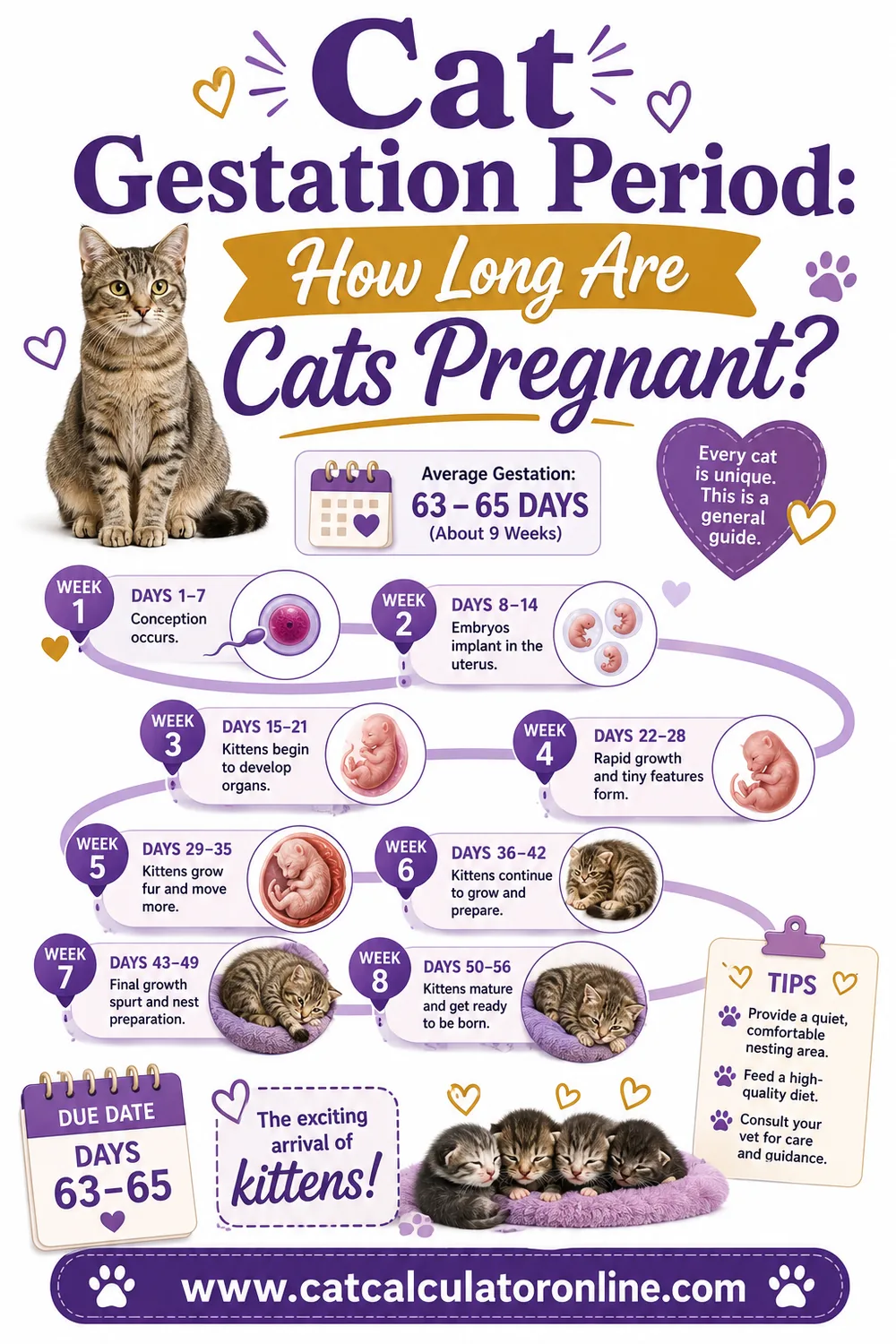
Cat pregnancy runs about 63 to 67 days — nine weeks — and divides neatly into three phases. Weeks 1–3 show almost nothing externally while the embryos implant. Weeks 4–6 bring the visible changes: pinking up, a rising appetite and a rounding belly. Weeks 7–9 are the final stretch, when kittens can be felt moving, the queen slows down and nesting begins. Knowing what belongs to each week makes it far easier to tell normal progress from something that needs a vet, and the cat pregnancy calculator places your own queen on the timeline.
What Is the Full Timeline at a Glance?
The whole nine weeks in one view, so you can place your queen and see what's coming next.
| Week | Days | Inside the queen | What you'll see | What to do |
|---|---|---|---|---|
| 1 | 1–7 | Fertilisation; embryos travel to uterus | Nothing; heat cycles stop | Note the mating date |
| 2 | 8–14 | Implantation around day 12–14 | Nothing visible | Normal routine |
| 3 | 15–21 | Organs forming; placenta establishes | Pinking up; possible appetite dip | Vet visit; ultrasound possible |
| 4 | 22–28 | Kittens grape-sized | Appetite rising; slight weight gain | Switch to kitten food |
| 5 | 29–35 | Recognisably kitten-shaped | Belly rounding; clear weight gain | Feed to appetite |
| 6 | 36–42 | Fur developing; skeletons mineralising | Obvious swelling; slowing down | X-ray for a count from day 40 |
| 7 | 43–49 | Kittens gaining weight fast | Movement visible; nesting begins | Set up nesting box |
| 8 | 50–56 | Final development | Heavy, less mobile; grooming harder | Keep her indoors |
| 9 | 57–67 | Ready for birth | Restlessness; appetite drops; temp falls | Stay quiet; have vet number ready |
Two patterns are worth reading off that table. The first third is invisible — which is why unplanned pregnancies are usually well established before anyone suspects. And your jobs cluster in weeks 3, 4 and 7: confirm it, change the food, prepare the nest. Everything else is largely observation.
What Happens in Weeks 1–2?
Nothing is visible, and nothing you do will reveal it.
Cats are induced ovulators — mating itself triggers the release of eggs, usually around 24 to 48 hours afterward. Fertilisation follows, and the embryos then travel down to the uterus, implanting into the uterine wall around day 12 to 14.
Because cats often mate several times across a heat, sometimes with different males, a single litter can genuinely have more than one father. This also means the "mating date" is often a span of days rather than a single point.
What you'll notice: almost nothing. The one indirect clue is that heat cycles stop. A queen who had been calling every two to three weeks goes quiet, which owners frequently only recognize in hindsight.
What to do: nothing special. Continue normal feeding and routine. If you suspect a mating, note the date — it's the single most useful piece of information for dating the pregnancy later.
Confirmation isn't possible yet. It's too early for ultrasound, too early to feel anything, and no home test exists for cats.
What Changes in Week 3?
The turning point, and the earliest that anything can be confirmed.
Pinking up appears around days 15 to 18 — the nipples become distinctly pinker and slightly enlarged as mammary tissue begins developing. It's the most reliable early sign, easiest to see on a pale or short-coated cat and harder on a dark or long-haired one.
Inside, the embryos are developing rapidly. Organs begin forming and the placenta establishes properly.
What you'll notice: pinking up. Some queens become noticeably more affectionate. A minority go briefly off their food — a rough equivalent of morning sickness — which usually resolves within a few days.
What to do: book a vet appointment. Ultrasound from around day 15 to 21 is the earliest reliable confirmation and detects heartbeats, though it's poor at counting kittens accurately.
This is also the point to review any medication or parasite treatment she's on, since some products aren't suitable during pregnancy. Ask rather than assume. The full list of early signs is in signs your cat is pregnant.
What Happens in Weeks 4–5?
The pregnancy starts becoming obvious.
By week four the kittens are roughly the size of a grape and their major structures are forming. By week five they're recognisably kitten-shaped, and a vet may be able to feel them by careful palpation — an examination only a vet should perform, since pressing on a pregnant abdomen at home risks real harm.
What you'll notice: appetite climbing steadily, the first clear weight gain, and a belly beginning to round rather than simply look fuller. Total gain across the whole pregnancy will reach 1 to 2 kg, which is a quarter to a half of a typical queen's starting body weight.
What to do:
- Switch to kitten food around week four. A pregnant queen needs more energy and protein than an adult maintenance diet supplies, and kitten formula is the standard recommendation.
- Feed to appetite rather than restricting. Underfeeding at this stage affects both the queen and the litter.
- Keep exercise gentle and normal. No need to restrict activity yet; she'll self-regulate.
What Should You Expect in Week 6?
No ambiguity left by now.
The kittens are developing fur and their skeletons are mineralising — which matters practically, because from around day 40 to 45 an X-ray can show them clearly and give a reliable count. Knowing how many to expect is genuinely useful at the birth, since it tells you when she has finished.
What you'll notice: marked abdominal swelling, a substantially increased appetite, and a queen who is slowing down and sleeping more.
What to do:
- Consider an X-ray if you want a count. Discuss timing with your vet.
- Move to smaller, more frequent meals. A uterus full of kittens leaves little room for a full stomach, and four or five small meals often suit better than two large ones.
- Start thinking about the nesting box — where it will go, and what will line it.
Litter size is typically around four kittens, ranging from one to eight or more, and first litters are often smaller. The range is covered in how many kittens are in a litter.
What Happens in Weeks 7–8?
The final preparations.
The kittens are now largely formed and putting on weight. You may be able to see or feel them moving, sometimes as visible ripples across her flank when she's resting. This is normal and reassuring.
What you'll notice: a noticeably heavy, slower queen. Grooming becomes harder for her. Nesting behavior begins — investigating wardrobes, drawers, under beds, and any quiet enclosed space she can find.
What to do:
- Set up the nesting box by around week seven. A cardboard box with a low entry, lined with soft washable bedding, in a quiet, warm, dimly lit spot away from household traffic. Show it to her, then accept that she may choose somewhere else entirely.
- Keep her indoors from around week eight. This prevents her giving birth somewhere inaccessible and reduces injury risk while she's slow and heavy.
- Have your vet's out-of-hours number written down. Not because you'll probably need it, but because looking it up at 3am is worse.
- Assemble a small kit: clean towels, and a box with a gentle heat source in case a kitten needs warming.
Handle her gently and less than usual. Late pregnancy is not the time for anything stressful — no house moves, no new pets, no rearranged furniture if avoidable.
A note on the nesting box, since it's the one preparation owners most often get wrong. The instinct is to build something elaborate and place it somewhere convenient for observation. A queen wants the opposite: dark, enclosed, quiet and out of the way. A plain cardboard box with a doorway cut into one side, tucked into the back of a wardrobe or a spare room, will be chosen over an expensive purpose-built bed in the living room almost every time. Line it with old towels or fleece you're happy to throw away, since birth is messy. Put it in place two weeks early so it stops being new by the time she needs it — and if she ignores it entirely and gives birth in the airing cupboard, that's a very normal outcome rather than a failure.
What Happens in Week 9?
The final days, and the signs change character.
Approaching labor, over roughly 24 hours: nesting intensifies and she settles on a spot. Appetite usually drops. Body temperature falls by about a degree — from a normal 38–39°C (100.5–102.5°F) — typically 12 to 24 hours before labor begins. She becomes restless, may vocalise, and often grooms her rear end more.
Labor itself usually runs two to six hours for the whole litter, with kittens arriving every 10 to 60 minutes. The queen normally manages entirely alone: she'll break each sac, clean the kitten, sever the cord and eat the placenta. Counting placentas is worthwhile — there should be one per kitten.
What to do: very little. Stay quiet, keep the room warm, watch from a distance and resist the urge to help. Most interference makes things worse rather than better. Note the time each kitten arrives, which makes it obvious if things stall.
Newborns weigh around 90–110 g, are blind and deaf, and can't regulate their own temperature. They should nurse within a few hours — that first milk carries important antibodies.
Afterward, the queen's needs rise further. A nursing queen may need two to four times her normal food intake, and she stays on kitten food throughout. Kittens shouldn't leave for new homes before eight weeks, and ten to twelve is better, as explained in when can kittens leave their mom.
How Should You Feed a Pregnant Queen?
Nutrition is the single biggest thing under your control across the nine weeks, and it changes in three distinct stages.
Weeks 1–3: no change needed. Energy requirements barely shift while the embryos are tiny. Continue her normal adult food at normal portions. Overfeeding this early achieves nothing except excess weight she'll carry through the pregnancy.
Weeks 4–6: switch to kitten food and let intake rise. This is the standard veterinary recommendation, and the reasoning is straightforward — kitten formula carries more calories, protein and calcium per gram than adult maintenance food, which is exactly what a queen building four kittens needs. Expect her intake to climb steadily.
Weeks 7–9: feed to appetite, in smaller meals. By this point she may need around 1.5 times her normal intake, but a uterus full of kittens leaves little stomach room. Four or five small meals suit most queens far better than two large ones. Some go off food entirely in the final 24 hours, which is normal and usually signals labor is close.
While nursing: requirements peak. A queen feeding a litter can need two to four times her pre-pregnancy intake — more than at any other point in her life. Keep her on kitten food throughout lactation, and let her eat freely.
Three things to avoid. Don't supplement calcium unless your vet specifically directs it; well-intentioned calcium supplementation during pregnancy can disrupt the queen's own regulation and is associated with eclampsia risk rather than protection against it. Don't restrict food to keep her slim. And don't switch foods abruptly — cats are prone to hepatic lipidosis if intake drops sharply, so make any change over about a week.
Fresh water matters more than usual throughout, and especially while nursing.
When Should You Call the Vet?
Most cat births need no assistance. These do.
Call immediately if:
- Straining hard for more than 20–30 minutes without producing a kitten
- More than two hours between kittens while she's still clearly straining
- Green, dark, foul-smelling or heavy bloody discharge before the first kitten
- The queen becomes lethargic, feverish or collapses
- Muscle tremors, twitching or stiffness — possible eclampsia, a genuine emergency that can occur late in pregnancy or while nursing
- Pregnancy running past day 70 with no sign of labor
- A kitten appears stuck and visible for more than a few minutes
- She ignores the kittens entirely after birth, or refuses to let them nurse
Two additional things worth knowing. A queen can pause labor for several hours between kittens and resume normally — that's not automatically an emergency if she's calm and not straining. And placentas should be counted; a retained placenta can cause infection, so mention any discrepancy to your vet.
It's also worth booking a post-birth check within a day or two, both for the queen and the litter. The vet will confirm nothing has been retained, check the kittens are feeding and gaining, and discuss when spaying becomes appropriate. A queen can come back into heat surprisingly quickly after giving birth — sometimes while still nursing — so that conversation is worth having sooner rather than later.
The general principle for the whole nine weeks: cats manage pregnancy and birth well on their own, and problems are the exception. But when something does go wrong it tends to escalate quickly, so knowing which signs justify a call is the useful preparation.
Frequently Asked Questions
How long is cat pregnancy week by week?
About nine weeks, or 63 to 67 days, with 64 to 65 typical. Weeks 1–3 show almost nothing, weeks 4–6 bring visible weight gain and a rounding belly, and weeks 7–9 cover fetal movement, nesting and birth.
When can you tell a cat is pregnant?
The earliest visible sign is pinking up around days 15 to 18. Ultrasound can confirm from about day 15 to 21, a vet can often feel kittens by palpation from day 17 to 25, and an X-ray from day 40 to 45 gives a reliable count.
When should I set up a nesting box?
Around week seven, so she has time to investigate and accept it. Use a box with a low entry, soft washable bedding, in a quiet, warm, dimly lit place. Expect her to consider alternatives — wardrobes and airing cupboards are common choices.
How do I know labor is starting?
Nesting intensifies, appetite usually drops, and body temperature falls by about a degree in the 12 to 24 hours before labor. She'll become restless, may vocalise and often grooms her rear end more. Once straining begins, the first kitten normally arrives within an hour.
How long does cat labor take?
Typically two to six hours for the whole litter, with kittens arriving every 10 to 60 minutes. A queen may pause for a few hours between kittens and resume normally. Straining hard for over 20–30 minutes without producing a kitten warrants an urgent call.
What should I feed a pregnant cat?
Switch to kitten food around week four, since it provides the extra energy and protein she needs, and feed to appetite rather than restricting. From week six, smaller and more frequent meals suit most queens better. Nursing raises her needs further still.
The nine weeks fall into a clear pattern: a silent first three, a visibly changing middle three, and a final three of movement, nesting and birth. Knowing which stage you're in tells you what's normal and what isn't — the single most useful thing during a pregnancy that moves this quickly. Note the mating date if you have it, put it into the cat pregnancy calculator for an estimated due date, and read the underlying timings in the cat gestation period.