How Long Do Cats Sleep? Hours by Age, and When to Worry
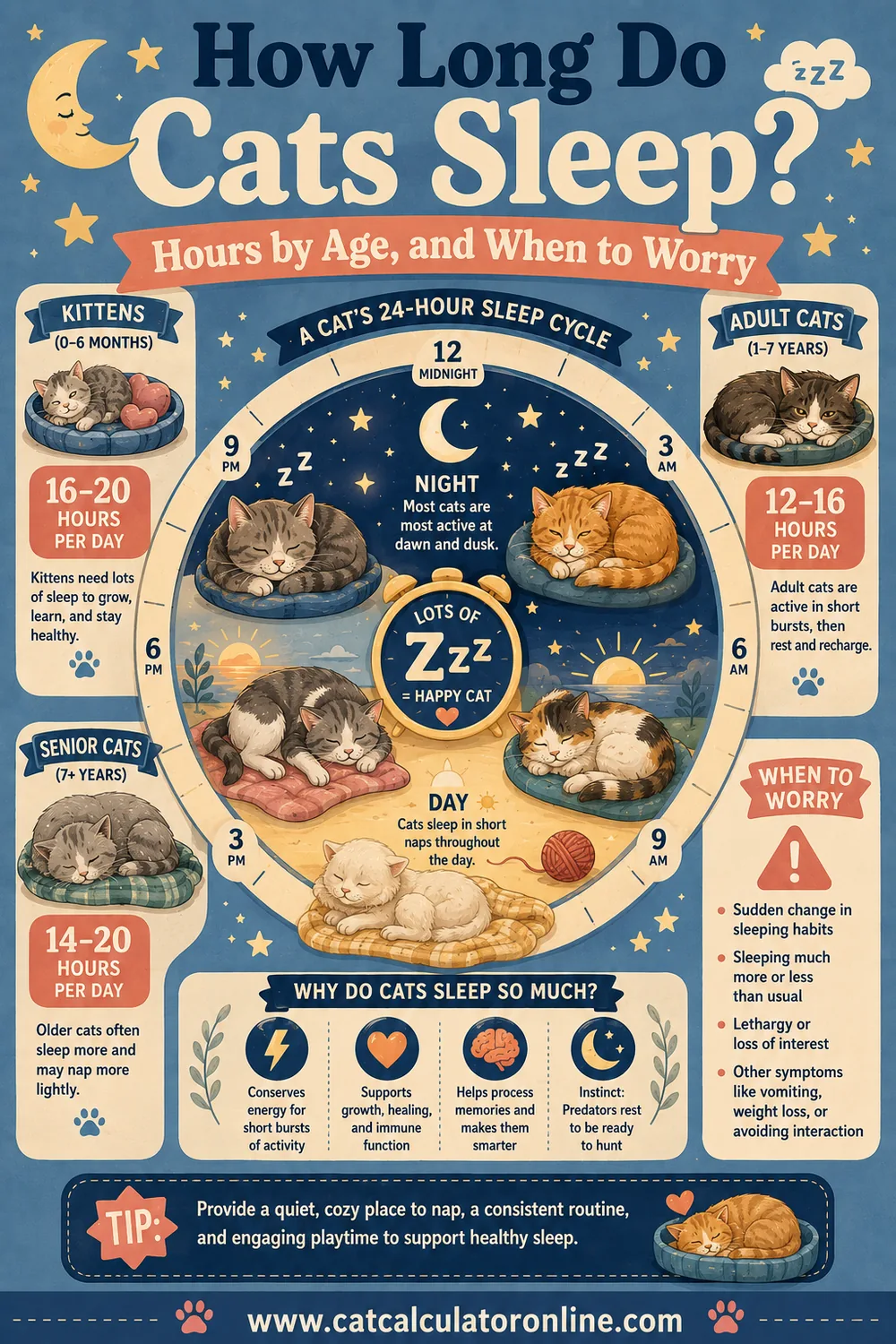
Most cats sleep roughly 12 to 16 hours a day. Kittens and senior cats sleep even more — often close to 20 hours. That's normal, not laziness: cats are crepuscular predators built for short bursts of intense activity separated by long stretches of rest.
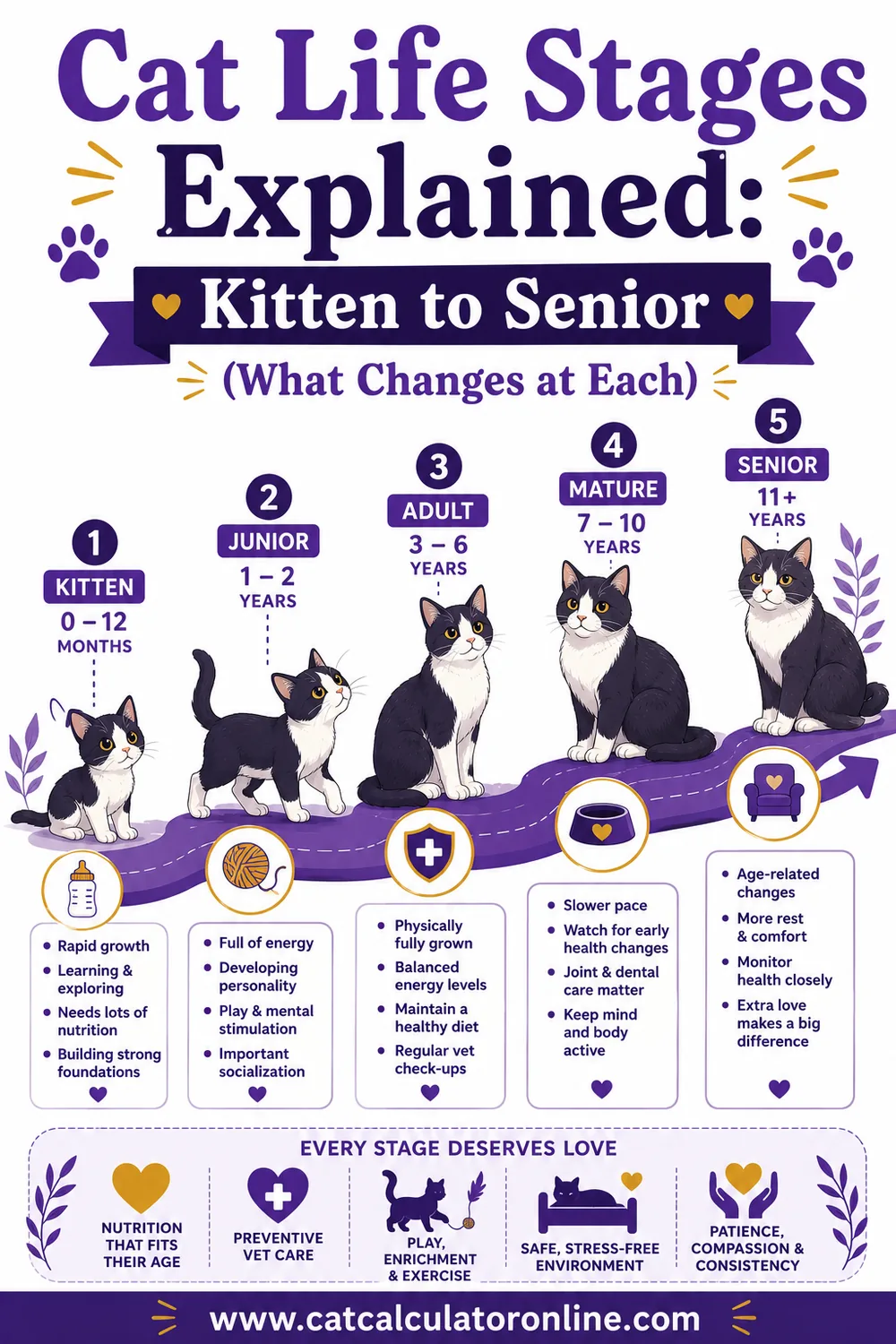
Because sleep needs shift with age, knowing where your cat sits on the life-stage map helps you judge what's normal for her. Our free cat age calculator converts her age to human years and shows her current life stage in one tap.
🐾 How much should your cat be sleeping?
Tap your cat’s age to see the typical daily sleep range:
Tap an age above to see the typical sleep range.
Key Takeaways
- Adult cats: about 12 to 16 hours of sleep a day is normal.
- Kittens and seniors: often close to 20 hours a day.
- Most of it is light sleep. Cats doze with their ears switched on and can be awake in an instant.
- Dawn and dusk are "go" time. Cats are crepuscular, so early-morning activity is normal.
- Change matters more than the number. A sudden shift from your cat's own normal is the real signal to call the vet.
The Short Answer, and Why It Varies
The commonly cited figure for a healthy adult cat is 12 to 16 hours of sleep in a 24-hour period. Kittens and seniors push toward 20.
That's a wide range, and the width is the point. Sleep in cats isn't a fixed requirement so much as a default state they fall into whenever nothing more interesting is happening. Individual cats vary by several hours depending on temperament, household activity, whether they go outdoors, how much they're played with, and what the weather's doing. Cold, gray days produce measurably sleepier cats. So do quiet houses.
What matters far more than the exact number is your cat's own baseline. A cat who's slept 14 hours a day for five years and suddenly sleeps 20 is telling you something. A cat who's always slept 18 probably isn't.
Typical Sleep by Life Stage
| Life stage | Age | Typical sleep per day | What's driving it |
|---|---|---|---|
| Newborn | 0–8 weeks | ~20 hours | Growth; sleep is where development happens |
| Kitten | 2–6 months | 16–20 hours | Extreme play bursts followed by hard crashes |
| Adolescent | 6–12 months | 15–18 hours | Settling into an adult rhythm |
| Young adult | 1–6 years | 12–16 hours | Peak energy, most consistent pattern |
| Mature adult | 7–10 years | 13–17 hours | Gradual slowing, slight upward drift |
| Senior | 10+ years | 16–20 hours | Lower energy, stiffer joints, less stimulation |
Two patterns worth noticing. First, the curve is U-shaped — very young and very old cats sleep most, with the middle of life the most alert. Second, the changes should be gradual. A senior cat drifting from 15 hours to 18 over a couple of years is aging. A seven-year-old going from 14 to 20 hours in two weeks needs a vet.
For a fuller picture of what shifts at each stage, read cat life stages explained.
Why Cats Sleep So Much
It's easy to read all that sleeping as an unusually good deal your cat has negotiated. It's actually straightforward biology.
They're built for burst hunting. A cat's ancestors ate by stalking and then exploding into a chase lasting a few seconds. That style of hunting is enormously expensive in energy and mostly unsuccessful — a lot of failed attempts per meal. Conserving energy between attempts isn't optional, it's the strategy.
Meat is efficient fuel. Cats are obligate carnivores. A protein-and-fat diet delivers a lot of energy per meal, so there's no need to graze constantly the way a grazing animal must. Eat, then rest.
Most of it isn't deep sleep. A large share of feline sleep is light dozing — the cat is resting but her ears keep swivelling toward sounds, and she can be fully alert and moving in a fraction of a second. Genuine deep sleep, including REM, comes in shorter stretches inside those longer rest periods. That's why "16 hours of sleep" doesn't mean sixteen hours of oblivion.
There's often nothing else to do. Indoor cats in quiet houses sleep more than cats with windows to watch, other pets to bother, and people who play with them. Some of what looks like sleepiness is genuinely boredom, which is fixable.
Light Sleep vs Deep Sleep: Are Cats Really Asleep?
Watch a sleeping cat for a few minutes and you will notice that "asleep" covers a lot of different states. Like people, cats cycle between lighter and deeper stages of sleep.
The cat nap: light sleep
Most of a cat's sleeping hours are spent in light sleep, the classic cat nap. Her eyes are closed or half-closed, but her ears still turn toward sounds, and her body is often in a loaf or a loose curl so she can spring up quickly. If a bag rustles in the kitchen, a cat in light sleep is usually on her feet before you have finished opening it.
Deep sleep and REM
Mixed into those naps are shorter stretches of deep sleep, including REM (rapid eye movement) sleep. During REM, the muscles relax more fully. This is when you are most likely to see a cat stretched out on her side, with twitching whiskers, paddling paws, flicking ears, or tiny chirps and squeaks. In people, REM is the stage most linked with dreaming, which is why it is widely believed that cats dream too. Our guide on whether cats dream looks at this in more detail.
Why the difference matters
- Let deep sleepers lie. A cat in deep sleep can be startled and grumpy if woken suddenly. If you need to move her, speak softly first.
- Twitching is normal. Small twitches during deep sleep are not a seizure. A seizure usually involves stiff, rhythmic jerking, drooling, or loss of bladder control, and the cat does not respond to her name. If you ever see that, call your vet right away.
- Long hours, light rest. Because so much of her sleep is light, a cat needs more total hours than you might expect to get the deep rest she needs.
Crepuscular: Why Your Cat Wakes You at 4am
Cats aren't nocturnal, despite the reputation. They're crepuscular — most naturally active around dawn and dusk.
That's a hunting adaptation. Low light suits a cat's eyes far better than it suits the eyes of the small mammals and birds they hunt, and dawn and dusk are exactly when those prey species tend to be moving. Millions of years of that scheduling doesn't unwind because a cat now lives in a flat and eats from a bowl.
So the natural rhythm looks something like:
- Pre-dawn to early morning: peak activity. Zoomies, patrolling, demanding breakfast.
- Mid-morning to afternoon: the long sleep block. Often the deepest rest of the day.
- Late afternoon to evening: second activity peak. Play, hunting behavior, social time.
- Night: mostly sleeping, with wake-ups — cats don't sleep through the night in one block the way we try to.
Surviving the 4am zoomies
If the pre-dawn wake-up call is ruining your life, a few things genuinely help:
- Play hard in the evening. A proper 15-minute wand session that ends with a real "catch" satisfies the hunting sequence in a way a scattered five minutes doesn't.
- Feed a meal right after that play. Hunt, catch, eat, groom, sleep — that's the natural chain, and running it before bed pushes her rest block later.
- Use a timed feeder for early morning. If breakfast arrives from a machine at 5am, you stop being the vending machine, and the sunrise campaign against your face loses its point.
- Don't reward the wake-up. Getting up to feed her — even once — teaches her the strategy works. Cats are excellent learners on this specific point.
- Leave something to do at night. A puzzle feeder or a few treats hidden around the room gives her a target that isn't you.
- Consider a second cat, carefully. Two cats often burn their dawn energy on each other. It's a big commitment, though, not a quick fix.
Do Cats Sleep More Than Dogs and Wild Cats?
Cats have a well-earned reputation as champion sleepers, but they are not alone. Here is how the house cat compares with a few familiar animals. These are the commonly cited ranges, and individuals vary.
| Animal | Typical sleep or rest per day | Why |
|---|---|---|
| House cat (adult) | About 12 to 16 hours | Burst hunter that saves energy between short, intense bouts of activity |
| Kittens and senior cats | Up to about 20 hours | Growth in kittens; lower energy and stiffer joints in seniors |
| Adult dog | Roughly 12 to 14 hours, often cited | Also a predator, but bred to work alongside people during the day |
| Lion | Often reported to rest up to around 20 hours | Big hunts burn huge amounts of energy, and hot days favor resting |
| Adult human | 7 to 9 hours recommended | One long block of sleep, mostly at night |
Two things stand out. First, the cats, big and small, sit near the top of the list, and it is for the same reason: hunting in short, explosive bursts is tiring, and resting in between is how they make it work. Second, cats split their sleep into many short naps across the day and night, while people try to get all of theirs in one long block. That mismatch is exactly why your cat is wide awake when you are trying to sleep.
Outdoor cats often spend more of their waking hours patrolling, exploring, and hunting, while indoor cats with little to do may sleep more out of boredom. If you have both a cat and a dog, you may notice the dog naps when you are home and quiet, while the cat keeps her own dawn-and-dusk schedule no matter what you are doing.
Sleep Positions and What They Mean
Cat sleeping positions are one of the more charming things about living with one, and they do carry information.
- Curled in a tight ball, tail over nose. Conserving heat and protecting the vital organs. The classic. Often means she's cold, or in a slightly exposed spot.
- Loaf position, paws tucked underneath. Resting but not committed. She can be up instantly. This is dozing, not deep sleep.
- Belly up, legs everywhere. Maximum vulnerability, which means maximum trust in her surroundings. A cat who sleeps belly-up in your living room feels genuinely safe. (Note: an exposed belly is not usually an invitation to rub it.)
- Side sleeping, fully stretched out. Deep, relaxed sleep, and often a sign she's warm — stretching out sheds heat.
- Face hidden under a paw or pressed into a cushion. Blocking light so she can sleep more deeply. Also just very sweet.
- Squeezed into a box, sink, or bag. Enclosed spaces feel secure and hold body warmth. Boxes aren't a joke to cats; they're a stress reducer.
- Perched high up on a shelf or wardrobe. Height means safety and a good view. Common in multi-pet homes.
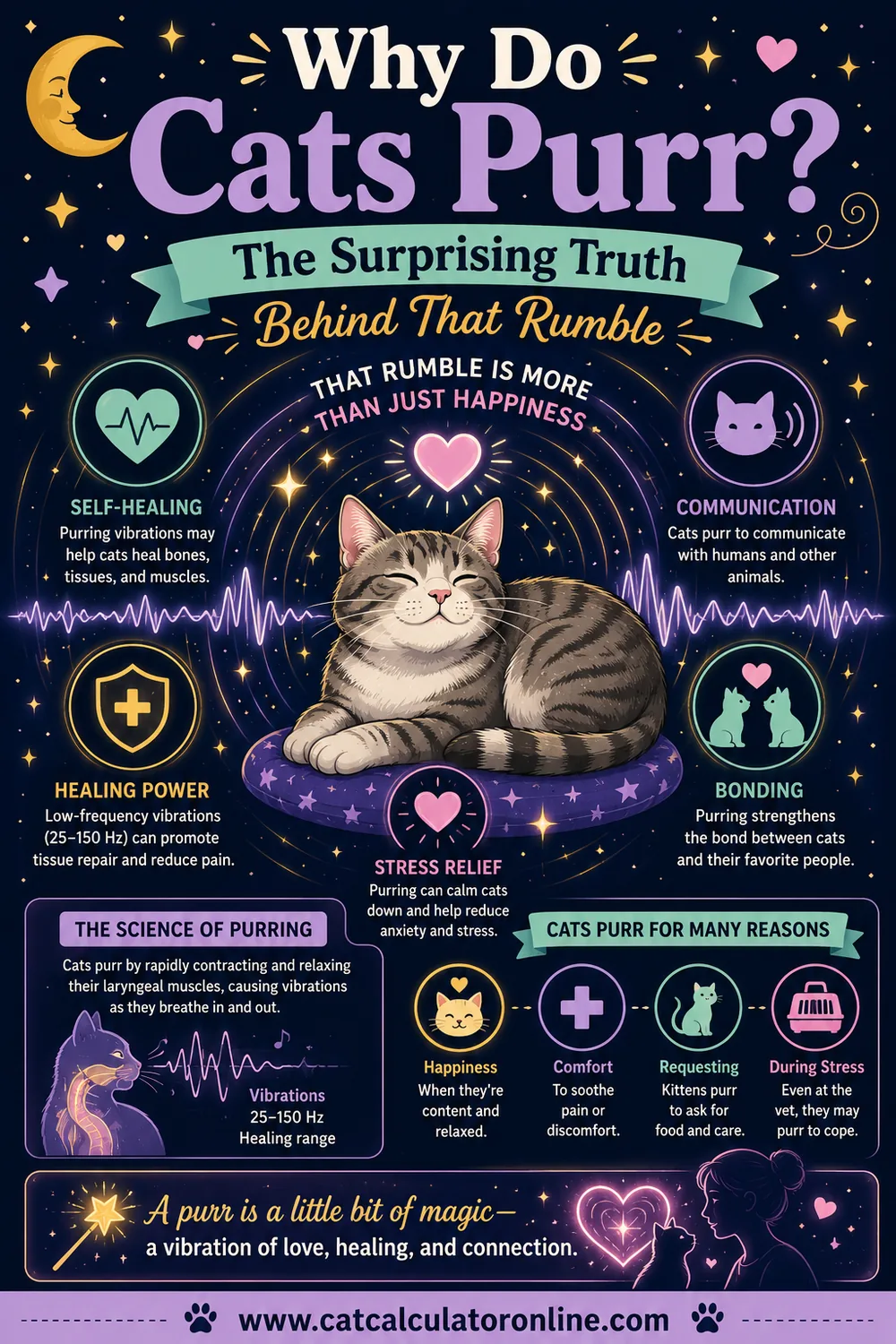
- Pressed against you. Warmth plus social bonding. Cats sleep near companions they trust — often accompanied by purring, which we cover in why do cats purr.
None of these are cause for concern on their own. A cat who suddenly changes her preferred position — especially one who stops curling up, or who starts sleeping hunched with her feet under her and won't settle — may be uncomfortable, and that's worth noticing.
Where Cats Choose to Sleep, and Why
Cats are picky about location and their reasons are consistent:
- Warmth wins. Sunbeams, radiators, laptops, a warm closet. A cat's comfortable temperature range sits above ours, so spots that feel too warm to you often feel right to her.
- Height means safety. An elevated perch gives a full view of the room and puts her out of reach. Cat trees and cleared shelf space get used far more than owners expect.
- Enclosure means security. Boxes, under beds, inside wardrobes. A covered bed suits anxious cats better than an open cushion.
- Near you, but not always on you. Plenty of cats want the same room rather than the same lap.
- Away from traffic. Nobody sleeps well next to a doorway everyone walks through.
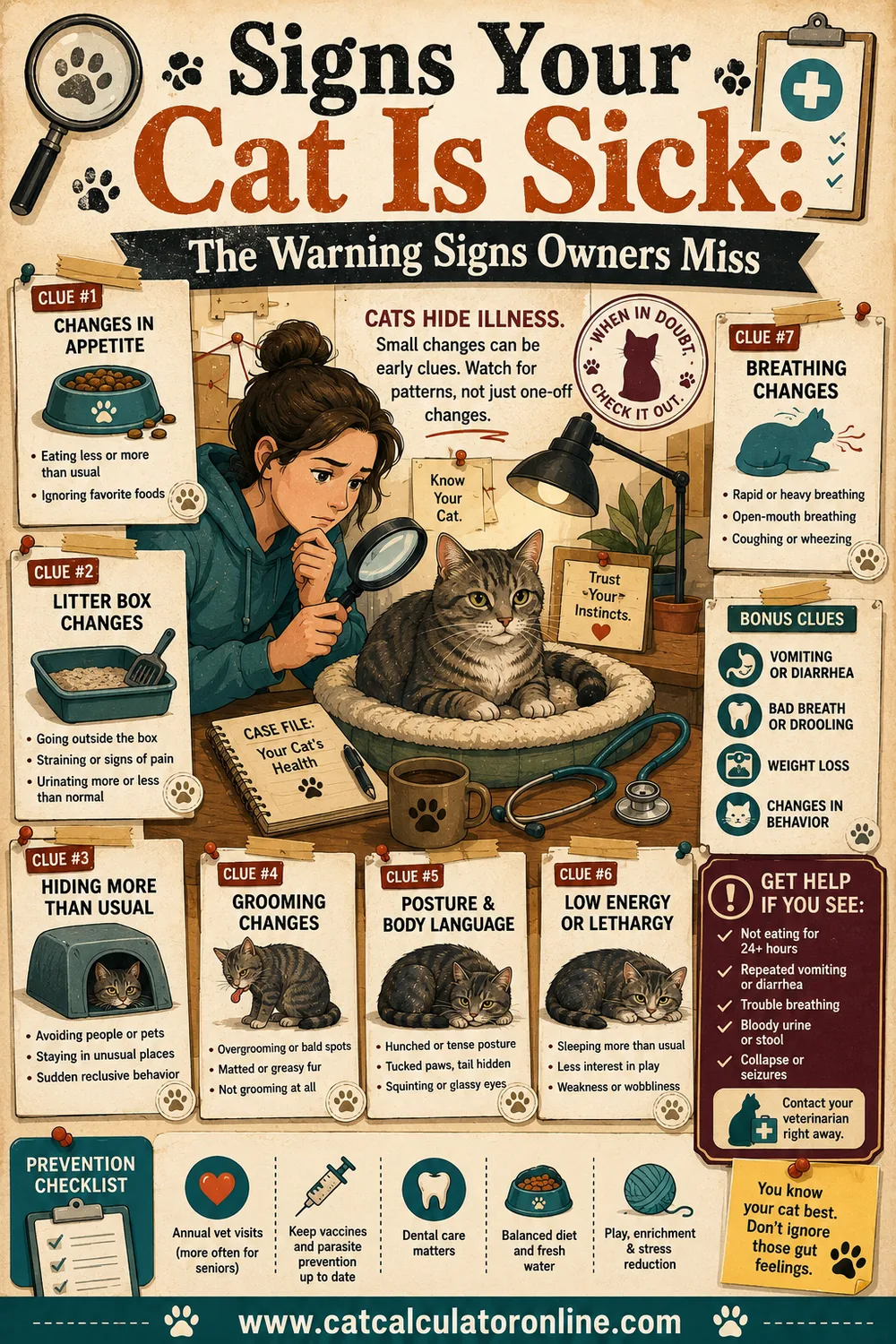
If your cat suddenly abandons a favorite spot for somewhere isolated and dark, take note. Hiding is one of the most common signs of a cat feeling unwell — see signs your cat is sick.
When a Change in Sleep Means See the Vet
This is the section that actually matters. Cats hide illness extremely well, and sleep is one of the earliest places a problem shows up. Contact your vet if you notice any of the following.
Sleeping much more than usual
A clear, sustained increase over her normal baseline — several extra hours a day for more than a couple of days — can accompany pain, infection, kidney disease, anemia, or arthritis making movement unappealing. Take it more seriously if it comes with eating less, drinking more, or weight loss.
Sleeping much less, or unable to settle
A cat who can't get comfortable, shifts constantly, or paces is worth a look. Restlessness can point to pain, an overactive thyroid, or high blood pressure.
Night-time yowling in an older cat
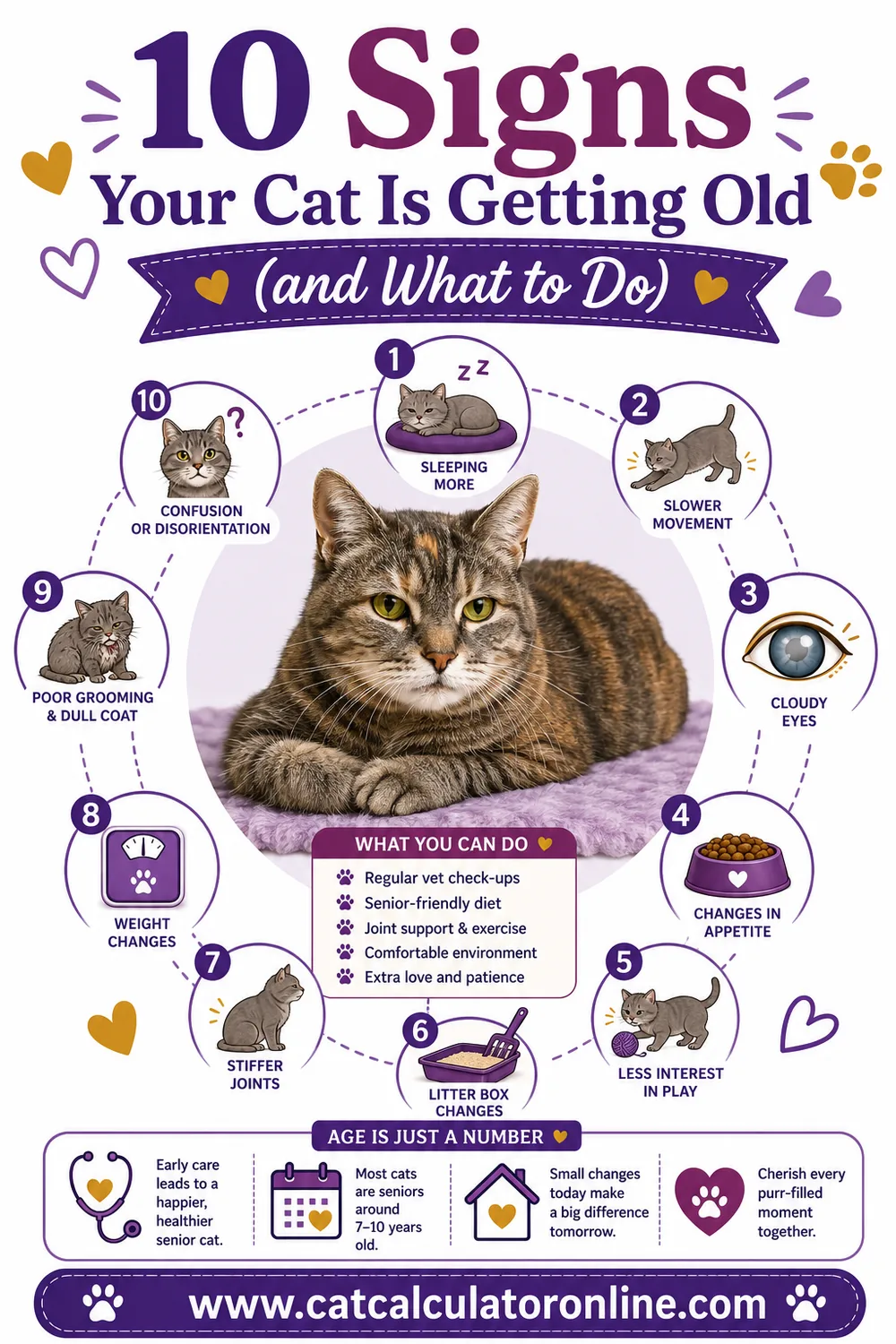
Common, distressing, and often treatable. In seniors, night vocalizing and disrupted sleep can relate to cognitive changes, hyperthyroidism, high blood pressure, or declining vision and hearing. Don't write it off as "she's just old" — several of the causes respond well to treatment. Our guide to signs your cat is getting old covers the wider set of changes.
Sleep plus other changes
Sleep alone rarely tells the whole story. Escalate faster if you also see:
- Eating noticeably less, or not at all — cats can become seriously ill from even a short period without food
- Drinking or urinating much more than usual
- Hiding in unusual places
- Labored, fast, or open-mouth breathing — this is urgent
- Reluctance to jump up, or missing jumps she used to make easily
- A change in litter box habits
- Grooming much less, leaving a dull or matted coat
Very sleepy plus unresponsive, cold, or difficult to rouse is an emergency. That's lethargy rather than sleep, and it needs same-day veterinary attention.
None of this is a diagnosis — it's a list of reasons to make a phone call. If you're unsure how often your cat should be seen anyway, when is a cat considered senior explains why vets step up to twice-yearly checkups around age 10.
Health Conditions That Change Cat Sleep
Many common feline health problems show up first as a change in sleep. This table is a quick reference, not a diagnosis. If you recognize your cat in it, the next step is a call to your vet.
| Condition | What it can do to sleep | Other signs to watch for |
|---|---|---|
| Hyperthyroidism | Less sleep, restlessness, night-time yowling | Weight loss despite a big appetite, drinking more, mostly in middle-aged and older cats |
| Arthritis | More sleep, trouble getting comfortable, sleeping in lower spots | Missing jumps, stiffness after rest, grooming less |
| Chronic kidney disease | More sleep and general tiredness | Drinking and urinating more, weight loss, poor appetite |
| Diabetes | Lethargy and more sleep | Drinking and urinating much more, weight loss, a changed walk in the back legs |
| Dental disease | Sleeping more and withdrawing | Bad breath, drooling, dropping food, chewing on one side |
| High blood pressure | Restlessness and night vocalizing | Often found alongside kidney or thyroid disease in older cats; sudden vision changes |
| Cognitive decline in senior cats | Broken night sleep, sleeping more by day | Seeming lost, yowling at night, forgetting the litter box |
| Infection or fever | Sudden heavy sleepiness | Hiding, not eating, feeling warm to the touch |
| Pain of any kind | Sleeping hunched, unable to settle, or sleeping far more | Hiding, squinting, a change in temper. See how to tell if a cat is in pain |
The pattern to remember is simple: a change from her normal, plus one other sign, is worth a vet visit. Older cats are more likely to have one of these conditions, which is one reason vets recommend more frequent checkups as cats age. Our senior cat health checklist covers what to keep an eye on.
How to Support Healthy Cat Sleep
You can't make a cat sleep less, and you shouldn't try. But you can make her waking hours better, which usually improves the sleeping ones too.
- Play twice a day, properly. Two focused sessions with a wand toy, ending in a catch, do more for a cat's wellbeing than a toy basket she ignores.
- Feed after play. It follows the natural hunt-eat-sleep sequence and helps set a rhythm.
- Give her good options. A warm bed, a high perch, an enclosed hideaway, and a window view cover every sleeping preference a cat has.
- Protect her sleep. Don't wake a sleeping cat for cuddles. Interrupted deep sleep leaves cats irritable, same as anyone.
- Enrich the environment. Puzzle feeders, cardboard boxes, a rotating handful of toys, and a bird-friendly window all reduce the boredom-sleeping that fills an under-stimulated cat's day.
- Keep a rough log if something feels off. A week of notes on hours slept, appetite, and litter box use turns "she seems tired lately" into something your vet can actually work with.
How to Find Your Cat's Normal Sleep Baseline
Averages are useful, but the most helpful number is your own cat's normal. You do not need any special gear to find it. A simple notebook or a note on your phone is enough.
- Pick a calm week. Avoid weeks with visitors, travel, or a move, so you see her everyday pattern.
- Check in a few times a day. Note whether she is asleep, resting, or active in the morning, at midday, in the evening, and before bed. You do not need to watch her all day.
- Add three quick notes. Appetite (normal, less, more), litter box (normal or not), and mood (normal, quiet, restless).
- Look for her pattern. After a week, you will know her usual nap spots, her active times, and roughly how much of the day she spends asleep.
- Repeat once or twice a year. A quick check each spring and fall shows slow changes as she ages.
A simple log can look like this:
| Day | Morning | Midday | Evening | Night | Appetite and litter box |
|---|---|---|---|---|---|
| Monday | Active, ate breakfast | Asleep on bed | Played 15 min | Asleep, up at 5am | Normal |
| Tuesday | Active | Asleep in sunbeam | Resting on cat tree | Asleep | Normal |
If something ever feels off, a log like this turns "she seems tired lately" into clear notes your vet can use. It also pairs nicely with a quick check of her life stage on the cat age calculator, since what counts as normal shifts as she moves from adult to senior.
Do Cats Sleep More in Winter or After a Move?
Yes, both can change how much a cat sleeps, and both are usually normal.
- Cold and gray weather: many cats sleep more on cold, cloudy days and seek out warm spots like sunny windows, heating vents, and your bed. A warm, draft-free bed helps, especially for older cats with stiff joints.
- Hot weather: cats often nap stretched out on cool floors and become more active in the cooler early morning and evening.
- A new home: after a move or adoption, some cats hide and sleep a lot at first, while others are too alert to rest much. Many shelters use the "3-3-3 rule" as a rough guide: about three days to decompress, three weeks to learn the routine, and three months to feel fully at home. Our guide to helping a cat settle into a new home has practical tips.
- A new kitten: very young kittens sleep in short, frequent bursts around the clock. See how much do kittens sleep for an age-by-age guide.
The same rule applies here as everywhere else on this page: if the extra sleep comes with eating less, hiding for days, or any of the warning signs above, check in with your vet.
FAQ
How many hours a day do cats sleep?
Most adult cats sleep 12 to 16 hours a day. Kittens and senior cats often reach around 20. Much of that is light dozing rather than deep sleep, which is why a "sleeping" cat can be alert instantly.
Do cats sleep more as they get older?
Yes, generally. Senior cats commonly sleep 16 to 20 hours as energy drops and joints stiffen. The change should be gradual, though — a sudden jump in sleep, or restlessness and yowling at night, is worth a vet visit rather than being written off as old age.
Why is my cat awake at 4am?
Cats are crepuscular, meaning they're naturally most active around dawn and dusk. Pre-dawn activity is normal biology, not misbehavior. A hard play session and a meal in the evening, plus a timed feeder for early morning, usually help.
Is it normal for a kitten to sleep 20 hours a day?
Yes. Very young kittens sleep close to 20 hours because growth and development happen during sleep. Expect the pattern to be lumpy — wild bursts of play followed by sudden, total collapse.
Do cats dream?
Almost certainly. Cats have REM sleep, the phase associated with dreaming in humans, and you can often see it: twitching whiskers and paws, flicking ears, quiet chirps. It's normal, and it's best left uninterrupted.
When should I worry about my cat sleeping too much?
When it's a clear change from her own normal, when it lasts more than a day or two, or when it comes with eating less, hiding, drinking more, breathing oddly, or trouble jumping. A cat who's hard to rouse needs same-day veterinary attention.
Do indoor cats sleep more than outdoor cats?
Often, yes — usually because there's less to react to. Some of that extra sleep is genuine rest and some is boredom. Adding vertical space, window views, puzzle feeders, and daily play gives an indoor cat more reason to be awake.
Do cats sleep 70% of their lives?
Roughly two-thirds is a fair estimate for an adult cat. Twelve to sixteen hours is about 50 to 67 percent of each day, and kittens and seniors who sleep close to 20 hours spend even more of the day asleep. So the "70 percent" figure you may have heard is in the right range, especially across a whole lifetime.
Is it normal for cats to sleep all day?
For many cats, sleeping through most of the day is normal, especially between mid-morning and late afternoon. What is not normal is a cat who will not wake up for food or play, sleeps far more than she used to, or seems weak or unresponsive when she is awake. Those changes are worth a call to your vet.
What is the 3-3-3 rule with cats?
The 3-3-3 rule is a rough guide many shelters share for newly adopted pets: about three days to decompress, three weeks to learn the household routine, and three months to feel fully at home. During the first few days, a new cat may hide and sleep a lot, which is usually normal.
Do cats sleep more in winter?
Many do. Cold, gray days tend to make cats sleepier, and they will seek out warm spots to nap in. A slight increase in sleep in winter is normal. A big, sudden increase that comes with other changes is not, and should be checked by your vet.
The Bottom Line
Twelve to sixteen hours a day is normal for an adult cat, with kittens and seniors closer to twenty. It's the natural pattern of a crepuscular burst hunter, not a sign of laziness or illness. What matters is your cat's own baseline — sudden changes in how much she sleeps, or restlessness and night-time yowling in an older cat, are worth a call to your vet.
Want to know where your cat sits on the curve? Our free cat age calculator gives you her age in human years and her life stage in one tap. From there, cat life stages explained and signs your cat is getting old will tell you what to expect next.