Kitten Vaccination Schedule (First Year)
The single most misunderstood thing about kitten vaccination is why it takes several visits. A kitten is not protected by her first injection — she is protected by the last one in the course, and that is why vets repeat the vaccine every three to four weeks until she is at least sixteen weeks old. The reason is antibodies inherited from her mother, which fade at an unpredictable age and can neutralise a vaccine given while they are still circulating. Nobody can tell by looking when that happens, so the course is repeated until it certainly has. Work out exactly where your kitten sits in her first year with the free cat age calculator.
When Does the Kitten Vaccination Course Start?
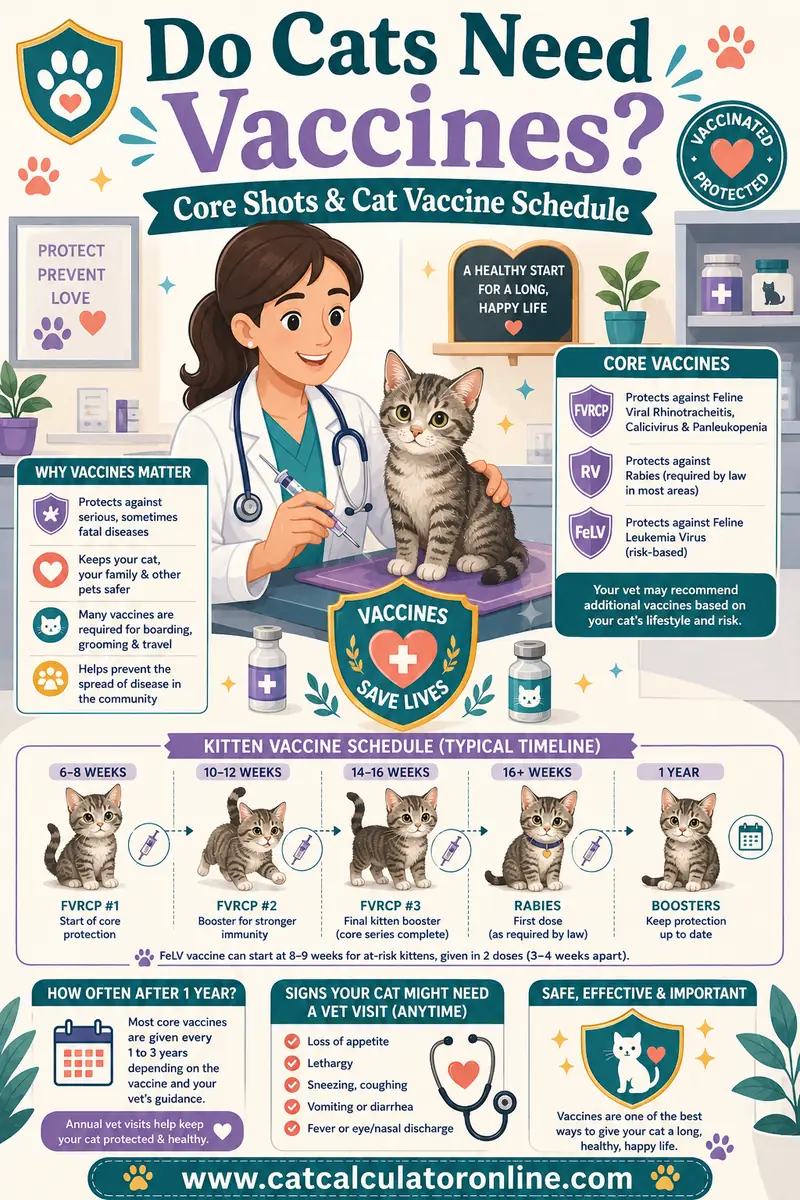
Most kittens have their first injection somewhere between six and eight weeks old.
Eight weeks is the usual starting point in practice. Many kittens are still with the breeder or rescue at that age, and the first dose is often given before they are rehomed. Some practices start at six weeks, particularly for kittens in a rescue or multi-cat environment where disease exposure is higher.
Starting earlier than six weeks is generally not useful. Maternal antibody levels are still high, and the vaccine is very likely to be neutralised before it does anything. There are specific high-risk situations where a vet will start earlier anyway; that is a decision for the practice, not a default.
The start date matters far less than the finish date. A kitten that begins at six weeks and one that begins at nine weeks can end up equally well protected, because what determines protection is when the last dose lands.
Ask the breeder or rescue for the vaccination card. It records the product used, the batch and the dates. Your vet needs it to continue rather than restart the course, and it saves you paying for a dose your kitten has already had.
Book the next appointment before you leave. Kitten vaccination visits fall three to four weeks apart, and practices book up. Slipping the interval is the commonest way a course goes wrong.
Why One Injection Is Not Enough
This is the part almost nobody explains properly, and it is the whole logic of the schedule.
Kittens are born with borrowed immunity. Antibodies pass from the queen to her kittens, mostly in the first milk, and they protect the kitten through the earliest weeks when its own immune system is not yet capable.
Those same antibodies block vaccines. A vaccine works by presenting the immune system with something to react to. Circulating maternal antibody mops up the vaccine before the kitten's own immune system registers it. The injection is given, and nothing happens.
They fade at an unpredictable age. In some kittens maternal antibody is gone by eight or nine weeks; in others it persists past twelve, occasionally to sixteen. It depends on the queen's own antibody levels and how much colostrum that individual kitten drank.
Nobody can tell which kitten is which without testing. In routine practice there is no blood test done to check, so the schedule is designed around the worst case.
Hence the repeat doses. Each dose is another attempt. Repeating every three to four weeks until at least sixteen weeks means that whenever the maternal antibody happened to fade, at least one dose landed in the window where it could work.
The "window of susceptibility" is the risky bit. There is a period in every kitten where maternal antibody has dropped too low to protect but is still high enough to block a vaccine. That is precisely why an unfinished kitten must be kept away from unvaccinated cats and unfamiliar environments.
The Core Kitten Vaccines
Core means recommended for every kitten, everywhere, regardless of lifestyle.
Feline panleukopenia (feline infectious enteritis, feline parvovirus). The most serious of the three. It causes severe vomiting, diarrhea and collapse, is frequently fatal in kittens, and the virus is exceptionally hardy — it survives in the environment for months and resists many disinfectants. This is the vaccine that matters most, and the reason indoor-only cats still need vaccinating.
Feline herpesvirus type 1 (feline viral rhinotracheitis). One of the two main causes of cat flu. It causes sneezing, conjunctivitis, ulcers and, in kittens, permanent eye damage. Vaccination does not prevent infection outright — it substantially reduces the severity — and the virus persists for life once caught, flaring at times of stress.
Feline calicivirus. The other main cat-flu agent, causing oral ulceration, lameness and respiratory signs. Like herpesvirus, the vaccine reduces severity rather than guaranteeing the kitten never catches it. Multiple strains circulate, which is why breakthrough cases still occur.
These three usually come as a single combined injection. You will see it written as FVRCP, or as F3, or simply "the first vaccination". One injection, three components.
Rabies, where law or travel requires it. In the United States rabies vaccination is a legal requirement in most states, typically given from twelve to sixteen weeks with a booster a year later. In the UK and Ireland it is not routine, and is given only for pet passport travel — not before twelve weeks of age.
Whether cats need any of this at all is a question some owners still ask; do cats need vaccines answers it, including the indoor-cat argument.
Non-Core Vaccines: FeLV and the Rest
Non-core does not mean optional in every case — it means risk-based.
Feline leukaemia virus (FeLV) is the important one. It is spread by prolonged close contact, mutual grooming, shared bowls, bites and from queen to kitten. It suppresses the immune system and causes lymphoma; infected cats often die within a few years of diagnosis.
Kittens are more susceptible than adults. Age-related resistance develops as cats mature, so a kitten exposed to FeLV is considerably more likely to become persistently infected than an adult would be. For that reason many guidelines advise vaccinating all kittens against FeLV, even if the plan is to keep the cat indoors — because plans change, and a cat that escapes at eighteen months is protected if she was done as a kitten.
FeLV vaccination normally means two doses, given two to four weeks apart, usually starting from around eight to nine weeks, with a booster at a year. A blood test to confirm the kitten is not already infected is often done first.
Chlamydia felis and Bordetella are given selectively — typically in breeding colonies, rescue centers or multi-cat households with a known problem, rather than to an average single kitten.
FIV vaccination is not universally available and its use is limited and debated. It is a conversation for your vet in areas where it exists.
Ask specifically what is included in the price you have been quoted. FeLV is frequently an add-on rather than part of the standard kitten course; how much do cat vaccinations cost breaks down what tends to be bundled and what is charged separately.
The First-Year Schedule at a Glance
Typical timings. Your vet may adjust them for your kitten's circumstances, the product used and local guidance.
| Kitten age | What normally happens |
|---|---|
| 6–8 weeks | First core vaccination (panleukopenia + herpesvirus + calicivirus). First worming doses already underway. |
| 9–12 weeks | Second core dose, three to four weeks after the first. First FeLV dose often given here. |
| 12–16 weeks | Third core dose. Second FeLV dose. Rabies where legally required. Microchipping often done at one of these visits. |
| 16 weeks or later | Final kitten core dose — this must fall at 16 weeks of age or older. Some protocols run a dose at 20 weeks in higher-risk kittens. |
| 1–2 weeks after the final dose | Immunity considered established. Safe point for outdoor access, cattery stays and meeting unknown cats. |
| 4–6 months | Neutering typically discussed and often carried out. |
| Around 12 months | First booster, consolidating the primary course. |
Three or four doses is normal, depending on whether the kitten started at six weeks or eight. Do not be surprised by a fourth appointment.
The rest of the first-year timetable — worming, flea treatment, microchipping, weight checks — is set out in the new kitten checklist, and the visit frequency across her whole life is in how often a cat should go to the vet.
When Is a Kitten Actually Protected?
Not on the day of the last injection, which catches a lot of owners out.
Allow one to two weeks after the final kitten dose. The immune response takes that long to develop properly. A kitten let outside the afternoon of her last appointment is effectively unvaccinated.
Until then, no unsupervised outdoor access. No garden roaming, no meeting neighborhood cats, no cattery, no cat cafés, no shows.
Visitors count too. Someone who has been handling an unvaccinated or unwell cat can carry panleukopenia in on their clothes and shoes. It is a hardy virus and it does not need a cat to travel.
Carrying her into the garden is usually fine, held or in a secure harness, on your own ground, away from other cats. Socialization matters and the sensitive period for it closes early — the compromise is controlled exposure, not isolation.
Vet visits are safe. Practices are set up for this. Keep her in the carrier in the waiting room rather than on the floor.
Neutering timing interacts with this, since most kittens are neutered a little after the course completes; when to neuter a cat covers the current thinking on age.
Side Effects and What Is Normal
Reactions are common, mild and short-lived. Serious ones are rare.
Expect a quiet evening. Mild lethargy, being slightly off her food, or sleeping more than usual for twelve to twenty-four hours is the usual picture and needs nothing done.
A small tender lump at the injection site can persist for a few days to a couple of weeks. Mention any lump that is still there after three to four weeks, is larger than about three-quarters of an inch (2 cm), or is growing — that is a specific instruction from feline vaccination guidelines, not general caution.
A mild temperature or a single sneeze or two can follow the flu components. Both settle.
Ring the practice the same day if she vomits repeatedly, has diarrhea, is limping and reluctant to move, or seems genuinely unwell rather than subdued.
Go straight in for facial swelling, hives, difficulty breathing or collapse. True anaphylaxis is very uncommon but happens within minutes to a couple of hours, which is one reason vets prefer morning appointments.
Never withhold food because she seems off. Cats should not be fasted, and a kitten missing meals is a reason to call rather than to wait.
Missed Doses, Late Starts and Rescue Kittens
Real life rarely matches the textbook, and most of it is fixable.
A dose given more than about six weeks late usually means the course is restarted rather than continued, because the interval no longer builds on the previous dose. Ring and ask rather than assuming.
A kitten with no records is treated as unvaccinated. Frustrating if she has in fact been done, but the alternative is assuming protection that may not exist.
An older kitten or adult starting from scratch needs fewer doses, not more — maternal antibody is long gone, so two doses three to four weeks apart is the usual adult primary course.
Rescue and stray kittens often start earlier and finish later, because exposure risk is higher and age is frequently an estimate. If your kitten's age was guessed, how old is my cat type calculations and a vet's dental check help pin it down.
Worming runs alongside all of this, on its own separate and much more frequent timetable — the cat worming schedule sets out why kittens are wormed fortnightly from three weeks.
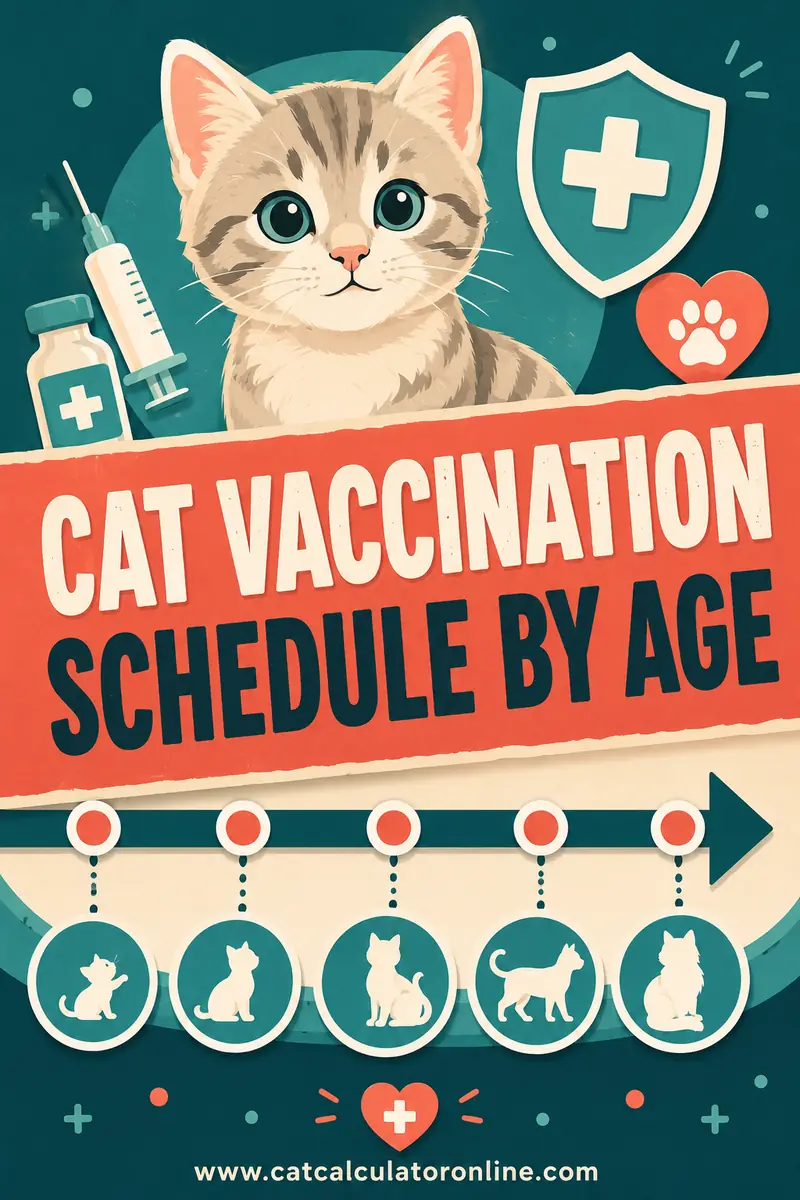
What happens after the first year — booster intervals, which components need repeating annually, and lifetime cadence — is covered in the cat vaccination schedule.
Frequently Asked Questions
At what age do kittens get their first vaccination?
Usually between six and eight weeks old, with eight weeks the most common starting point in practice. Rescue and multi-cat environments sometimes start at six weeks because exposure risk is higher. The start date matters much less than completing the course at sixteen weeks or later.
How many vaccinations does a kitten need in the first year?
Typically three or four core doses spaced three to four weeks apart, finishing no earlier than sixteen weeks of age, then a booster at around twelve months. FeLV adds two doses within that same period, and rabies one where it is legally required.
Why do kittens need boosters every few weeks?
Because antibodies inherited from the mother can neutralise a vaccine before it works, and they fade at an unpredictable age between roughly eight and sixteen weeks. Repeating the dose every three to four weeks ensures at least one lands after those antibodies have gone.
When can my kitten go outside after vaccinations?
One to two weeks after the final dose of the primary course, so realistically from about seventeen to eighteen weeks old. Immunity takes that long to develop, and a kitten let out on the day of her last injection is effectively unprotected.
Do indoor kittens need vaccinating?
Yes. Panleukopenia is extremely hardy and can be carried indoors on shoes and clothing without any cat being involved. Plans also change — cats escape, move house, or need a cattery — and a course completed as a kitten is far simpler than starting later.
What if my kitten misses a vaccination appointment?
A short delay of a week or two is usually absorbed by simply continuing. Beyond about six weeks late, most vets restart the course, because the interval is too long for the next dose to build on the previous one. Ring the practice rather than guessing.
The kitten vaccination schedule looks repetitive because it is designed around something invisible: maternal antibody that blocks vaccines and fades at an unpredictable age. That is why the course runs from six to eight weeks with doses every three to four weeks, and why the final one must fall at sixteen weeks or later. Add FeLV for almost any kitten, rabies where the law requires it, and allow one to two weeks after the last dose before she goes outside. Then book the twelve-month booster. Keep track of where she is in her first year with the free cat age calculator.