At What Age Do Cats Go Into Heat?
Usually between five and nine months old, and sometimes as young as four — which is the part that catches people out, because a four-month-old kitten still looks and behaves like a baby. She can be pregnant while she is still growing herself. The calendar is not really what triggers it either: reaching about 5 lb (2.3 kg), or roughly 80% of her adult size, matters more than the number of months, and breed and time of year shift the date considerably in both directions. That combination is exactly why veterinary advice on neutering has moved earlier over the last two decades. Start by pinning down her age with the free cat age calculator.
The Short Answer
Five to nine months covers most cats. Six months is the single most common answer, and plenty of first heats happen at five.
Four months happens. It is well documented, particularly in early-maturing breeds and in kittens who grow quickly. A kitten of that age weighs perhaps 4.5 lb (2 kg) and looks nothing like an adult cat.
Some cats wait until well past a year. Large, slow-maturing breeds are the usual reason, and a kitten born late in the year is another.
A first heat may be short and vague. Some kittens have a quiet, barely noticeable first cycle — a bit of extra rubbing and restlessness — before the full performance arrives a few weeks later. A silent first heat is still a fertile one.
After the first, the pattern establishes fast. She will cycle roughly every two to three weeks through the season unless she is mated or spayed.
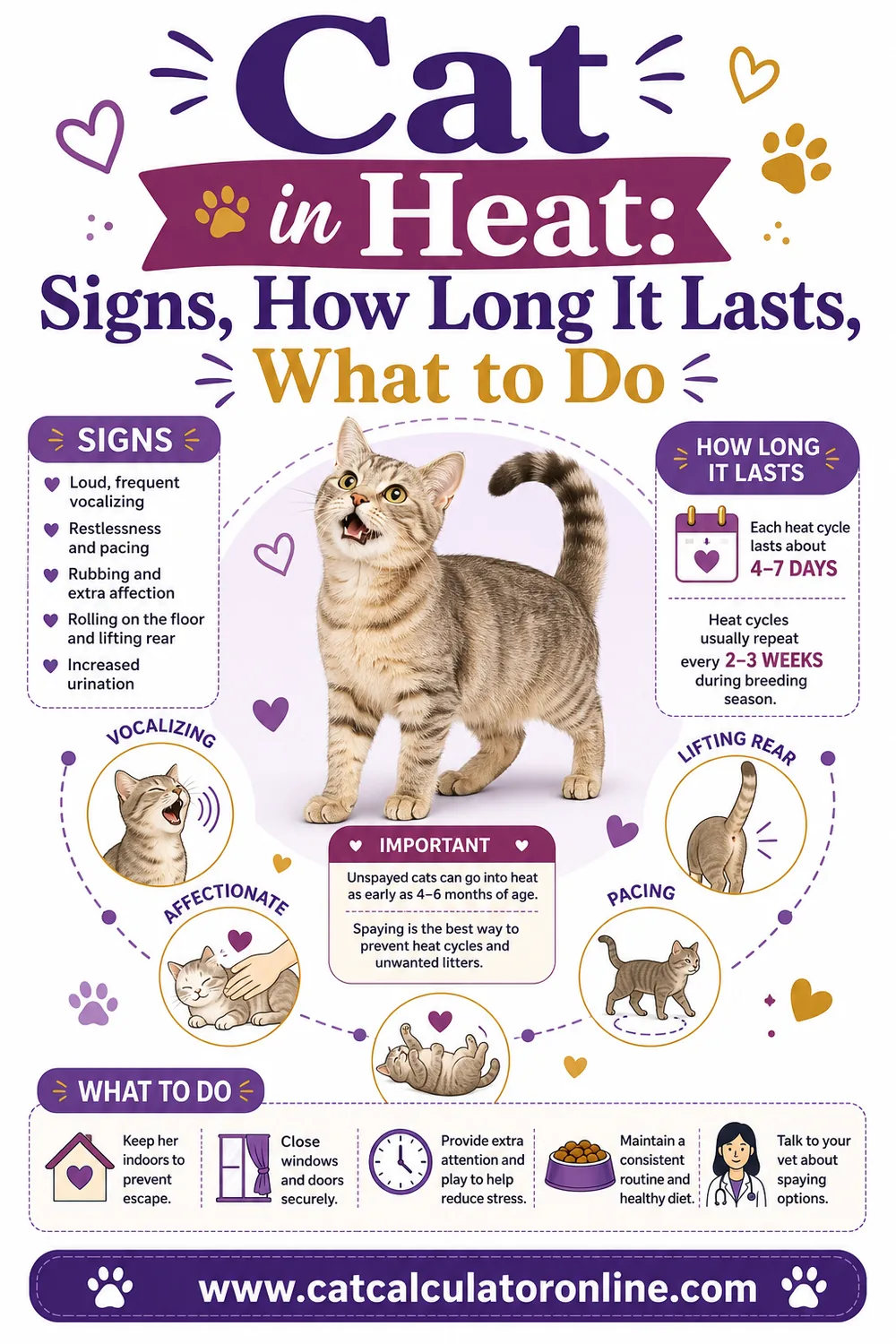
What it looks like is described sign by sign in cat in heat behavior.
Why Body Weight Predicts It Better Than Age
Puberty in cats is a growth milestone rather than a birthday, and thinking of it that way makes the variation make sense.
The usual threshold is around 5 lb (2.3 kg), or approximately 80% of her expected adult body weight. Cross that line in the right season and the cycle switches on.
Fast-growing kittens get there sooner. A well-fed kitten hitting the threshold at four and a half months will cycle earlier than a littermate who grew more slowly.
Underweight or unwell kittens are delayed. Reproduction is the first system the body postpones, so a kitten who has had a rough start may not cycle until much later.
This is why "she is too young" is unreliable. Age tells you very little on its own; weight tells you a great deal.
Track her growth rather than guessing. Our kitten weight calculator shows whether she is on the expected curve for her age, which is also the clearest way to see her approaching the threshold.
Growth continues afterwards, too. Sexual maturity is not the same as being fully grown — most cats are still filling out until around twelve months, and later in big breeds, as covered in when cats stop growing.
Breed Makes a Real Difference
The spread between breeds is wider than most owners expect.
| Breed type | Typical first heat | Why |
|---|---|---|
| Siamese, Burmese, oriental shorthairs | 4 to 6 months | Fast maturing, famously vocal in estrus |
| Domestic shorthair (most cats) | 5 to 9 months | The standard window |
| Bengal, Abyssinian and similar | 5 to 8 months | Active, lean, generally early |
| British Shorthair | 8 to 12 months | Slower to reach adult mass |
| Persian, Ragdoll | 10 to 15 months | Long-haired and slow maturing |
| Maine Coon, Norwegian Forest | 10 to 18 months | Very large adult size takes longer to approach |
These are tendencies, not rules. An individual Maine Coon can surprise you at seven months, and mixed-breed cats fall anywhere across the range.
Coat length correlates loosely with lateness, mostly because long-haired breeds tend also to be large.
Do not use breed to justify delaying neutering, because the exceptions are common enough to matter.
When She Was Born Changes the Timing
This is the factor almost nobody accounts for, and it explains a lot of apparently late kittens.
Cats are long-day breeders. The cycle is switched on by lengthening daylight, and in the northern hemisphere the natural season runs roughly February to October.
A spring kitten usually cycles the same year. Born in March, she reaches puberty weight in August or September while the season is still open, and she cycles.
An autumn kitten often waits. Born in September, she reaches the same weight in February or March — right as the days lengthen — or, if she got there in December, she may simply wait for the season to open.
Indoor kittens frequently ignore all of that. Evening household lighting keeps the cycle running through winter, which is why indoor cats have first heats in December as readily as in June.
So an indoor autumn kitten can absolutely cycle at five months in midwinter, and owners who have been told "not until spring" are caught out.
Assume the earlier date when planning. Being early with the spay costs nothing; being late can cost a litter.
Signs the First Heat Is Coming
There is usually a little warning, if you know what to watch for.
She becomes more affectionate. A sudden increase in rubbing against furniture, door frames and your legs is often the first change.
She gets restless. Pacing, poor settling, and a new interest in what is happening beyond the front door.
She rolls. Repeated rolling on the floor, sometimes for the first time in her life.
She raises her rear when stroked along the lower back, with the tail moved aside and the back feet treading.
Then the calling starts. A long, low, insistent yowl, usually worse at night, and startlingly loud from a small cat.
Cats do not bleed. No blood is involved in a feline heat at any age, and any bleeding is a reason to call your vet rather than a sign of puberty.
She may lose interest in her food for a day or two. That is common during a heat at any age. A kitten who eats nothing at all for 24 hours is a different matter and needs a vet, because cats develop serious liver problems within days without calories — and food should never be withheld to try to influence behavior.
The whole performance may arrive with no warning at all. Plenty of owners report going from a normal kitten to full-volume calling overnight, which is why relying on advance signs to time the neutering appointment is a poor plan.
Yes, a Kitten Can Get Pregnant
This is the practical consequence, and it is worth stating without hedging.
If she is in heat, she is fertile. There is no grace period, and a first heat carries the same pregnancy risk as any later one.
Pregnancy in a very young queen is riskier. She is still growing, and supporting a litter while doing so puts real demands on her. Difficult births are more common in immature and very small queens.
Litters can have more than one father. A queen mating with several toms during a heat can produce a single litter of kittens with different sires.
Siblings are not a safeguard. Entire male littermates become fertile in the same age range and will mate with their sisters. Housing brothers and sisters together past four months without neutering is a common route to an accidental litter.
Cats will also mate with related adults. There is no behavioral block on it.
A cat who has just weaned kittens can conceive again quickly, which is how one young queen ends up with two litters in a year.
What This Means for Neutering
The early first heat is the entire reason neutering guidance has shifted.
The traditional advice was five to six months. That was the standard for decades and is still what many owners remember being told.
Neutering at around four months is now widely recommended by welfare organizations and a growing number of veterinary bodies, because it reliably precedes the first heat.
The old worries have not held up in cats. Concerns that early neutering would stunt growth or cause urinary problems were investigated and not supported. Early-neutered cats grow slightly taller if anything, because the growth plates close later, and urinary blockage rates were not found to increase.
Neutering before the first heat also reduces mammary tumour risk substantially, and the protection is greatest the earlier it is done.
It removes the risk of pyometra entirely, which is a serious uterine infection in entire cats.
Talk to your vet about the right week for your cat, taking her weight and development into account. The whole picture, including recovery and the calorie change afterwards, is in when to neuter or spay a cat.
What About Male Kittens?
Half the equation, and frequently overlooked because males do not have an obvious cycle.
Toms usually become fertile between five and eight months, occasionally earlier in fast-maturing breeds.
There is no visible event to mark it. No calling cycle, no obvious change on a particular week — which is why male kittens are so often left entire for too long.
Behavior usually gives it away. Spraying strongly scented urine on vertical surfaces, roaming, escape attempts and fighting with other cats all arrive together.
Neighbouring queens in season will drive it further. A young tom who has smelled a calling female becomes far more determined to get outside.
Neutering resolves most of it, and the earlier it is done the less likely the marking is to persist as a learned habit.
call your vet promptly if any young cat strains in the litter tray producing little or nothing, which is an emergency in males, or if she stops eating for a day or more — cats develop liver problems quickly without food, and food should never be withheld to influence behavior. The full picture of the cycle itself is in the main cat in heat guide.
Frequently Asked Questions
When do cats go into heat for the first time?
Most cats have a first heat between five and nine months old, with six months the most common. Some cycle as early as four months. Body weight — around 5 lb (2.3 kg), or 80% of adult size — predicts it better than age does.
Can a four-month-old kitten be in heat?
Yes. First heats at four months are documented and not especially rare, particularly in fast-growing kittens and oriental breeds. She is fully fertile at that point, despite looking like a baby.
Why has my six-month-old kitten not gone into heat yet?
Usually breed or season. Large and long-haired breeds often wait until ten to eighteen months, and a kitten who reached puberty weight as the days shortened may not cycle until spring unless she lives under indoor lighting.
Can a kitten get pregnant during her first heat?
Yes. A first heat is fully fertile, and pregnancy in a still-growing queen carries higher risks for her, including a greater chance of a difficult birth. Entire male littermates will mate with their sisters.
At what age can a male cat get a female pregnant?
Usually between five and eight months, sometimes earlier. There is no obvious milestone, so the first sign is often spraying, roaming or fighting. Both sexes need planning for at the same age.
Should I let my cat have one heat before spaying?
There is no health benefit in waiting, and neutering before the first heat gives the greatest reduction in mammary tumour risk. Many organizations now recommend neutering at around four months for that reason.
Most cats have their first heat between five and nine months, some at four, and the trigger is really body weight — about 5 lb (2.3 kg), or 80% of adult size — rather than the date. Breed shifts it either way, oriental types early and large long-haired breeds late, and a kitten who matures as the days shorten may wait for spring unless indoor lighting keeps her cycling through winter. The practical point is simple: she can be pregnant before she looks grown, entire brothers mature at the same time, and neutering at around four months now sits comfortably ahead of all of it. Pin down her age with the free cat age calculator.