How Long Does a Cat Stay in Heat?
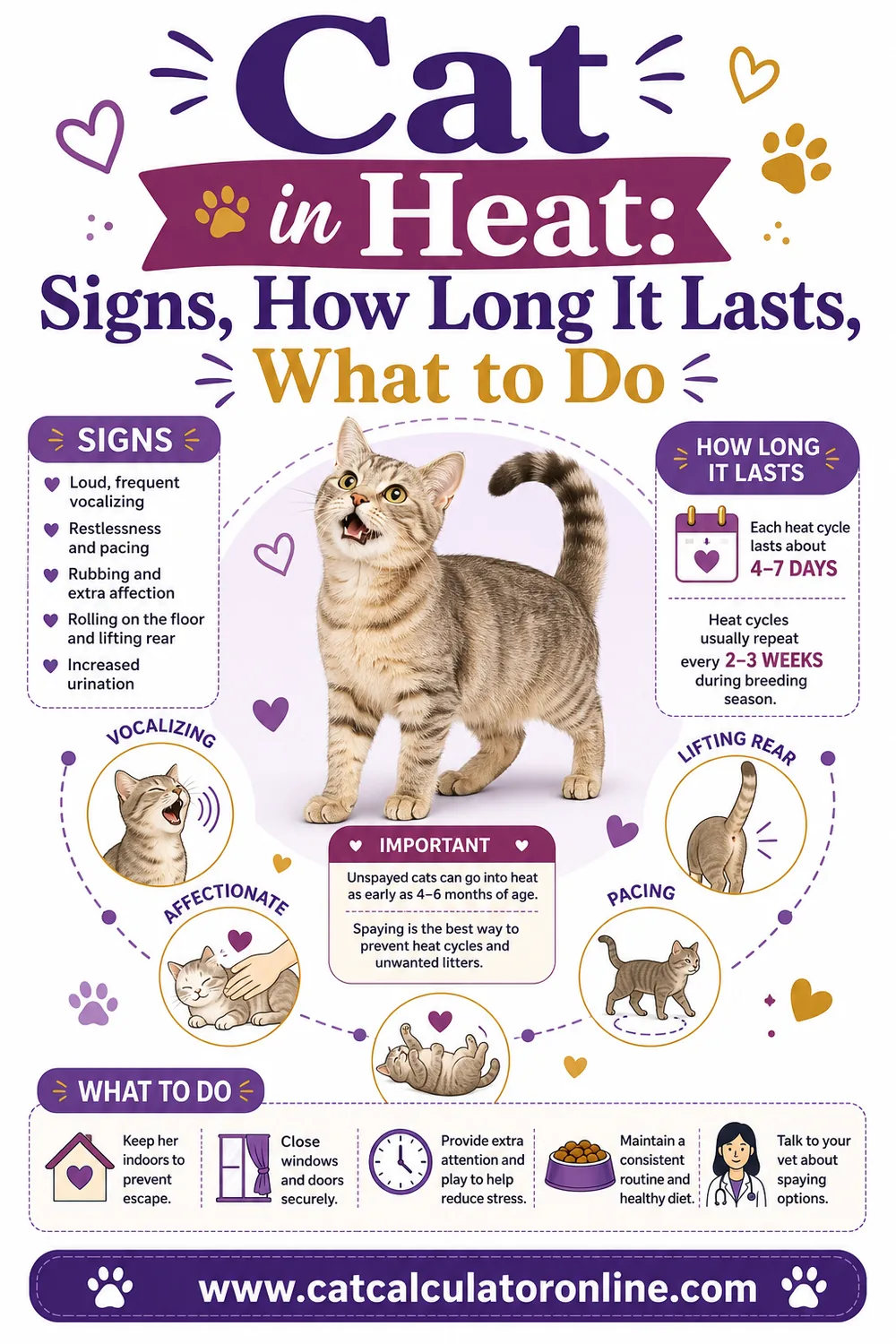
About four to ten days, with six or seven being typical — but that number on its own is misleading, because the heat you are living through now is one installment rather than the whole story. An unmated cat comes back into heat after a gap of one to three weeks and does it again, and again, for as long as the season runs. There is one exception that changes the rhythm completely: a cat who mates but does not conceive ovulates anyway and goes quiet for five or six weeks. Those two very different patterns explain almost every confused question owners ask about duration. Work out her life stage first with the free cat age calculator.
How Long Is a Single Heat?
The honest answer is a range, because individual cats vary a lot.
Four to ten days is the usual span. Most cats land at six or seven. A few are done in three days; a few run past ten.
It does not start and stop cleanly. There is usually a day or two of build-up — restlessness, extra rubbing, more affection — before the full calling begins. Owners often date the heat from the first night of yowling, which shortens it by a day or two in their memory.
The end can be abrupt. Many cats go from calling all night to entirely normal within twenty-four hours.
Her own pattern is fairly consistent. If her first heat ran seven days, later ones usually will too. Writing down the dates is genuinely useful and takes ten seconds a month.
Very short or very erratic heats are common in a cat's first season, when the system is still settling.
The signs themselves — what to expect on each of those days — are set out in the main cat in heat guide.
The Cycle in Four Stages
Vets divide the cycle into named phases, and the names make the timings much easier to hold onto.
| Stage | What it is | How long |
|---|---|---|
| Pro-estrus | Build-up. Restless, affectionate, rubbing. Not yet receptive to a male | 1 to 2 days |
| Estrus | The heat proper. Calling, rolling, lordosis, fertile | 4 to 10 days |
| Interoestrus | The quiet gap when no mating occurred | 1 to 3 weeks |
| Dioestrus | Only after ovulation, if she is not pregnant. False pregnancy | 5 to 6 weeks |
| Anoestrus | The seasonal off-switch, driven by short days | Winter, or never indoors |
Two of those five are optional. Dioestrus only exists if she ovulated, and anoestrus only exists if she gets enough natural darkness.
Which is why an indoor unmated cat feels like she cycles forever. She alternates between estrus and interoestrus with nothing else in the way, all year.
Pro-estrus is the useful one to spot. If you recognize the build-up, you have a day of warning to tighten door discipline before the calling starts.
What Happens When a Heat Ends Without Mating
This is the standard case in a household cat, and it explains the short interval.
She does not ovulate. Cats are induced ovulators: eggs are released in response to mating, and usually only after several matings within a day or two. Without that trigger, the follicles simply regress.
No ovulation means no progesterone phase. There is no hormonal brake to hold the system quiet, so nothing stops the next wave of follicles developing.
The gap is therefore short. One to three weeks, sometimes less than a week, and in some cats it is barely detectable — which is why owners report a heat lasting "a month".
She is completely normal in between. Eating, sleeping and behaving as usual. If she does not return to normal between heats, that is worth mentioning to a vet.
And then it repeats. The full pattern, and how many times a year it happens, is covered in how often cats go into heat.
What Happens If She Mates But Does Not Conceive
Here is where the timing changes shape entirely, and it catches out plenty of owners who assume a quiet cat must be pregnant.
Mating ends the heat quickly. Calling usually stops within a day or two of successful mating, because ovulation has occurred and the hormonal signal has changed.
Ovulation does not guarantee pregnancy. Fertilisation may fail, or too few matings may occur to trigger a full release of eggs.
If she ovulates without conceiving, she enters a false pregnancy. Progesterone stays elevated for roughly five to six weeks and she stops cycling entirely during that time. Some cats show mild maternal behavior — nesting, slight mammary development — although it is far less dramatic in cats than in dogs.
Then she cycles again as if nothing happened. The heats resume on the usual schedule.
The practical consequence: a cat who went quiet after getting out is not necessarily pregnant. A real pregnancy runs about 63 to 67 days and produces visible changes from around week three. The tell-tale differences are in early signs of cat pregnancy and the week-by-week timeline is in the cat gestation period guide.
If there is any chance she mated, get her checked. A vet can confirm pregnancy with ultrasound from around three to four weeks, and knowing early changes every decision that follows.
How Long Does the Breeding Season Last?
Duration is not only a question about days. It is also a question about months.
Day length runs the whole system. Cats are long-day breeders, so lengthening days switch the cycle on and short days switch it off.
In the northern hemisphere the natural season is roughly February to October. Peak activity falls in spring and early summer.
Indoor cats often have no off-season. Evening household lighting is enough to keep the cycle running, which is why a January heat in an indoor cat is normal rather than a sign of illness. This is the single most useful thing to know about feline cycling.
So the realistic total is startling. A year-round cat spending seven days in heat every two and a half weeks is calling for something like a hundred days a year.
Reducing evening light exposure does not reliably fix it, and dark rooms are not a humane management plan. It is worth knowing as an explanation, not as a treatment.
Can You Shorten a Heat?
No, and being straight about that saves a lot of money and frustration.
Nothing available at home ends a heat early. Not diet changes, not supplements, not bathing her, not the various herbal products marketed for it. The cycle runs its course.
Never use human medication. Painkillers in particular are dangerous to cats — paracetamol can be fatal, and ibuprofen is toxic at small doses. There is nothing in a household medicine cabinet that helps here.
Hormonal suppression exists but is rarely used. Progestogens can postpone estrus, and vets do occasionally use them in breeding programs, but they carry real risks including uterine infection, mammary changes and diabetes. This is a veterinary decision, not an option to seek out.
What you can do is make the days easier. Warmth, a quiet dark corner, hard play sessions, a spotless litter tray and strict door discipline all genuinely help. The full set is in how to comfort a cat in heat.
Catnip settles some cats and winds others up. Try it once and watch, rather than assuming.
The only permanent answer is spaying, which ends the cycling for good.
Can She Be Spayed While She Is in Heat?
A frequent question when the calling has become unbearable at two in the morning.
Yes, it is possible. Spaying a cat in estrus is done routinely when circumstances require it.
Many vets would rather wait a week or two. During heat the reproductive tract is engorged with blood, which makes the surgery slightly more technically demanding and can mean a marginally longer procedure.
Some practices charge a little more for it, for that reason.
The wait is short. If she is on day two of calling, the quiet window is usually only a week or so away, and booking then is straightforward.
Do not delay for months, though. Each cycle carries another chance of escape and pregnancy, and every year entire raises her risk of pyometra and mammary tumours. The current guidance on when to neuter a cat has moved earlier than most owners expect, partly for this reason.
Effects are not instant. Hormonal behavior usually settles within days of surgery, though a cat who was mid-heat may show residual signs briefly.
When the Duration Is a Reason to Call
Most timings that feel wrong are just normal variation. A few are not.
Calling that genuinely never breaks. Weeks of continuous estrus with no quiet days at all can indicate ovarian cysts or persistent follicles. A diary of calling days makes the difference between this and closely spaced normal heats obvious.
A heat that runs well past two weeks without a break is worth mentioning on the same basis.
Heat behavior in a cat who was spayed. Ovarian remnant syndrome is the classic explanation and it is correctable.
Any bleeding from the vulva, at any point in the cycle. Cats do not bleed during heat.
A cat who goes quiet and then becomes unwell. Lethargy, increased thirst, a swollen belly or any discharge in the weeks after a heat can mean pyometra, which is an emergency in an entire cat.
A cat who stops eating. Reduced appetite for a day or two during a heat is common. Eating nothing for 24 hours or more is not, and cats develop serious liver problems fast without food — so never withhold meals in an attempt to influence her behavior.
Frequently Asked Questions
How long is a cat in heat?
A single heat lasts about four to ten days, most often six or seven, if she does not mate. There is then a gap of roughly one to three weeks before the next one begins, and the pattern repeats through the breeding season.
Why does my cat seem to be in heat for a month?
Almost always because several separate heats are running close together with brief gaps you have not noticed. Cats only ovulate when they mate, so an unmated cycle resets quickly. Genuinely unbroken calling for weeks deserves a vet check.
How long is a cat in heat after mating?
Calling usually stops within a day or two of mating, because mating triggers ovulation. Several matings are typically needed for a full release of eggs, which is why one brief encounter does not always end the heat.
How long until a cat comes back into heat if she is not pregnant?
If she never ovulated, one to three weeks. If she mated and ovulated but did not conceive, she enters a false pregnancy and stays quiet for about five to six weeks before cycling again.
Can I do anything to make a cat heat end faster?
No. Nothing available at home shortens estrus, and human painkillers are dangerous to cats. Warmth, quiet, play and a clean litter tray make the days easier; spaying is the only permanent solution.
Do cats stay in heat all year?
Indoor cats often do, because artificial lighting removes the natural winter pause. Cats living mostly by natural daylight typically cycle from about February to October and go quiet over the winter.
One heat lasts four to ten days, and the reason it feels so much longer is that it comes back within one to three weeks unless she mates. If she does mate and ovulates without conceiving, expect five or six quiet weeks of false pregnancy instead — a quiet cat is not proof of a pregnancy. Nothing at home shortens a heat, so the practical job is comfort and containment while it passes, and never human medication. Treat unbroken calling for weeks, any bleeding, or a cat who stops eating as reasons to call your vet. Place her life stage first with the free cat age calculator.