Cat in Heat: Behavior Explained
The behavior that frightens owners most is the one that means least. A cat yowling, writhing on the floor and pressing her hindquarters into the air is not in pain and is not ill — she is advertising, in the loudest way her species has, that she is fertile. Every classic heat behavior has a specific reproductive job, and knowing which job each one does turns a distressing week into a manageable one. The exceptions matter too: a small number of behaviors that look like heat are genuinely urgent. This guide takes them one at a time. If you are still working out how old your cat is, the free cat age calculator will place her.

What a Cat in Heat Actually Does
A first heat catches most owners completely off guard, because none of it resembles ordinary cat behavior.
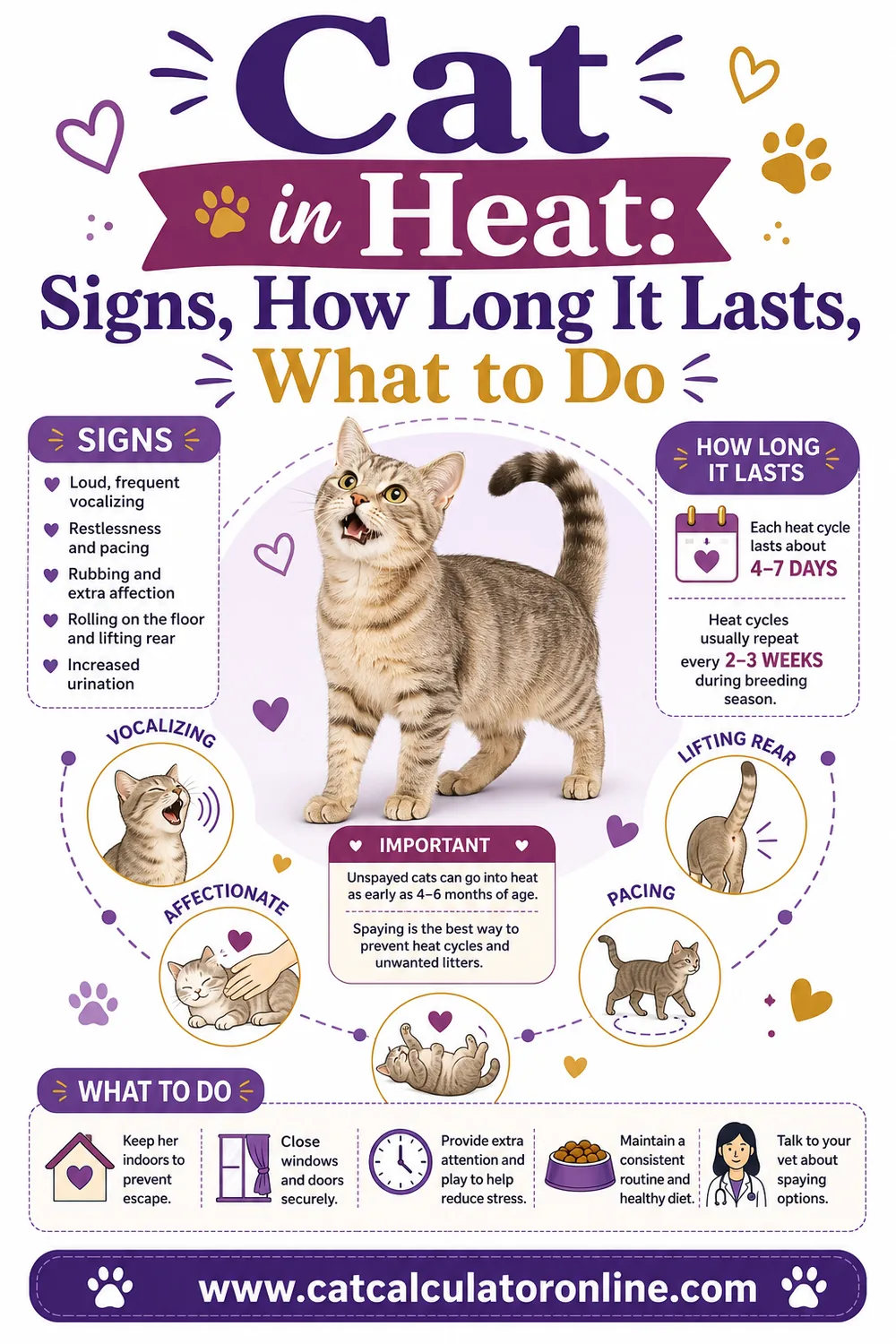
She becomes extremely vocal. Not meowing — a long, low, rising call, repeated for hours, and often loudest at two in the morning. Owners routinely describe it as sounding like a cat in agony or a baby crying.
She rolls constantly. On her back, side to side, on the carpet, in doorways, in front of you, over and over.
She rubs everything. Chair legs, door frames, skirting boards, your ankles, her own face against corners.
She raises her hindquarters when touched. Stroke her lower back and she drops her chest, lifts her rear, moves her tail aside and paddles with her back feet.
She turns unusually affectionate — or unusually irritable. Both happen. Most cats become clingy and attention-seeking; a minority get short-tempered and swat.
She stops settling. Pacing, restlessness, broken sleep, pawing at doors and windows, and a fixed interest in getting outside.
None of it needs treating. It stops on its own in a few days, then comes back two weeks later unless she is mated or spayed.
Is a Cat in Heat in Pain?
No — and this is worth stating flatly, because the noise is so convincing that many owners book an emergency appointment for a perfectly healthy cat.
The vocalisation is a broadcast, not a complaint. It is designed to travel, to be heard by toms across several gardens. Evolution optimised it for carrying distance, not for being pleasant indoors.
Nothing about estrus is physically painful. There is no cramping, no bleeding, no injury. Cats do not have a menstrual bleed; that is a dog and primate thing, and blood from a cat is never a normal heat sign.
Her body language stays sociable. A cat in heat seeks you out, rubs on you, and wants contact. That is the giveaway. A genuinely painful cat withdraws, hides, hunches, tucks her belly, dislikes being touched and goes quiet rather than loud.
She is, however, frustrated and stressed. Restlessness, poor sleep and reduced appetite are real. Distress is not the same thing as pain, but it is not nothing either, and it is a reasonable argument for booking the spay.
If you are unsure which you are seeing, the specific signals to look for are set out in how to tell if a cat is in pain. Loud and affectionate points to heat. Silent and hidden does not.
What Each Behavior Means
Every sign maps onto a job. This is the whole vocabulary in one place.
| Behavior | What it means | Should you worry? |
|---|---|---|
| Long, loud yowling | Mating call to attract males | No |
| Rolling on the floor | Spreading scent, plus hormonal restlessness | No |
| Rubbing on objects and people | Scent marking with facial glands | No |
| Rear raised, tail to one side | Lordosis, the mating position reflex | No |
| Treading with back paws | Part of the same reflex | No |
| Clinginess or crankiness | Hormonal mood change | No |
| Spraying urine on walls | Advertising availability to toms | No |
| Trying to get outside | Seeking a mate | Yes, manage it |
| Reduced appetite for a day or two | Common in estrus | Watch it |
| Eating nothing for 24 hours or more | Not a heat sign | Call your vet |
| Blood from the vulva | Not a heat sign | Call your vet |
| Straining in the litter tray | Not a heat sign | Call your vet urgently |
The bottom four rows are the ones to memorize. Everything above them is theater.
Why the Yowling Is Worse at Night
The night shift is what breaks most households, and there is a reason for it.
Cats are crepuscular. They are wired to be most active around dawn and dusk, and a cat in heat concentrates her calling into those windows and the quiet hours between them.
Quiet carries. Her call is meant to reach males at a distance, and it does that best when the neighborhood has gone silent.
Toms answer. Once one responds outside your window, she has confirmation that the strategy is working, and she will keep going.
Blocking the audience helps a little. Closing curtains, moving her bed away from external doors and using a radio or fan for masking noise takes the edge off. It will not stop her.
Tiring her out during the day helps more. A serious play session in the evening, with a wand toy and a proper chase-and-catch finish, buys some quiet. This and other practical measures are covered in how to comfort a cat in heat.
Never shut her somewhere isolated as a punishment. She is not being naughty, and separating her tends to increase the calling rather than reduce it.
Rolling, Treading and the Mating Stance
The physical behaviors look strange out of context and make complete sense in it.
Rolling is partly scent deposition. Cats have scent glands along the cheeks, chin and flanks, and rolling transfers that scent onto floors and furniture where a visiting male will find it.
Rubbing does the same job vertically. Head bunting against door frames and furniture legs leaves facial pheromones at nose height.
Lordosis is the mating position. Chest down, hindquarters elevated, tail deflected to one side, back legs treading in place. It is a reflex triggered by touch along the back and by hormonal state, which is why petting her lower back sets it off instantly.
Treading is part of that same reflex, not an attempt to walk or a sign of distress.
Rolling in front of you specifically is not a request for anything from you. She is simply performing the behavior where she happens to be, and you happen to be there.
She may also groom her rear more than usual. Mild, clear discharge is possible. Anything cloudy, smelly or bloody is not part of it.
Spraying and Marking During Heat
Spraying during heat is one of the most misdiagnosed behaviors in cats.
It is not a litter tray failure. Spraying is a small volume of urine deposited on a vertical surface by a standing cat with a quivering tail. Squatting and emptying the bladder on the floor is a different behavior with different causes.
In heat it is deliberate advertising. The urine of a queen in estrus carries hormonal information, and she is placing it where a passing tom will read it.
Females absolutely do spray. The stereotype that only toms spray causes real confusion and, occasionally, unnecessary investigation of an entirely normal cat.
Cleaning matters more than correcting. Use an enzymatic cleaner rather than anything ammonia-based, which smells like urine to a cat and encourages repetition.
Neutering resolves most of it. Spray marking driven by hormones usually stops or drops sharply after spaying, though a habit of long standing can persist. The broader approach is in how to stop a cat spraying.
Punishment makes it worse, because it adds anxiety, which is itself a cause of marking.
The Escape Risk Nobody Warns You About
If you take one practical point from this page, take this one.
Heat is when indoor cats get out. A cat who has ignored the front door for three years will wait beside it and shoot through the gap. The drive is strong enough to override normal caution about traffic, dogs and unfamiliar territory.
Outside almost certainly means pregnant. A calling queen attracts multiple toms quickly, and cats can carry kittens from more than one father in a single litter.
Check windows as carefully as doors. Tilt-and-turn windows, loose flyscreens and cat flaps are all routes out. A screen that holds against a bored cat will not necessarily hold against a determined one.
Warn everyone in the household, including visitors and deliveries. Most escapes happen because someone else opened the door.
Microchip and tag her now, not later. If she does get out, that is what brings her home.
And expect visitors. Entire toms will gather, spray around your doors and fight. Keeping her in protects her from pregnancy, from fights, and from the diseases that come with both.
When It Is Not Heat At All
A short list, because most yowling really is heat — but these are the ones you cannot afford to file under it.
Straining in the litter tray with little or nothing produced. In a male cat this is a urinary blockage and a genuine emergency measured in hours, not days. It is often mistaken for constipation or for calling.
Bleeding from the vulva. Not part of a feline heat. It needs a call.
Yowling with hiding, hunching or aggression when touched. That pattern points to pain rather than estrus.
Yowling in a spayed cat. Consider ovarian remnant syndrome, but also pain, high blood pressure, hyperthyroidism, and the disorientation that makes elderly cats call at night.
Sudden lethargy, thirst, a swollen abdomen or a discharge in the weeks after a heat. Pyometra, an infected uterus, is a life-threatening emergency in an unspayed cat.
Any cat who stops eating entirely for a day or more. Cats develop serious liver problems within a few days without food, so this is never something to wait out — and never withhold food to try to change her behavior.
The permanent answer to all the hormonal behavior is spaying, and the current thinking on when to neuter a cat has moved earlier than the advice most owners remember. The full overview of the cycle sits in the main cat in heat guide.
Frequently Asked Questions
Is my cat in pain when she is in heat?
No. Estrus is not painful in cats. The yowling is a mating call built to carry over distance, which is why it sounds so alarming. A cat in heat still seeks contact and affection; a cat in pain hides, hunches and avoids being touched.
Why does my cat lift her bottom when I stroke her?
That is lordosis, the mating position reflex. Touch along the lower back triggers it in a cat who is in estrus: chest down, hindquarters raised, tail moved aside, back paws treading. It is automatic and not a sign of discomfort.
Do female cats spray when in heat?
Yes, frequently. Spraying small amounts of strongly scented urine on vertical surfaces is how a queen advertises to males. It is hormonal marking rather than a litter tray problem, and it usually stops after spaying.
Why does my cat in heat yowl all night?
Cats are most active around dawn and dusk, night is quiet enough for the call to carry, and any tom who answers encourages her to continue. Masking noise, closed curtains and a hard play session before bed help a little.
Does a cat in heat still eat normally?
Often she picks at her food for a day or two, which is common and not concerning on its own. A cat who eats nothing at all for 24 hours or more needs veterinary attention, whatever the reason.
Will my cat calm down after her heat ends?
Yes, usually within a few days, and she will behave completely normally in between. Without mating or spaying, though, the whole pattern typically returns every two to three weeks through the breeding season.
Every dramatic thing a cat does in heat — the yowling, the rolling, the raised rear, the treading, the sudden spraying — is reproductive advertising rather than illness or pain, and none of it needs treating. What does need managing is the escape risk, because a calling queen will take any open door and outside means an almost certain pregnancy. Keep the doors shut, clean marking with an enzymatic cleaner rather than punishing it, and reserve real concern for straining in the litter tray, bleeding, hiding with hunched posture, or a cat who stops eating. Start by placing her life stage with the free cat age calculator.