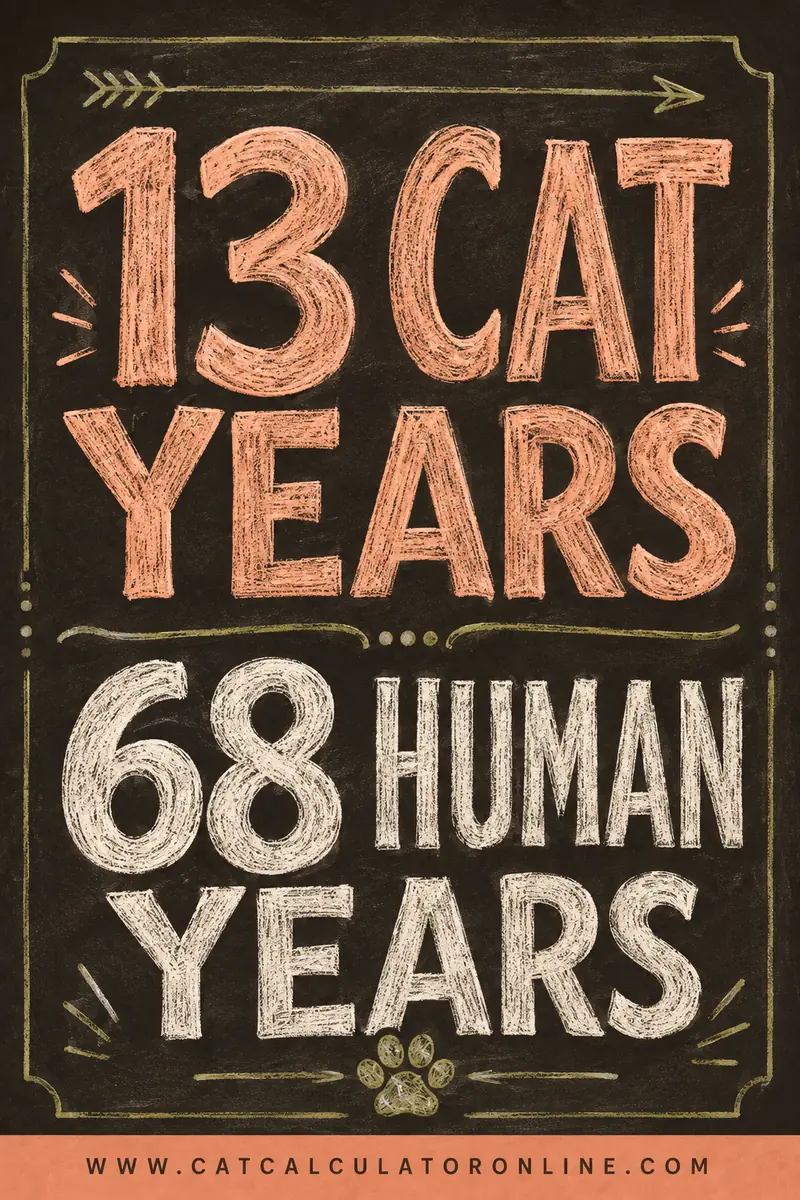
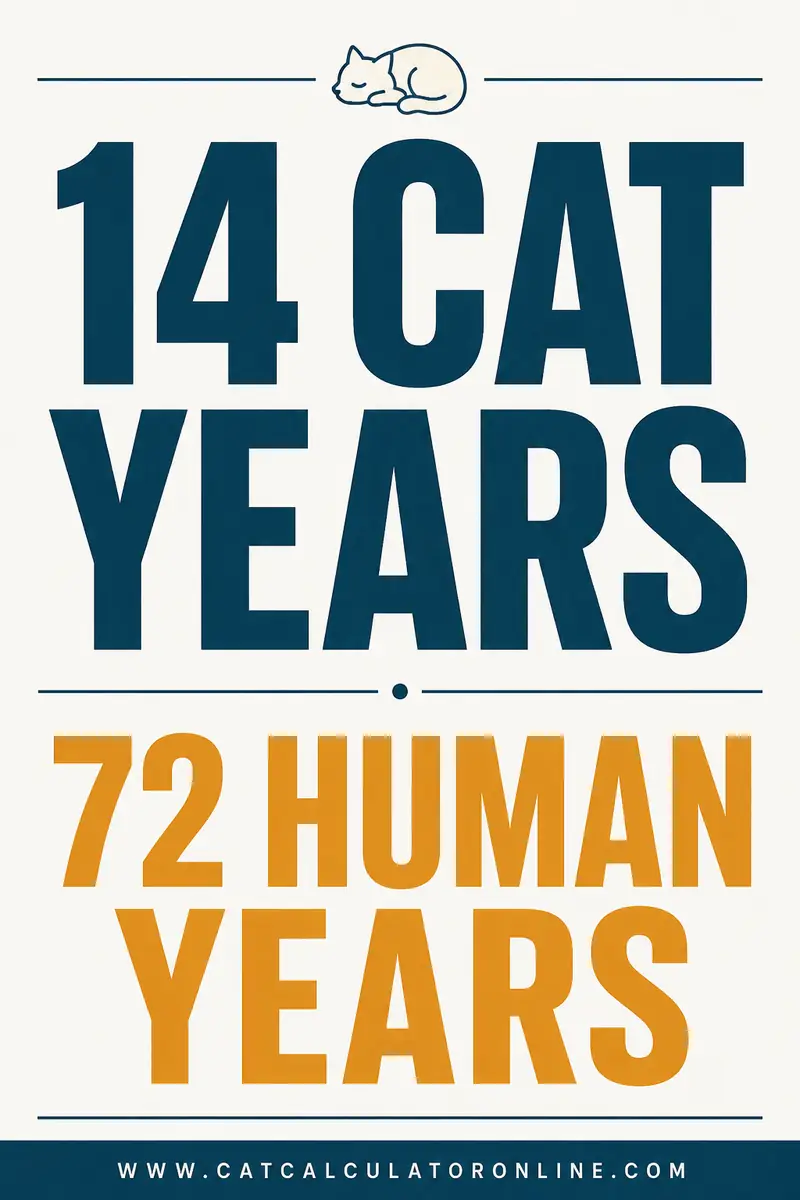
14 Cat Years in Human Years
A fourteen-year-old cat is about 72 in human years. Fourteen is comfortably inside old age — most cats at this point are managing at least one long-term condition, most have some degree of joint disease, and nearly all have slowed noticeably. None of that means decline is inevitable or fast. Cats routinely live several more years from fourteen, and the two things that most influence how those years go are how closely appetite and thirst are watched, and how comfortable the house is made. This page covers the arithmetic and both of those. Any age converts with the cat age calculator.
How Do You Get 72?
The same three-step method used at every age past two.
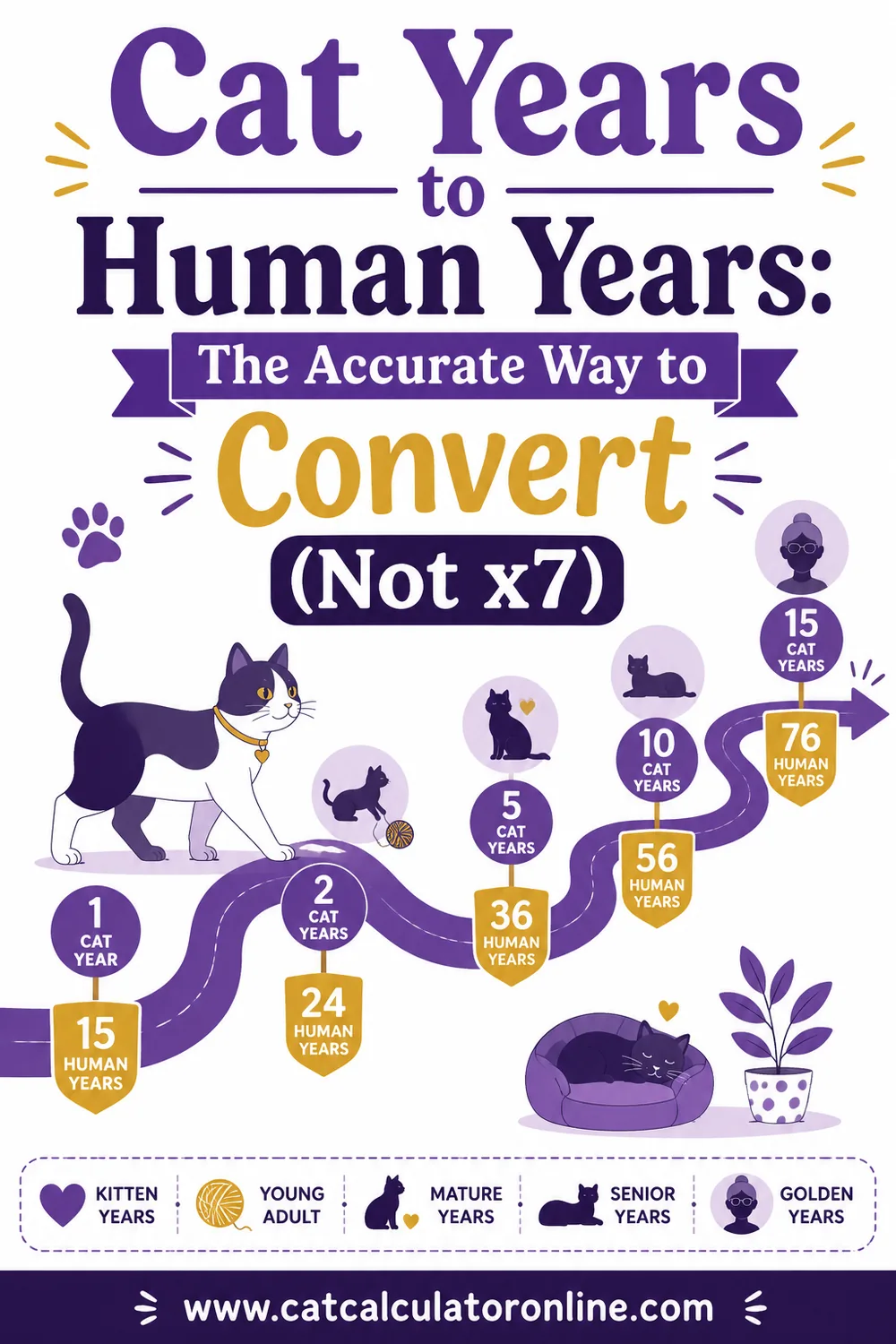
15 for year one, 9 for year two, 4 for every year after. By fourteen: 24 + (12 × 4) = 72.
| Cat's age | Human years | Life stage |
|---|---|---|
| 12 | 64 | Senior |
| 13 | 68 | Senior |
| 14 | 72 | Senior |
| 15 | 76 | Senior |
| 16 | 80 | Senior |
| 17 | 84 | Senior |
| 18 | 88 | Senior |
| 20 | 96 | Senior |
A fourteen-year-old cat at 72 is comparable to someone in their early seventies — frequently active and independent, usually with something being managed, and at an age where six-monthly review is simply sensible.
Neighbouring ages are covered in 13 cat years in human years and 15 cat years in human years, the full table in cat years to human years, and the method in how a cat age calculator works.
Why Are Appetite and Thirst the Signals That Matter?
Because between them they change early in nearly every condition that becomes common at this age, and because both are things you can observe at home without any equipment.
Increased thirst is the classic early sign of chronic kidney disease, hyperthyroidism and diabetes — the three conditions that dominate feline medicine after twelve. A cat that starts emptying the water bowl, seeking taps, drinking from the shower tray or standing at the sink has changed for a reason. This is the single most useful observation an owner makes, and it is frequently interpreted as the cat simply liking running water.
How to notice it properly. Use the same bowl in the same place and note roughly how often you refill it. A rough baseline beats no baseline. If you can measure, a cat drinking more than about 100 ml per kilogram of body weight per day is drinking excessively — but "much more than she used to" is a perfectly good trigger for a phone call.
Increased appetite with weight loss points strongly at hyperthyroidism, which is common at fourteen and responds very well to treatment.
Reduced appetite is broader — kidney disease, dental pain, nausea, gastrointestinal disease. Any of these deserves investigation rather than a change of flavor.
The approach-and-walk-away pattern — interested, sniffs, turns away — usually means nausea or mouth pain rather than fussiness.
And treat total refusal as urgent. A cat that has eaten nothing for a couple of days is at real risk from hepatic lipidosis, a liver problem that develops specifically because cats don't tolerate fasting. This is not a wait-and-see situation at any age, least of all fourteen.
Why Does the Scale Matter More Than the Mirror?
Because a cat's coat conceals weight loss until a great deal of it has happened.
The arithmetic. A 4.5 kg cat losing 40 grams a month looks identical week to week and is down almost half a kilo — over 10% — within a year. In an older cat, that degree of loss is significant whatever the cause.
What to do: weigh monthly, on the same scales, and write the number down. Kitchen scales work — weigh yourself, then yourself holding the cat, and subtract. Look at the twelve-month trend rather than month-to-month wobble.
Distinguish two different things. Muscle loss over the spine and hips is a normal part of ageing and can happen in a cat holding steady weight — it's why a fourteen-year-old often feels bonier along the back while the belly stays soft. Actual weight loss on the scales is different, and it is a symptom.
Take gain seriously too. Sudden gain, or a distended abdomen, warrants a call rather than satisfaction that the cat is eating well.
And photograph from above every couple of months. A picture from directly overhead is a useful cross-check on both weight and muscle, and easier to compare than memory. The wider monitoring routine is in senior cat health checklist.
What Should the Six-Monthly Check Cover?
By fourteen, this is monitoring known things and catching new ones early.
Kidney values including SDMA, alongside previous results. Ask for the printed history — a value climbing steadily within the normal range is meaningful.
Urine specific gravity. Frequently the earliest change, and the test most often skipped.
Total T4, with anything borderline rechecked in weeks rather than filed for six months.
Blood pressure, ideally at every senior visit. Feline hypertension is common, silent, and capable of causing sudden blindness through retinal damage.
Blood glucose interpreted with fructosamine, since a stressed cat can produce a high glucose reading with no diabetes at all.
Complete blood count and liver enzymes.
A dental assessment, because painful teeth are among the most common correctable causes of poor appetite at this age.
Full physical examination — thyroid palpation, kidney size and shape, heart murmur, joint range of movement, lumps, and a look at the eyes.
Realistic expectations. At fourteen, most cats have something. Early kidney disease is managed with diet, hydration and monitoring, and cats often remain well for years. Hyperthyroidism has several effective treatments. Hypertension responds to medication. Arthritis responds to weight control, environment and pain relief. A diagnosis at fourteen is a management plan, not a prognosis.
How Should the House Work at Fourteen?
The same principles as thirteen, applied more thoroughly, because the margin is narrower.
Warmth, deliberately. Several soft, deep beds with sides to lean against, in warm draught-free spots in the rooms your cat actually uses. Near a radiator but not against it. Older cats hold heat poorly and warmth genuinely eases stiff joints.
Access to everything. Steps or a stool to the bed, the sofa, the windowsill. A cat that can still reach its places stays part of the household; one that can't quietly withdraws to a single spot.
Litter, simplified. A box on every floor, at least one low-entry. A plastic storage tub with a U cut into one side gives full floor area with a two-inch step, which shop-bought boxes rarely match. Keep them away from food and in quiet corners.
Non-slip surfaces at landing points and along regular routes. Laminate and tile are hard work for an unsteady cat.
Night lighting, which helps a cat whose vision has dimmed navigate a familiar route.
Everything within reach. Food, water and a box on the floor the cat sleeps on, so nothing important requires stairs.
Grooming as a routine, not a treat. Several short sessions a week over the back, hips and tail base, plus a monthly nail check — reduced scratching means claws keep growing and can curl into the pad. More in how to care for a senior cat.
What Behavior Changes Should You Investigate?
At fourteen, a new behavior is a symptom until something proves otherwise.
Night yowling. The usual causes are hyperthyroidism, high blood pressure, declining hearing or sight, pain, and cognitive change. The first four are found by the standard senior panel, so it's worth investigating before accepting it as a habit.
Litter box lapses. Going beside the box rather than in it is very often physical — sore joints making the step painful, or a urinary problem. A low-entry box and a vet visit solve most cases.
Hiding, or a sudden change in where the cat sleeps. A cat that has moved to somewhere low, dark and out of the way and stays there is usually uncomfortable rather than antisocial.
Confusion — staring at walls, standing in doorways, forgetting a route. Feline cognitive dysfunction is real. There's no cure, but consistent routine, night lights, keeping furniture where it is, and gentle enrichment all help.
Reduced grooming, or over-grooming one spot. The first suggests stiffness or nausea; the second often marks something painful underneath.
Increased clinginess. Common and usually benign, but worth noting alongside everything else.
How to raise any of it usefully: describe the specific change rather than summarising. "He used to jump to the windowsill and now goes via the chair" leads somewhere; "he's slowing down" doesn't.
How Do You Think About the Years Ahead?
Calmly, and preferably before you need to.
The realistic picture. Cats commonly live to 17, often to 18 or 19, and sometimes past 20. Fourteen with a managed condition is not a countdown — many cats diagnosed with kidney disease in their early teens live several more comfortable years on diet and monitoring alone.
Track quality of life simply. A mark on a calendar each day — good, fair, poor — takes seconds and gives an honest picture over weeks. Memory smooths things over; a calendar doesn't. The markers worth tracking are eating, comfort, mobility, engagement, and the ratio of good days to bad ones.
Spend where it counts. In rough order of value: the screening that finds things early, dental treatment that keeps a cat eating, weight and diet management, and pain relief for joints. Those four buy more comfortable years than anything else available.
Ask about pain specifically. Feline pain relief has improved considerably, but it usually won't be offered unless joint disease is raised. Never give human painkillers — paracetamol is fatal to cats, and ibuprofen and aspirin are toxic.
And keep the cat doing things. Short gentle play once a day preserves muscle, tells you what your cat can still manage, and matters more at fourteen than it did at four. A cat that stops moving loses muscle, which makes moving harder, which is a loop worth interrupting early.
Frequently Asked Questions
How many human years is 14 cat years?
About 72. The method is 15 human years for the first year, 9 for the second and 4 for each year after — giving 24 at age two, plus twelve further years at four each.
Is 14 old for a cat?
Yes, it's genuinely old age, but not unusual. Indoor cats commonly reach 17 and often go further, so a well fourteen-year-old frequently has several good years left.
My 14-year-old cat is drinking much more than usual — what does that mean?
Increased thirst is the classic early sign of kidney disease, hyperthyroidism or diabetes. All three are common at this age and all are more manageable when found early, so it warrants a vet visit rather than a bigger bowl.
How often should a 14-year-old cat have bloodwork?
Every six months is the standard recommendation, with urinalysis and blood pressure included. Six months of a cat's life at fourteen is roughly two human years.
Why does my 14-year-old cat feel bonier along the spine?
Muscle loss over the back and hips is a normal part of ageing and can happen even when weight is stable. Actual weight loss on the scales is different and should be investigated.
Should I still play with a 14-year-old cat?
Yes — shorter, gentler sessions, but daily if possible. Gentle activity preserves the muscle that supports ageing joints, and it shows you what your cat can comfortably still do.
Fourteen cat years is about 72 human years — old, commonly well, and the age where appetite, thirst and the monthly weight are your most useful instruments. Keep the six-monthly bloods, make the house warm and easy, treat new behavior as a symptom, and ask about pain relief specifically. Convert any age with the cat age calculator.