Signs a Cat Is Nearing the End of Life
If you are reading this at midnight with an old cat asleep on the bed beside you, take a breath. Here is the thing most owners are never told: the end of a cat’s life is almost never one dramatic sign — it is a slow subtraction, and the most reliable measure is not any single symptom but the ratio of good days to bad ones. A cat who still eats a little, still settles in her spot, still greets you, is having a good day even if she is thin and slow. When the bad days start outnumbering the good ones, that is the signal. This page describes what the last weeks, days and hours actually look like, and where the line for ringing your vet sits. Her life stage frames all of it, and the free cat age calculator will tell you which one she is in.
The Honest Short Answer
A cat nearing the end of life usually shows a cluster of quiet changes rather than one clear sign.
The core cluster is this. She withdraws and hides. She eats less and drinks either much less or much more. She loses weight, and you feel the bones along her spine. She stops grooming. She stops jumping and sleeps in one low, fixed spot. Her breathing changes. In the last day or two, her ears and paws go cold.
Not all of these appear, and they do not appear in order. A cat with kidney failure often goes the thirst-and-weight-loss route. A cat with a chest tumour goes the breathing route. A cat with untreated arthritis simply stops moving. What they share is the direction of travel — more sleeping, less doing.
None of it is a diagnosis. Every single sign on this page also appears in conditions that are treatable, sometimes very treatable. An old cat who has gone quiet and thin may have an overactive thyroid or early kidney disease, both of which are managed for years. That is exactly why the first step is a phone call, not a decision.
The Signs in the Last Few Weeks
This is the stage where you notice something has shifted but cannot name it.
She retreats. A cat who used to hold court on the sofa starts choosing the back of the closet, under the bed, behind the boiler. The old story that cats go away to die is mostly wrong — hiding is what cats do when they feel vulnerable, and it is a behavior, not a farewell.
Her appetite narrows before it stops. First she leaves the dry food. Then she only wants one flavor. Then she sits at the bowl, sniffs, and walks away. Sitting at the bowl without eating usually means nausea rather than disinterest, and nausea is often treatable.
She gets thin in a specific way. Run your hand down her back. Late-life weight loss takes muscle from either side of the spine and over the hips, so the bones feel sharp and the fur sits loose over them. This is different from a cat who is simply lean.
Her coat goes. Grooming is the first luxury a sick cat drops. A dull, greasy, slightly clumped coat and crusty corners of the eyes are one of the most honest signs that she does not feel well — and one of the easiest to explain away as old age.
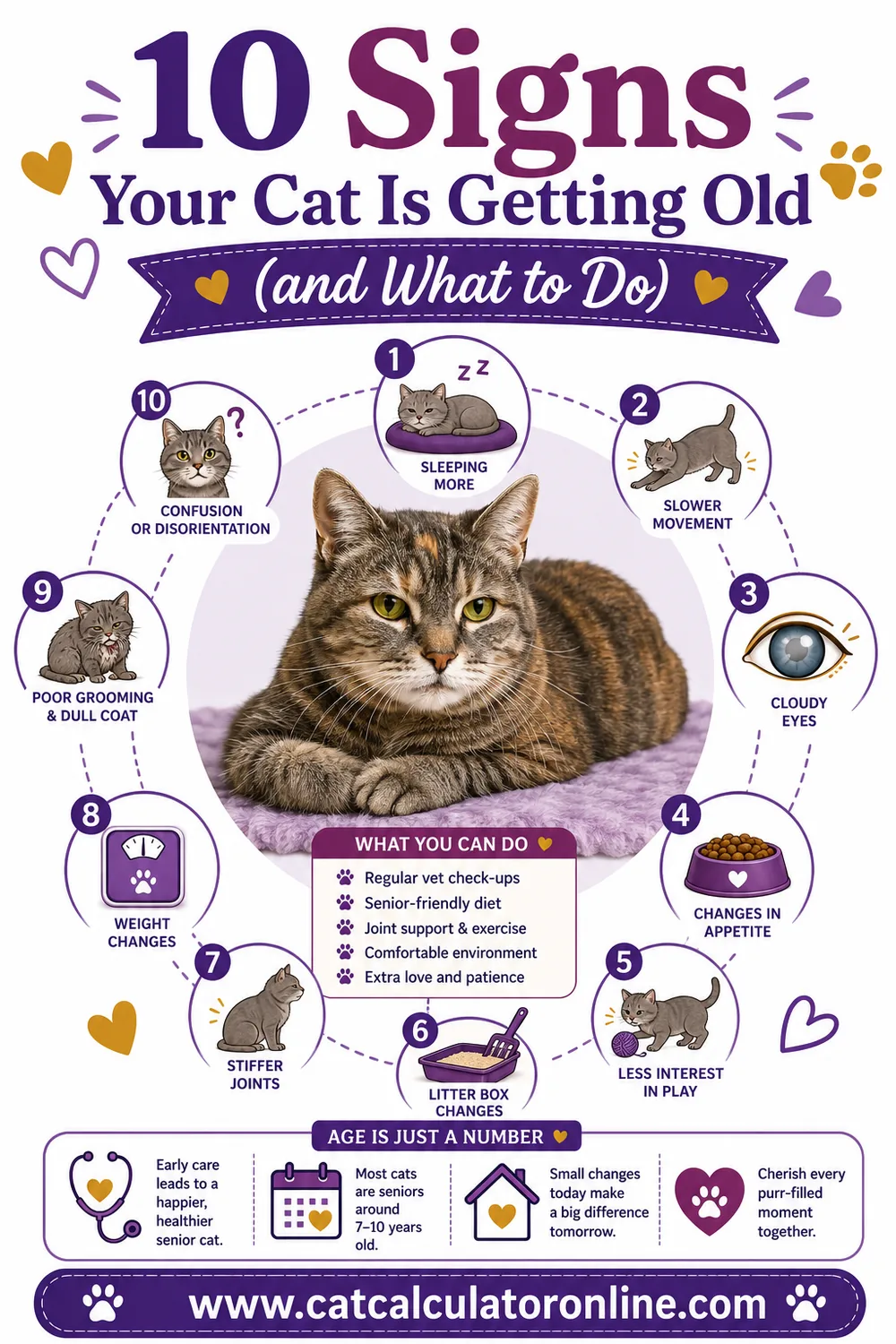
She sleeps more, and moves less. The perch she used to jump to goes unused. She takes the stairs one at a time or stops using them. Reduced jumping is so common that owners rarely mention it to the vet, which is a shame, because it is often pain rather than age and pain relief can give real time back.
The Signs in the Last Few Days
The changes here are more physical and harder to mistake.
Body temperature drops. A healthy cat runs 100.5–102.5°F (38–39.2°C). In the final day or two that falls, and the first place you feel it is the ear flaps and the pads of her feet. Cold ears on a cat who is otherwise declining is a genuine late sign.
Breathing changes character. Watch her flank for 30 seconds and double it. A resting cat should take 15–30 breaths a minute. Faster than 40, open-mouthed, or with the belly visibly pumping, means fluid or failure and needs an emergency vet the same night — that is not a stage to sit through at home.
She stops drinking. Dehydration follows within hours. Her gums go tacky rather than slick, and the skin at the scruff, when lifted, sinks back slowly. There is more on what dehydration looks like in cats if you want to check properly.
Continence goes. She may soil where she lies, or lie half in the litter box. She is not being difficult and she is not embarrassed. Puppy pads under a soft blanket, changed often, keep her comfortable and save you scrubbing.
She becomes unresponsive to things she loved. No head turn at your voice. No interest in the window. A cat who no longer tracks you across the room with her eyes has withdrawn a long way.
Some cats have a bright evening. A brief return of appetite and alertness late on happens often enough that owners describe it consistently. Enjoy it. It does not usually mean recovery.
Signs, What They Look Like, and What to Do
The middle column is what matters — vague descriptions are why owners miss these.
| Sign | What it actually looks like | What to do |
|---|---|---|
| New hiding | Closet, under the bed, behind furniture, for most of the day | Call your vet this week — often treatable pain |
| Appetite loss | Sniffs the bowl and turns away; leaves dry food first | Ring within 24 hours. Warm the food, offer by hand. Never withhold food |
| Weight and muscle loss | Sharp spine and hips under loose fur | Book a check-up; weigh her weekly at home |
| Stopped grooming | Greasy, clumped coat; crusty eyes; matted rear | Wipe gently with a warm damp cloth; vet check |
| Not jumping | Uses furniture as steps; sleeps at floor level | Vet visit — pain relief often restores months of comfort |
| Cold ears and paws | Ear flaps and pads noticeably cool to touch | Late sign. Warm bedding, gentle heat, call your vet |
| Breathing changes | Over 40 breaths a minute at rest, open mouth, belly effort | Emergency vet tonight |
| Straining in the tray | Repeated squatting, nothing produced, crying | Emergency — blocked bladder kills in under 24 hours |
What Is Not an End-of-Life Sign
Getting this wrong in either direction causes real harm.
Straining to urinate is an emergency, not a decline. A blocked male cat squats repeatedly, produces nothing and cries. Untreated, it kills in a day or two. Treated, he often walks out fine. Never file this under "she is old".
Sudden collapse or dragging back legs is an emergency. A clot at the back of the heart (saddle thrombus) causes a cat to scream and lose the use of her hind legs, often with cold back feet. It is agonising and needs a vet immediately.
Weight loss with a huge appetite is usually treatable. An old cat eating like a horse and getting thinner is the classic picture of an overactive thyroid, which is managed with a daily tablet. This one is missed constantly.
Sleeping a lot is normal. Cats sleep 12–16 hours a day at any age, and seniors more. Sleep in itself proves nothing — it is the change in where and how she sleeps that carries information. The general signs of aging are worth separating from the signs of dying.
Purring proves nothing. Cats purr when content and also when frightened, injured and dying. It seems to be partly self-soothing. Never read a purr as evidence that she is comfortable.
Scoring Her Quality of Life
If you take one practical tool from this page, take this one. It turns a swirl of feelings into something you can look at.
Score seven things out of 10, every day. Hurt, hunger, hydration, hygiene, happiness, mobility, and whether she has more good days than bad. Write the seven numbers in a notebook or your phone with the date. This framework is used widely in veterinary hospice care.
Anything scoring 5 or below in a category needs attention now. A 3 for hurt means her pain relief is not working. A 3 for hunger means she needs an appetite stimulant or an anti-nausea drug — both exist and both are cheap.
A total under about 35 out of 70, sustained over several days, is the point most vets treat as a serious conversation. Not a single bad day. A pattern.
The diary is the real value. Memory is unreliable and heavily weighted toward the last hour. Owners regularly discover, on reading back two weeks of scores, that the good days stopped a while ago. Others discover the opposite and stop panicking.
Bring the numbers to the appointment. A vet who can see fourteen days of scores gives you a far more useful conversation than one working from "she has not been herself". It also makes the discussion about her, not about your resolve.
Keeping Her Comfortable at Home
Comfort care is mostly small, unglamorous things, done often.
Bring the world to her. Water, food, a low-sided litter box and a soft bed all within a few feet, on one floor. A cat who has to cross the house to drink will simply stop drinking.
Warm her. Old, thin cats lose heat fast. A microwaveable heat pad wrapped in a towel, or a bed near a radiator with room to move away, is one of the kindest things you can do. Always leave an escape route from any heat source.
Feed whatever she will eat. This is the moment to abandon the diet rules. Warm the food to body temperature to lift the smell, offer it on a flat saucer rather than a deep bowl so her whiskers are free, and hand-feed if she likes that. Never withhold food to "see if she gets hungry" — two days without eating can trigger fatty liver disease, which makes a poorly cat far worse.
Ask about anti-nausea and appetite drugs. Maropitant and mirtazapine are commonly prescribed for exactly this and often buy weeks of comfortable eating. Many owners never think to ask.
Handle her gently and keep her clean. A warm damp cloth over her face, chin and rear once a day replaces the grooming she can no longer do. Mats over bony hips hurt — a vet nurse can shave them out.
Keep her routine and her people. Familiar smells matter more than anything new. Do not move her to an unfamiliar room to "keep an eye on her" unless she chooses to go there.
The Euthanasia Conversation, Practically
Nobody wants this section, and everyone wants to know what actually happens.
It is quick and it is not distressing to watch. A sedative goes in first, and she becomes deeply relaxed within a few minutes. The final injection is an overdose of anaesthetic given into a vein; consciousness goes within seconds. Her eyes stay open, and there may be a last breath or a twitch afterwards — both are reflexes, not awareness.
Home visits exist. Many practices and dedicated services will come to you, which spares her the carrier and the car. Expect roughly $250–$600 for a home visit in the US versus around $100–$400 in the clinic, depending on your area and the time of day.
Aftercare is a separate cost. Communal cremation without ashes returned typically runs $50–$150; individual cremation with ashes back is usually $150–$400. Deciding this in advance saves you making choices in the worst ten minutes of the year.
Let your other cats see the body if you can. Give them ten quiet minutes. There is decent evidence that surviving cats search less and settle sooner when they have done this.
"Too early" is usually kinder than "too late". Vets say almost universally that owners regret waiting more than they regret acting. The aim is a good day, not a crisis at 3am.
Ask for what you want. A blanket from home, staying with her, a paw print, a quiet room, a back entrance so you do not walk through a full waiting room. Practices are used to all of it and none of it is an imposition.
When to Call Your vet
The escalation line matters more than any list of signs, so here it is plainly.
Ring immediately, day or night, for open-mouthed or labored breathing, a resting rate over 40 breaths a minute, blue or gray or white gums, collapse, sudden inability to use the back legs, a seizure, repeated straining in the litter box with nothing produced, or crying that will not settle.
Ring the same day for no food in 24 hours, no water in 24 hours, repeated vomiting, a temperature that feels cold to the touch, or a quality-of-life score that has dropped sharply.
Ring this week for new hiding, gradual weight loss, a coat she has stopped maintaining, reduced jumping, or a nagging feeling that she is not herself. That last one is worth more than owners think — you know her baseline and nobody else does.
Ask directly. "Is she suffering, and what would you do if she were yours?" Most vets will answer that honestly if you ask it straight.
Book the longer appointment. If your practice offers double slots, take one. Senior consultations are not a five-minute job, and how often an older cat should be seen rises to twice a year for a reason.
Frequently Asked Questions
Do cats know when they are dying?
There is no evidence that cats understand death the way people do. What they clearly do experience is feeling unwell and vulnerable, which drives them to hide in enclosed, safe places. That behavior is often read as a cat knowing, but it is a response to how she feels now.
How long can a cat live once she stops eating?
A cat who stops eating entirely is usually in serious trouble within two to three days, because cats develop fatty liver disease (hepatic lipidosis) far faster than dogs. Never wait it out at home. Call your vet within 24 hours of a complete refusal to eat.
Do cats go away to die?
Mostly a myth. Outdoor cats who feel very unwell hide in the nearest sheltered spot — a shed, a hedge, under a car — and are often found close to home rather than having gone anywhere. Indoor cats do the same thing inside the house.
What are the signs a cat is dying of kidney failure?
Heavy drinking and large wet patches in the tray early on, then weight loss, poor coat, bad breath with an ammonia smell, vomiting, mouth ulcers and severe lethargy as it advances. Kidney disease is often managed for years, so these signs warrant a vet visit rather than assumptions.
Is my cat in pain at the end of life?
Not always, but often enough that it should be assumed and treated rather than guessed at. Cats hide pain by instinct, so look for reduced jumping, a hunched posture, hiding and a stopped grooming routine. Licensed feline pain relief works well; never give human painkillers.
How do I know it is time?
Use a daily score for hurt, hunger, hydration, hygiene, happiness, mobility, and whether good days outnumber bad. A sustained run where the bad days win, or where pain and appetite cannot be controlled with treatment, is the point most vets treat as the honest answer.
The end of a cat’s life is quiet, gradual and easy to misread, which is why the diary matters more than any single symptom. Watch for the cluster — withdrawal, appetite loss, muscle wasting over the spine, a coat she no longer maintains, reduced jumping, cold ears — and score her days rather than trusting your memory of them. Treat the emergencies as emergencies: breathing changes, straining in the tray, collapse. And do the small things well, because warmth, food she can smell, a tray she can reach and her own people nearby are most of what comfort means to a cat. There is more on caring for a senior cat day to day, and the free cat age calculator will place her life stage before you ring.