Why Does My Cat Stare at Me? Every Kind of Stare, Decoded
Your cat stares at you because you're the most important, most unpredictable, most snack-dispensing thing in her world — staring is how she gathers information and communicates. Depending on the moment, that gaze can mean affection (especially with slow blinks), anticipation of food, focused curiosity about what you'll do next, or simple hunting-style attention locked onto your movements.
The good news: the rest of her body tells you which one it is, and once you can read it, the staring stops being unnerving and starts being a conversation. If you'd also like to know how old the little observer on your bookshelf is in human terms, our free cat age calculator works it out in one tap.
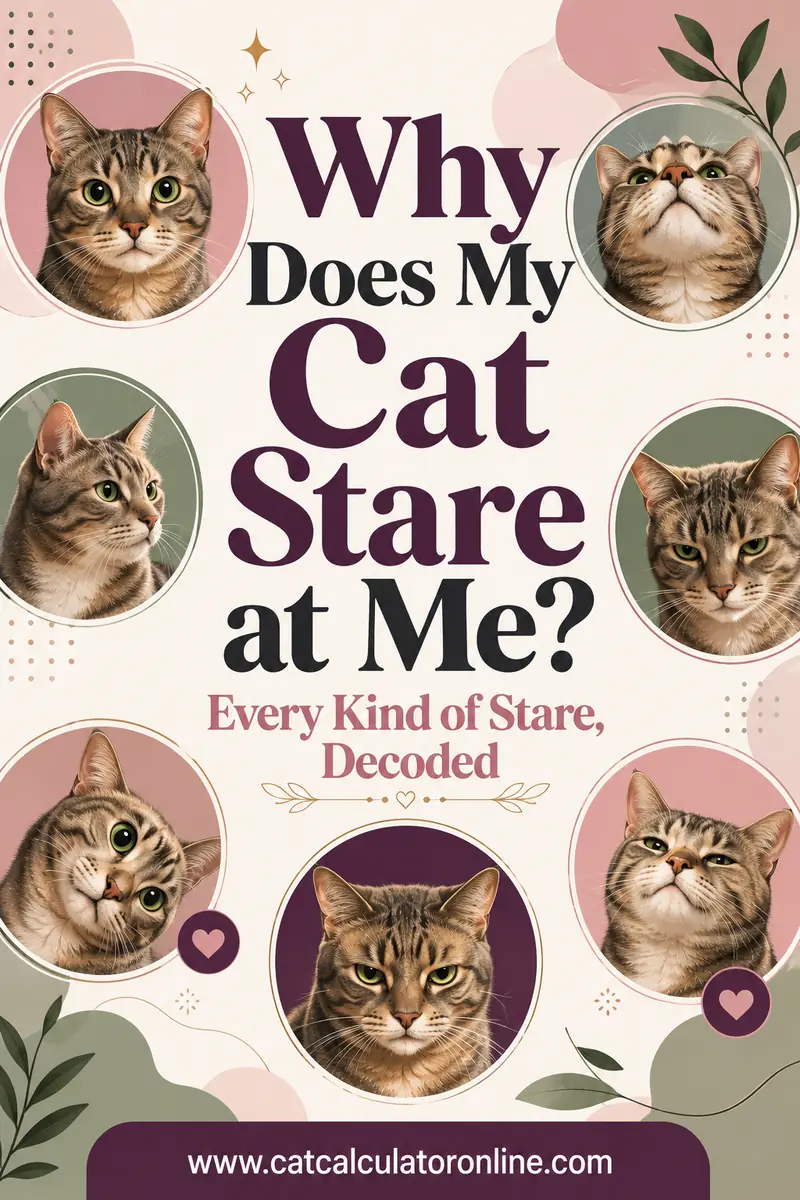
👀 Decode the stare
Tap the stare your cat is giving you right now:
Tap a stare above to see what it most likely means.
What Is My Cat Actually Doing When She Stares?
Two things, usually at once: gathering information and communicating.
Cats are watchers by design. As ambush predators, their whole hunting strategy is built on long, patient observation — find the interesting thing, lock on, and study it until the moment is right. As small animals that can also be hunted, they run the same surveillance in the other direction, keeping tabs on anything big that moves. You qualify on both counts: you're enormous, you move unpredictably, and everything good in her life (food, doors, warmth, play) flows through you.
So a lot of cat staring is simply high-quality attention. She's not judging you. She's studying the most consequential creature in her territory, the way you might keep half an eye on the weather.
But staring is also a channel she uses deliberately. Cats are quiet communicators — much of their signalling runs through eyes, ears, tail, and posture rather than sound. A cat who wants something from you often positions herself in your eyeline and simply... looks. Many owners can confirm the eerie experience of feeling watched, turning around, and finding the cat already mid-stare, waiting. That's not an accident. She's learned that human attention follows human eyes, and getting into your gaze is step one of getting what she wants.
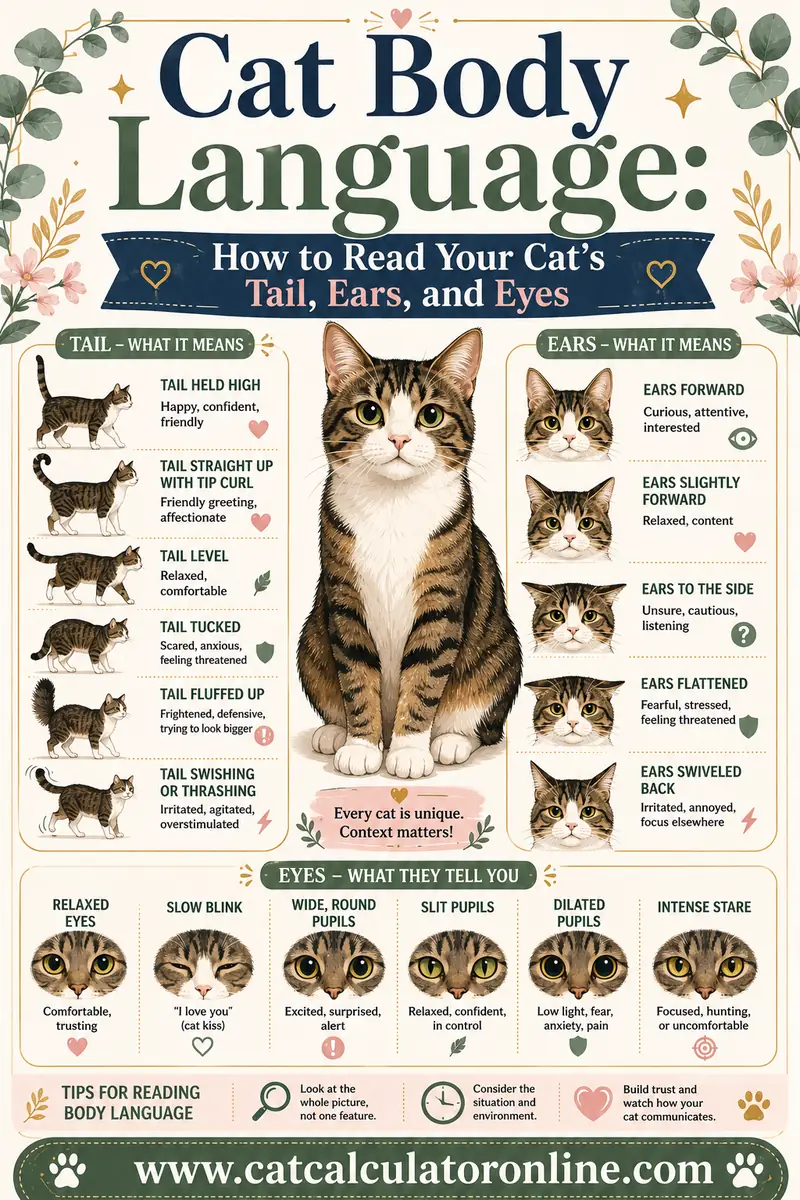
The meaning of any particular stare lives in the rest of her body. Eyes alone are ambiguous; eyes plus ears, tail, whiskers, and posture are a full sentence. That's the core skill of reading cats, and our complete guide to cat body language covers every signal in detail.
Is Staring a Sign of Affection?
Often, yes — and there's one version of the stare that's about as close to "I love you" as cat communication gets.
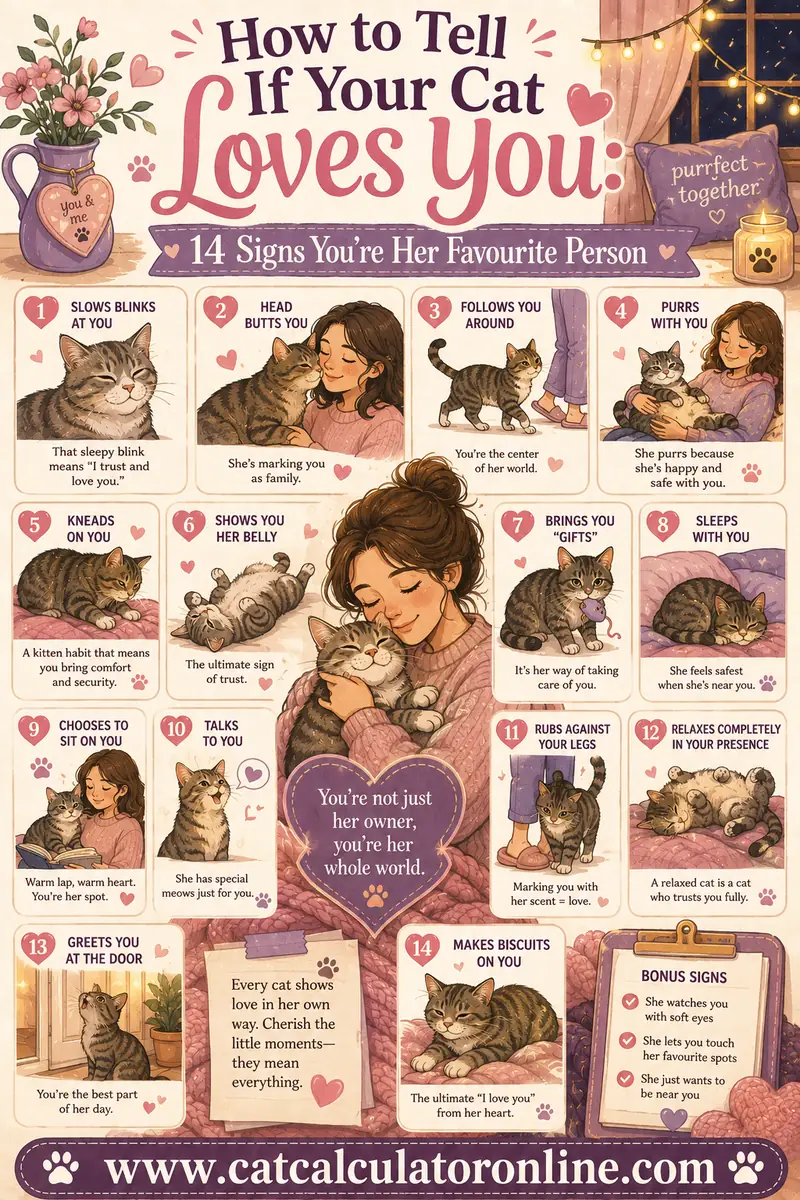
Watch for the soft gaze with slow blinks: her eyes are relaxed and slightly narrowed rather than wide, her face is loose, and every so often her eyes drift closed in a slow, deliberate blink before opening again. Behavior researchers have studied this "slow blink sequence," and the evidence points the same way owners' instincts do — it's a positive, friendly signal, sometimes described as a cat smile.
Here's why it makes sense from her side: closing her eyes around you is a small act of trust. A cat never voluntarily goes blind, even for half a second, in front of something she's worried about. A slow blink says the threat-assessment part of her brain has filed you under safe.
Two things you can do with this:
- Slow-blink back. Look at her softly (don't lean in or go wide-eyed), let your eyes close slowly, hold a beat, and open them. Many cats respond in kind — research suggests cats are more likely to slow-blink and approach people who slow-blink at them. It's the closest thing we have to a shared phrase in cat language.
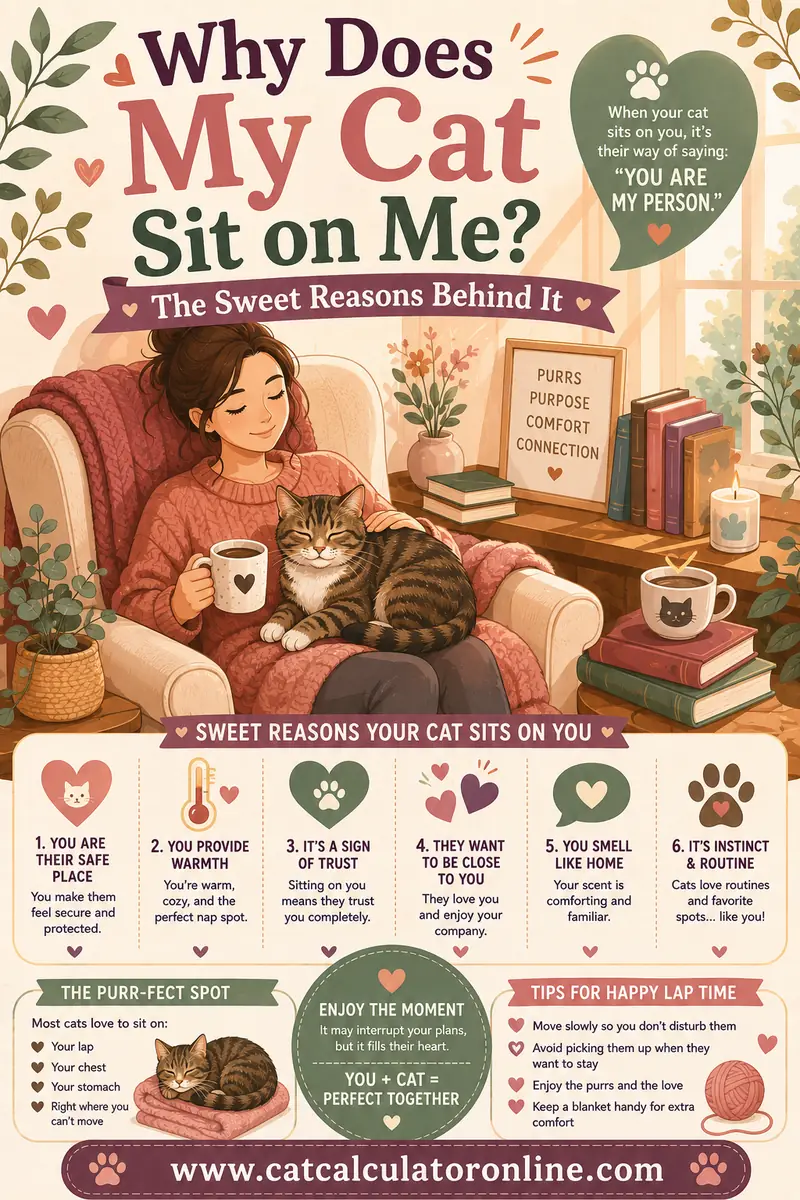
- Count it as bonding evidence. A cat who settles in the same room as you, points her body your way, and offers soft eyes and slow blinks is telling you the relationship is good. There are plenty more signals like this in how to tell if your cat loves you — and if she takes it further and plants herself on your legs, that's its own topic, covered in why does my cat sit on me.
One caution: affectionate staring is soft. A hard, wide-eyed, unblinking stare is a different signal entirely — more on that below.
Why Does My Cat Stare at Me While I Eat or Cook?
Because you are, from her point of view, the snack dispenser — and dispensers deserve monitoring.
Cats are superb pattern-learners. She has long since mapped your routines: which cupboard the food lives in, what the can opener sounds like, what time you usually give in and share a piece of chicken, what you look like in the minutes before feeding. Staring during your meals and kitchen time is anticipation built on that database. Some cats add commentary — weaving, chirping, a pointed meow — while others deploy the silent, unwavering supervisory stare from the counter's edge.
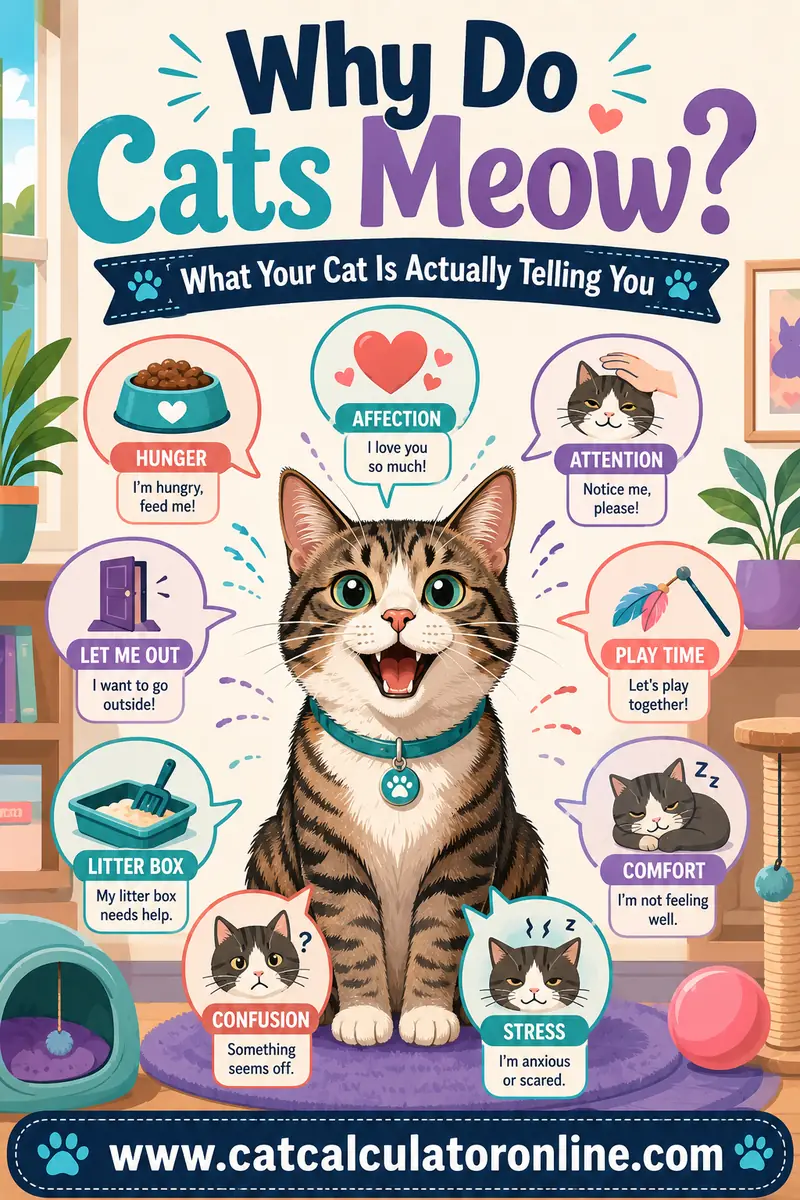
If the mealtime stare comes with vocals, you might enjoy our breakdown of what all that noise means in why do cats meow — adult cats meow almost exclusively at humans, which tells you exactly who trained whom.
Is it a problem? Only if it escalates into behavior you don't want (counter-surfing, food-stealing, yowling). The stare itself is harmless. If you'd rather dial it down:
- Never feed from your plate. One success funds a thousand future stares.
- Feed her before you eat. A cat with a full bowl supervises with noticeably less intensity.
- Keep feeding times consistent. Anticipation staring is worst when mealtimes wander; a predictable schedule shrinks the window of hopeful surveillance.
Why Does My Cat Stare at Me at 3am?
Waking to find two round eyes centimeters from your face is a rite of passage for cat owners. It feels supernatural. It's almost always breakfast.
Cats are crepuscular — wired to be most active at dawn and dusk, when their ancestors' prey was moving. Your 3–5am window sits right at the edge of her natural activity peak. She wakes up ready for action, discovers her human is inconveniently unconscious, and applies the tools that history has shown to work: staring, sitting on your chest, the tactical single paw to the cheek.
And here's the mechanism to be honest with yourself about: it has worked. At some point, a face-stare or a 4am serenade ended with you getting up and doing something — food, attention, even just grumbling, which is still attention. Cats repeat what pays.
Breaking the cycle is straightforward but requires nerve:
- Don't reward the wake-up. Ever. No food, no play, no chat, no eye contact. Any response at all keeps the behavior funded.
- Shift breakfast away from wake-up. If she's fed the moment you rise, your alarm becomes her dinner bell — and she'll try to move the alarm. Feed 20–30 minutes after you're up.
- Load her evening. A vigorous play session before bed, followed by a meal, mimics the hunt-eat-groom-sleep cycle and pushes her longest sleep block into your night.
- Consider a timed feeder for the early slot, so 5am hunger has a solution that isn't you.
Give it a couple of weeks of consistency. The stare will move to a more civilised hour.
Is My Cat Hunting Me When She Stares?
Sort of — but not the way it sounds. The intense, tracking stare your cat aims at you when you move around the house runs on her hunting attention system, without you being prey.
An ambush predator's superpower is sustained focus on a moving target. Your cat applies that machinery to anything interesting in motion: birds, the red dot, a bug on the ceiling — and you. When you're doing something novel (unpacking bags, exercising, wrapping presents, dragging a suitcase out), you become the most stimulating show in the house, and you get the full locked-on treatment: still body, forward ears, eyes tracking every move.
Sometimes it tips into play. The stare-plus-wiggle — crouched low, hindquarters shimmying, pupils going wide — is a pounce warm-up, and if it's aimed at your ankles, she's telling you she's under-exercised and you've been elected prey-substitute. That's a request for structured play, not aggression: grab a wand toy and give the instinct a proper target. A cat who gets one or two real hunt-style play sessions a day ambushes ankles dramatically less.
Pure curiosity explains most of the rest. Cats keep an eye on the state of their territory, and you are the biggest variable in it. The stare that follows you from room to room is often nothing more than "what is the big one doing now, and does it affect me?"
What Do Different Stares Mean? A Quick Reference
Same eyes, very different messages. The decoder is always the rest of her body:
| The stare | Eyes | Body | Most likely meaning | What to do |
|---|---|---|---|---|
| Soft gaze + slow blinks | Relaxed, slightly narrowed | Loose, settled, maybe kneading | Affection and trust | Slow-blink back |
| Kitchen supervision | Alert, bright | Sitting tall, tail wrapped, near the food zone | Food anticipation | Stick to schedule; don't feed from your plate |
| The 3am face stare | Round, expectant | Perched on or beside you | Hunger or learned routine | Ignore it; adjust feeding and play times |
| Locked-on tracking | Focused, following movement | Still, ears forward | Curiosity or play drive | Offer a play session |
| Crouched stare + butt wiggle | Wide, dark pupils | Low, coiled, tail twitching | Pounce incoming (play) | Redirect to a wand toy |
| Hard wide-eyed stare | Very wide pupils | Stiff, low or frozen, ears back or flat | Fear or high arousal | Give space; find and remove the stressor |
| Vacant stare at walls (senior) | Unfocused, "not there" | Standing oddly, may seem lost | Possible medical issue | Book a vet visit |
Print-worthy rule of thumb: soft eyes, soft meaning; hard eyes, hard meaning. A relaxed face around the stare almost always signals something benign. Wide pupils with a rigid body signal arousal — fear, threat, or overstimulation — and the kind response is distance, not cuddles.
Do Cats Think Staring Is Rude?
Between themselves — yes, more or less. Cats don't share human politeness rules about eye contact, but in cat-to-cat society a hard, direct, unbroken stare is a confrontational signal. Cats use it to claim resources and control space: the dominant cat in a multi-cat home can park herself in a hallway and block another cat's access to the litter box with nothing but a look. Standoffs before cat fights are stare-heavy; the cat who looks away first is usually de-escalating.
That has two practical consequences for you.
With your own cat, avoid locking eyes wide and unblinking, especially close to her face — from a cat's grammar book, that's a challenge. If you want to look at her lovingly, do it the cat way: soft eyes, angled slightly aside, slow blinks. Nervous cats in particular warm up faster to people who don't stare at them, which is why cats so often make a beeline for the one visitor who's ignoring them.
When your cat stares at you, though, don't translate it as rudeness in reverse. Cats clearly treat humans differently from cats — the stare she gives you is overwhelmingly information-gathering or request-making, not challenge. She's not being dominant when she watches you eat toast. She's being a cat with excellent focus and an interest in toast.
When Is Staring a Health Warning?
Rarely — but there's a short list every owner, especially of an older cat, should know.
- Staring at walls or into empty space, seeming "not there." An occasional glance at nothing is normal (cats hear things we don't). But a senior cat who regularly stares vacantly at walls or corners, seems to get lost in familiar rooms, or stands in one spot looking confused may be showing cognitive dysfunction — the feline version of age-related cognitive decline. It's common in older cats and worth a vet conversation, because management options exist.
- Vacant staring in a senior can also point to high blood pressure. Hypertension is underdiagnosed in older cats, often rides along with kidney or thyroid disease, and can affect vision and the brain. A vet can check it quickly. If your cat is in her senior years, our guide to signs your cat is getting old covers what normal aging looks like versus what needs attention.
- Staring with pupils of two different sizes, a newly cloudy eye, or apparent vision loss (bumping into things, startling easily) — same day vet call.
- Pressing her head against walls or furniture while staring or seeming dazed is an emergency sign, not a quirk.
- A sudden personality change in the staring — a formerly relaxed cat now rigidly staring at housemates or people, with stiff body language — can reflect pain or illness making her defensive.
None of this applies to the everyday soft stares, food stares, and 3am stares that make up 99% of feline eye contact. The pattern to watch for is change: new vacancy, new confusion, new intensity, especially in a cat past ten.
FAQ
Why does my cat stare at me without blinking?
Usually focused attention — she's tracking what you're doing, often hoping it ends in food or play. Check her body: a relaxed posture means benign curiosity, while wide pupils and a stiff body mean she's aroused or worried about something. Rare blinking alone isn't a bad sign; cats simply blink less than we do.
What does it mean when my cat stares at me and slow blinks?
That's affection and trust. Closing her eyes around you is a small act of vulnerability a cat only offers to something she considers safe. Return the slow blink — soft eyes, close slowly, hold, open — and many cats will answer.
Why does my cat stare at me while I sleep?
Almost always hunger or routine. Cats are most active around dawn, and staring at your face has probably earned breakfast before. Ignore night-time wake-ups completely, feed a while after you rise instead of immediately, and add evening play so her longest sleep block matches yours.
Should I stare back at my cat?
Not with a hard, wide-eyed stare — between cats that's confrontational, and nervous cats find it threatening. Use soft, slightly averted eyes and slow blinks instead. That's friendly in cat language, and it's why cats often gravitate to the person paying them the least direct attention.
Why does my cat stare at me and then meow?
She's making a request with two channels at once: the stare secures your attention, the meow delivers the ask — usually food, a door, or play. Adult cats meow almost entirely at humans, so the combination is genuine directed communication rather than random noise.
My older cat stares at walls — should I worry?
If it's frequent, or comes with confusion, getting lost in familiar rooms, night-time yowling, or personality changes, yes — book a vet visit. Vacant staring in seniors can signal cognitive dysfunction or high blood pressure, and both are far better caught early.
The Bottom Line
Your cat stares because watching is what cats do best — and you're the headline act of her world. Soft eyes and slow blinks mean love; the kitchen stare means the dispenser is being monitored; the 3am stare means the dispenser is late; wide pupils and a stiff body mean back off and find the problem. Read the whole cat, not just the eyes, and the staring turns from spooky to fluent conversation.
Want to know more about the little observer running surveillance on your life? Our free cat age calculator tells you her age in human years in one tap — then master the rest of her signals with cat body language.