Dental Disease in Cats
Dental disease is the most common health problem in adult cats, and also the most overlooked — most cats past the age of three or four have some degree of it. The reason it slips past owners is simple and slightly heartbreaking: cats hide mouth pain extremely well. They keep eating, keep purring, keep behaving normally, right up until treatment reveals how uncomfortable they'd been. Treatment isn't cheap, at roughly $800 to $2,000 for a proper dental under anaesthesia, but prevention genuinely works and costs almost nothing. The cat cost calculator helps you plan for it before it becomes urgent.
Why Is Dental Disease So Common in Cats?
Partly anatomy, partly the fact that nobody brushes their teeth.
In the wild, a cat's teeth got a certain amount of natural cleaning from tearing at prey. Domestic cats eating kibble or pouches get very little of that, and the idea that dry food "cleans teeth" is largely a myth — most kibble shatters on contact rather than scraping the tooth surface.
So plaque builds up along the gum line. Within days it hardens into tartar, which can't be brushed away. The gum reacts with inflammation — gingivitis — and if that continues, the infection works deeper, damaging the tissues and bone holding the tooth in place. That's periodontal disease, and by then it's irreversible.
There's a second condition specific to cats that owners rarely hear about until it's found. Tooth resorption is a process where the tooth structure itself breaks down from within, essentially dissolving. It affects a large share of adult cats, it's genuinely painful, and it's often invisible without dental X-rays because it starts below the gum line. Nobody fully understands why it happens, and there's no way to prevent it — the only treatment is extracting the affected tooth.
That combination — near-universal plaque plus a common condition you can't see or prevent — is why dental disease is so widespread, and why annual mouth checks matter so much.
What Are the Signs?
Quieter than you'd expect. This is the part worth reading carefully.
Bad breath is usually first, and it's the sign most often dismissed. Healthy cat breath is fairly neutral. A strong or foul smell is not "just cat breath" — it's usually bacteria.
Then, in rough order of how obvious they are:
- Chewing on one side, or tilting the head while eating
- Dropping food, or approaching the bowl and walking away
- Preferring wet food when they used to eat dry, because it hurts less
- Drooling, sometimes tinged with blood — never normal in cats
- Pawing at the mouth or shaking the head
- Red, swollen or bleeding gums along the tooth line
- Grooming less, leading to a scruffy coat
- Reduced appetite and gradual weight loss
- Hiding or becoming withdrawn
Here's what makes this difficult: many cats show almost none of these. They eat, they purr, they sit on your lap, and their mouth is quietly a mess. Vets very often hear "she's been completely fine" from owners whose cat turns out to need multiple extractions — and then hear, two weeks after treatment, that the cat is playing more, eating better and seems years younger.
That's the real argument for checking rather than waiting for signs. A cat that appears fine may still be uncomfortable, as covered more broadly in signs your cat is sick.
How Can You Check at Home?
Gently, and briefly. Thirty seconds is enough.
Lift the lip. With your cat relaxed — not restrained — lift the upper lip on one side and look at the gum line where gum meets tooth. You're looking for:
- A healthy mouth: pale pink gums, white teeth, no strong smell
- Early trouble: a thin red band along the gum line
- Established disease: yellow-brown tartar, receding or bleeding gums, visible holes or pink spots on teeth
Watch your cat eat. Thirty seconds of observation tells you a lot. Chewing on one side, head tilting, dropping food or eating unusually slowly are all worth noting.
Smell. Unglamorous but genuinely useful. A noticeable change in breath odor is meaningful.
Two things to be clear about. Don't force it — a cat that objects strongly shouldn't be wrestled, and you'll learn more from a calm five-second look than a struggle. And a home check doesn't replace a professional one. Tooth resorption and bone loss happen below the gum line, invisible to you and to your vet without X-rays. What you're doing at home is spotting the obvious cases early, not clearing your cat.
How Is It Treated?
With a proper dental procedure under general anaesthesia — and it's worth understanding why anaesthesia isn't optional.
A full dental involves:
- Pre-anaesthetic bloodwork to confirm your cat is safe to anaesthetise
- General anaesthesia with monitoring
- Dental X-rays, which reveal what's happening below the gum line — often the majority of the actual disease
- Scaling and polishing above and below the gum line
- Extractions of teeth that are damaged beyond saving
- Pain relief, and antibiotics if there's infection
You cannot X-ray, probe or extract in a conscious cat, which is why "anaesthesia-free dental cleaning" is not equivalent. It removes visible tartar from the crown, leaving the disease under the gum untouched — and it can make a mouth look better while the actual problem continues. Most veterinary bodies advise against it.
Extractions sound drastic and usually aren't. Cats manage remarkably well without teeth — many eat dry food comfortably after full-mouth extractions, and the relief from removing painful teeth almost always outweighs the loss. Owners are frequently astonished at how much brighter their cat seems afterward.
Stomatitis deserves a mention. It's a severe, painful inflammation of the whole mouth, and it sometimes requires removing most or all of the teeth. It's distressing to hear, but the outcomes for these cats are often very good once the source of inflammation is gone.
What Does It Cost?
| Procedure | Typical cost |
|---|---|
| Dental exam at a routine visit | Included in consultation |
| Pre-anaesthetic bloodwork | $80–$200 |
| Scale and polish, no extractions | $400–$800 |
| Dental with a few extractions | $800–$1,500 |
| Multiple or difficult extractions | $1,500–$2,500 |
| Full-mouth extraction (stomatitis) | $2,000–$3,000+ |
| Home care (brush, paste, per year) | $20–$50 |
The gap between the last row and all the others is the whole argument for prevention.
Two things worth knowing about insurance. Dental disease is usually covered by accident-and-illness policies, whereas routine cleaning usually isn't. And many insurers require evidence of regular dental checks before they'll pay a dental claim — skip the annual look for three years and an insurer may reasonably argue the disease was preventable. That makes the free part of dental care worth doing partly to protect the expensive part. Coverage detail is in what cat insurance covers, and general pricing in cat vet costs explained.
What Actually Prevents It?
Four things, in descending order of effectiveness.
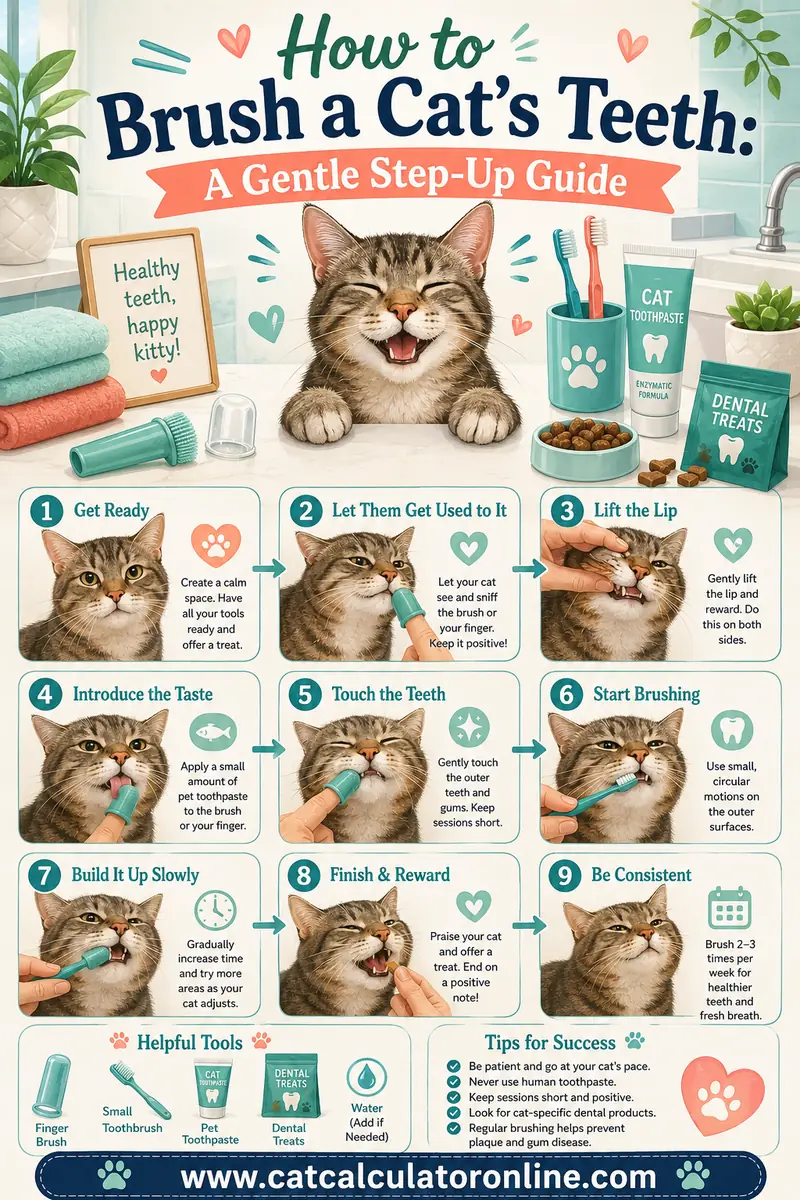
1. Brushing. The gold standard, and nothing else comes close. Daily is ideal, but even a few times a week makes a real difference. Use a cat-specific toothpaste — never human toothpaste, which contains ingredients unsuitable for cats — and a small soft brush or finger brush.
The trick is going slowly. Start by letting your cat lick the paste off your finger for a few days. Then touch the outside of the teeth with your finger. Then introduce the brush for a few seconds. Building this over two or three weeks works far better than attempting a full brushing on day one, and it's much easier to start with a kitten than an adult. Step-by-step guidance is in how to brush a cat's teeth.
2. Dental diets and approved products. Some therapeutic dental foods have larger, fibrous kibble designed to scrape the tooth rather than shatter. Certain treats, gels and water additives carry independent approval from the Veterinary Oral Health Council, which is a more reliable signal than packaging claims. Useful as a supplement to brushing, not a replacement.
3. Annual mouth checks. Free as part of a routine appointment, and the single easiest thing on this list. Twice yearly from around seven.
4. Catching it early. Gingivitis is reversible. Periodontal disease isn't. The window between those two states is where all the value sits.
What doesn't work: relying on dry food to clean teeth, bones (which fracture teeth), and anaesthesia-free cleaning.
Does It Change With Age?
Yes, and knowing the pattern helps you pitch your attention correctly.
Kittens and young cats. Baby teeth are replaced by adult teeth between roughly three and six months, and some mild gum redness during that period is normal. Occasionally a baby tooth fails to fall out and sits alongside its adult replacement — worth mentioning at a routine visit, since it traps food and plaque. This is also the ideal age to start toothbrushing, because a kitten who accepts it will accept it for life.
Young adults, one to four. Plaque and tartar begin accumulating in earnest. Most cats have some gingivitis by three or four. This is the window where prevention pays best, because gingivitis is still reversible.
Middle age, five to nine. Where established disease shows up. Tooth resorption becomes more common, and the first extractions often happen around here. Annual mouth checks matter.
Senior, ten and over. Dental problems are close to universal without ongoing care, and there's an added complication: anaesthesia feels riskier in an older cat, so owners often delay. That instinct is understandable and usually backwards. Modern anaesthetic protocols with pre-op bloodwork are safe for the large majority of healthy seniors, and leaving an infected, painful mouth untreated carries its own real costs. If you're worried, ask your vet directly about the specific risks for your cat rather than deciding alone. Twice-yearly checks from seven are covered in the senior cat health checklist, and general visit frequency in how often should a cat go to the vet.
Why Does Untreated Dental Disease Matter?
Because it isn't only about teeth.
Chronic pain. This is the main one, and the least visible. A mouth with resorptive lesions or advanced periodontal disease genuinely hurts, and cats endure it silently for months or years.
Reduced eating and weight loss. Eventually the discomfort wins, and appetite drops — often at the age when a cat can least afford to lose condition.
Infection spreading. Bacteria from a diseased mouth enter the bloodstream. There's ongoing veterinary interest in the links between chronic oral infection and the heart, liver and kidneys, and while the picture isn't fully settled, no one considers a permanently infected mouth harmless.
Tooth loss and jaw damage. Advanced periodontal disease destroys the bone anchoring teeth, and in severe cases weakens the jaw itself.
Escalating cost. A mouth treated early may need a scale and polish. The same mouth three years later may need six extractions.
None of this is said to alarm — it's said because dental disease is unusually easy to ignore and unusually rewarding to treat. Of all the things you can do for an ageing cat, sorting out a painful mouth often produces the most visible change in how they seem day to day.
Frequently Asked Questions
What are the signs of dental disease in cats?
Bad breath is usually first, followed by chewing on one side, dropping food, drooling, red or bleeding gums, grooming less, and gradual weight loss. Many cats show almost no signs at all, which is why annual mouth checks matter more than waiting for symptoms.
How much does a cat dental cleaning cost?
Roughly $400–$800 for a scale and polish without extractions, $800–$1,500 with a few extractions, and $1,500–$2,500 for multiple or difficult ones. Pre-anaesthetic bloodwork adds $80–$200. Full-mouth extraction for stomatitis can exceed $2,000.
Is anaesthesia-free dental cleaning safe for cats?
It's generally advised against. It removes visible tartar from the crown but can't address disease below the gum line, where most feline dental problems actually are — and it can't include the X-rays needed to find tooth resorption. It may make a mouth look better while the real problem continues.
Can cats eat normally after having teeth removed?
Yes, remarkably well. Many cats eat dry food comfortably even after full-mouth extractions, and most owners report their cat seems brighter and eats more enthusiastically once painful teeth are gone. The relief usually far outweighs the loss.
How do I brush my cat's teeth?
Build up slowly over two or three weeks — first letting your cat lick cat-specific toothpaste off your finger, then touching the teeth, then briefly introducing a soft brush. Never use human toothpaste. A few times a week still makes a genuine difference.
Does dry food clean cats' teeth?
Not meaningfully. Standard kibble tends to shatter on contact rather than scraping the tooth surface. Some therapeutic dental diets are specifically designed with larger, fibrous kibble that does help, but ordinary dry food isn't a substitute for brushing.
Dental disease is the condition most likely to be quietly affecting your cat right now, and the one most likely to go unnoticed. The encouraging part is how much difference small habits make: a thirty-second lip lift once a month, an annual mouth check at a routine appointment, and brushing a few times a week will prevent most of what would otherwise become a $1,500 procedure. If your cat has never had its mouth properly examined, that's worth booking — and you can plan the costs with the cat cost calculator.