Leash Training a Cat: Gear and Method
Almost every failed attempt at walking a cat comes down to the same two things, and neither is the cat's fault. The harness has to be a cat-specific H-style or vest design that she cannot reverse out of — never a collar, and never a dog harness scaled down — and the whole process has to be measured in weeks indoors before a paw touches the sidewalk. Rush either and you get a cat who flattens herself on the ground and refuses to move, which most owners read as failure when it is simply the normal first response. Be honest with yourself too: plenty of cats never enjoy this. Gear costs sit alongside everything else in the cat cost calculator.
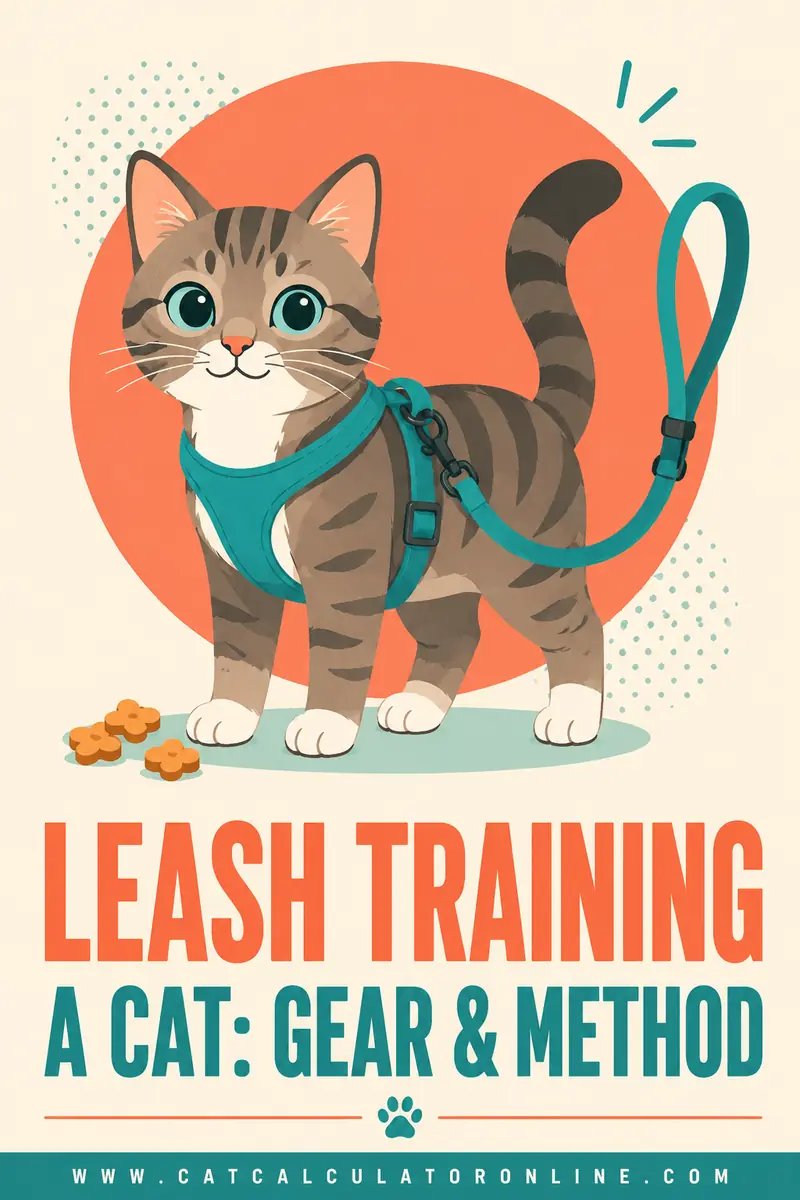
Why Is the Harness the Whole Decision?
Because a cat that can get out of her harness will, usually at the worst possible moment, and a cat in a badly fitted one will not walk at all.
Never attach a lead to a collar. Cat collars are designed to break away under load — that is a safety feature that stops cats hanging themselves on fences — so a collar either releases and your cat is loose, or it does not and you are pulling on her throat. Neither outcome is acceptable.
Cats are shaped to reverse out of things. A cat backing up against tension can flatten her shoulders and slide out of a loop that looked snug thirty seconds earlier. This is the single most common escape, and it happens fastest when something has frightened her.
Dog harnesses are the wrong geometry. They are built for a deep chest and a wide front, and they leave a gap at the shoulder that a cat slips straight through.
H-style harnesses use two adjustable loops — one behind the front legs, one around the neck — joined by a strap along the spine. Light, cool in warm weather, minimal fabric, and good ones adjust at four points. They suit slim cats and cats who dislike being covered.
Vest and jacket harnesses wrap the body in a panel of fabric with the clip on the back. They spread pressure widely, are the hardest to escape, and many cats accept them faster because the pressure feels less like a grab. They are warmer, which matters in summer.
Figure-of-eight harnesses tighten when pulled, which is a real drawback. They can constrict a cat who panics and are best avoided.
Look for the D-ring between the shoulder blades, a wide back panel, and adjusters that lock rather than creep. Metal hardware outlasts plastic, but plastic is lighter and quieter.
How Should a Cat Harness Fit?
The two-finger test, at every strap, every time you put it on.
Two fingers laid flat should slide under each strap — not two fingers stacked, and not a fingertip. Tighter than a dog harness would be, because the escape risk is higher.
Check the neck loop first. It should sit at the base of the neck, not up under the jaw, and you should not be able to pull it over her head with moderate force.
Check the chest strap behind the front legs. This is the one that usually needs another notch, and the one people leave too loose because it feels mean.
Watch her walk in it indoors. A harness that rides forward toward the neck, gapes at the shoulder, or spins around the body is not fitted right.
Weight is not size. Measure girth just behind the front legs with a tape and buy to that number. Cat harnesses are usually sold in ranges around 10–16 in (25–40 cm) chest girth, but the brands differ.
Recheck the fit after every winter. Coats thicken, cats gain and lose weight, and a harness fitted in July can be loose in January or tight in reverse.
Expect to spend $15–$35 on a decent cat harness and lead set in the US. A cheap one that gapes is not a saving.
What Actually Happens the First Time?
Two things, and both look alarming if you were not expecting them.
The flop. You do up the harness and your cat immediately falls over sideways and lies there like a dropped scarf. This is not distress in the way it appears — pressure across the back triggers a freeze response, an inherited reflex from being carried and from being pinned. Almost every cat does it, and almost every cat grows out of it in a few sessions.
The reverse-crawl. She walks backwards low to the ground, trying to leave the harness behind her. Also normal, also temporary.
The freeze outdoors. A cat who trots happily around the kitchen in her harness may stop dead on the doorstep and refuse to move a paw. Outside is enormous, loud and full of information. Sitting still and processing it is a sensible response, not a stubborn one.
What to do about all three: nothing dramatic. Do not lift her upright, do not pull the lead, do not laugh at her while she is stuck. Drop a few treats where she is lying, wait, and take the harness off after a couple of minutes on a positive note.
Short and frequent beats long and thorough. Two or three minutes, several times a day, ending before she has had enough, gets you there far faster than one long session.
Never force any stage. A cat pushed through this will associate the harness with being trapped, and that association is much harder to undo than it was to create. The general principle applies to all feline training and is set out in can you train a cat.
What Does a Realistic Timeline Look Like?
| Stage | Typical duration | What it looks like |
|---|---|---|
| Harness in the room | 2–4 days | It lies out near her food, she sniffs it, treats appear beside it |
| Harness on, unfastened | 3–7 days | Draped over her back for seconds, then removed with a treat |
| Harness on and fastened | 1–2 weeks | Worn during meals, building from 30 seconds to 10 minutes |
| Moving in the harness | 1–2 weeks | Playing and walking around indoors, flop response fading |
| Lead attached, dragging | 3–7 days | She wears it loose indoors under supervision |
| You holding the lead | 1 week | Following her, never steering, indoors only |
| First trip outside | 1 session | Carried out, set down in a quiet garden, five minutes |
| Regular short walks | Ongoing | 10–20 minutes, her route, her pace |
Six to eight weeks is a normal total for a confident adult cat. Some take a two weeks. Nervous cats take months, and some never complete the table.
Kittens learn faster. The window between about 8 and 16 weeks is when new experiences are accepted most readily, so a kitten introduced to a harness then usually treats it as unremarkable for life. Wait until she is fully vaccinated before going outdoors.
Go back a stage whenever she stalls. Progress is not linear, and a bad session is normal rather than a signal to push harder.
Feed the sessions. Use part of her daily food allowance as the reward rather than extra treats, so training does not quietly add weight.
Where Should the First Walks Be?
Somewhere small, quiet and enclosed, and nowhere near a road.
Carry her out, do not walk her out. A cat who learns to walk herself out of the front door on a lead may try it without one.
Start in your own garden or a fenced yard, five minutes at a time. If you have no garden, a quiet corner of a parking lot at dawn beats a park at midday.
Let her choose the direction. Walking a cat is not walking a dog. She will sniff a wall for six minutes and then sit under a hedge. That is the walk. The lead is a safety line, not a steering wheel.
Keep the lead short, around 4 ft (1.2 m), and never use a retractable lead — the handle is snatched from your hand easily and the sudden stop at full extension is unpleasant.
Avoid dogs, children and open ground. Most escapes happen when a startled cat bolts and either slips the harness or drags you into a hedge.
Never tie her up and leave her, not for a moment. A tethered cat cannot escape a threat, and cannot get out of the sun.
Have a plan for a panic. Scoop her up firmly against your chest rather than chasing the lead. Some owners carry a lightweight bag or a soft carrier for exactly this, which is also useful on longer outings — see how to travel with a cat.
What Are the Real Risks?
Escape is the big one. A frightened cat outdoors, in unfamiliar territory, in a harness she may snag on something, is a bad situation. Microchipping is non-negotiable before you start, and an ID tag helps.
Parasites. Outdoor access means fleas and ticks, so she needs regular preventive treatment from a vet. Check her over after every walk, particularly around the ears, neck and between the toes.
Infectious disease. Contact with other cats' urine, feces or saliva carries risk, so keep vaccinations current and avoid places where unowned cats congregate.
Toxins. Slug pellets, antifreeze, treated lawns and lilies in flower beds are all genuine hazards at cat height.
Stress. This is the underrated risk. A cat who is not enjoying it is not being enriched, she is being frightened repeatedly, and that has a cost.
Learning to want out. Some indoor cats become vocal and frustrated at the door once they have tasted outside. If your household relies on her being content indoors, weigh that up honestly first — the trade-offs are laid out in indoor vs outdoor cat.
Harness sores. Rare, but a harness worn for hours can rub, particularly under the front legs. Walks only, never all day.
Which Cats Take to It, and Which Never Will?
Good candidates: confident cats who greet visitors rather than hiding, cats who already enjoy the carrier, food-motivated cats, and kittens introduced early. Some breeds — Bengals, Abyssinians, Siamese and other active, people-focused types — are disproportionately represented among cats who genuinely enjoy walks.
Poor candidates: nervous cats, cats who hide from the vacuum, cats over about ten who have never been outside, and cats with arthritis or heart or breathing problems.
Cats with outdoor experience are a mixed group. A former stray may love being out and hate being restrained, which is its own kind of frustration.
Being realistic is not giving up. If after six to eight patient weeks she is still flattening herself on the doormat, she has answered the question. The goal was enrichment, and there are other ways to get it.
A secure outdoor run does the same job with none of the risk. She gets fresh air, birdsong, sunshine and grass, at her own pace, with no escape risk and no harness — the options are covered in catios and outdoor cat enclosures.
Indoor enrichment closes most of the gap. Vertical space, window perches, food puzzles and daily play do more for most cats than a weekly walk ever will — see how to keep an indoor cat entertained and the daily targets in how much playtime does a cat need.
Call your vet if she pants heavily, drools, or seems distressed for more than a few minutes after a session, or if she stops eating. Open-mouthed breathing in a cat is never normal and needs same-day advice.
Frequently Asked Questions
What kind of harness is best for leash training a cat?
A cat-specific H-style or vest harness with the lead ring between the shoulder blades. Vest styles are the hardest to escape and spread pressure most evenly. Never use a collar for a lead, and never a scaled-down dog harness — cats slip out at the shoulder.
How tight should a cat harness be?
Snug enough that you can slide two fingers laid flat under each strap, and no looser. Check the neck loop and the strap behind the front legs separately. A harness that gapes at the shoulder or spins around the body is not safe to go outside in.
Why does my cat flop over when I put a harness on?
Pressure across the back triggers a freeze reflex, so she goes limp and lies down. It is normal, it happens to most cats, and it fades within a few sessions. Drop a treat beside her, wait a minute or two, then remove the harness calmly.
How long does it take to leash train a cat?
Six to eight weeks is typical for a confident adult, working in two to three minute sessions several times a day. Kittens introduced between 8 and 16 weeks often take a two weeks. Nervous cats can take months, and some never accept it.
Is it safe to walk a cat on a leash?
Reasonably, with precautions: microchip her first, keep vaccinations and parasite treatment current, use a 4 ft fixed lead rather than a retractable one, stay in quiet enclosed spaces away from roads and dogs, and never tie her up and leave her unattended.
What if my cat hates the leash?
Stop. After six to eight patient weeks, a cat still flattening herself on the doorstep has given you her answer, and pushing further only builds a negative association. A secure outdoor run or a window perch delivers most of the same enrichment without the stress.
Something worth holding onto through the slow weeks: the point was never the walk. It was giving an indoor cat access to smells, textures and small changes she cannot get from a living room. If she gets that from ten minutes sitting under a shrub in your own garden, twice a week, the training worked completely.
Buy the right harness, fit it properly, expect the flop, and let the indoor phase take as long as it takes. Let her set the route once you are outside, keep the first trips to five minutes, and treat any refusal as information rather than defiance. To see where the harness, lead and any outdoor kit sit against the rest of a year's spending, put the numbers into the cat cost calculator.