8 Cat Years in Human Years
An eight-year-old cat is about 48 in human years — solidly middle-aged, a year into the mature adult stage, and typically still looking and behaving exactly as it did at four. Eight is the year where screening should have become routine rather than novel, and where the honest advice shifts from "start watching" to "you should already have a baseline to compare against". This page covers the arithmetic, what a healthy eight-year-old looks like, the conditions that genuinely start appearing now, and which changes are worth a phone call rather than a wait-and-see. Any age converts instantly with the cat age calculator.
How Do You Get 48?
The same three-step method, and by now it's routine.
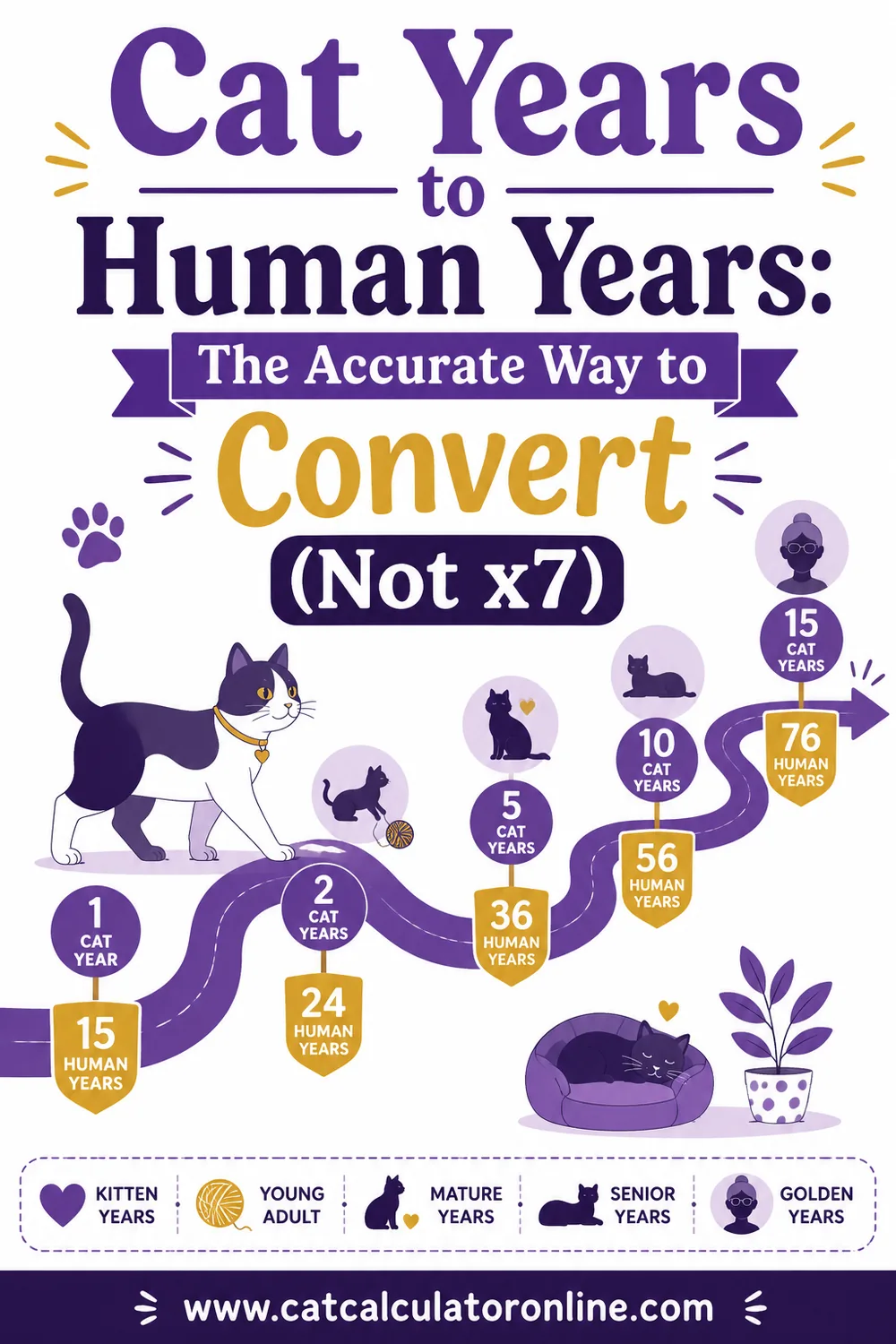
15 for year one, 9 for year two, 4 for every year after. By eight: 24 + (6 × 4) = 48.
| Cat's age | Human years | Life stage |
|---|---|---|
| 6 | 40 | Young adult |
| 7 | 44 | Mature adult |
| 8 | 48 | Mature adult |
| 9 | 52 | Mature adult |
| 10 | 56 | Senior |
| 11 | 60 | Senior |
| 13 | 68 | Senior |
| 16 | 80 | Senior |
Eight is the quiet middle of middle age. Seven had the stage boundary and ten has the senior threshold; eight sits between them with no milestone attached, which is precisely why it gets skipped. The screening that started at seven should simply continue.
The adjacent ages are in 7 cat years in human years and 9 cat years in human years, the full table in cat years to human years, and the reasoning in how a cat age calculator works.
What Does a Healthy Eight-Year-Old Look Like?
Largely unchanged from five, and the small differences are worth knowing.
Still active, slightly less so. Play sessions may be shorter but shouldn't have stopped. A cat that no longer engages with a wand toy at all is worth investigating rather than accepting.
Sleeping a little more. Fourteen to sixteen hours a day is typical at this age, up modestly from the young adult years, and spread across more separate naps.
Weight stable. A healthy eight-year-old should be holding steady. Either direction of movement is now informative.
Coat still well maintained. Cats groom less as joints stiffen, so a coat that has started looking untidy — particularly over the lower back, hips and base of the tail — is an early flag rather than cosmetic.
Jumping still confident, though many cats at eight have started staging jumps through intermediate furniture without their owners noticing the change.
Teeth are the likely exception. By eight, most cats have some degree of periodontal disease, and a fair proportion need a professional clean. This is the most common thing to be genuinely wrong in an otherwise healthy cat of this age.
What's normal to see: slightly reduced activity, a little more sleep, some greying around the muzzle in dark-coated cats. What isn't normal: weight loss, increased drinking, vomiting more than occasionally, or a cat that has stopped jumping onto things it used to reach.
What Conditions Start Appearing at This Age?
Four worth knowing by name, because early recognition genuinely changes outcomes.
Diabetes mellitus. Strongly associated with excess weight, and middle-aged neutered males are the highest-risk group. The early signs are increased drinking, increased urination, increased appetite and weight loss despite eating well. Caught early, some cats achieve remission with diet and treatment. Detail in diabetes in cats.
Chronic kidney disease. The most common serious diagnosis in older cats, and it begins silently well before symptoms. Screening at this age is precisely aimed at catching it in the stage where management makes a real difference.
Hyperthyroidism. Typically appears from middle age onward. Eating more while losing weight is the classic combination, often with restlessness, increased vocalisation and a poor coat.
Urinary tract disease. Common in cats generally and worth understanding because of one specific emergency: a male cat that is straining in the litter box and producing little or no urine may have a blocked urethra, which is fatal within 24 to 48 hours untreated. This is not a wait-until-morning situation. The signs and the urgency are set out in urinary blockage in cats.
Also increasingly likely: hypertension, arthritis, and dental disease severe enough to warrant treatment. None of these are inevitable at eight; all become more probable with each year from here, and all are considerably easier to manage when the first sign is a screening result rather than a visibly unwell cat.
What Changes Deserve a Phone Call?
Worth being clear about, because middle-aged cats are exactly where owners talk themselves out of appointments.
Call the same day for:
- A male cat straining in the box with little or no output
- Not eating at all for 24 hours — cats that stop eating risk hepatic lipidosis, which develops quickly
- Labored breathing, open-mouth breathing, or breathing with obvious effort
- Sudden weakness, collapse or dragging a back leg
- Repeated vomiting with lethargy
Book within the week for:
- Weight loss you can see or measure
- Noticeably increased drinking or urination
- Eating more than usual without gaining
- Vomiting more than about once a month
- A coat that's gone unkempt
- Any new lump
- Reduced jumping, or going beside the box rather than in it
Mention at the next routine visit:
- Slightly more sleeping
- Mild reduction in play
- Occasional hairballs
- Small changes in sociability
The rule that serves best: in a middle-aged cat, a change in a settled pattern is worth more attention than the absolute state. A cat that has always drunk a lot is less interesting than one that has started drinking more this month.
Should Anything Change in Daily Care?
Modest adjustments, none of them expensive.
Increase the wet food proportion if your cat is mostly on dry. Hydration is one of the few kidney-relevant variables you control directly, and eight is a sensible point to shift the balance.
Keep the weight steady. For the first time, holding weight matters more than reducing it. An eight-year-old that is slightly heavy and stable is in a better position than one losing weight for unknown reasons.
Maintain play. Shorter sessions if needed, but daily. Activity preserves muscle mass, which becomes genuinely important in the years ahead.
Make the environment easy. Steps to favorite perches, a litter box with at least one low side, food and water reachable without a jump. Introduce these before they're needed.
Warmth matters more. Older cats seek heat, and it starts around here. A warm, draught-free bed is worth providing.
Keep brushing teeth, and act on veterinary advice about a dental. Anaesthetic risk at eight, with normal bloodwork, is low — and it rises with each year the procedure is postponed. Deferring a dental until twelve means doing it in a cat with more risk factors and worse disease.
Groom more. Cats that groom less need help, especially long-haired ones. A few minutes of brushing a week prevents the matting that becomes a real problem in older cats, and it doubles as a weekly check for lumps, scabs and sore spots you would not otherwise find under the coat.
What doesn't need changing: the food brand, if the cat is well on it. Supplements, in the absence of a diagnosis. Check-up frequency, which stays annual until ten.
One addition worth making at eight: a proper record. A single page with your cat's normal weight, normal daily food, normal water intake, how many times it uses the box, and a note of any medication. Keep it where you'd find it in a hurry. If your cat ever needs an emergency appointment — or if someone else has to look after it — that page is worth more than anything you'd be able to recall under pressure.
And take a photograph from above, once a year. Body shape changes so gradually that comparison photos are genuinely more reliable than your eye. Same angle, same lighting, same spot on the floor. It takes ten seconds and it will show you at eleven what you couldn't see at ten.
Why Is Eight the Year People Skip?
Worth naming, because the pattern is remarkably consistent and it costs cats years.
There's no milestone attached. Seven has the stage boundary and the "your cat is middle-aged now" conversation. Ten has the senior threshold and the switch to twice-yearly checks. Eight and nine have nothing — no birthday prompt, no change in advice, no visible difference in the cat.
The cat looks fine. An eight-year-old in good health is indistinguishable from a five-year-old to anyone who isn't measuring. There's no external reason to book an appointment.
The previous screen was normal. Having had bloods at seven that came back clear, many owners reasonably conclude the next set can wait a year or two. But screening works by comparison — a creatinine that has risen within the normal range is meaningful, and you only see it if you took the second measurement.
Money is a real factor. A full screen costs money for a cat that seems well, and it's the easiest expense in the year to defer. Worth weighing against what a late kidney diagnosis costs, both financially and in months of the cat's life.
What actually happens is that screening lapses at eight and nine, and resumes at ten or eleven when the cat is visibly unwell — by which point the condition that would have been caught early is established.
The counter-argument in one line: the whole value of screening a middle-aged cat is in the years where nothing appears to be wrong. If you only test when the cat seems ill, you haven't screened at all — you've investigated.
Frequently Asked Questions
How many human years is 8 cat years?
About 48. The calculation is 15 for the first year, 9 for the second, and 4 for each year after — so 24 at age two plus six further years at four each.
Is an 8-year-old cat old?
Not old, but middle-aged. Under AAHA guidelines eight sits in the mature adult stage, which runs from seven to ten. The senior stage begins at ten, so an eight-year-old typically has many years ahead.
What health problems start at eight?
Chronic kidney disease, hyperthyroidism, diabetes, hypertension, arthritis and significant dental disease all become more likely from middle age. None is inevitable, and all are considerably more manageable when found through screening rather than symptoms.
Should an 8-year-old cat have annual blood tests?
Yes, that's a reasonable default. A panel covering kidney values, thyroid and glucose, plus a urinalysis and a blood pressure reading, is the standard screening set for a cat in the mature adult stage.
My 8-year-old cat is losing weight — is that a problem?
It's worth a vet appointment. Unexplained weight loss in a middle-aged cat is a more significant signal than gain, and commonly indicates hyperthyroidism, kidney disease or diabetes — all of which respond far better to early treatment.
When is straining in the litter box an emergency?
When a male cat is straining and producing little or no urine. A blocked urethra can be fatal within 24 to 48 hours and needs immediate veterinary attention rather than an appointment the next day.
Eight cat years is about 48 human years — the unremarkable middle of middle age, which is exactly why it gets skipped. Keep the annual screening going, hold the weight steady, sort the teeth while anaesthesia is still low-risk, and treat any change in a settled pattern as worth a call. Convert any age with the cat age calculator.