How Many Cats Is Too Many?
There's no legal number and no magic figure — too many is the point where you can't meet each cat's needs, and that threshold depends far more on your space, time and money than on a headcount. Some households run beautifully with five cats; others are struggling with two. What actually determines it is whether every cat has enough resources — litter boxes, feeding stations, resting places, vertical space — and whether you can afford proper veterinary care for all of them. This page covers the rules that matter, the honest costs, and the warning signs that a home has tipped over. The cat cost calculator is the practical starting point for the money side.

What Are the Resource Rules?
Cats in groups don't share the way dogs do. They tolerate one another when there's enough to go round, and compete when there isn't. The rules below are what welfare organizations and behaviourists work to.
| Resource | Rule | For 3 cats |
|---|---|---|
| Litter boxes | One per cat plus one | 4 |
| Feeding stations | One per cat, separate locations | 3 |
| Water bowls | One per cat, away from food | 3 |
| Beds / resting spots | Two or more per cat | 6+ |
| Scratching posts | One per cat, minimum | 3 |
| High perches | One per cat | 3 |
| Hiding places | One per cat | 3 |
Spread them out. Two litter boxes side by side count as one location to a cat. The point isn't just quantity — it's that a cat can always reach a resource without passing another cat that makes it uneasy. More on box numbers and placement in how many litter boxes per cat.
Vertical space multiplies floor space. Cats resolve social tension by using different heights rather than confronting each other, so shelves, cat trees and high perches genuinely increase how many cats a room can hold comfortably — see cat tree buying guide.
The rule of thumb on space: roughly 200 square feet of usable living area per cat is often quoted. Treat it loosely — a well-organized flat with plenty of vertical space works better than a large house with nothing off the floor.
What Does Each Extra Cat Actually Cost?
The number most people underestimate, because they think about food and forget veterinary care.
| Item | Per cat, per year |
|---|---|
| Food | £250–£500 |
| Litter | £100–£200 |
| Preventive vet care (vaccines, worming, flea) | £150–£300 |
| Insurance | £150–£400 |
| Toys, beds, replacements | £50–£100 |
| Routine total | £700–£1,500 |
Then the part that decides whether a household is viable: unexpected veterinary costs. A single emergency — a blocked bladder, a road accident, a dental extraction — runs from several hundred to a few thousand pounds. With one cat that's a bad year. With six, the probability that something happens each year approaches certainty.
The honest test: if two of your cats needed £1,500 of emergency treatment in the same month, could you fund it? If the answer is no, you're at or past capacity regardless of how well things are going day to day.
Boarding and cover scale too. A week away with five cats means five boarding fees or a sitter, and a lot of catteries charge per cat even for siblings sharing a pen.
Run your own numbers through the cat cost calculator before adding another cat rather than after.
What Are the Warning Signs of Too Many?
The cats tell you before the household does.
Behavioral signs:
- Spraying or urine marking — the classic sign of territorial insecurity
- House soiling outside boxes
- Fighting, or the subtler version: blocking doorways, staring, one cat unable to reach food or a box
- A cat that hides constantly or has effectively withdrawn to one room
- Overgrooming, often to bald patches, in one or more cats
- Reduced play and interaction
- Eating problems — a cat that eats too fast, or barely eats, because it feels rushed
Practical signs:
- Persistent litter smell despite regular cleaning
- Skipping or delaying veterinary care because of cost
- Not knowing exactly what each cat weighs, eats or how it's behaving
- Fleas or worms recurring, because treating everyone is expensive and fiddly
- Feeling that cat care has become a chore rather than a pleasure
The quiet one to watch for: a cat that has stopped using the shared spaces. It isn't fighting, it isn't ill, it's simply gone. That's a cat living under chronic stress, and it's easy to interpret as a quiet personality. Tension between cats is often subtle — how to stop cats fighting covers what to look for.
Physical signs in the cats: weight loss in the lower-ranking ones, recurrent cystitis — stress-linked bladder disease is common in crowded homes — poor coat condition, and infections passing round the group.
Do Cats Even Want Company?
Worth asking, because the assumption that a cat must be lonely is behind a lot of poorly considered second cats.
Cats are facultatively social — they can live in groups, and they don't need to. Domestic cats descend from a solitary ancestor, and while feral colonies do form, they're built around related females with abundant food, and cats join and leave freely. That's a very different situation from two unrelated adults confined to a flat.
Cats that generally do well together: littermates raised together, cats introduced as kittens under about six months, a young cat with a tolerant adult, and cats with plenty of space and resources.
Cats that often don't: two unrelated adults introduced abruptly, a confident cat with a timid one in a small space, elderly cats asked to accept a boisterous kitten, and any cat with a history of not tolerating others.
Signs your single cat is fine alone: relaxed, eating well, playing, sleeping normally and interacting with you. That cat does not need a companion, and introducing one may make its life worse.
Signs a companion might genuinely help: a young, playful, sociable cat that's alone for long stretches and is showing boredom-related behavior. Even then, enrichment and playtime should be tried first — see how to keep an indoor cat entertained.
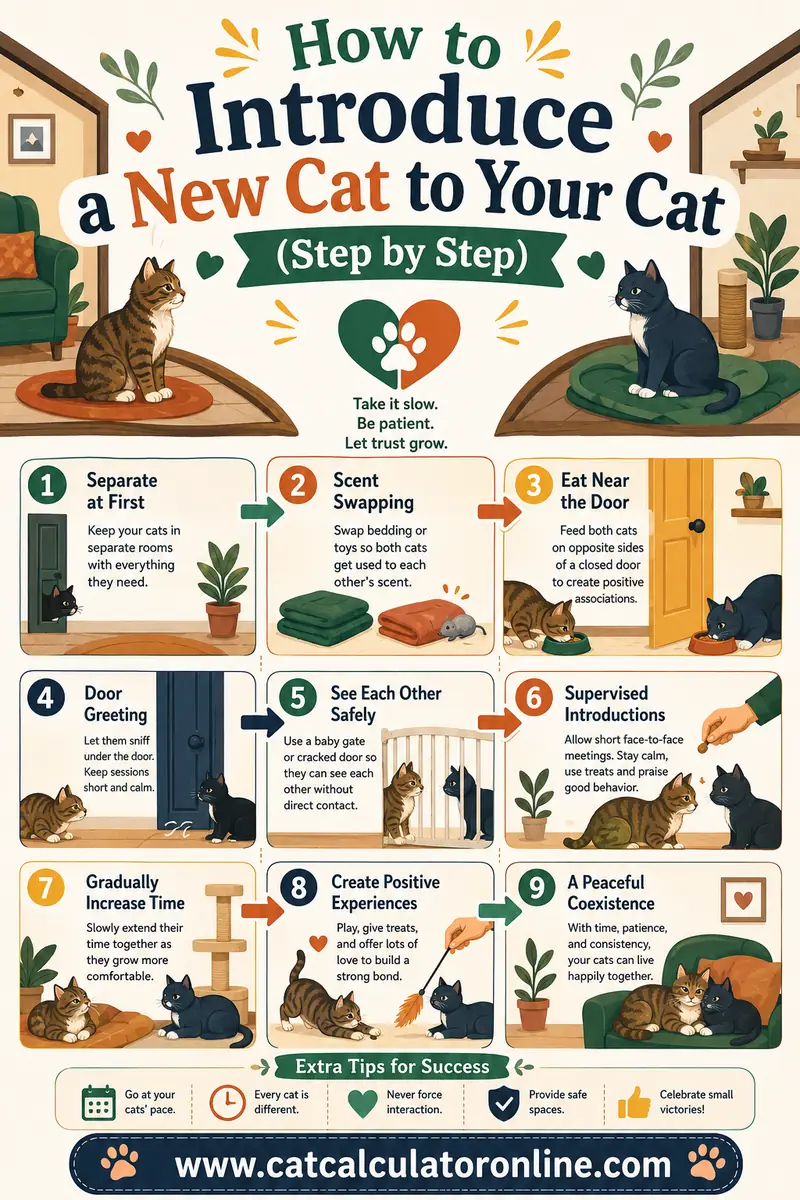
If you do add one, take the introduction slowly. Weeks, not an afternoon. A rushed introduction is the most common cause of long-term conflict, and it's covered properly in how to introduce a new cat.
What Does Time Cost, Not Just Money?
The constraint people plan for least, and often the one that bites first.
Litter maintenance scales linearly. Four boxes scooped twice daily is roughly ten minutes a day, every day, plus full changes and washing. It doesn't sound like much until you're doing it on a Sunday morning with flu.
Individual attention doesn't scale at all. Each cat needs interactive play — most benefit from two short sessions a day — and playing with four cats separately is close to an hour. Group play doesn't substitute, because the confident cat takes over and the timid one watches. How much playtime does a cat need sets out the individual requirement.
Medication becomes a logistical problem. One cat on twice-daily tablets is manageable. Two cats on different medications, one of which must be given away from food, in a household where cats swap bowls, is a genuine daily project.
Feeding separately takes time. In a multi-cat home you often can't free-feed, because one cat gains weight and another gets pushed off. Separate rooms, timed feeders or supervised meals all cost minutes twice a day.
Monitoring gets harder with every cat. In a one-cat home you know immediately if the box output changes. With five cats sharing four boxes, a cat straining to urinate can go unnoticed for days — and that's precisely the problem that becomes fatal fastest.
Vet trips multiply. Annual checks, vaccinations, dental work and follow-ups for five cats is a meaningful number of appointments, carriers, and afternoons off work.
Introductions take weeks each time. Every new cat added to an established group needs a proper phased introduction, which is a matter of weeks of managed separation, scent swapping and supervised contact. Adding a fourth cat is considerably more work than adding a second, because you're introducing it to three existing relationships rather than one.
What If You Already Have Too Many?
No judgment in this section — households drift into it, usually through kindness rather than carelessness.
First, stop adding. Including strays, fosters and "just until we find a home for her".
Neuter everyone, without exception. An unneutered pair becomes a crisis quickly, and unneutered cats spray, fight and roam far more.
Add resources before anything else. More litter boxes, more feeding stations, more vertical space, more hiding places. This is the fastest improvement available and it's cheap.
Divide the space. Two smaller, resource-complete territories often work better than one contested open-plan area. Doors, baby gates and separate feeding rooms all help.
Get the veterinary care done, prioritising whatever is most urgent, and ask your practice about payment plans or a health plan. Charities including the PDSA, Blue Cross and Cats Protection help those who qualify.
Consider rehoming, which is not a failure — it's the responsible response to a household that has outgrown its capacity. A reputable rescue will help, and a cat that's currently hiding under a bed for twenty hours a day will very likely be happier elsewhere.
Ask for help early. Where the number has grown well beyond what's manageable, animal welfare charities can offer practical support including neutering assistance. Approaching them yourself is always better than the situation deteriorating.
And keep the environment safe as numbers rise — more cats means more chances that something dangerous gets found, which is worth reviewing in how to cat proof your home.
Frequently Asked Questions
How many cats is too many for one house?
There's no fixed number. Too many is the point where you can't provide enough litter boxes, feeding stations, resting places and vertical space, or afford veterinary care for all of them. Some homes manage five well; others are stretched at two.
How many litter boxes do I need for multiple cats?
One per cat plus one, placed in genuinely different locations. Three cats need four boxes spread around the home rather than lined up together, since two boxes side by side count as a single location to a cat.
Do cats get lonely if kept alone?
Not necessarily. Cats are social by choice rather than necessity, and many are perfectly content alone with enough enrichment and interaction. A relaxed cat that eats, plays and sleeps normally doesn't need a companion.
What are the signs of too many cats in a home?
Spraying, house soiling, fighting or subtle blocking behavior, a cat that hides constantly, overgrooming, persistent litter odor, and delayed veterinary care because of cost. A cat that has quietly withdrawn to one room is the sign most often missed.
How much does each additional cat cost per year?
Roughly £700–£1,500 a year in routine costs. The bigger consideration is emergencies — a single incident can run to several thousand pounds, and with more cats the chance of one occurring each year rises sharply.
Is it cruel to have a lot of cats?
Not by number alone. It depends entirely on whether each cat's needs are met — space, resources, veterinary care and attention. A well-run home with five content cats is fine; a home with two stressed cats and unaffordable vet bills is not.
A last word on how these situations arise. Almost nobody sets out to have too many cats. It happens through a stray that stayed, a foster that never left, an unneutered pair, or a family member's cat that needed a home. Each decision is kind and reasonable on its own, and the total quietly exceeds what the household can carry. Noticing that early — and acting on it — is the responsible thing, not the sign of a failure.
The useful question isn't how many cats you can fit, but whether every cat in your home can eat, toilet, rest and move around without competing. Add resources before you add cats, be honest about the veterinary math, and treat a withdrawn cat as a signal rather than a personality. Work out what another cat would actually cost with the cat cost calculator.