How Do Cat Years Work? The Non-Linear Formula, Explained
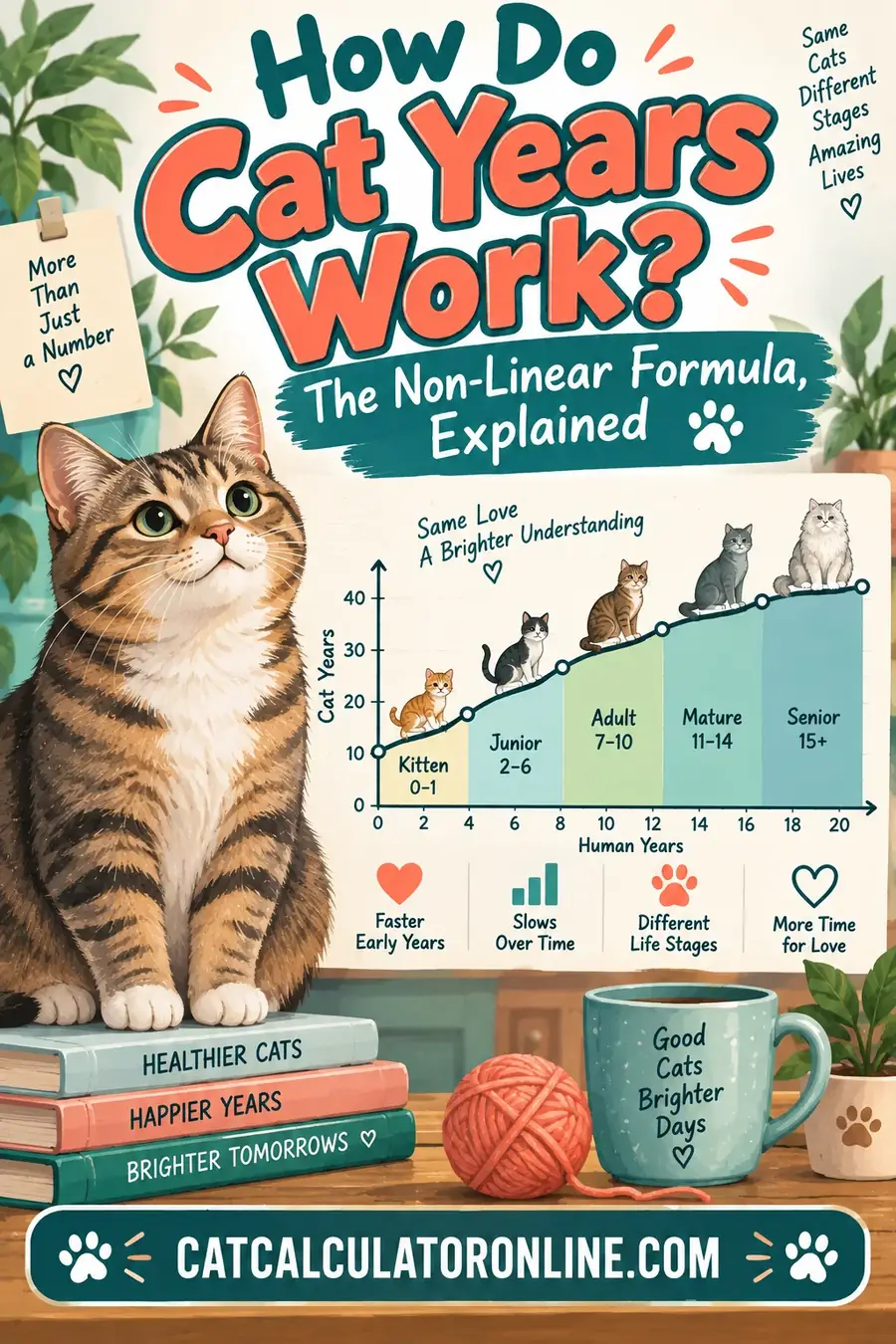
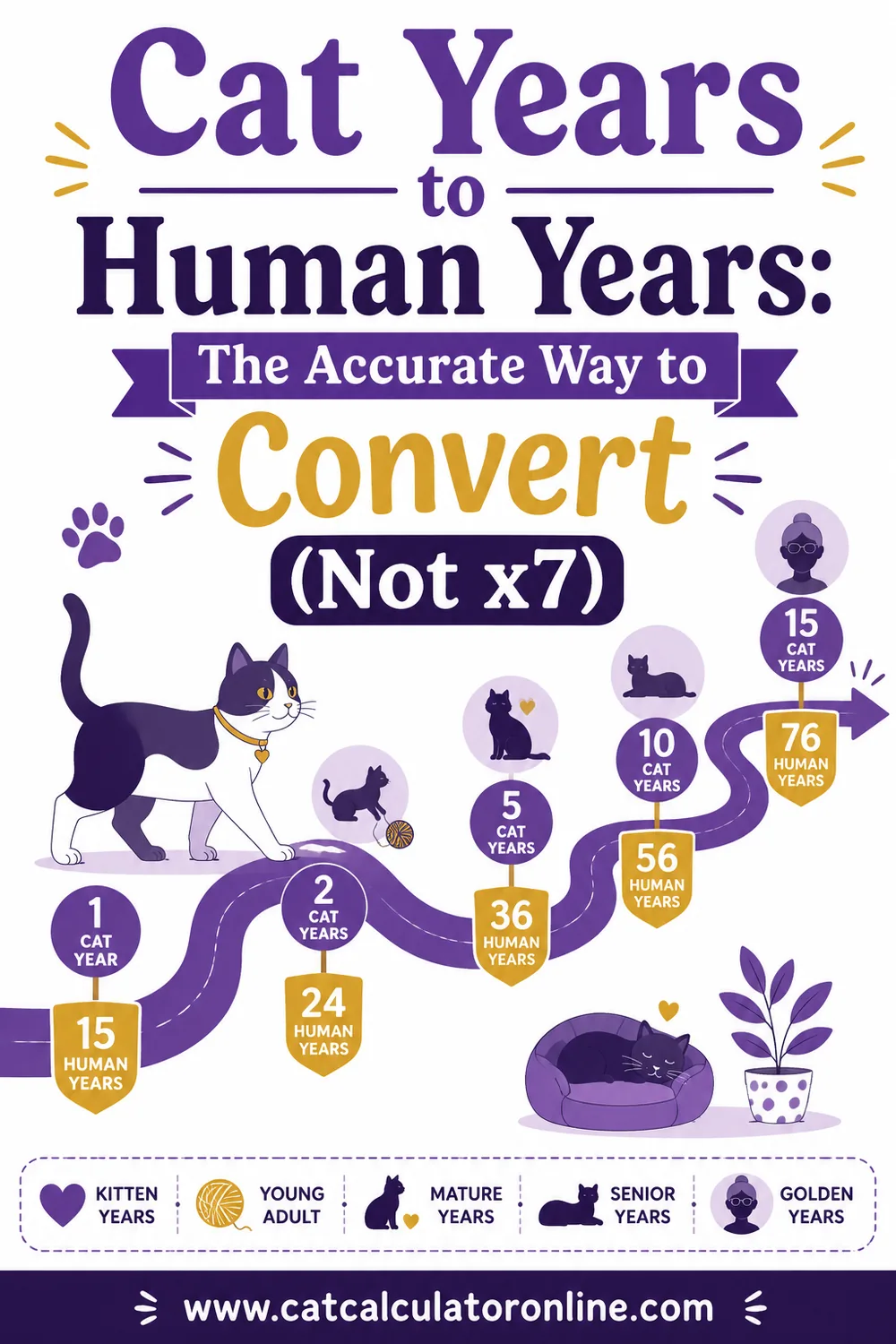
Cat years don't work as a multiplier — they work as a curve. A cat's first year is worth about 15 human years, the second adds about 9 more, and every year after that adds roughly 4. So a 2-year-old cat is around 24 in human terms, and a 10-year-old cat is around 56.
The "multiply by seven" rule that most people have heard is a dog-years myth that got borrowed for cats, and it's wrong at both ends of a cat's life.
The Formula
| Cat's age | Add | Human-equivalent total |
|---|---|---|
| First year | +15 | 15 |
| Second year | +9 | 24 |
| Each year after | +4 | 28, 32, 36... |
So the arithmetic for any cat over two: 24 + (4 × (age − 2)).
A 7-year-old cat: 24 + (4 × 5) = 44. A 15-year-old cat: 24 + (4 × 13) = 76.
Full Conversion Chart
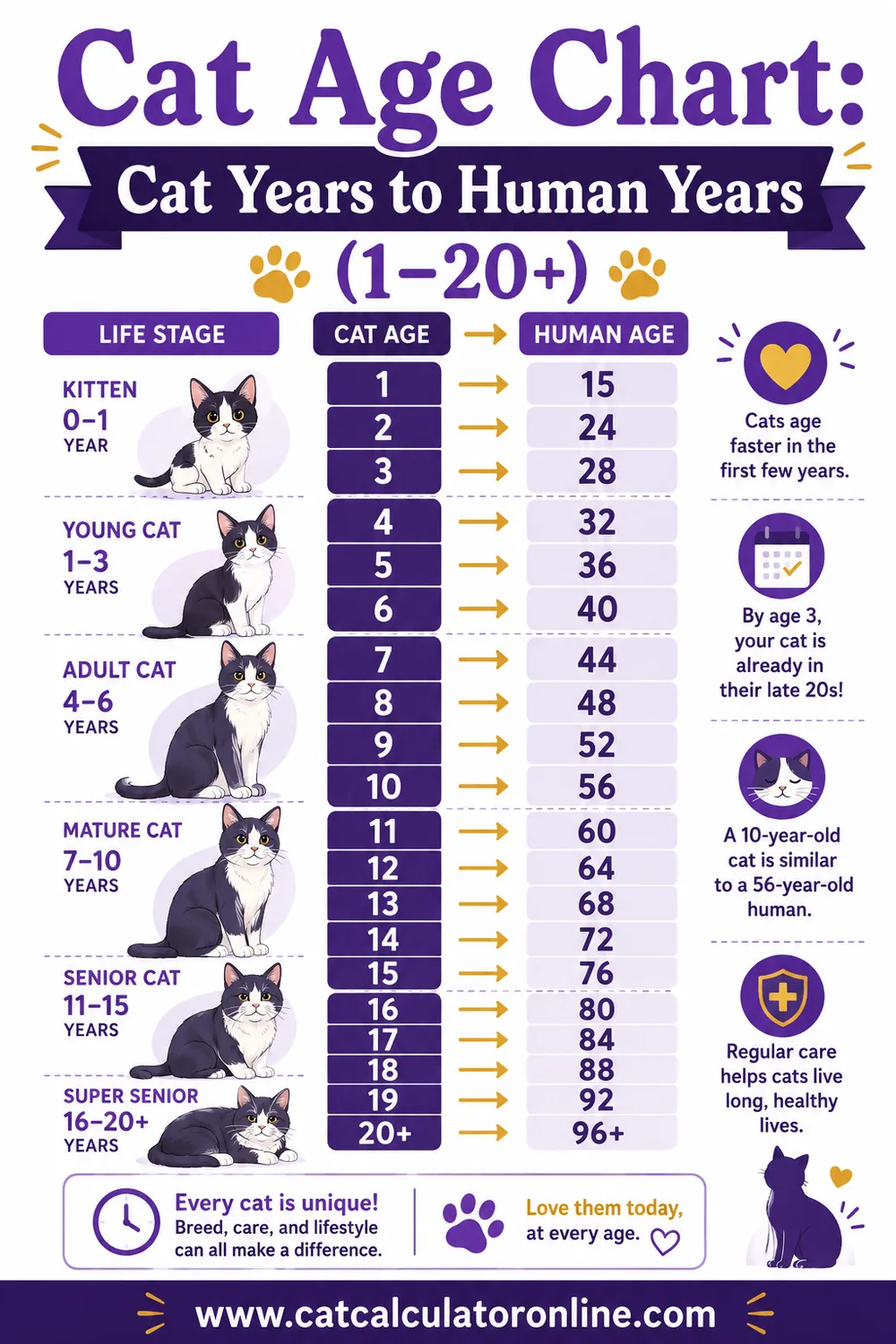
| Cat's age | Human equivalent | Life stage |
|---|---|---|
| 1 month | ~1 year | Kitten |
| 3 months | ~4 years | Kitten |
| 6 months | ~10 years | Kitten |
| 1 year | 15 years | Junior |
| 2 years | 24 years | Junior |
| 3 years | 28 years | Adult |
| 4 years | 32 years | Adult |
| 5 years | 36 years | Adult |
| 6 years | 40 years | Adult |
| 7 years | 44 years | Mature |
| 8 years | 48 years | Mature |
| 9 years | 52 years | Mature |
| 10 years | 56 years | Mature |
| 12 years | 64 years | Senior |
| 14 years | 72 years | Senior |
| 15 years | 76 years | Senior |
| 18 years | 88 years | Geriatric |
| 20 years | 96 years | Geriatric |
| 25 years | 116 years | Exceptional |
A cat age calculator does this instantly and adjusts for lifestyle, which changes the picture more than most owners expect.
Why the Curve Is Steep Early
The front-loading isn't arbitrary. It reflects what's actually happening biologically.
A cat reaches sexual maturity at around 5 to 9 months. A human doesn't reach the equivalent stage for well over a decade. That alone accounts for most of the first year's steepness.
Full physical growth completes around 12 to 18 months. By her first birthday a cat is essentially an adult — full size, full capability, capable of reproduction. Calling that "seven" makes no sense against any developmental measure.
After maturity, the rate settles. Once growth and development are done, aging becomes a slower, steadier process, which is why the curve flattens to about 4 years per year.
This is the same general pattern seen across mammals: rapid development to reproductive maturity, then a long slower adult phase.
Why "Multiply by Seven" Fails
At the young end: it says a 1-year-old cat is 7 — a young child. In reality she's fully grown and can have kittens. The gap between the myth and the biology is enormous.
At the old end: it says a 20-year-old cat is 140, which is beyond any human lifespan. The real figure of around 96 is high but coherent.
The rule appears to have originated as rough division — average human lifespan divided by average pet lifespan — rather than from any study of development. It stuck because it's easy to remember.
What Changes the Numbers
The chart above assumes a typical, reasonably cared-for cat. Two factors shift real outcomes substantially:
Indoor vs. outdoor. Indoor cats commonly live 12 to 18 years, sometimes past 20. Outdoor cats average considerably less — often cited in the range of 2 to 5 years in high-risk areas — largely because of traffic, predators, fights and disease exposure rather than faster biological aging.
Size and breed. Unlike dogs, where large breeds age faster, the effect in cats is weaker. Some larger breeds like Maine Coons trend slightly shorter-lived, and some smaller breeds like Siamese trend longer, but the difference is far less pronounced than the dog equivalent — see cat years vs dog years for why the two species differ here.
Weight and dental health are the two modifiable factors with the clearest link to lifespan. Both are worth more attention than the conversion arithmetic.
What the Number Is Actually For
The practical use isn't trivia — it's knowing when to change care.
Around age 7 (44 human): most vets recommend beginning senior screening — bloodwork and urinalysis annually, even in an apparently healthy cat. Kidney and thyroid changes frequently begin here and are much easier to manage caught early.
Around age 11-12 (60-64 human): twice-yearly vet visits become the common recommendation, since conditions progress faster and small changes matter more.
Any age: sudden weight change, appetite change, or changes in drinking and urination warrant a visit regardless of what the conversion says.
The conversion is a communication tool. It makes "she's 12" mean something to an owner who otherwise wouldn't register that as a senior animal.
Life Stages in Detail
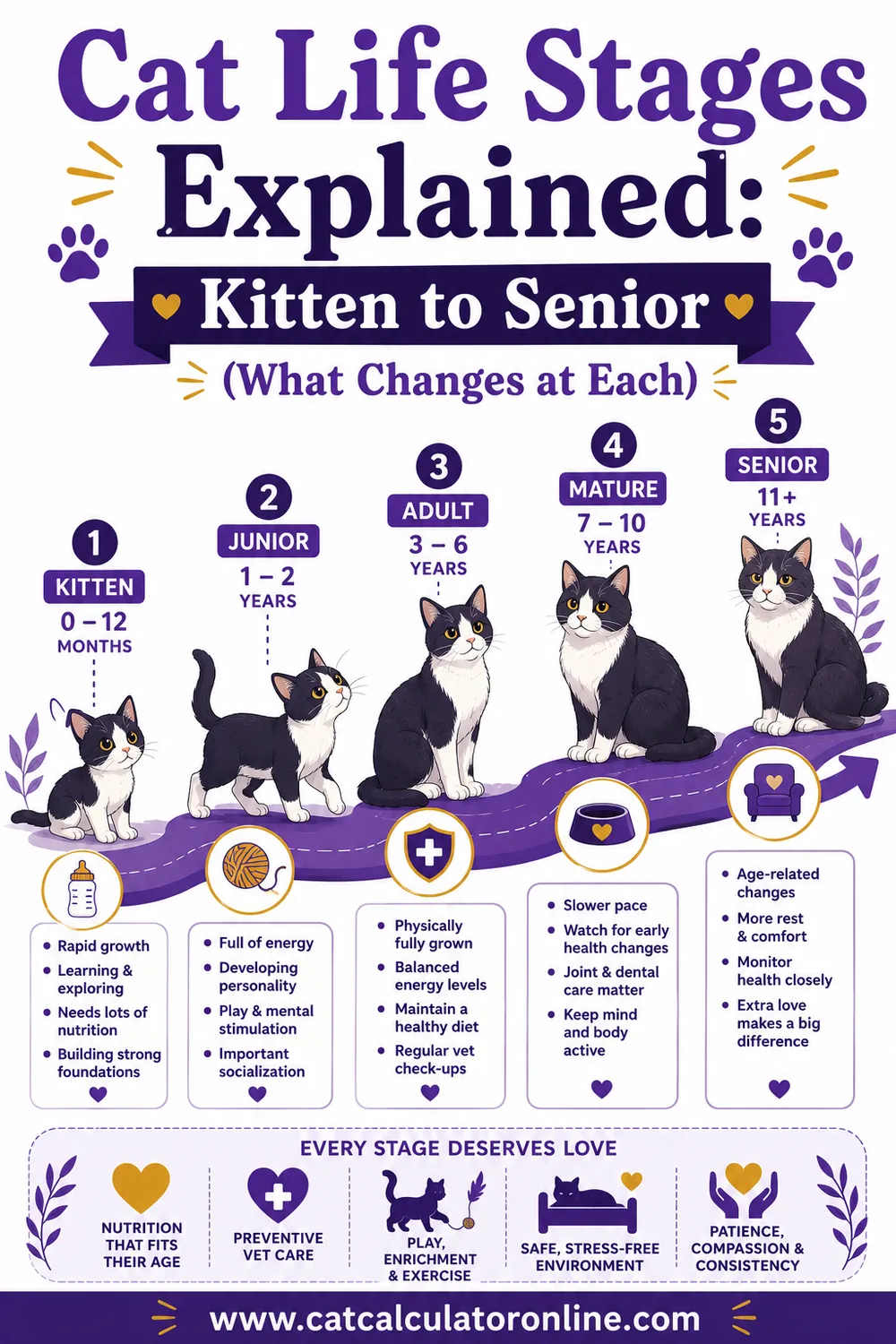
The conversion is most useful when it maps onto actual care decisions, and veterinary bodies generally recognize six stages.
Kitten (0-6 months). Extremely rapid development. Weaning, vaccinations, socialization, and the beginnings of adult behavior all happen here. A six-month-old kitten is roughly a ten-year-old child in developmental terms — capable and independent, nowhere near mature.
Junior (7 months-2 years). Sexual maturity arrives early in this window, often between five and nine months. Full physical size is generally reached by twelve to eighteen months. Behaviorally this is adolescence, with the energy and boundary-testing that implies.
Adult (3-6 years). The prime. Stable weight, established routine, lowest health-risk period. This is where most of a cat's life is spent and where the least changes.
Mature (7-10 years). The equivalent of human middle age. Metabolism slows, weight gain becomes easier, and early changes in kidney and thyroid function frequently begin. This is the stage where annual bloodwork starts to earn its cost.
Senior (11-14 years). Reduced activity, more sleep, possible joint stiffness, higher risk of dental disease. Twice-yearly veterinary visits become the standard recommendation.
Geriatric (15+). Many cats reach this comfortably. Care shifts toward comfort, mobility support, and closer monitoring of weight, appetite and hydration.
What Actually Affects Lifespan
The conversion chart assumes an average cat. Several factors move the real outcome considerably.
Indoor vs. outdoor is the single largest. Indoor cats commonly live 12-18 years and often longer; outdoor cats average substantially less, primarily through traffic, predation, fights and infectious disease rather than faster biological aging.
Weight. Obesity is strongly associated with diabetes, joint disease and reduced lifespan in cats, and it's among the most modifiable factors an owner controls.
Dental health. Periodontal disease is extremely common and genuinely consequential, with links to kidney and cardiac problems. It's also one of the most preventable issues.
Neutering. Neutered cats live longer on average, largely through reduced roaming, fighting and reproductive-tract disease.
Breed. A smaller effect than in dogs. Some larger breeds trend slightly shorter-lived and some smaller ones slightly longer, but the range is narrow.
Veterinary care. Regular screening catches the two most common serious conditions in older cats — chronic kidney disease and hyperthyroidism — at stages where management makes a real difference.
Reading Your Own Cat's Age
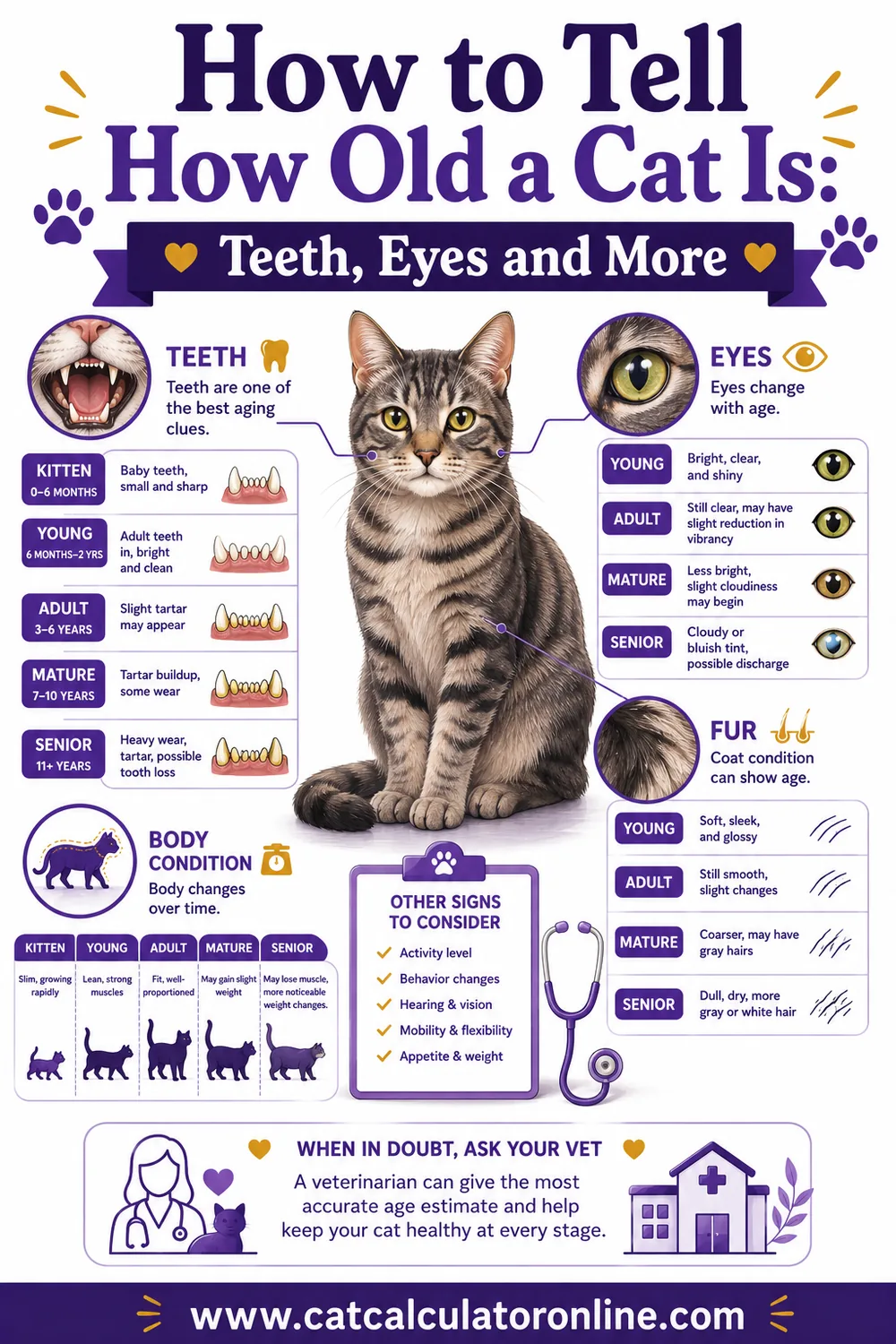
If you don't know her birthday, a vet can estimate age reasonably well from teeth, coat condition, eyes and muscle tone. It's an estimate rather than a measurement, but it's usually close enough to place her in a life stage, which is what matters for care decisions.
Kittens are easier to age than adults, since tooth eruption follows a fairly predictable timetable through the first six months.
Adult cats are hardest. A healthy four-year-old and a healthy seven-year-old can look very similar, and the estimate widens accordingly.
Older cats show it again — dental wear, lens changes in the eyes, reduced muscle mass and coat texture all give a vet something to work from.
Where the Formula Came From
Worth knowing, because it explains why it looks the way it does.
The non-linear model in wide use today reflects guidance developed jointly by feline veterinary bodies, which grouped cats into life stages based on observed physiology rather than arithmetic convenience. The stages came first; the human-equivalent numbers were fitted to them afterwards as a communication tool.
That ordering matters. The figures aren't derived from a biological constant — they're a translation designed to make a cat's life stage intelligible to an owner. Fifteen for year one isn't a measurement; it's the human age at which a person is roughly as developed as a one-year-old cat.
Which is also why slightly different versions of the chart circulate. Some sources use 15 and 9 for the first two years; others use 15 and 10, or adjust the annual increment between 4 and 5. The differences are small and none of them are wrong, because there's no precise value being approximated. The shape of the curve — steep, then flattening — is the part that reflects real biology.
The practical takeaway: treat any specific number as approximate and the life stage as the useful information. Whether your ten-year-old is "56" or "58" changes nothing; that she's in the mature stage and due for senior screening changes quite a lot.
Quick Reference
| Cat's age | Human equivalent |
|---|---|
| 6 months | ~10 |
| 1 year | 15 |
| 2 years | 24 |
| 5 years | 36 |
| 7 years | 44 |
| 10 years | 56 |
| 15 years | 76 |
| 20 years | 96 |
The formula for any age over two: 24 + (4 × (age − 2)).
Common Misconceptions
"Multiply by seven." Wrong at both ends. It understates a young cat's maturity badly — a one-year-old cat can reproduce, which no seven-year-old human can — and overstates an old cat's age to the point of absurdity, putting a twenty-year-old at 140.
"Indoor cats age more slowly." They live longer, which isn't the same thing. The biological rate is broadly similar; the difference is that indoor cats avoid the accidents, fights and disease exposure that cut outdoor lifespans short.
"Big cats age faster, like big dogs." Only very weakly. The size range in cats is far too narrow to produce the effect seen across dog breeds.
"A cat that seems healthy doesn't need senior screening." The opposite is the case — screening is most useful precisely when nothing is visibly wrong, because that's when early changes are detectable and manageable.
When the Number Should Change Your Behavior
At 7 (around 44). Start annual bloodwork even if she seems perfectly well. This is the baseline that makes later readings interpretable.
At 11 (around 60). Move to twice-yearly veterinary visits. Watch weight, drinking and litter box habits closely.
At 15 (around 76). Comfort becomes the priority. Lower-sided litter boxes, easier access to favorite spots, and closer monitoring.
At any age. Sudden weight change, appetite change, or altered drinking and urination warrant a call regardless of what the chart says.
How to Figure Out Cat Years Yourself
The table above does the work, but the method is easy enough to do in your head, and knowing it means you never need a chart again.
Forward. How do you convert cat years to human years? Start at 15 for the first year, add 9 for the second to reach 24, then add 4 for every year after that. Written out: 24 + (4 × (age − 2)).
Backward. Subtract 24, divide by 4, add 2. A human-equivalent 60 comes out at (60 − 24) ÷ 4 + 2, or 11 calendar years.
Under two. Below the two-year mark the curve is steep enough that months matter: 6 months lands near 10, 9 months near 13, 12 months near 15, 18 months near 21.
Two practical notes on how do you figure out cat years for a rescue with no birthday. Teeth are the usual guide — a vet reads tartar, wear, and gum condition to place a cat within a few years — and after that, eye clarity, coat texture, and muscle tone fill in the picture. That is genuinely how do you measure cat years in a clinic when nobody knows the birth date: you estimate the calendar age from the body, then run the same conversion.
How Many Years Can a Cat Live?
The conversion is only useful if you know where the finish line usually sits.
How many years can a cat live is really three questions with three answers. Typically: an indoor cat commonly reaches 12 to 18 years, and reaching the high teens is unremarkable in a cat kept at a healthy weight with regular dental care. Realistically at the top end: 20 to 22 happens often enough that most veterinary practices have several on the books. At the extreme: the oldest documented cat, Creme Puff, is recorded as living to 38.
The gap between those numbers is mostly environment rather than genetics. Indoor living is the single largest factor, followed by weight, dental disease, and whether chronic kidney disease is caught early or late. Neutering matters too, both for disease risk and for the roaming behavior that shortens outdoor lives.
In human-equivalent terms, an 18-year-old cat sits near 88 and a 22-year-old near 104 — which is a useful reminder that a cat in its late teens is genuinely elderly and should be seen twice a year, not annually.
Frequently Asked Questions
How old is a 1-year-old cat in human years? About 15. A cat reaches sexual maturity and near-full size within her first year, which is developmentally closer to a human mid-teenager than to a young child.
Is the multiply-by-seven rule accurate for cats? No. It came from a rough division of average lifespans rather than any developmental research, and it's wrong at both ends — badly understating a young cat's maturity and overstating an old cat's age.
How old is a 10-year-old cat in human years? Around 56, using the standard formula of 24 at two years plus 4 for each year after. That places her in the mature life stage, where annual senior screening is usually recommended.
Do indoor cats age more slowly than outdoor cats? Not biologically, but they typically live substantially longer — commonly 12 to 18 years indoors versus far less outdoors. The difference comes from accidents, predators and disease exposure rather than a different rate of aging.