How Much Is Cat Insurance Per Month?
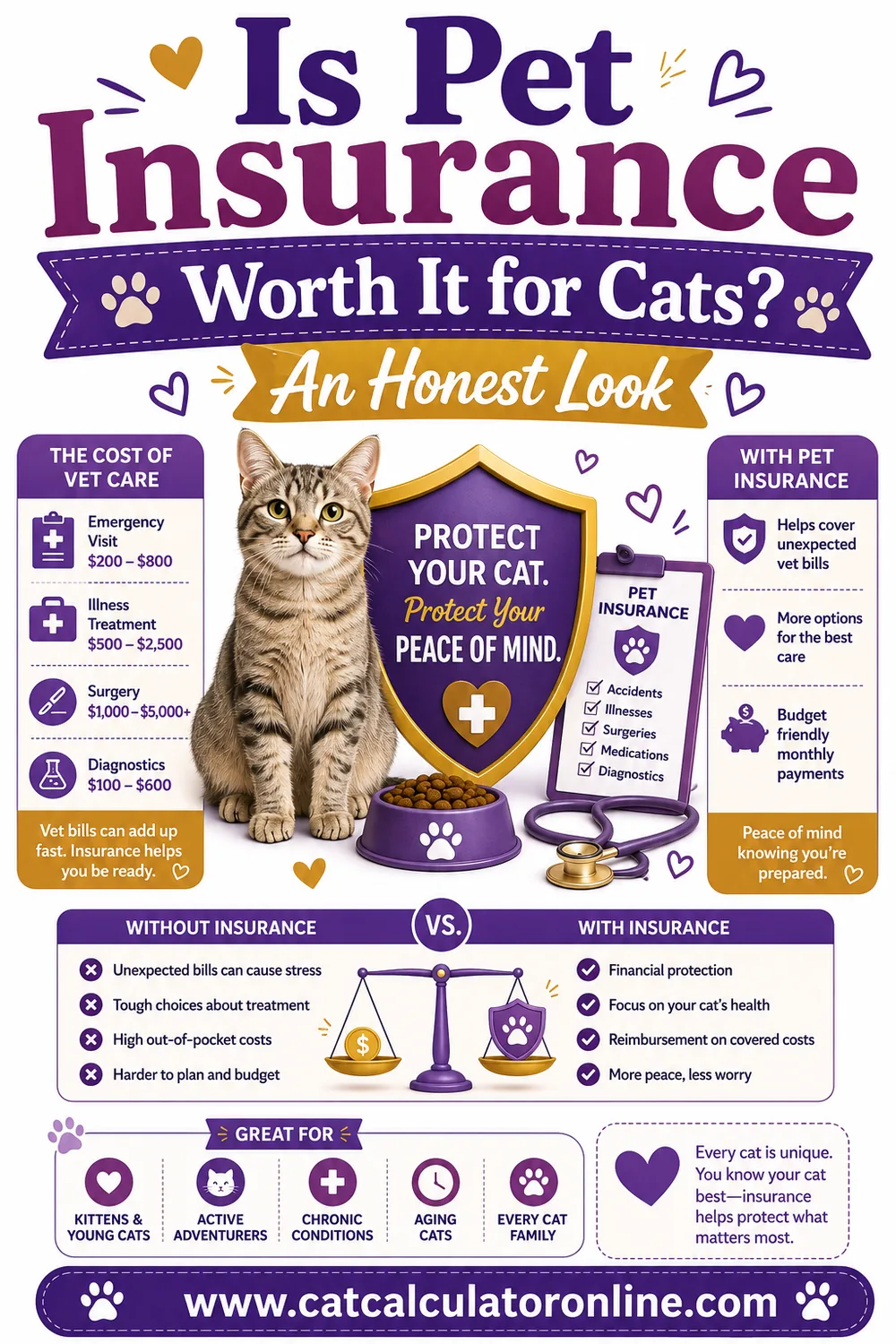
Most cat owners in the US pay somewhere between $25 and $35 a month for a standard accident-and-illness policy on a healthy adult cat. Accident-only cover is much cheaper — often $10 to $18 a month — and a senior cat, a pedigree breed, or an expensive metro area can push a full policy past $50. That spread is wide because a premium is really five or six separate decisions stacked together, and once you can see them individually the number stops feeling arbitrary. The free cat cost calculator helps you slot whichever figure you land on into your cat's whole yearly budget.
What Is the Average Monthly Cost of Cat Insurance?
The honest answer is a band, not a number. For a healthy adult domestic shorthair on a typical plan — a $500 annual deductible, 80% reimbursement, and a $5,000 annual limit — most quotes land in the mid-twenties to mid-thirties per month.
Here's how the main policy types compare:
| Policy type | Typical monthly cost | What it covers |
|---|---|---|
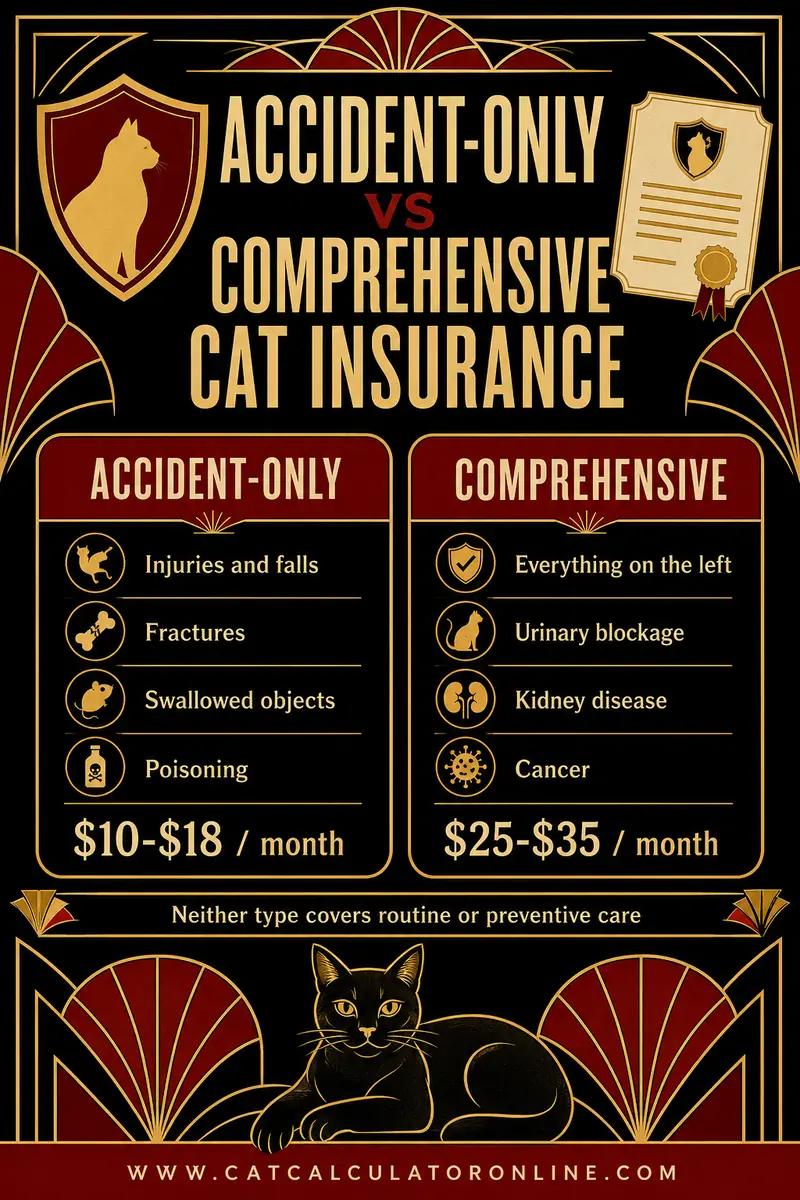
| Accident-only | $10–$18 | Injuries, broken bones, swallowed objects, toxin ingestion |
| Accident + illness (standard) | $25–$35 | The above plus infections, cancer, urinary disease, diabetes, dental illness |
| Accident + illness (high-spec) | $40–$60+ | Same categories with a low deductible, 90% payout and unlimited annual cap |
| Wellness add-on | +$10–$25 | Routine care: vaccines, checkups, flea treatment. Not insurance |
The National Association of Pet Health Insurance Providers (NAPHIA) publishes industry-wide averages each year, and the consistent finding is the one most owners find surprising: cats cost meaningfully less to insure than dogs, usually a little over half as much for equivalent cover.
Treat every number above as a starting point rather than a quote. Two cats of the same age on the same plan can be priced 40% apart purely on breed and ZIP code, which is why the only figure that means anything is the one with your own cat's details in it.
Why Is Cat Insurance Cheaper Than Dog Insurance?
Three structural reasons, and they all come back to the size and shape of feline vet bills.
Body size drives the bill. Almost everything in veterinary medicine is priced by weight. Anaesthesia, antibiotics, pain relief, chemotherapy — a 10 lb cat needs a fraction of what a 70 lb dog does. Surgical time is shorter and hospitalisation is cheaper. The same diagnosis genuinely costs less to treat in a cat.
Cats claim less often. Indoor cats in particular live a low-risk life. They don't get hit by cars, don't tear cruciate ligaments chasing balls, don't eat things on walks, and don't get into fights with other people's pets. Orthopedic surgery — one of the largest and most expensive claim categories in dog insurance — is comparatively rare in cats.
Breed risk is more contained. Dog breeds have been selected into some very expensive shapes: brachycephalic airways, deep chests prone to bloat, joints that fail early. Cat breeds carry hereditary risks too, but the range between the cheapest and most expensive cat breed is narrower than the equivalent range in dogs.
None of this means feline claims are small. Chronic kidney disease, hyperthyroidism, diabetes, and urinary blockage are all common, all expensive, and all exactly what an accident-and-illness policy exists to absorb. A blocked male cat is a genuine emergency that routinely runs $1,500–$3,000. Cats are cheaper to insure than dogs; they are not cheap to treat.
What Makes One Cat's Quote Higher Than Another's?
Six factors do nearly all the work. The first four are fixed facts about your cat, and the last two are choices you make.
- Age. The single strongest driver. Kittens are the cheapest cats anyone will ever insure, and the premium climbs at every renewal for life. The full curve is broken down in our guide to cat insurance cost by age.
- Breed. Domestic shorthairs and longhairs — the majority of pet cats — sit at the bottom of the pricing table. Pedigrees with documented hereditary conditions carry a surcharge, sometimes a substantial one.
- Location. Premiums are built from local veterinary prices. A cat in a high-cost metro can be quoted 50% above an identical cat in a rural low-cost state.
- Sex and neuter status. A minor factor, but present with some insurers. Unneutered males tend to roam and fight, which shows up in claims data.
- Deductible. The amount you pay before cover starts each year. Common options run from $100 to $1,000, and the choice moves the premium a lot — see how deductibles work.
- Reimbursement percentage and annual limit. How much of each eligible bill the insurer pays, and the ceiling on what they'll pay in a policy year. Higher payout and higher ceiling means a higher premium.
Notice that four of the six are simply facts about the cat sitting next to you. That's worth knowing, because it means comparison shopping mostly reveals differences in the last two — and the cheapest quote on a comparison page is frequently the one with the highest deductible and lowest payout.
How Do Plan Settings Change the Monthly Price?
This is where owners have real control, and where the cheapest-looking policy can quietly become the worst value.
Take a hypothetical adult cat quoted at $30 a month on a $500 deductible with 80% reimbursement and a $5,000 annual limit. Adjusting one dial at a time moves the number roughly like this:
| Change | Effect on monthly premium | Effect at claim time |
|---|---|---|
| Deductible $500 → $250 | Up | You reach cover sooner each year |
| Deductible $500 → $1,000 | Down, often sharply | You absorb far more of a small claim |
| Reimbursement 80% → 90% | Up | Insurer covers more of every bill |
| Reimbursement 80% → 70% | Down | Your share of a $3,000 bill rises by $300 |
| Annual limit $5,000 → unlimited | Up | No ceiling in a catastrophic year |
| Annual limit $5,000 → $2,500 | Down | A single serious illness can exhaust the policy |
The trade is always the same shape: lower monthly cost means higher cost at the moment you actually need the policy. Neither direction is automatically right. If a surprise $2,000 bill would be genuinely destabilising for your household, a lower deductible and higher payout is worth paying for. If you have savings that could absorb the first $1,000 comfortably, a high deductible buys catastrophe protection cheaply and is arguably the smarter structure.
What rarely makes sense is a low annual limit. Limits exist to cap the insurer's exposure in exactly the scenario — cancer, kidney failure, a long hospitalisation — that made you buy the policy.
How Much Does Cat Insurance Cost at Each Age?
Age reprices every year, and the curve is steeper than most owners expect. For a domestic shorthair on a standard plan, quotes tend to move roughly like this:
| Cat's age | Typical monthly premium | What's happening |
|---|---|---|
| Under 1 (kitten) | $15–$25 | Lifetime low; empty medical chart |
| 1–6 (young adult) | $25–$35 | Gentle annual increases |
| 7–10 (mature adult) | $35–$55 | Curve steepens; first chronic conditions appear |
| 11–14 (senior) | $55–$80 | Kidney, thyroid and dental claims rise sharply |
| 15+ (geriatric) | $70–$110+ | Highest premiums; some insurers stop new enrollments |
Two things follow from this table, and they matter more than the individual figures.
First, enrolling early does not lock in a low price. The premium reprices upward at every renewal regardless of when you started. What early enrollment does buy is a clean medical chart — and since anything already diagnosed becomes a permanent exclusion, that turns out to be the more valuable thing.
Second, many insurers cap new accident-and-illness enrollments somewhere in the low-to-mid teens. Existing policies renew for life, but the option to buy full cover expires before your cat does.
Is Accident-Only Cover Worth the Lower Premium?
Sometimes — but read what you're buying. At $10–$18 a month it looks like an obvious saving over a $30 full policy, and for a specific kind of cat it can be a reasonable choice.
Accident-only pays for injuries: falls, road traffic accidents, fractures, bite wounds, swallowed string, poisoning. It does not pay for illness, and illness is what most cats actually claim for. Chronic kidney disease, hyperthyroidism, diabetes, urinary blockage, cancer, dental disease, inflammatory bowel disease — none of these are accidents, and together they make up the bulk of feline veterinary spending over a lifetime.
For a young indoor-only cat whose owner has real savings, accident-only can be a defensible hedge against the rare catastrophic injury. For most owners, it's protection aimed at the wrong risk. We compare the two structures properly in accident-only vs comprehensive cat insurance.
One genuine use case: cats past the age cap for illness cover. Many insurers will still sell accident-only to a senior cat, and some protection beats none.
What Does Cat Insurance Cost Over a Whole Life?
Monthly figures hide the total, so it's worth adding up. Take a cat insured continuously from kitten to 16 on a standard plan, using the midpoints above: roughly $20 a month through the first year, $30 through the young adult years, $45 through the mature years, $65 through the senior years, and $90 in the geriatric stretch.
Summed honestly, that's in the region of $6,000–$9,000 in lifetime premiums. More for a pedigree in an expensive city; less for a domestic shorthair in a cheap state.
Whether that's good value depends entirely on what the policy absorbs. One urinary blockage at four ($2,500), a dental extraction under anaesthesia at nine ($1,200), and kidney management from twelve onward ($200–$400 a month in food, bloodwork and medication) and the policy has comfortably justified itself. A cat that sails through sixteen healthy years leaves you several thousand dollars lighter — which is the deal with all insurance, and the honest reason a dedicated savings account is a legitimate alternative for owners who can genuinely build and keep one.
Our guide to whether cat insurance is worth it works through both sides of that judgement without picking a side for you.
What Does the Monthly Premium Not Include?
The premium is not the whole cost of being insured, and this is where budgets most often go wrong. Four things sit outside it.
Your deductible. Before the insurer pays anything in a policy year, you cover the deductible yourself. On a $500 deductible, a $600 claim returns very little — you pay the first $500, and the insurer reimburses its percentage of the remaining $100. Small claims frequently fall entirely inside the deductible.
Your co-insurance share. After the deductible, you still pay whatever the reimbursement percentage doesn't cover. On an 80% plan, a $3,000 surgery costs you $500 (deductible) plus 20% of the remaining $2,500 — another $500. The insurer's cheque is $2,000, and your real out-of-pocket is $1,000 on top of twelve monthly premiums.
The exam fee. Many policies exclude the consultation fee itself and cover only the treatment that follows. It's typically $50–$90 a visit, and over a year of managing something chronic it adds up.
Everything routine. Vaccines, annual checkups, flea and worm treatment, dental cleaning, neutering, and food are not covered by a standard accident-and-illness policy. These are ordinary, predictable, and yours — which is exactly why they belong in a yearly budget rather than an insurance policy.
There's also a cash-flow point worth planning for. Most pet insurers work on reimbursement, not direct payment: you settle the full bill at the clinic and claim it back afterward, usually within a couple of weeks. That means you need access to the money up front even when you're fully insured. A handful of insurers can pay some vets directly, but you shouldn't assume it.
How Can You Lower the Monthly Premium Without Gutting the Cover?
Four levers that don't hollow out the policy:
- Raise the deductible, not the reimbursement. Going from a $250 to a $750 deductible cuts the premium meaningfully while leaving the payout percentage intact. You self-insure the small stuff and keep strong cover for the big stuff — which is what insurance is for.
- Enroll while the chart is clean. This doesn't lower the monthly figure, but it dramatically raises what you get for it. Every condition diagnosed before enrollment is excluded permanently.
- Skip the wellness add-on unless you'll use all of it. Wellness riders are budgeting tools, not insurance. They bundle predictable costs — vaccines, checkups, flea treatment — and rarely return much more than you pay in. Paying those directly and putting the difference toward a lower deductible is usually the better trade.
- Ask about multi-pet and annual-payment discounts. Modest, but real. Many insurers discount 5–10% for a second pet, and paying annually often shaves a few percent versus monthly billing.
What to avoid: letting a policy lapse to save a month's premium. A gap resets waiting periods and re-runs the pre-existing screen against a longer chart, and for an older cat that can be genuinely costly.
Frequently Asked Questions
How much is cat insurance per month on average?
For a healthy adult cat on a standard accident-and-illness plan, most US owners pay $25–$35 a month. Accident-only cover typically runs $10–$18, while low-deductible, high-payout plans for pedigree or senior cats can exceed $50. Your own quote depends most on the cat's age, breed and your ZIP code.
Is cat insurance cheaper than dog insurance?
Yes, usually by a wide margin — often a little over half the cost for equivalent cover. Cats are smaller, so drug doses, anaesthesia and surgery cost less; they claim less often, especially indoor cats; and expensive orthopedic claims are far rarer than in dogs.
Does cat insurance get more expensive every year?
Almost always. Premiums reprice at each renewal for two reasons unrelated to your claims: your cat is a year older on the insurer's actuarial tables, and veterinary costs inflate. Most insurers don't penalise individual claim history, but the age-and-inflation escalator raises the premium regardless.
Is it cheaper to insure an indoor cat?
Some insurers price indoor-only cats slightly lower, but many don't distinguish at all. The reasoning cuts both ways: indoor cats face fewer accidents, but they're also more prone to obesity-linked conditions like diabetes. Never misstate your cat's lifestyle to chase a discount, since it can jeopardise a claim.
What is the cheapest way to insure a cat?
A high deductible on an accident-and-illness policy is usually the best value-per-dollar structure: you absorb routine costs and keep meaningful protection against the expensive diagnoses. Accident-only is cheaper still, but leaves out kidney disease, cancer, diabetes and urinary blockage — the things cats most commonly need.
Can I get cat insurance for an older cat?
Often yes, though many insurers cap new accident-and-illness enrollments in the low-to-mid teens, after which only accident-only may be available. Premiums for senior cats are high and any existing condition will be excluded, so the value depends heavily on how short your cat's medical history still is.
Cat insurance pricing looks opaque from the outside and turns out to be fairly mechanical once you can see the individual dials. Age and breed you can't change; deductible, payout percentage and annual limit you can — and those three are where a policy becomes either good value or an expensive disappointment. When you've settled on a figure, drop it into the cat cost calculator alongside food, litter and vet care to see what your cat really costs across a full year, or read the wider breakdown in how much a cat costs per year.