How Much Do Kittens Sleep?
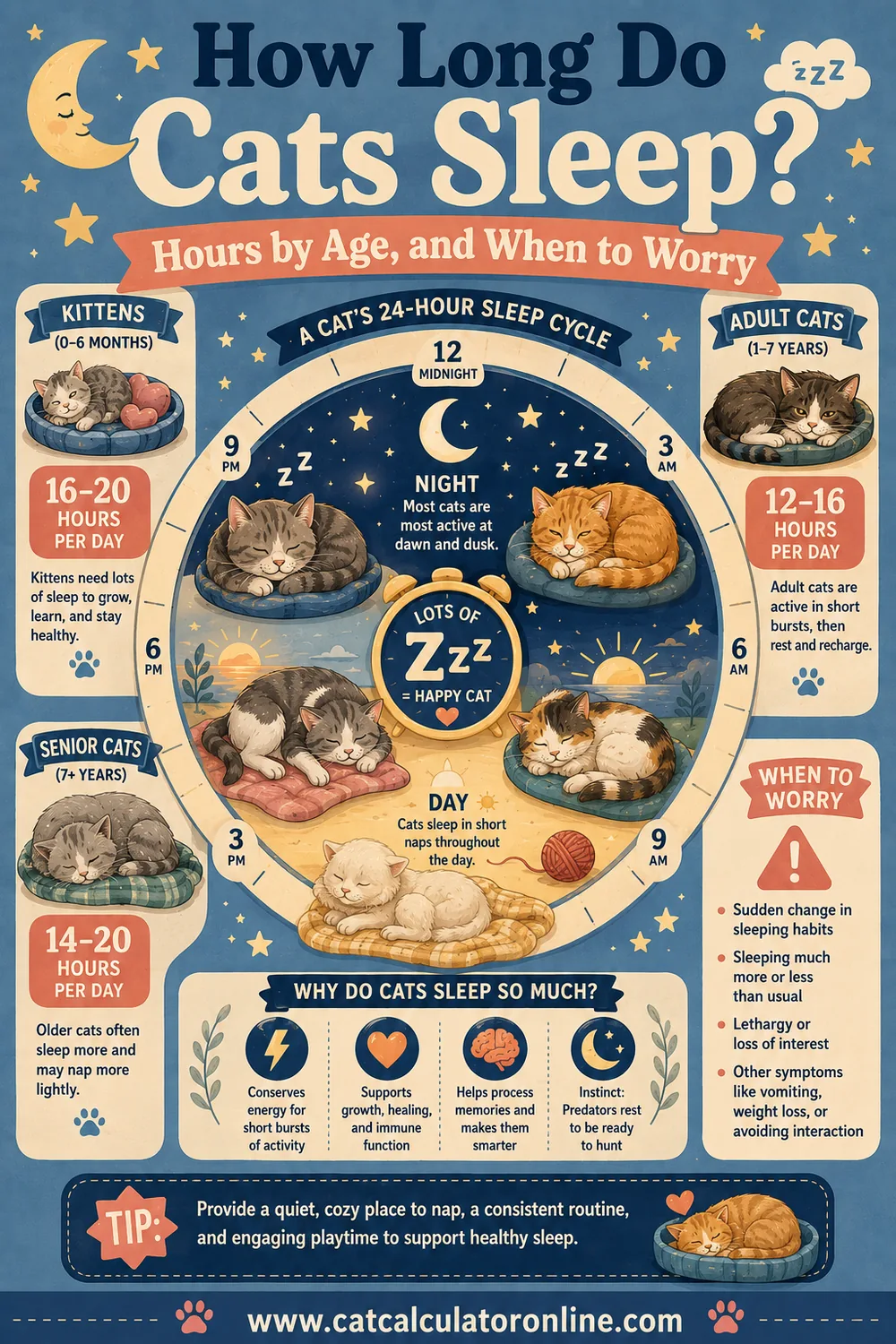
A newborn kitten sleeps roughly 90% of the day — around 22 hours — and by twelve weeks she is still putting away 18 to 20 hours, which is more than an adult cat. If you have just brought one home and she seems to spend the whole afternoon unconscious in a shoe, that is exactly right. The reason is not laziness but chemistry: growth hormone is released mainly during sleep, so a kitten who is asleep is a kitten who is growing. The number only really drops once she is past six months. Sleep is one of the few things you can watch change week by week, alongside her weight — the kitten weight calculator plots the other half of that picture.

Hours of Sleep by Age
The number changes fast in the first two months, then barely moves until she is half grown.
| Age | Typical sleep per day | What waking time looks like |
|---|---|---|
| 0 to 2 weeks | ~22 hours (about 90%) | Wakes only to nurse, every 1 to 2 hours |
| 3 to 4 weeks | ~20 hours | Short, wobbly explorations near the nest |
| 5 to 8 weeks | 18 to 20 hours | Bursts of play with littermates, then a crash |
| 9 to 12 weeks | 18 to 20 hours | Longer play sessions, still frequent hard sleeps |
| 4 to 6 months | 16 to 18 hours | Fewer naps, much more intense activity |
| Over 6 months | 12 to 16 hours | Adult pattern, clustered around dawn and dusk |
These are averages with real spread either side. An hour or two more or less than the figures above is normal and not worth worrying about on its own.
Total hours matter less than the pattern. A kitten who plays hard, eats well and sleeps deeply is fine at 16 hours or 21.
She will not sleep in one block. Kitten sleep comes in many short stretches spread across the whole 24 hours, which is why she is awake at 4am.
Big changes are the signal. A sudden jump of several hours, or a kitten who cannot settle at all, is worth a look.
Adults follow the same shape. The full adult picture, including why cats wake at dawn, is in how long cats sleep.
Why Kittens Need So Much More Sleep Than Adults
This is the mechanism, and it explains why interrupted sleep is worth taking seriously.
Growth hormone is released mainly during deep sleep. A kitten roughly doubles her birth weight in the first week and keeps up an extraordinary rate of building for months. Nearly all of that work happens while she is unconscious.
Her brain is wiring itself at the same time. Sleep is when new connections are consolidated, which is why the weeks she sleeps most are also the weeks she learns fastest.
Her body cannot bank energy well yet. Small animals lose heat quickly and have little in reserve, so the sensible strategy is short bursts of effort separated by long rest.
Warmth and sleep are linked. A kitten under about four weeks cannot properly regulate her own temperature and depends on her mother or a heat source. A cold kitten sleeps badly and, more importantly, cannot digest properly.
Immune development runs on rest too. This is part of why an under-slept, stressed kitten picks up infections more easily.
So the useful rule is: let her sleep. Never wake a sleeping kitten to play, however tempting she looks.
What Normal Kitten Sleep Actually Looks Like
Some of this alarms first-time owners, and almost none of it should.
She will twitch, jerk and paddle. Very young kittens spend most of their sleep in a state where the muscles are not switched off, so they visibly twitch. It looks like a nightmare and is completely normal.
She may squeak or make small sucking movements. Also normal, and it fades as she matures.
She sleeps in absurd positions and places. Face-down in a bowl, half in a shoe, wedged behind a cushion. Kittens fall asleep wherever the tiredness lands.
She may sleep with her eyes slightly open. Common in very young kittens and not a problem by itself.
Breathing is fast. A kitten breathes noticeably faster than an adult cat, and it speeds up further in active sleep.
Deep sleep should be genuinely deep. A well kitten who is properly asleep is hard to wake and then wakes brightly. That contrast is the thing to remember for the section further down.
The Play-Crash Cycle, and How to Work With It
From about five weeks, kitten days settle into a shape that is easier to live with once you can see it.
Ten to twenty minutes of chaos, then a hard stop. She hunts, tears about, climbs your leg, and then falls asleep mid-motion. This is normal and not a sign of exhaustion or illness.
Feed, play, sleep is the natural order. Cats hunt, eat, groom and then sleep. Running a play session before her meal, rather than after, works with that sequence instead of against it.
Short and frequent beats long. Several five to ten minute sessions across the day suit a kitten far better than one marathon.
Waking her out of a crash backfires. An overtired kitten gets bitey and clumsy, exactly like an overtired toddler.
The 4am spell is biology, not defiance. Cats are built for dawn and dusk activity. A late play session and a small meal before bed shift it later more effectively than anything else.
Expect this to peak around three to five months. It settles considerably by a year. What to expect at each stage is set out in kitten growth stages week by week.
Where Should a Kitten Sleep?
The setup matters more for a kitten than for an adult cat, mostly because of warmth.
Warm, enclosed and off the floor is the formula. Kittens prefer a covered bed or a box on its side to an open cushion. Being surrounded on three sides is what makes them settle.
Keep her close to you at first. A kitten who has just left her littermates has gone from sleeping in a heap to sleeping alone, and a bed in your room usually means far less crying.
Do not force a bed she has rejected. Cats choose sleeping spots by warmth, height and security. If she picks the laundry basket, move a blanket there instead of fighting it.
Very young kittens need a heat source, but never a direct one they cannot move away from. Warmth should always be on one side of the bed, so she can crawl off it.
Confine her at night early on. One warm, kitten-proofed room with a tray, water and a bed is safer than the run of the house, and it usually improves everyone's sleep.
A full list of what to have ready is in the new kitten checklist.
Sleeping Through the Night: What Actually Helps
You cannot make a kitten nocturnal into a diurnal cat, but you can shift the timing.
Move the biggest play session to late evening. A proper hunt with a wand toy, ending in a catch, does more than anything else on this list.
Follow it with food. Hunt, kill, eat, sleep is the cycle a cat's body expects. A meal after play triggers the sleep part.
Use a timed feeder for the early hours. If breakfast appears from a machine at 5am, you stop being the thing she wakes.
Never reward the noise. Getting up to a crying kitten teaches her that crying produces a person. Wait for the pause, then go if you must.
But do check on a kitten under twelve weeks who cries persistently. Very young kittens can genuinely be cold, hungry or stuck, and that is not the same as attention seeking.
Give it a two weeks. Most kittens settle into the household rhythm within two to three weeks of arriving.
Sleepy, or Actually Unwell?
Here is the distinction that matters, because "she sleeps a lot" is both entirely normal and one of the first signs of a sick kitten.
Sleep is not the same as lethargy. A sleeping kitten wakes up brightly, stretches, and joins in. A lethargic kitten is limp when awake, does not respond much to a toy, and looks flat rather than restful.
Watch appetite alongside sleep. A kitten who is sleeping more and eating less is a different animal from one who is sleeping more after a big play day.
Kittens go downhill quickly. They have almost no reserves, so a kitten who is off her food for even a day needs a vet — not a wait-and-see. Never withhold food from a kitten for any reason.
Call the vet the same day if she is limp or floppy, cold to the touch, not eating, has diarrhea or vomiting, or cannot be roused easily.
Treat it as an emergency if she is unresponsive, gasping, cold and unmoving, or has had a fall or a crush injury. Very young kittens can fade in hours rather than days.
Weigh her. A kitten who is growing steadily is very rarely seriously ill, and a stalled or falling weight is the most reliable early alarm there is. Other warning signs are listed in signs your cat is sick.
How Sleep Changes as She Grows Up
The trajectory is predictable, and knowing it saves a lot of unnecessary worry.
The first drop comes around four months. Naps get fewer and activity gets far more intense — same total, different shape.
Six to twelve months is the adolescent phase. Around 16 hours, with real athletic energy in the waking parts.
By about a year she is on adult hours, typically 12 to 16, mostly in short naps.
Senior cats climb again. Cats over eleven often return to 18 or 20 hours, and that is usually normal aging rather than a problem.
Deep sleep gets easier to spot with age. Adult cats spend proportionally more of their sleep in the light, ears-still-working state that lets them wake instantly.
The first weeks set habits. A kitten who learns that night is quiet and mornings are for food generally keeps that pattern. If you are hand-rearing, the timings are in newborn kitten care week by week, and eye opening at around 7 to 14 days is covered in when kittens open their eyes.
Frequently Asked Questions
How many hours a day do kittens sleep?
Newborn kittens sleep around 22 hours a day, about 90% of the time. From roughly five weeks to three months they sleep 18 to 20 hours, dropping to 16 to 18 hours by four to six months and settling at the adult range of 12 to 16 hours after about a year.
Is it normal for my 8-week-old kitten to sleep all day?
Yes. An eight-week-old kitten sleeping 18 to 20 hours is completely normal, especially in short stretches between bursts of intense play. What matters is how she is when awake: bright, hungry and playful is fine. Flat, uninterested or off her food needs a vet.
Why does my kitten twitch and jerk in her sleep?
Very young kittens spend most of their sleep in an active state where the muscles are not fully switched off, so twitching, paddling and small squeaks are normal and healthy. It becomes much less noticeable from around six to eight weeks as her nervous system matures.
Should I wake my kitten to feed her?
Only if she is under about four weeks old and being hand-reared, when she needs feeding every two to four hours around the clock. A weaned kitten over four weeks should be left to sleep and fed when she wakes — never wake a healthy kitten simply to play with her.
Why is my kitten awake at 3am?
Cats are naturally most active around dawn and dusk, and kittens sleep in many short stretches spread across 24 hours rather than one long block. A wand-toy play session late in the evening followed by a meal, plus a timed feeder for the early hours, shifts the pattern most reliably.
When should I worry about a kitten sleeping too much?
Worry about how she is awake, not how long she sleeps. Call your vet the same day if she is hard to rouse, limp or floppy when awake, cold to the touch, not eating, or vomiting. Kittens have very few reserves and deteriorate faster than adult cats.
A kitten sleeping most of the day is doing her job. Around 22 hours at birth, 18 to 20 through the first three months, then a gradual slide to adult hours by about a year — and all of it driven by the fact that growth hormone is released during deep sleep, so rest is literally what turns food into a bigger cat. The pattern you will actually live with is the play-crash cycle: short bursts of chaos, then flat out with no warning, worst at dawn. Let her sleep when she sleeps, run the big play session late in the evening, and judge her by how she is awake rather than by the clock. Track the other half of her growth with the kitten weight calculator, or check her age in human terms with the free cat age calculator.